Table of Contents
- The Shifting Sands of Pannonia: Prelude to Conflict
- A Land Between Empires: The Geopolitical Importance of Pannonia
- The Lombards Rise: From Migration to Kingdom
- Byzantium’s Eastern Vision: Justinian’s Ambitions
- The Frankish Factor: Power Intrigues in the West
- Pannonia in the Mid-6th Century: A Battleground of Empires
- The Lombard Strategy: Resilience Amidst Pressure
- Byzantine Campaigns: The Quest to Reclaim the West
- Frankish Maneuvers: Opportunism and Rivalry
- Skirmishes and Sieges: Life in a Crossfire
- The Human Toll: Displacement and Devastation
- The Fall of Lombard Pannonia: An Inevitable Exodus?
- The Great Migration South: The Lombards Enter Italy
- The Aftermath for Pannonia: A Province at Crossroads
- Long-term Consequences: The Shaping of Early Medieval Europe
- The Memory of Pannonia’s Turmoil in Later Chronicles
- Lessons from the Pannonian Struggle: Empire, Identity, Survival
1. The Shifting Sands of Pannonia: Prelude to Conflict
At the heart of the European continent, nestled between mighty rivers and rolling plains, lay the province of Pannonia—a land of strategic crossroads and cultural confluences. The 540s were years etched in tumult, where human ambition and survival intertwined in a dramatic narrative spanning empires and tribes. The Lombards, a formidable Germanic people, found themselves squeezed between the resurgent power of the Byzantines, freshly energized under Emperor Justinian, and the expanding Franks, a burgeoning force stirring in the west. This intricate pressure cooker would set the stage for one of the most pivotal upheavals of the early medieval period.
Imagine the cold dawns where Lombard warriors gazed warily over the Danube, sensing the tightening noose. To their south, Byzantine legions marched with the dream of reviving the lost Roman glory. From the west, Frankish chieftains, opportunistic yet loosely coordinated, eyed the territories ripe for conquest or alliance. The land itself seemed to hold its breath, waiting for the eruption that would alter the course of history.
2. A Land Between Empires: The Geopolitical Importance of Pannonia
Pannonia was no ordinary frontier. Once a flourishing Roman province, it retained immense strategic and economic value. The fertile plains fed legions, the towns were remnants of imperial administration, and the natural barriers—like the Danube River—formed a defensive backbone coveted by all. For the Byzantines, recovering Pannonia was part of Justinian’s grand vision: to restore the Roman Empire in all its former breadth.
Yet Pannonia was more than geography; it embodied cultural and political complexities. The Lombards, who migrated into the region from the north and east, had established control over large swaths of the territory. They were no mere invaders but a people beginning to shape a durable polity, blending Roman legacies with Germanic traditions.
Meanwhile, the Franks, growing in strength under leaders like Clovis’s successors, were extending their influence eastwards, controlling parts of Gaul and eyeing the fragmented landscape of central Europe. Pannonia thus became the fulcrum of power plays, where empires met barbarians, and ambition clashed with survival.
3. The Lombards Rise: From Migration to Kingdom
The story of the Lombards is a tale of resilience and adaptation. Originally migrating from Scandinavia and northern Germany, by the early 6th century they had settled in Pannonia after traversing the Danube’s crossings during the late migrations. Their arrival was not a sudden invasion, but a gradual process of settlement, conquest, and interaction with the local Romanized populations.
By the 540s, the Lombards had forged a kingdom in Pannonia, marked by a complex relationship with neighboring powers. Their society blended warrior traditions with remnants of Roman administration, Christianity mingled with pagan rites, and a fledgling aristocracy sought legitimacy amid chaos.
They were a people aware of precariousness. Caught between the ambitions of Justinian’s Byzantium to reclaim the West and the expansive Franks flexing muscles from the west, the Lombards had to navigate diplomacy, warfare, and survival strategies sharply — a balancing act with high stakes.
4. Byzantium’s Eastern Vision: Justinian’s Ambitions
Emperor Justinian I (r. 527–565) famously envisioned a renewed Roman Empire, seeking to repossess lost western provinces. His campaigns in Italy, North Africa, and beyond underscored a will to restore imperial unity. Within this context, Pannonia emerged as both prize and obstacle.
For the Byzantines, controlling Pannonia meant securing a frontier against future barbarian invasions, stabilizing the Danube corridor, and facilitating the retaking of Italy and Gaul. The ambition was logistical as much as symbolic: the province was a gatekeeper to the western Mediterranean and Central Europe.
Justinian’s generals, notably Belisarius, led campaigns that tested the resolve of regional powers. Byzantine diplomacy mixed force and alliances, offering federate status to tribes like the Lombards but also applying military pressure. The 540s witnessed a dynamic flux where Byzantine legions pushed forward, tested by the rugged landscape and tenacious defenders.
5. The Frankish Factor: Power Intrigues in the West
To the west, the Franks were consolidating power under Merovingian rule. While their eyes were often turned towards Gaul, Burgundy, and beyond, the weakness seeded in central Europe offered possibilities. The Lombard presence in Pannonia represented a barrier but also an opportunity.
Frankish chieftains and kings were pragmatic. Some sought alliances with the Lombards to check Byzantine expansion; others saw advantage in destabilizing the region altogether. Frankish interventions varied from direct military pressure to subversion and support for rebellious factions.
This intricate dance between the Franks, Byzantines, and Lombards created a tripartite tension where no single power could dominate outright. Instead, skirmishes, shifting loyalties, and diplomatic maneuvers defined Pannonia’s fate.
6. Pannonia in the Mid-6th Century: A Battleground of Empires
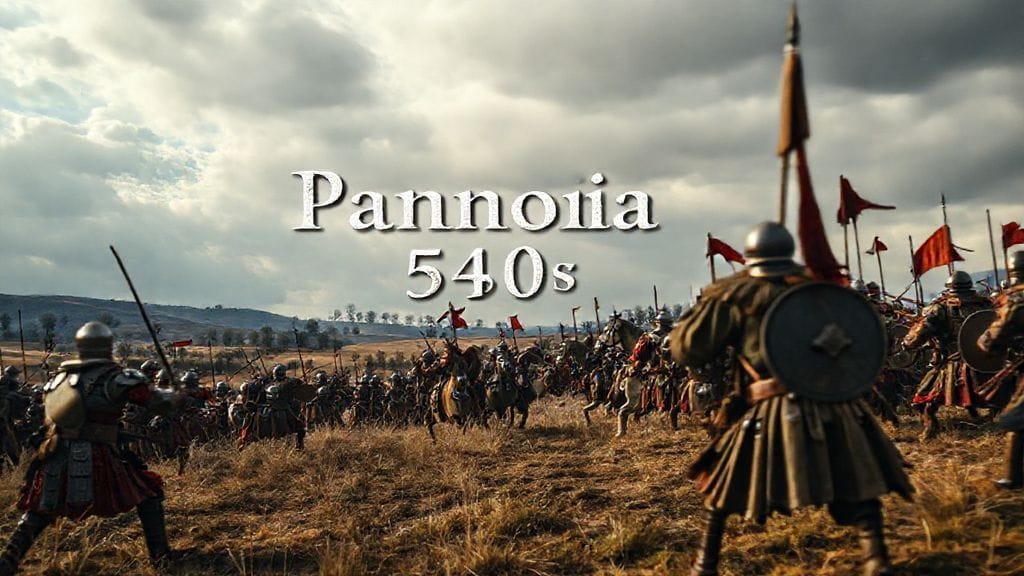
The 540s became a decade of intense conflict in Pannonia. The province was neither peaceful land nor simply a war zone; it was a crucible where cultures, armies, and ambitions met. Byzantine campaigns, spearheaded by generals who combined tactical brilliance with brutal resolve, pressed hard against Lombard positions.
Lombard fortresses turned into battlegrounds, while towns and villages suffered under raids and conscriptions. Frankish raids on Pannonian borderlands created further chaos. The Danube flanked campaign routes; winter bitterly tested soldiers and civilians alike.
Despite being outnumbered and technologically disadvantaged compared to Byzantine forces, the Lombards drew on intimate knowledge of the terrain, guerrilla tactics, and local alliances to delay the Byzantine advance. But pressure mounted relentlessly.
7. The Lombard Strategy: Resilience Amidst Pressure
Under immense strain, the Lombard response showcased adaptability. Leaders combined defensive fortifications and strategic withdrawals with surprise attacks and political negotiations. The use of federate contracts—formal agreements granting tribes autonomy in exchange for military support—became a tool for survival.
Lombard chieftains like Audoin—who would later lead the migration into Italy—balanced war and diplomacy, understanding that outright victory against Byzantium was unlikely. Instead, preserving their people and options for future movements became paramount.
This strategic patience reflected not weakness but pragmatic leadership under duress, embodying a keen awareness of the shifting political landscape.
8. Byzantine Campaigns: The Quest to Reclaim the West
Byzantine forces employed a combination of direct confrontation, siege tactics, and alliance-building with other barbarian groups to isolate and defeat the Lombards in Pannonia. Military logistics were demanding; supply lines stretched across difficult terrain, and the threat of Frankish intervention complicated plans.
The campaigns were costly but ultimately successful in pressuring the Lombards out of their Pannonian heartlands. The fall of key fortresses and loss of control over the plains signified a turning point, signaling the waning of Lombard dominance in the region.
Yet Justinian’s generals knew that the victory in Pannonia was but a segment of a larger, grueling war across Italy and Gaul.
9. Frankish Maneuvers: Opportunism and Rivalry
While Byzantium marched east, the Franks sought to exploit any opening. Some Frankish groups moved into the power vacuum left by the Lombards or contested Byzantium’s growing presence. Internal Frankish rivalries at times hindered a coordinated approach, yet their pressure distracted and drained both Byzantine and Lombard resources.
Frankish diplomacy involved both conflict and marriage alliances, seeking to harness the chaos of Pannonia to extend Merovingian influence. This multipolar contest transformed Pannonia into a truly contested frontier—not solely a Byzantine-Lombard clash but a wider game of thrones.
10. Skirmishes and Sieges: Life in a Crossfire
Beyond grand strategies and imperial ambitions, the everyday reality in Pannonia was brutal. Villages endured looting; civilians suffered forced conscription, famine, and displacement. Archaeological evidence and contemporary chronicles describe scenes of hardship—the ruin of cultivated lands, the flight of families, and the grim resilience of communities caught between armies.
Sieges became lengthy affairs, draining morale and resources, while small battles and raids were constant. The Danube line became a corridor of peril and transition, with refugees moving to safer lands or deeper into bosky wildernesses.
Stories from this time capture human courage and tragedy, painting a vivid emotional tableau beyond mere military history.
11. The Human Toll: Displacement and Devastation
The conflict’s human cost was staggering. The Lombards, pressured into retreat, induced waves of migration—tens of thousands uprooted, often leaving behind farms, homes, and generations of history. The Byzantines counted heavy casualties too, with campaigns draining manpower and treasuries.
Local civilian populations—Romanized, Gothic survivors, and others—became pawns and victims. Disease compounded suffering, with plague recurring in the 6th century’s shadows. These hardships reshaped demographic patterns and social structures, rippling through future generations.
Eyewitness accounts lament the lost prosperity of Pannonia, once a breadbasket, now scarred by centuries of conflict.
12. The Fall of Lombard Pannonia: An Inevitable Exodus?
By the late 540s, it became clear: Lombard control over Pannonia was untenable. Faced with Byzantine advances and Frankish strategic encroachment, the Lombards confronted a defining choice: resist a doomed stand or flee to new pastures.
Historical records show the beginning of what became known as the Great Lombard Migration—a monumental movement southwards across the Alps into Italy. This exodus was not only a military retreat but a transformative event, ushering in a new chapter in European history.
The sense of forced farewell to ancestral lands is palpable in chronicles—echoes of loss mingled with hope for survival and renewal.
13. The Great Migration South: The Lombards Enter Italy
The shift from Pannonia to Italy marked a seismic realignment. The Lombards crossed the Julian Alps, entering a fractured Italian peninsula where Byzantium’s hold was tenuous and Gothic remnants still lingered.
This movement reshaped Italy’s political landscape for centuries. The Lombard Kingdom established there would become a major player in medieval affairs, its legacy enduring in law, culture, and identity.
Yet, the migration also bore scars and challenges, as the Lombards faced new enemies, unfamiliar terrain, and the daunting task of creating a new homeland.
14. The Aftermath for Pannonia: A Province at Crossroads
With the Lombards gone, Byzantium reasserted nominal control, though administration was often thin and contested. Frankish influence grew in adjacent regions, and Slavic groups, emerging from the east, began to settle in depopulated areas.
Pannonia entered a period of fragmentation, losing its cohesion. It became a mosaic of competing influences, its Roman past fading even as it remained a vital corridor connecting East and West.
The province’s transformation presaged the complexities of the early medieval order in Central Europe, where identity, borders, and power were in constant flux.
15. Long-term Consequences: The Shaping of Early Medieval Europe
The pressure exerted on the Lombards in Pannonia and their subsequent migration were pivotal in shaping Europe’s medieval map. The fall of Lombard Pannonia accelerated the decline of late antiquity’s order, contributing to the rise of new kingdoms and the eventual emergence of feudal Europe.
It also altered the balance between Byzantium and the emerging barbarian polities, defining spheres of influence that would echo through centuries, influencing policies, conflicts, and cultural synthesis across the continent.
The echoes of the 540s still resonate in the complex tapestry of European history.
16. The Memory of Pannonia’s Turmoil in Later Chronicles
Medieval chroniclers and later historians retold the Pannonian struggles with a blend of myth, memory, and political commentary. Works such as Paul the Deacon’s History of the Lombards immortalized the migration, depicting it as a defining ordeal and foundation myth.
Byzantine historians viewed the campaigns as heroic efforts to preserve Rome’s legacy, while Frankish sources often highlighted their kings’ diplomatic acumen.
The narratives shaped medieval identity and justified claims to territory, reflecting that the memory of these events exceeded their immediate impact.
17. Lessons from the Pannonian Struggle: Empire, Identity, Survival
The story of the Lombards pressed between Byzantines and Franks in Pannonia is more than an episode of warfare; it is a testament to the complexities of identity, the fragility of empires, and the resilience of peoples in flux.
It invites reflection on how geography, ambition, and human will intertwine to forge history. The Lombards’ adaptation, the Byzantine quest for restoration, and the Frankish rise each offer insights into the dynamics of power and survival.
Ultimately, the 540s Pannonia episode underscores how historical forces shape not only borders but the very fabric of civilization, reminding us of the human stories beneath grand events.
Conclusion
The saga of the Lombards pressed by Byzantines and Franks in 540s Pannonia resonates as a powerful chapter of transition and turmoil. It encapsulates the struggles of a people squeezed between mighty empires and emerging kingdoms, caught in the relentless tides of change.
This episode is not merely about battles or shifting borders; it is a vivid story of adaptation, loss, and hope. The courage of the Lombards, the vision of Justinian, and the ambition of the Franks shaped the destiny of Europe. Their echoes remind us that history is made not only by rulers and generals but by every soul living through upheaval.
Today, as we trace the scars and legacies of this era, we glimpse the formative roots of medieval Europe—a world born of conflict and resilience, forever marked by the battles fought on the plains of Pannonia.
FAQs
Q1: Why was Pannonia such a strategically important region in the 6th century?
Pannonia was key because of its location between the East and West Roman worlds, fertile lands, and control over major rivers like the Danube. It acted as both a defensive buffer and a conduit for military and economic movements.
Q2: Who were the Lombards and why were they in Pannonia?
The Lombards were a Germanic people who migrated from northern Europe in search of new territories. They settled in Pannonia in the early 6th century, establishing a kingdom blending Germanic traditions with Roman influences.
Q3: What motivated the Byzantine Empire to pressure the Lombards during the 540s?
Justinian aimed to restore the Roman Empire’s former territories, including the western provinces. Controlling Pannonia was crucial to securing borders and controlling routes into Italy and beyond.
Q4: How did the Frankish kingdoms influence the conflict in Pannonia?
The Franks, expanding eastward, pressured both Lombards and Byzantines, sometimes allying with one side or instigating conflicts to advance their power, contributing to the complexity of the regional struggle.
Q5: What were the consequences of the Lombards’ expulsion from Pannonia?
The Lombards migrated into Italy, establishing a new kingdom that shaped Italian medieval history. Pannonia became fragmented, with Byzantine, Frankish, and Slavic powers filling the power vacuum.
Q6: How did the people caught in Pannonia’s conflicts fare during this period?
Civilians faced displacement, famine, violence, and societal breakdowns. The upheavals caused demographic shifts and long-term social disruption across the region.
Q7: In what ways did the events in Pannonia influence the broader early medieval European landscape?
They helped redefine power boundaries, facilitated new migrations, and contributed to the decline of Roman order, leading to the formation of early medieval kingdoms and reshaping European political geography.
Q8: How is this episode remembered in medieval and modern historical narratives?
It is often recalled as a critical moment in the Lombards’ rise and the transition from antiquity to medieval Europe, with chroniclers portraying it as a tale of survival, loss, and empire-building.

