Table of Contents
- The Dawn of a New Power: Italy, 572 AD
- The Fall of the Ostrogothic Kingdom and the Byzantine Struggle
- Who Were the Lombards? Origins and Identity
- Alboin: The Warrior King and His Vision
- Crossing the Alps: The Invasion That Changed Italy
- The Siege and Capture of Pavia: A Grim Turning Point
- The Founding of the Kingdom: Structure and Society
- Lombard Rule: A Mosaic of Cultures and Traditions
- The Role of Pavia: From Fortress to Capital
- Clashes with the Byzantines: A Protracted Struggle
- The Church and the Lombards: Tensions and Alliances
- Lombard Law and Customs: Codifying a New Order
- The Lombard Legacy in Italy: Integration and Transformation
- The Kingdom in Context: Europe’s Fragmented Landscape
- Myth and Memory: The Lombards in Historical Imagination
The Dawn of a New Power: Italy, 572 AD
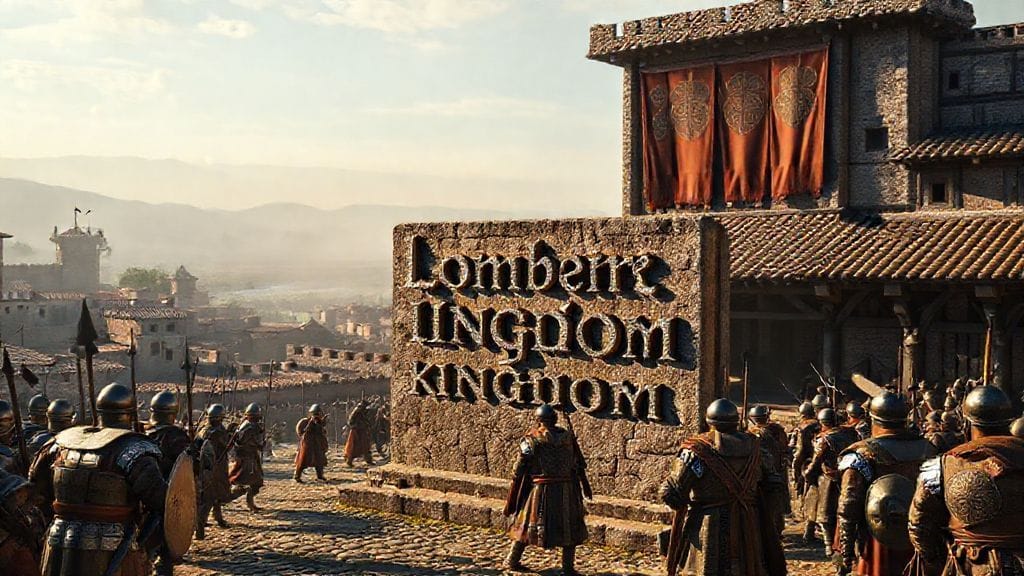
The early morning of 572 AD greeted northern Italy with an air of uneasy anticipation. Mist curled over the rivers and rolling hills surrounding the ancient city of Pavia, soon to become the heart of a nascent kingdom destined to alter the peninsula’s fate. The clank of armor and the murmur of campfires bore the promise of a restless future — one forged by warriors crossing alpine passes, hungry for new lands and glory. A moment pregnant with transformation was unfolding. In the distance, groups of determined Lombard horsemen assembled, their fierce eyes fixed on the rich, fragmented lands below — lands left vulnerable by the fading grip of the Byzantine Empire.
It would be here, amid ancient Roman ruins and rugged geography, that the Kingdom of the Lombards would be born, setting in motion a saga of conquest, adaptation, and resilience that would echo through centuries.
The Fall of the Ostrogothic Kingdom and the Byzantine Struggle
To understand the rise of the Lombards and their sudden grip on Italy, we must first gaze backward to the turbulent decades preceding 572 AD. The Ostrogothic Kingdom, established by Theodoric the Great a century earlier, had managed to blend Roman administrative traditions with Gothic military power but was in steady decline. The Gothic War (535–554), waged by Byzantine Emperor Justinian I through his generals Belisarius and Narses, ravaged Italy, leaving cities in ruin and populations decimated.
By the mid-sixth century, the Byzantine grasp on the peninsula was tenuous at best. Territories were isolated, governance fragile, and the population exhausted by decades of conflict and plague. Meanwhile, in the east, the Byzantine Empire faced persistent threats on multiple fronts, stretching its resources thin. Italy, though nominally reclaimed, was more a battleground than a cohesive province. This power vacuum rendered the peninsula ripe for new actors.
Who Were the Lombards? Origins and Identity
The Lombards, or Langobards as they were originally known, were a Germanic people whose origins oscillate between legend and archaeological traces. Emerging from the shadows of the Elbe and the Danube regions in Central Europe, they crafted a reputation as fierce warriors and astute opportunists. Their name is believed to derive from “long beards,” emblematic of their warrior culture and distinct identity that set them apart from various neighboring tribes.
Migrating southward, the Lombards carried with them a blend of pagan traditions, Germanic legal habits, and a high degree of internal cohesion under strong chieftains and kings. By the sixth century, their societal organization had evolved into a confederation of tribes led by a king elected by the nobility — somewhat fluid but increasingly militarily effective.
Alboin: The Warrior King and His Vision
Alboin stands as an iconic figure in Lombard history — a king whose ambition and martial prowess catalyzed the transformation of his people from wandering warriors to rulers of a kingdom. A man hardened by battle, with a reputation for both ruthlessness and strategic genius, he inherited leadership at a time when the Lombards were looking beyond their traditional lands for new opportunities.
Legend paints Alboin as a man marked by personal tragedy and vengeance, especially after the death of his father. His relentless push southward was both strategic and practical: the lands of northern Italy, devastated and poorly defended, offered the promise of wealth and permanence. His crossing of the Alps was not merely a journey — it was an epoch-making march into history.
Crossing the Alps: The Invasion That Changed Italy
In the winter of 568 AD, the Lombard forces, numbering perhaps tens of thousands, began a daring and arduous crossing over the Alpine passes. The details are scattered across chronicles such as Paul the Deacon’s Historia Langobardorum, but the striking image remains: a fierce Germanic horde descending into Italy’s fragmented landscape, attacking Byzantine outposts and establishing footholds.
The invasion was not a sudden blitzkrieg but a slow, grinding push — first taking the areas of the modern Veneto and Friuli, then pushing westward. There was bloodshed, but also negotiation and accommodation with local populations, many of whom were weary of Byzantine taxes and who found the Lombards, paradoxically, to be liberators or at least tolerable rulers.
The Siege and Capture of Pavia: A Grim Turning Point
Perhaps the greatest symbol of the Lombard conquest was the capture of Pavia — then called Ticinum — a city of vital strategic and symbolic value. Despite years of resistance, the city succumbed after a protracted siege, ending Byzantine dominance in the region.
Pavia’s fall cemented the Lombard foothold and transformed it into a capital, becoming the nerve center of administration, a vibrant market, and a royal residence. The city walls, ancient Roman gates, and battlements bore silent witness to the transition from empire to barbarian kingdom. The siege was brutal, with suffering on both sides, yet it also marked a consolidation of power that would enable the Lombards to govern and defend their expanding realm.
The Founding of the Kingdom: Structure and Society
With Pavia secured, the Lombards formally established a kingdom — a patchwork of duchies, tribal territories, and urban centers governed according to a mix of old Germanic customs and Roman legacies. The king wielded authority but relied heavily on a network of dukes, who managed their territories semi-autonomously.
This decentralized structure was both a strength and a vulnerability. It allowed rapid expansion and adaptability to local conditions but sometimes hampered unified military and political actions. Society was hierarchical yet fluid: nobles, warriors, free peasants, and dependent serfs lived alongside Romanized townsfolk and conquered peoples, weaving a complex social fabric.
Lombard Rule: A Mosaic of Cultures and Traditions
The Lombards did not simply conquer and impose; they adapted. Their rule became a mosaic of cultures — Germanic, Roman, Byzantine, and local Italian traditions intermingled to produce new customs, laws, and artistic styles.
Their pagan roots gradually gave way to orthodox and then Catholic Christian practices, influenced by their encounters with Roman clergy and populations. Likewise, the Lombard court reflected a synthesis of northern warrior code and southern courtly sophistication, illustrating the transformational nature of rulership in post-Roman Europe.
The Role of Pavia: From Fortress to Capital
Pavia’s rise from a strategic fortress to the political heart of Lombard Italy was swift and profound. It housed the royal palace, the treasury, and the main ecclesiastical authorities allied with the kingdom.
Beyond politics, Pavia thrived as an economic hub, benefiting from trade routes that linked the Po Valley and the Mediterranean. The city’s transformation symbolized the wider Lombard claim to legitimacy: controlling not only land and arms but also the cultural and economic levers inherited from the Roman world.
Clashes with the Byzantines: A Protracted Struggle
The establishment of the Lombard kingdom did not mean the end of Byzantine presence in Italy. Far from it. The Byzantines clung to key enclaves — notably Ravenna and parts of southern Italy — and engaged in decades-long warfare, raids, and shifting alliances.
These clashes shaped the political contours of Italy, limiting Lombard expansion at times and preventing complete Byzantine withdrawal until the kingdom itself would eventually face new threats in the centuries ahead. This contested landscape underscored Italy’s liminal status between east and west during the early Middle Ages.
The Church and the Lombards: Tensions and Alliances
Religion was a crucial dimension of Lombard rule. Initially pagan and then Arian Christian, the Lombards’ relationship with the Catholic Church was fraught and evolving.
Over time, pragmatic alliances formed, with rulers seeking to legitimize their rule by embracing Catholicism, supporting ecclesiastical institutions, and incorporating bishops into governance. Yet tensions persisted, especially regarding control of church lands and influence over local populations.
This religious evolution was central in knitting together the disparate peoples of the kingdom and in shaping the identity of early medieval Italy.
Lombard Law and Customs: Codifying a New Order
One of the most lasting achievements of the Lombards was the compilation of legal codes that institutionalized their customs while integrating Roman law. The Edictum Rothari (circa 643 AD), promulgated under a later king, remains a landmark example.
These laws regulated crime, property rights, and tribal obligations, reflecting a complex fusion of Germanic tradition and Roman judicial thought. They positioned the Lombards as rulers not just by force, but by institution — laying foundations for governance that influenced subsequent Italian polities.
The Lombard Legacy in Italy: Integration and Transformation
Over the following centuries, Lombard rule transformed from a foreign conquest to a distinct chapter in Italian history. Their presence altered demographics, political structures, and culture, influencing language, architecture, and legal norms.
Even after their kingdom fell to Frankish conquerors in 774 AD under Charlemagne, the Lombard imprint persisted, integrated into the fabric of medieval Italy, remembered in chronicles, laws, and legends.
The Kingdom in Context: Europe’s Fragmented Landscape
The Kingdom of the Lombards emerged in a Europe still reeling from Rome’s collapse and the migration period’s upheavals. It was one of several successor polities transforming the continent from empire into a patchwork of kingdoms and tribes.
Its story illuminates broader themes — survival in chaos, identity formation, and the endurance of Roman legacies amid Germanic adventurers — offering a window onto the complex birth of medieval Europe.
Myth and Memory: The Lombards in Historical Imagination
Throughout centuries, the Lombards inspired myth, literature, and historiography. From Paul the Deacon’s 8th-century Historia Langobardorum to modern scholarship, their saga has been viewed alternately as barbaric invasion or foundational chapter.
Legends of King Alboin, their battles and laws, have permeated Italian culture, reflecting how history, memory, and identity intertwine. Far from a mere footnote, the Lombards’ story remains a testament to the turbulent yet creative power of human migration and political rebirth.
Conclusion
The establishment of the Kingdom of the Lombards in 572 AD was more than a mere historical event; it was a profound transformation that echoed across Italy and Europe. Into a land shattered by war, plague, and imperial decay stepped a people bound by warrior ethos and a hunger for permanence. Led by King Alboin, they carved out a kingdom that blended old and new, conquest and accommodation, barbarism and civilization.
Yet, beyond swords and sieges, the Lombard epoch reveals the human story of adaptation, resilience, and the forging of identity. Pavia’s stones whisper stories of battles and kings, but also of laws, faith, and culture melding into a new world order.
In reflecting on this moment, one realizes that the Kingdom of the Lombards was both an end and a beginning — an emblem of the relentless flux of history, where worlds fade and rise anew, shaped forever by those daring enough to cross mountains and borders in search of destiny.
FAQs
1. Why did the Lombards decide to invade Italy in 568 AD?
The Lombards were motivated by a combination of pressure from other tribes, demographic needs, and the opportunity to occupy a wealthy but politically fragmented Italy, weakened by Byzantine wars.
2. What made Pavia so important to the Lombards?
Pavia was strategically located on the Ticino river with strong fortifications, serving as a military, political, and economic center, which became the kingdom’s capital.
3. How did the Lombards interact with the Byzantine Empire after their invasion?
Their relationship was marked by ongoing conflict, with the Byzantines retaining pockets of territory in Italy, leading to intermittent warfare and negotiated settlements.
4. In what ways did Lombard rule change Italian society?
They introduced Germanic legal codes, new social structures, and blended their culture with Roman customs, influencing the development of medieval Italian identity.
5. What role did religion play in the Lombard kingdom?
Religious affiliation transitioned from paganism and Arianism to Catholicism over time, affecting alliances with the Church and the broader acceptance of Lombard rule.
6. How long did the Kingdom of the Lombards last?
Established around 572 AD, the kingdom endured until 774 AD when it was conquered by the Frankish king Charlemagne.
7. What is the significance of the Edictum Rothari?
It was a comprehensive legal code that formalized Lombard customs, marking a fusion of Germanic and Roman legal traditions, and leaving a lasting impact on medieval law.
8. How are the Lombards remembered today?
They remain a key subject of historical study and cultural memory, symbolizing the transformational era between antiquity and the Middle Ages in Italy and Europe.

