Table of Contents
- A Royal Union Amidst the Shadows of Italy
- The Lombards’ Arrival and Struggle for Power
- Northern Italy on the Brink: A Fragmented Land
- Who Were Authari and Theodelinda?
- The Political Climate in Late 6th-Century Italy
- The Origins of the Lombard-Bavarian Alliance
- Verona: The Stage of a Historic Marriage
- The Wedding Day: Ceremony, Symbols, and Spectacle
- The Role of Theodelinda: From Bavarian Princess to Queen of the Lombards
- How Religion Shaped the Alliance: A Catholicizing Quest
- The Marriage as a Strategic Diplomatic Move
- Aftermath: Political Ramifications in Italy and Beyond
- Theodeinda’s Influence on Lombard Culture and Policy
- Reinforcing Power through Blood and Faith
- The Decline and Legacy of the Lombard Kingdom
- Reflections on an Alliance that Changed Italy’s Future
- Conclusion
- FAQs
- External Resource
- Internal Link
1. A Royal Union Amidst the Shadows of Italy
The air in Verona was thick with anticipation on that pale spring day in 589. The city, ancient and layered with Roman grandeur and the scars of recent turmoil, had become the grand stage for a momentous occasion. King Authari, leader of the Lombard tribes pressing relentlessly into Italian lands, was taking a Bavarian princess, Theodelinda, as his bride. This was no simple wedding—it was a carefully crafted alliance that would ripple through the centuries, shaping the fragile mosaic of power within a land torn between the ruins of Rome and the rising tide of new kingdoms.
Imagine the street crowded with nobles and warriors, with banners fluttering, the clank of chainmail on cobblestones, and the hopeful whispers of people wondering if this royal union might finally bring stability. But beneath the surface shimmer of celebration lay deep strategic calculations. Authari, newly anointed as “rex Italicorum” — king over the Italics — knew well that marriage was a weapon potent enough to extend his rule beyond mere conquest.
This was a time when kingdoms were fragile mosaics of kinship, religious faith, and forged promises. The alliance between the Lombards and the Bavarians was one of the earliest diplomatic ties to seek endurance through both blood and belief. Yet this tale is not merely a political footnote; it encapsulates a pivotal moment of cultural fusion and transformation in early medieval Europe. Let us dive in to unfold the true story behind King Authari’s marriage to Theodelinda—and why it matters far more than a ceremonial “I do.”
2. The Lombards’ Arrival and Struggle for Power
To understand the profound significance of this alliance, we must first look to the Lombards themselves. A Germanic people, the Lombards had wandered long after the disintegration of the Western Roman Empire. From their ancestral lands somewhere near the Elbe River, they had pushed southward, drawn by the promise of Italy’s fertile plains—lands both coveted and ravaged by centuries of war.
Their arrival in Italy in 568 under King Alboin marked the beginning of a tumultuous new chapter. The peninsula was no longer the seat of a unified empire but a patchwork of competing powers: the Byzantines clung to their duchies of Ravenna and beyond; the Franks eyed expansion; and indigenous Roman populations endured hardship. The Lombards were warriors and survivors, but their dominance was fragile, limited by internal struggles and external enemies.
Following Alboin's assassination in 572, the Lombard kingdom faced a dangerous vacuum. Power fragmented; rival chiefs jostled for supremacy. Into this tumult stepped Authari, Alboin's successor and son-in-law, who faced the daunting task of uniting a fractious people while defending them from the ever-encroaching Byzantines.
3. Northern Italy on the Brink: A Fragmented Land
Italy in the late 6th century looked little like the romanticized land of marble and viniculture painted by poets. Instead, it was a landscape punctuated by fortresses, battlegrounds, and fledgling settlements. The war-weary rural populations bore the brunt of marauding armies, dilapidated towns, and scarce resources.
The Byzantines, heirs of the Eastern Roman Empire, maintained control over parts of the Italian peninsula, especially in the Po Valley and coastal cities, but their power was fading. Meanwhile, the Papacy, located in Rome, attempted to navigate these fractured political waters, wielding spiritual authority to secure temporal safety.
In this cauldron of instability, the Lombards were both a threat and a potential stabilizing force. But without cohesion, their rule risked perpetual decline.
4. Who Were Authari and Theodelinda?
Authari was both a warrior and a reluctant politician. Likely born in the 540s, his ascendancy to the Lombard throne was not straightforward, requiring a mix of martial prowess and careful alliance-building. He was seen as a beacon to pull together divided factions, yet his legitimacy hung in balance due to internecine feuds.
Theodelinda, by contrast, was a princess raised amid the Christian traditions of the Bavarian kingdom, a land then emerging from pagan roots toward a more firmly Christian identity. She was reputed for her intelligence, piety, and diplomatic sensibilities—qualities that would become crucial in her new role far from home.
Their marriage promised more than a union of two people; it was a bridge between cultures, faiths, and political ambitions.
5. The Political Climate in Late 6th-Century Italy
The broader political landscape was one of fragmentation and contestation. The Byzantine Emperor Justin II struggled to maintain nominal control over Italian territories amidst internal rebellion and external pressure from the Lombards.
The Papacy, under Pope Gregory I—one of the era’s most influential pontiffs—had begun to assert its role as a temporal power. Gregory would later view Theodelinda as a significant ally in his campaign to spread Catholic orthodoxy among the predominantly Arian Lombards—a sect deemed heretical by Rome.
Meanwhile, the Franks to the northwest monitored these power shifts with wary interest, eager to expand their own influence.
6. The Origins of the Lombard-Bavarian Alliance
The marriage between Authari and Theodelinda was carefully crafted. The Bavarian dynasty viewed the Lombards simultaneously as a threat and an opportunity. Through marriage, Bavaria sought to secure its southern borders and gain influence over the volatile Lombard kingdom.
Authari, for his part, realized that to cement his reign, he needed allies, legitimacy, and above all, Christian approval to unify his largely pagan or Arian followers under a more widely accepted faith.
Thus, the alliance was a strategic masterstroke—a blend of political, cultural, and religious intentions.
7. Verona: The Stage of a Historic Marriage
Verona, then a thriving Lombard center, was chosen for the wedding—an ideal location both symbolically and logistically. The city had witnessed countless imperial legacies and was a crossroads between Germanic and Roman spheres.
The ceremony itself was likely held in an early Christian basilica. Chroniclers of the time—whose accounts, though sparse, shimmer with the significance attributed to this event—describe a spectacle combining Roman ritual, Germanic tradition, and Christian ceremony.
8. The Wedding Day: Ceremony, Symbols, and Spectacle
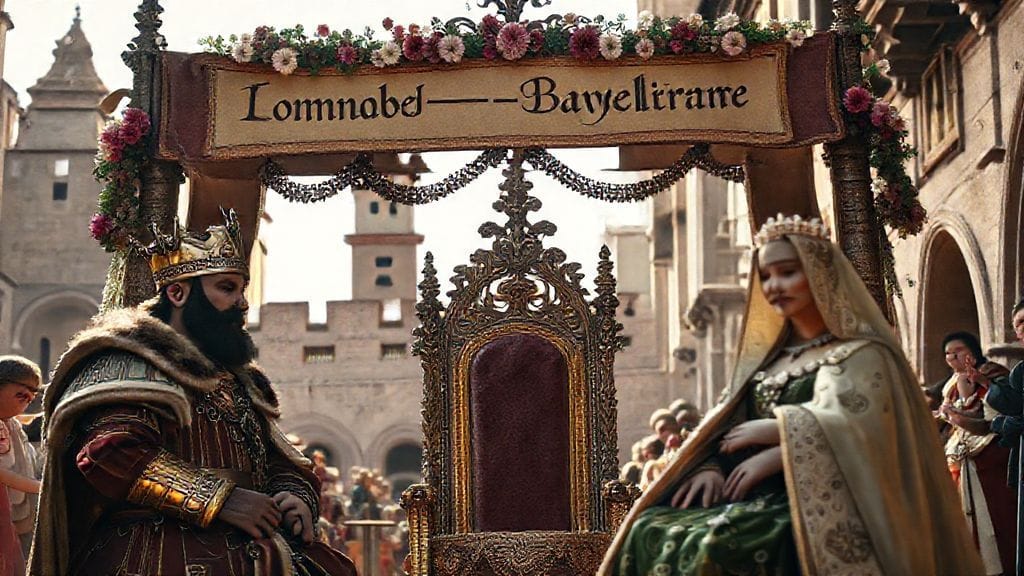
The scene was both regal and solemn. Mounted nobles in armor lined the streets; ladies in flowing silks, attendants bearing gifts, priests chanting prayers. Theodelinda, adorned with a crown signifying both her Bavarian heritage and new status, joined hands with Authari before witnesses who knew this was more than matrimonial bliss—it was a symbol of renewed hope.
Gifts exchanged—a mix of precious jewels, horses, and relics—signified the merging of two powerful houses and the promise of mutual defense.
One chronicler notes, “The crown of peace was laid upon the bride’s head as prayers called forth God’s blessing on the kingdom.”
9. The Role of Theodelinda: From Bavarian Princess to Queen of the Lombards
Soon after the wedding, Theodelinda’s influence emerged as transformative. She championed the cause of Catholic Christianity, a faith her new husband largely accepted. Her court became a center of ecclesiastical reform, patronage of churches, and diplomatic outreach.
Importantly, Theodelinda served as a cultural conduit, introducing Lombard nobles to Romans and Bavarians alike, fostering an era of exchange and relative peace.
Her correspondence with Pope Gregory I—preserved in fragments—reveals a shrewd and devout queen seeking to mold her adopted people into a more unified Christian polity.
10. How Religion Shaped the Alliance: A Catholicizing Quest
Religion was not a mere backdrop—it was central. The Lombards were mostly Arians, considered heretics by Rome, which complicated alliances and internal governance.
Theodelinda’s Catholic faith and Authari’s willingness to adopt more orthodox practices smoothed internal tensions with Roman populations and the Church.
This religious rapprochement was vital for the Lombards’ acceptance in Italy, transforming the kingdom from a disparate tribal confederation into a realm with a credible claim to legitimacy.
11. The Marriage as a Strategic Diplomatic Move
Authari’s marital alliance signaled to enemies and allies alike a new political reality: the Lombards were both committed to ruling Italy and willing to integrate with continental European powers.
The Bavarians gained a reliable southern ally; the Lombards gained political legitimacy and access to broader trade and military supports.
For Byzantium, the move was ominous, indicating that the Lombards were not only military conquerors but also emerging statesmen.
12. Aftermath: Political Ramifications in Italy and Beyond
Following the wedding, the Lombard kingdom gained steadier control in northern Italy. While battles and rebellions persisted, the alliance stabilized Authari’s throne sufficiently to deal with external threats.
This period also marked the slow but decisive cultural convergence between Germanic settlers and native Italians.
In Bavaria, the alliance enhanced the ruling family’s prestige, setting a pattern of marriage alliances as instruments of diplomacy.
13. Theodelinda’s Influence on Lombard Culture and Policy
Queen Theodelinda’s patronage reshaped nearly every aspect of Lombard life. She founded churches, encouraged the construction of monasteries, and introduced Roman legal and artistic traditions.
Her influence extended to Lombard laws, where some decrees reflected Christian moral codes rather than tribal customs.
Politically astute, she positioned the Lombard court toward longevity beyond mere conquest.
14. Reinforcing Power through Blood and Faith
The marriage underscored a new principle in European politics: power was not only asserted on battlefields but reinforced through matrimonial diplomacy and ecclesiastical alliances.
The blending of bloodlines and faith created a durable foundation for kingdoms in flux. It was a model repeated countless times across medieval Europe, where dynasties sought to weave stability amid chaos.
15. The Decline and Legacy of the Lombard Kingdom
Though the Lombards would eventually fall to Charlemagne’s Franks in 774, the legacy of Theodelinda and Authari’s union persisted in the cultural DNA of northern Italy.
The alliance laid foundations for the Christianization of northern Germanic tribes and influenced European political culture for centuries.
Theodelinda herself was later canonized, esteemed as a saint for her role in transforming her people.
16. Reflections on an Alliance that Changed Italy’s Future
It is incredible to consider how a marriage in 589, in a city long famed for Roman glories, could echo through the centuries to influence the political and religious contours of Europe.
Authari and Theodelinda’s union was more than a royal pact; it was a turning point where war-weary peoples began to envision coexistence, faith as unifier, and diplomacy as an art.
As Italy oscillated between kingdoms and empires, the Lombard-Bavarian alliance stood as a beacon illustrating how fragile peace often begins with human intimacy and shared belief.
Conclusion
The wedding of King Authari and Theodelinda in Verona was a defining moment in early medieval Europe—a tapestry woven from threads of power, faith, and culture. It illustrated the profound human need for alliance beyond conquest, a synthesis of war and peace, blood and belief. Through a partnership forged in hope and strategy, two peoples found a way forward amid chaos.
Today, that marriage teaches us how history is often shaped not just by armies and treaties, but by the delicate, fraught moments where personal bonds meet political ambition. Authari and Theodelinda remind us that behind every coronation and conquest, there is the human story yearning for stability, identity, and legacy.
FAQs
Q1: Why was the marriage between Authari and Theodelinda politically significant?
A1: It secured a crucial alliance between the Lombards and Bavarians, legitimizing Authari’s rule and fostering religious unity through Theodelinda’s Catholic influence, which helped integrate diverse populations in Italy.
Q2: What was the religious landscape of the Lombard kingdom at the time?
A2: The Lombards were primarily Arians, considered heretics by the Catholic Church. Theodelinda’s Catholic faith helped bridge this divide, promoting Catholicism in the kingdom and aligning the Lombards more closely with Rome.
Q3: How did the marriage affect the Lombard’s relations with the Byzantines?
A3: It signaled a shift toward a more consolidated Lombard state, less reliant on Byzantine mercy or interference, and posed a greater political challenge to Byzantine control in Italy.
Q4: Who was Theodelinda beyond her role as queen?
A4: Theodelinda was a politically savvy and devout queen who influenced Italian cultural and religious life profoundly, advocating for church reforms and fostering the Christianization of the Lombards.
Q5: What was Verona’s significance in the wedding?
A5: Verona was a strategic and symbolic center for the Lombards, representing both Roman heritage and emerging Germanic power, making it an ideal location to stage a union bridging these worlds.
Q6: Did this alliance have lasting effects on European history?
A6: Yes, the alliance set a precedent for dynastic marriages as political tools and influenced the religious and cultural integration of Germanic tribes into Western Christendom.
Q7: How is Theodelinda remembered today?
A7: She is venerated as a saint and key figure in the Catholic tradition, remembered for her role in shaping early medieval Italy both politically and religiously.
Q8: What ultimately happened to the Lombard kingdom?
A8: The Lombard kingdom fell to Charlemagne’s Frankish Empire in 774, but its political and cultural impacts persisted in the regions it once ruled.

