Table of Contents
- The Turbulent Frontier: Syria on the Edge of Empires
- Ghassanids and Byzantines: A Complex History of Alliance and Ambition
- The 6th Century: A Crossroads of Faith, Power, and Identity
- The Ghassanid Kingdom: Arab Federates of Byzantium
- Byzantium’s Eastern Strategy: The Role of the Ghassanids
- Early Strains: Conflicts and Cooperation on the Syrian Borderlands
- The Reaffirmation of the Alliance: Context and Catalysts
- The Political Landscape of the Byzantine Empire under Justinian I
- Al-Mundhir III ibn Al-Harith: Leader, Diplomat, Warrior
- The Pact Renewed: Ceremonies and Diplomatic Overtures in the Syrian Desert
- Military Implications: Securing the Frontier Against Lakhmids and Persians
- Religious Undertones: Monophysitism and Chalcedonian Controversies
- Economic and Cultural Exchanges Along the Syria Frontier
- Ghassanid Autonomy vs Byzantine Authority: Balancing Acts
- The Role of the Frontier Cities: Emesa, Palmyra, and Beyond
- The Aftermath: Consolidation and Periodic Frictions
- Seeds of Future Conflict: How the Alliance Shaped Islamic Conquests
- Personalities Behind the Pact: Byzantine Officials and Ghassanid Nobles
- The Alliance in Chronicles and Poetry: How History Remembered It
- Reflections on Border Diplomacy in Antiquity
- Conclusion: The Enduring Legacy of the Ghassanid-Byzantine Partnership
- FAQs About the Ghassanid-Byzantine Alliance
- External Resource
- Internal Link
The Turbulent Frontier: Syria on the Edge of Empires
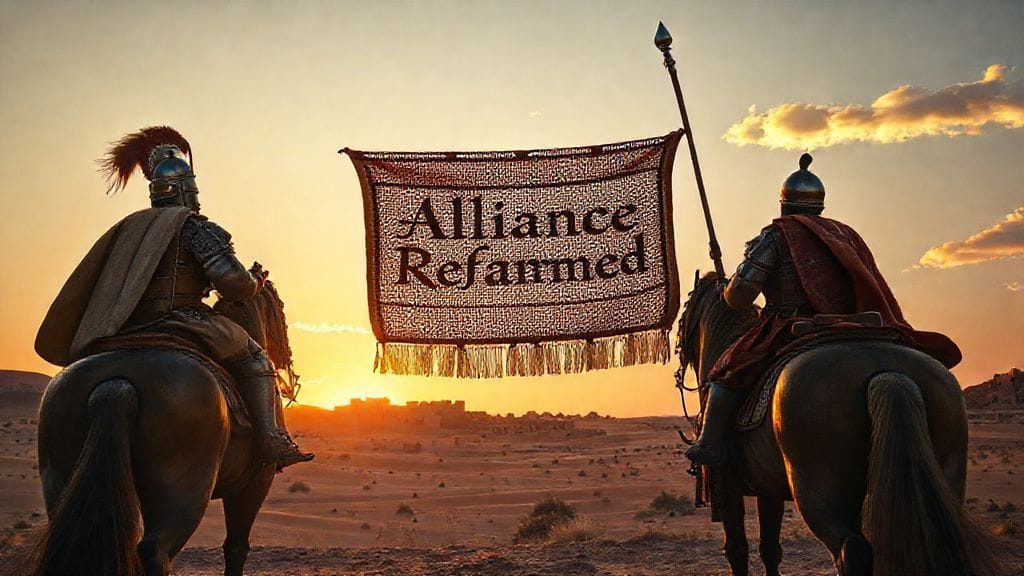
The dry Syrian sun stung the faces of horsemen galloping across the perched cliffs overlooking the vast desert. The 6th century was a time when swords clashed and emissaries whispered hopes of peace and dominion. Here, where the Palmyrene caravans once met Roman legions, the Ghassanid clans rallied beneath their banners—their horses pawing the sandy earth, eyes full of resolve as they awaited Byzantine envoys to seal an alliance that would shape the destiny of the Levantine frontier.
To understand this crucial moment, we must immerse ourselves in a world of shifting imperial ambitions, tribal loyalties, religious strife, and the delicate art of diplomacy — for the Ghassanid-Byzantine alliance was far more than a mere pact: it was a mutual lifeline in a chaotic world.
Ghassanids and Byzantines: A Complex History of Alliance and Ambition
Long before the reaffirmation of their alliance in the mid-6th century, the Ghassanids had established themselves as formidable players in the border politics between Byzantium and the Persian Sassanids. Their story was one interwoven with threads of cooperation and tension, faith and pragmatism, as both parties sought to harness local power in a volatile region.
The Ghassanids, an Arab Christian confederation, had been embraced by Byzantium as allies and foederati — federated allies — tasked with guarding the empire’s southern flank. But this relationship was never simply hierarchical; it was a dance of mutual respect and necessity. The Ghassanids needed Byzantine patronage, military support, and recognition to solidify their internal power. The Byzantines in turn relied on these Arab warriors to act as buffers, policing trade routes and repelling incursions.
The 6th Century: A Crossroads of Faith, Power, and Identity
The early 6th century presented a tinderbox of religious tensions and political uncertainties in the Near East. Emperor Justinian I, ruling from Constantinople, aimed to reconsolidate imperial strength, restore Roman glory, and religious uniformity. Yet the Eastern frontier, particularly Syria, was a mosaic of Chalcedonian Christians, Monophysites, pagans, and Saracen tribes.
Within this crucible, the Ghassanids served as a Christian Arab identity, standing firm both as a political entity and as a religious bastion against rival provinces or tribal confederations aligned with the Persian Empire. The reaffirmation of their alliance was thus not only a matter of politics but a crucial gesture of ideological solidarity.
The Ghassanid Kingdom: Arab Federates of Byzantium
The Ghassanids, descending from South Arabian tribes who migrated north centuries prior, had cemented their rule over vast stretches of southern Syria, Jordan, and northern Arabia by the 6th century. Their capital, Jabiyah, became a cultural and political hub, where Arab customs blended with Greco-Roman administrative practices.
Their Christian identity distinguished them from many other Arab tribes, abiding mainly by Miaphysite or Monophysite doctrines—a fact that complicated their relationship with the Orthodox Constantinople but forged bonds with local populations. This hybrid identity allowed them to operate as mediators between the Byzantine world and pre-Islamic Arabian tribes.
Byzantium’s Eastern Strategy: The Role of the Ghassanids
For Constantinople, the Ghassanids represented a strategic pawn and partner on the eastern chessboard against the Sassanid Empire and their allied Lakhmid Arabs. The empire’s vast territories required local enforcement arms—tribal confederations like the Ghassanids acted as military vanguards and intelligence gatherers.
Their alliance was vital in maintaining control over trade routes that funneled Silk Road goods, spices, and luxury items from the east to Mediterranean markets. Without tribal partners familiar with the harsh desert terrain, Byzantine control would have been precarious at best.
Early Strains: Conflicts and Cooperation on the Syrian Borderlands
The alliance was not without its perils. Early on, tensions simmered over autonomy, religious policies, and military command. The Ghassanid rulers chafed at Byzantine attempts to integrate them directly into imperial structures, while Byzantium feared the sometimes independent spirit of the Ghassanid commanders.
Skirmishes with neighboring Lakhmids, rivals backed by Persia, exposed the frontier to recurrent raids and retaliation. Yet every crisis renewed the necessity of cooperation, forging an uneasy but enduring partnership.
The Reaffirmation of the Alliance: Context and Catalysts
The reaffirmation of the Ghassanid-Byzantine alliance around the mid-6th century was less a new invention than a necessary restatement of old ties under shifting circumstances. Emperor Justinian I faced mounting Persian aggression and internal revolts, making frontier stability urgent.
The Ghassanid king, Al-Mundhir III ibn al-Harith, sought to reinforce his legitimacy with Byzantine backing, navigating the complexities of religious discord within his realm and the ever-present threat of Lakhmid incursions. Mutual threats and mutual needs propelled them to step forward once again in solidarity.
The Political Landscape of the Byzantine Empire under Justinian I
Justinian's ambitious reign was marked by grand projects—such as the Hagia Sophia—and relentless campaigns to reclaim lost western provinces. Yet the east, with its ever-looming Persian threat, remained a persistent preoccupation.
Religious unity was declared a cornerstone of imperial authority, with the Chalcedonian creed elevated above all resistance, often alienating Monophysite populations — including some Ghassanid factions. Against this backdrop, renewing the Ghassanid alliance was both a political and theological gamble.
Al-Mundhir III ibn Al-Harith: Leader, Diplomat, Warrior
Al-Mundhir III, the most prominent Ghassanid king of the era, embodied the complex duality of his people: a warrior defending his tribal identity and a diplomat negotiating imperial politics. His leadership was legendary—not just in commanding cavalry charges, but in brokering peace treaties.
He navigated Byzantine court intrigues and tribal rivalries alike, striving to maintain Ghassanid autonomy while adapting to the demands of empire. His role was pivotal in the alliance’s renewal deliberations.
The Pact Renewed: Ceremonies and Diplomatic Overtures in the Syrian Desert
The reaffirmation possibly took place amid desert encampments or in fortified towns like Emesa, a crossroads of culture and commerce. Byzantine envoys brought gifts and formal proclamations; Ghassanid nobles pledged loyalty and military support.
These moments blended ritual and realpolitik: a feast followed by oaths, emissaries cloaked in fine silks shaking hands beneath the unforgiving desert sky. The ceremony symbolized not just military alliance but an exchange of honor and mutual recognition.
Military Implications: Securing the Frontier Against Lakhmids and Persians
The alliance renewed deterrence against the Lakhmid Arabs, who, under their own Persian patrons, destabilized the corridor from Iraq into Syria. Joint military campaigns and coordinated raids became more frequent, with Ghassanid cavalry screening Byzantine troops, warning of invasions, and controlling key passes.
This frontline warfare tested loyalties and endurance but underscored the indispensability of the Ghassanids to Byzantine eastern defense.
Religious Undertones: Monophysitism and Chalcedonian Controversies
Despite sharing Christian faith, Byzantium and the Ghassanids diverged on theological doctrines. The Ghassanids often aligned with Monophysite or Miaphysite positions—emphasizing the single divine nature of Christ—contrasting the Chalcedonian orthodoxy enforced by Justinian.
This religious rift created undercurrents in their alliance, influencing court politics and ecclesiastical appointments. Yet, it never entirely severed the alliance, testifying to the primacy of political and military concerns.
Economic and Cultural Exchanges Along the Syria Frontier
The reaffirmed alliance invigorated local trade and cultural exchange. Caravans laden with silk, spices, and glassware passed between desert oases and Byzantine cities, bringing wealth and ideas.
Artisans, soldiers, and merchants mingled, blending Greco-Roman and Arab styles. Ghassanid poetry and Christian architecture flourished under Byzantine patronage, creating a rich cultural tapestry along the frontier.
Ghassanid Autonomy vs Byzantine Authority: Balancing Acts
The Ghassanids maneuvered carefully to maintain their autonomy. While they fought under Byzantine influence, they prided themselves on ruling their people. This tension between local sovereignty and imperial control was constant.
Justinian’s governors sometimes clashed with Ghassanid leaders over jurisdiction, tax collection, and religious doctrine, requiring delicate negotiation to keep the alliance intact.
The Role of the Frontier Cities: Emesa, Palmyra, and Beyond
Cities such as Emesa (modern Homs) and Palmyra were vital nodes in this geopolitical landscape. They housed both military garrisons and thriving economic centers, serving as stages for diplomatic meetings and supply points for armies.
Their strategic position amplified the importance of the Ghassanid alliance, as controlling them meant access to critical roads and desert gateways.
The Aftermath: Consolidation and Periodic Frictions
Following the reaffirmation, the alliance entered a period of relative stability, yet smaller conflicts between Ghassanid autonomy and Byzantine demands periodically flared. Shifting regional dynamics, new emperors, and tribal changes constantly redefined the relationship.
Ultimately, the alliance sustained Byzantine dominion over the Levant until the dramatic changes sweeping the region in the 7th century.
Seeds of Future Conflict: How the Alliance Shaped Islamic Conquests
In retrospect, this alliance laid foundations as much as fissures. The relationships and rivalries it forged influenced the region’s response to the coming Islamic expansions.
Ghassanid tribes would either integrate into, resist, or be displaced by emerging Muslim powers, their alliances and histories echoing into new configurations of power.
Personalities Behind the Pact: Byzantine Officials and Ghassanid Nobles
Behind formal treaties were colorful figures—local commanders, poets, and courtiers—who shaped events. Byzantine generals like Belisarius, Ghassanid princes renowned for courage, Hellenized Arab scribes weaving tales of valor, all populated this vibrant scene.
Their human stories remind us that history is lived by people, not just recorded as dates and decrees.
The Alliance in Chronicles and Poetry: How History Remembered It
Byzantine chroniclers like Procopius and Arab poets immortalized the alliance in their works, sometimes praising its merits, other times lamenting betrayals and losses.
These narratives help reconstruct the emotional and cultural weight of the pact, offering windows into how contemporaries understood their world.
Reflections on Border Diplomacy in Antiquity
The Ghassanid-Byzantine alliance exemplifies ancient frontier diplomacy’s complexity: how empires relied on local actors, negotiated religious differences, and managed fragile coalitions to hold frontiers together.
Its study enriches our understanding of how power was exercised not just through force but through agreement and recognition.
Conclusion: The Enduring Legacy of the Ghassanid-Byzantine Partnership
The reaffirmation of the Ghassanid-Byzantine alliance on the Syria frontier was more than a military pact: it was a testament to the enduring human capacity for cooperation amid adversity, the balancing of identity and empire, faith and power. From the parched deserts to imperial palaces, this alliance shaped a world teetering between the ancient and the medieval, laying the groundwork for transformations that would resonate for centuries.
In the shifting sands of history, their handshake echoes still—a story of loyalty, pragmatism, and the fragile unity that held empires together on the edge of the world.
FAQs About the Ghassanid-Byzantine Alliance
Q1: Why was the Ghassanid-Byzantine alliance important in the 6th century?
A1: It secured the Byzantine Empire’s eastern frontier against Persian-backed enemies, ensured the safety of vital trade routes, and maintained a buffer zone through local Arab federates, effectively shaping the politics of the Levant.
Q2: Who was Al-Mundhir III ibn al-Harith?
A2: He was the Ghassanid king who led efforts to reaffirm the alliance with Byzantium, acting as both warrior and diplomat to safeguard his people’s autonomy while supporting Byzantine imperial interests.
Q3: How did religious differences affect the alliance?
A3: The theological split between Chalcedonian Christianity (Byzantines) and Monophysitism (many Ghassanids) created tensions but was often subordinated to political and military needs, demonstrating pragmatic coexistence.
Q4: Were the Ghassanids truly autonomous under Byzantine rule?
A4: They enjoyed considerable local autonomy as federated allies but were ultimately subordinate to Byzantine authority, a relationship marked by negotiations and occasional conflicts over control and jurisdiction.
Q5: What role did the Lakhmids play in this context?
A5: The Lakhmids, allied with the Persian Sassanid Empire, were the primary rivals of the Ghassanids, engaging in frequent raids and proxy wars that made the Ghassanid-Byzantine alliance strategically crucial.
Q6: Did the alliance influence later Islamic conquests?
A6: Yes, the alliances, rivalries, and social structures established during this period influenced tribal politics and regional stability, affecting how early Islamic forces engaged with the Levantine territories.
Q7: How is the alliance remembered in historical sources?
A7: Byzantine chroniclers and Arab poets recalled it with a mix of admiration and critique, reflecting its complex legacy as a military necessity and a cultural encounter.
Q8: What can modern historians learn from the Ghassanid-Byzantine alliance?
A8: It offers insights into ancient border diplomacy, the interplay between empire and tribe, and the negotiations of identity and power in a religiously diverse world.

