Table of Contents
- A Fragile Peace: Setting the Stage for the Treaty of 591
- The Byzantine-Sassanian Conflict: A Clash of Empires
- The Strategic Importance of Mesopotamia and Nisibis
- Emperor Maurice: The Man Behind the Byzantine Revival
- The Sassanian Empire under Khosrow II: Ambitions and Turmoil
- The Early Phases of the War: Stalemates and Shifting Fronts
- The Turning Point: Byzantine Victories and Sassanian Defeats
- The Siege and Battle for Nisibis: A City at the Crossroads of Empires
- The Role of Diplomacy: Negotiations Leading to the Treaty
- Signing the Treaty of 591: Terms and Territorial Reconfigurations
- The Restoration of Byzantine Control: Political and Military Implications
- Economic Consequences: Trade, Taxes, and Border Stability
- Cultural and Religious Dimensions of the Treaty Era
- The Legacy of the Treaty in Byzantine-Sassanian Relations
- How the Treaty Paved the Way for Future Conflicts
- Reflections on Empire: Lessons from the Byzantine-Sassanian Rivalry
- The Nisibis Region Today: Echoes from an Ancient Borderland
- Conclusion: A Moment of Respite in the Endless Struggle
- FAQs: Exploring the Treaty of 591
- External Resource
- Internal Link
1. A Fragile Peace: Setting the Stage for the Treaty of 591
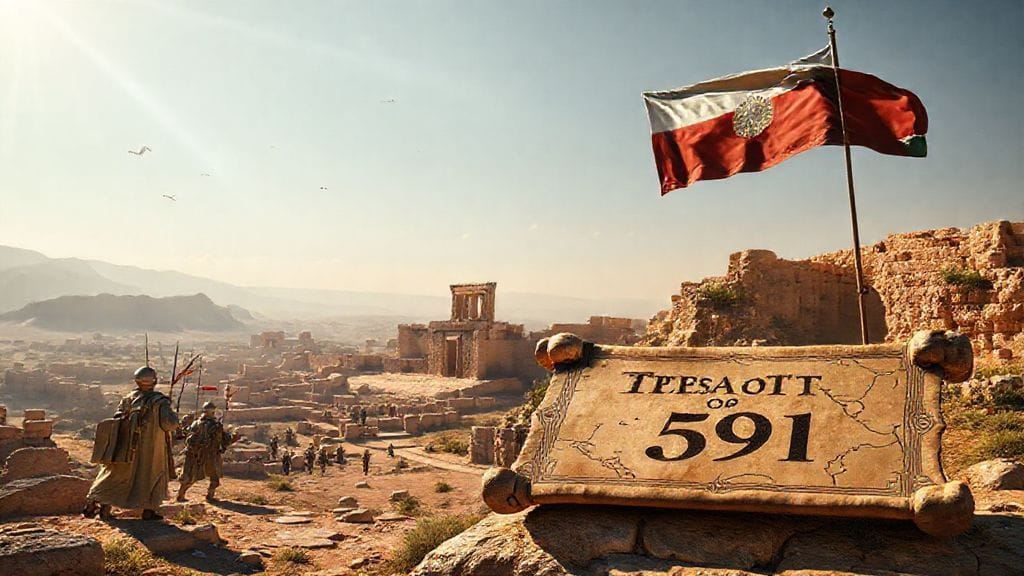
Imagine standing on the parched earth of Mesopotamia, where the air is thick with dust and the scent of scorched olive trees clings to the breeze. It is the year 591 AD, and the landscape bears the scars of decades of conflict—burned villages, devastated farmland, and the ruinous echo of battle cries. Along the winding banks of the Tigris River, two great empires—the Byzantine and the Sassanian Persian—stand weary but unyielding, their soldiers gazing across a contested borderland drenched in both blood and hope. The two belligerents are on the cusp of signing a treaty—a fragile pact that will restore significant territories to Byzantium and temporarily end a bitter war for dominance over the ancient lands of Mesopotamia.
This treaty, forged after years of relentless warfare, represents not only a shift in territorial control but also a critical moment of recalibration in the balance of power between East and West. The Treaty of 591 would reinstate Byzantine authority over the Nisibis region—an area of immense military and economic value—and redraw the boundary lines that had long been sources of tension between these empires. Yet, as the ink was drying on this accord, both sides knew that the peace was tentative, fragile, and perhaps merely a prelude to new struggles.
2. The Byzantine-Sassanian Conflict: A Clash of Empires
The Byzantine Empire and the Sassanian Persian Empire were two colossal powers locked in a protracted struggle for supremacy across the Near East—a rivalry that had spanned centuries. The battlefield of Mesopotamia, cradle of civilization, had morphed into a narrow, deadly corridor in which the destinies of these empires intertwined. What few fully grasped was that this was not merely a territorial dispute but a profound contest of ideologies, cultures, and imperial visions—Christian Byzantium against Zoroastrian Persia.
Each side sought control over Mesopotamia for strategic reasons: it was the gateway between East and West, a vital artery for trade caravans, and a possession symbolically associated with legitimacy and power. Control over cities like Nisibis, with its massive fortifications and position on critical trade routes, was essential. Yet, this was not just a clash of generals and armies—it was a war underpinned by decades of mutual suspicion, religious fervor, and conflicting legacies of empire.
3. The Strategic Importance of Mesopotamia and Nisibis
Mesopotamia, the “Land Between Rivers,” had been the cradle of human civilization with its fertile soil and ancient cities. But by the 6th century AD, it was no longer just an agricultural heartland; it had become a militarized border zone caught between two rival empires. Nisibis, in particular, held strategic value unrivaled by its neighbors. The city was a fortress of monumental significance, perched on trade routes connecting the Roman-Byzantine world with the Persian east and beyond.
For Byzantium, retaining Nisibis meant securing its eastern frontier; every stone of its fortifications was a bulwark against Persian expansion. For Persia, possession of Nisibis represented both a gateway to Syria and a bargaining chip in negotiations. The city’s control had swung back and forth over time, and as the century turned, it was a prize fiercely contested.
4. Emperor Maurice: The Man Behind the Byzantine Revival
At the helm of the Byzantine Empire stood Emperor Maurice, a shrewd and steadfast leader whose military acumen was matched by his political vision. Ascending to power in 582 AD, Maurice inherited an empire strained by fiscal difficulties and relentless external threats. Determined to restore Byzantine fortunes, he embarked on a campaign of reorganization, strengthening the military and forging alliances.
Maurice’s campaigns against Persia were characterized not only by battlefield success but by a deeper strategic insight—he grasped the necessity of restoring Byzantine hegemony in lost territories while ensuring the empire's internal stability. Under his leadership, the Byzantine army, led by generals such as Narses and Comentiolus, slowly regained lost ground, pushing back Sassanian advances and regaining key cities including the prized Nisibis.
5. The Sassanian Empire under Khosrow II: Ambitions and Turmoil
Opposite Maurice stood Khosrow II, the Persian king whose reign was marked by both grand ambitions and internal turmoil. Initially exiled during dynastic struggles, Khosrow was restored to power with Byzantine assistance—a debt that complicated relations between the two empires. Known as “Khosrow Parviz,” he sought to reclaim Persia's lost glory by expanding its borders westwards and asserting dominance over Mesopotamia.
His early reign saw the rapid reconquest of cities, but his fortunes soon turned when Byzantine forces began to push back. The war would become a costly and grueling ordeal for Persia, draining its treasury and exhausting its manpower. Khosrow's ambition and personal vendettas played a significant role in prolonging the hostilities, setting the stage for the eventual negotiations.
6. The Early Phases of the War: Stalemates and Shifting Fronts
The war that culminated in 591 was not a sudden eruption but the latest chapter in a long series of conflicts. The early 580s were marked by indecision and attrition. Neither side could claim decisive victories; battles were costly, and the brutal campaigns devastated border regions. Troops endured blistering heat and bitter winters as they fought over patchwork terrain of deserts, marshes, and fortified cities.
This period was one of brutal siege warfare, surprise raids, and negotiated truces. The Sassanian army’s initial advances were halted as Byzantine generals adapted their tactics. The protracted conflict drained resources from both empires, made worse by simultaneous threats on other frontiers, including the Avars and Slavs pressing against Byzantine borders in the Balkans.
7. The Turning Point: Byzantine Victories and Sassanian Defeats
By the late 580s, the tide began to shift unmistakably in favor of Byzantium. Emperor Maurice's reforms paid off on the battlefield, as well-disciplined Byzantine forces under commanders like Narses launched coordinated offensives. The capture of key fortresses and the strategic use of cavalry disrupted Persian lines.
One noted episode featured a daring night assault on a Persian-held fortress, where Byzantine troops scaled walls amidst enemy fire—a victory that boosted morale and set a precedent for further assaults. Persian forces, stretched thin and suffering from internal discontent due to Khosrow’s brutal policies, started to crumble in key sectors.
8. The Siege and Battle for Nisibis: A City at the Crossroads of Empires
The siege of Nisibis was, without doubt, the war’s crucial episode. The city's massive walls resisted several assaults, but the Byzantines, mindful of its strategic importance, spared no effort or resource to reclaim it. Historians recount how soldiers and siege engineers worked relentlessly—digging tunnels, launching trebuchet attacks, and cutting off supply routes to starve the defenders.
After a protracted standoff, the Byzantine forces succeeded in breaching outer defenses. The ensuing street fighting was fierce, with ancient walls witnessing the clash of swords and the cries of the wounded. The fall of Nisibis was a symbolic and strategic victory—it restored a vital bulwark to Byzantium and signaled a turning point in the conflict.
9. The Role of Diplomacy: Negotiations Leading to the Treaty
Victory on the battlefield was only half the story. For the empires to finalize their shifting fortunes, diplomacy had to take center stage. The war had exhausted both treasuries, and the populations on both sides yearned for peace. Byzantine envoys and Persian representatives met in painstaking discussions, balancing pride, pragmatism, and raw necessity.
The negotiations embodied classic elements of power politics: territorial concessions, military guarantees, and recognition of sovereignty. Khosrow, compromised by internal strife and the looming threat of rebellions, saw in peace an opportunity to consolidate rather than continue costly conflicts. Maurice, for his part, sought to secure gains while ensuring a durable peace that would allow Byzantine focus on other pressing threats.
10. Signing the Treaty of 591: Terms and Territorial Reconfigurations
The Treaty of 591 formalized what had been fought for during years of bloodshed. Most notably, it restored Byzantine control over Nisibis and the surrounding Mesopotamian territories, reversing Persian gains made in earlier decades. The border was redrawn with clarity for the first time in a long while, providing a semblance of stability.
The treaty included clauses ensuring mutual non-aggression, freedom of trade, and the return of prisoners of war. It was a diplomatic triumph for Maurice, enhancing his reputation as a capable statesman beside his military prowess. Yet the terms, though clear, left ample room for future conflict—a peace of exhaustion rather than reconciliation.
11. The Restoration of Byzantine Control: Political and Military Implications
Restoring territories was only the initial step. Byzantium faced the challenge of re-establishing political authority in areas long under Persian influence. The reintegration of Nisibis brought with it dilemmas regarding governance, military occupation, and the loyalty of local populations—in this region, a patchwork of ethnicities and faiths.
Militarily, the Byzantines fortified their eastern frontier, shoring up defenses and stationing garrisons to deter future incursions. The victory and treaty elevated the empire’s prestige but also entangled it deeper into Near Eastern politics, with responsibilities and risks attached to holding contested lands.
12. Economic Consequences: Trade, Taxes, and Border Stability
The reopening of trade routes through Mesopotamia under Byzantine control invigorated commerce. Caravans laden with silk, spices, and raw materials once more moved relatively safely, stimulating markets from Constantinople to the Persian Gulf. However, the wartime devastation meant economic recovery was gradual—fields had to be replanted, and cities rebuilt.
The treaty brought more predictable taxation and customs enforcement, allowing Byzantine administrators to extract revenues vital for maintaining border defenses. Yet the fragility of peace meant merchants and farmers often lived under the shadow of renewed conflict.
13. Cultural and Religious Dimensions of the Treaty Era
The Treaty of 591 resonated beyond politics and economics; it also influenced cultural and religious landscapes. The region’s diverse populations—Miaphysite Christians, Zoroastrian Persians, Jews, and various Arab tribes—found themselves again under Byzantine rule. The empire sought to consolidate religious orthodoxy but had to navigate complex realities on the ground to avoid alienating local communities.
Artistic exchanges occurred as symbols and motifs from both cultures mingled in frontier cities. Moreover, the treaty period allowed for an uneasy but essential dialogue between opposing faiths, fostering a dynamic cultural coexistence.
14. The Legacy of the Treaty in Byzantine-Sassanian Relations
Though hailed as a milestone of peace, the Treaty of 591 was but a pause in the long saga of Byzantine-Sassanian rivalry. The boundary lines drawn echoed through subsequent decades, influencing later conflicts such as the great war of 602-628. Historians often view the treaty as the last relative peace before the final Sassanian struggles against Byzantine resurgence.
Its legacy is mixed—a testament to diplomatic achievement but also a reminder of the fragile balance of empires perpetually teetering on war.
15. How the Treaty Paved the Way for Future Conflicts
Ironically, the Treaty of 591, while ending immediate hostilities, sowed seeds for future wars. Both empires viewed the peace as temporary, an interlude in a broader narrative of competition. The reinforced Byzantine presence in Mesopotamia threatened Persian ambitions, while Persia’s resentment simmered under Khosrow’s successors.
The strained peace emboldened factions within Persia, contributing to the eventual fall of the Sassanian dynasty amid the rise of Islam. The treaty stands as a historical fulcrum—marking conclusion yet hinting at inevitable return of conflict.
16. Reflections on Empire: Lessons from the Byzantine-Sassanian Rivalry
The protracted Byzantine-Sassanian wars, culminating in the Treaty of 591, teach us enduring lessons about empire, diplomacy, and survival. They show the limits of military might alone to secure lasting peace, the intricate relationship between conquest and governance, and the resilience of cultures amid turmoil.
Above all, they underscore the human dimension behind history’s grand narratives—soldiers’ sacrifices, leaders’ ambitions, and civilians’ hopes and sufferings woven into the tapestry of time.
17. The Nisibis Region Today: Echoes from an Ancient Borderland
Modern archaeology and scholarship have uncovered remnants of Nisibis’s storied past—a citadel’s ruins, fortifications, and artifacts revealing the city’s vibrant history. Today’s landscape remains a crossroads, an enduring symbol of interaction between civilizations.
Studying this region enriches our understanding not only of the 591 treaty era but of the broader human saga where borders are drawn and redrawn, and cultures collide and blend.
18. Conclusion: A Moment of Respite in the Endless Struggle
The Treaty of 591 was more than a document—it was a breath caught between storms. It temporarily halted a brutal rivalry, restored territory and honor to Byzantium, and brought hope for a peaceful era that, though fleeting, was deeply cherished. In the dust-laden winds of Mesopotamia, beneath ancient walls scarred by missiles and struggles, peace was signed—a fragile gift amid relentless history’s march.
This treaty reminds us that even in the darkest times of empires’ conflicts, moments of negotiation and restoration emerge, carrying the promise of new beginnings, however uncertain.
FAQs
Q1: What were the main causes of the war leading to the Treaty of 591?
A: The war was rooted in longstanding territorial disputes between Byzantine and Persian empires, especially regarding control over Mesopotamia and key frontier cities like Nisibis. Religious, political, and economic rivalries also fueled the conflict.
Q2: Who were the key figures involved in the negotiations of the treaty?
A: Emperor Maurice of Byzantium and Shah Khosrow II of Persia were central figures, supported by their diplomats and generals. Maurice’s military successes strengthened Byzantine bargaining power.
Q3: What territorial changes resulted from the Treaty of 591?
A: The treaty restored the Byzantine Empire’s control over Nisibis and surrounding Mesopotamian regions, reversing previous Persian gains.
Q4: How did the treaty impact trade and the economy?
A: The reestablishment of control over key trade routes allowed for the revival of commerce between East and West, though recovery was slow due to wartime devastation.
Q5: Did the Treaty of 591 create lasting peace?
A: No. While it ended immediate hostilities, tensions remained high, and the treaty served as a temporary respite before further wars erupted in following decades.
Q6: How did religious dynamics influence the treaty and its aftermath?
A: Religious identities shaped loyalties and policies on both sides; the Byzantines aimed at consolidating Christian influence, yet had to accommodate diverse communities in reconquered lands.
Q7: What role did Nisibis play in the broader Byzantine-Persian rivalry?
A: Nisibis was a key strategic fortress city controlling access between empires, symbolizing power and military advantage.
Q8: How is the Treaty of 591 remembered in historical scholarship?
A: It is regarded as a significant but ultimately fragile moment of peace in a centuries-long rivalry, illustrating the complexities of diplomacy and warfare in Late Antiquity.

