Table of Contents
- Dawn of a New Era: The Persian Siege of Jerusalem
- Jerusalem in the Early 7th Century: A City at Crossroads
- The Byzantine-Sassanian Conflict: Roots of a Great Struggle
- Khosrow II’s Vision: Reclaiming the Lost Glory
- Preparing for War: Strategies and Alliances
- The Siege Begins: The Fall of the Holy City
- Inside the Walls: The Fateful Days of 614
- The Capture of the True Cross: Symbolism and Shockwaves
- The Aftermath: Bloodshed, Hardship, and Transformation
- The Role of Jewish and Christian Communities
- Propaganda and Memory: Narratives of the Fall
- The Byzantine Response: Attempts at Reconquest
- Persian Rule Over Jerusalem: Administration and Religion
- Cultural and Religious Consequences in the Region
- The Long-Term Impact on Christian Imagination
- Archaeological Evidence and Historical Debates
- The Event in Later Chronicles and Art
- The Path to Byzantine Recovery and the Rise of Islam
- Revisiting the 614 Siege in Modern Scholarship
- Conclusion: A Moment Frozen in Time, Echoes Through History
- FAQs: Understanding the Persian Capture of Jerusalem
- External Resource
- Internal Link
1. Dawn of a New Era: The Persian Siege of Jerusalem
It was a chilling autumn morning in the year 614 CE when the once impregnable walls of Jerusalem trembled under the assault of the Sassanian forces. The ancient city, regarded as sacred by Jews, Christians, and soon, Muslims, was on the precipice of transformation. In the crisp air, the clash of swords and the desperate cries of the defenders echoed alongside the destruction of homes that had sheltered generations. From the ramparts, one could see the Persian banners fluttering—symbols of a distant empire’s far-reaching ambitions to reshape the religious and political landscape of the Near East. At the heart of this violent storm lay more than just territory; it was a battle for symbols of faith, power, and identity, epitomized by the much-revered True Cross. The capture of Jerusalem by the Persians was not merely a military victory—it was a cataclysmic event that would reverberate through centuries.
2. Jerusalem in the Early 7th Century: A City at Crossroads
Jerusalem at this time was a jewel of antiquity, cradling the spiritual centers sacred to Judaism and Christianity alike. Under Byzantine rule for centuries, the city had blossomed into a bustling hub of pilgrimage and religious scholarship. Yet, beneath its sanctified surface simmered tensions—a mosaic of ethnic, religious, and political fractures. The Byzantine Empire, stretched thin by wars on multiple fronts, struggled to maintain its grip on its eastern provinces. Meanwhile, local Jewish populations, heavily restricted under Christian rule, held onto hopes of renewed autonomy. The city had endured sieges and upheavals before, but none quite like the one looming on its horizon. The grand churches that dotted Jerusalem’s landscape stood as testimonies of imperial piety—and would soon become pawns in geopolitical gambits.
3. The Byzantine-Sassanian Conflict: Roots of a Great Struggle
To understand the fall of Jerusalem, one must grasp the titanic rivalry simmering between the Byzantine East Roman Empire and the formidable Sassanian Persian Empire. These two powers contested dominance over Mesopotamia, the Levant, and beyond for centuries, weaving wars and uneasy peace treaties into the fabric of their histories. By the early 7th century, the conflict escalated into a brutal, sustained war—sometimes dubbed the Byzantine-Sassanian War of 602–628—that drained resources, peoples, and morale on both sides. The Sassanians, under the ambitious and militarily astute King Khosrow II, sought to reclaim lands lost to Byzantium and to strike a decisive blow. Jerusalem’s capture was not an isolated event but a crucial chapter in this sprawling saga of empire and faith.
4. Khosrow II’s Vision: Reclaiming the Lost Glory
Khosrow II, the last great king of the Sassanian dynasty, harbored grand ambitions. His reign was marked by both brilliant military campaigns and devastating setbacks, but his determination to restore Persian prestige proved unyielding. Jerusalem’s symbolic significance—a city revered by Christians but lying within Byzantine borders—presented an irresistible target. To capture Jerusalem was to strike a psychological and ideological blow against a rival empire, disrupting the spiritual heart of Byzantine Christianity. Khosrow’s invasion was framed not only as a military conquest but also as a providential act, supported by alliances with local Jewish communities who saw in the Persians a potential means to overturn Christian hegemony.
5. Preparing for War: Strategies and Alliances
The military preparations preceding the siege were meticulous. The Sassanians forged alliances with Jewish factions discontented with Byzantine policies, promising religious freedoms and restoration of communal rights. Persian commanders marshaled a diverse array of troops—cavalry, archers, and infantry—well-supplied despite an enduring war that had stretched their empire. On the other side, Byzantine forces, weakened by years of conflict and internal political turmoil, struggled to muster a strong defense. Jerusalem was fortified, but cracks in leadership and civilian morale rendered the city vulnerable. This was a war of wills as much as of swords, with faith and political reckoning intertwined.
6. The Siege Begins: The Fall of the Holy City
When the siege commenced, the city braced for a torment that would test the endurance of all within its walls. For weeks, Persian soldiers encircled Jerusalem, assaulting the gates and drowning the city in fear and uncertainty. Inside, Christian defenders rallied behind their bishops and monks, drawing on centuries of religious fortitude. Yet famine, disease, and the relentless pressure of assaults slowly eroded the spirit of the inhabitants. Persian siege engines battered the walls, while the invaders exploited the city’s fractured defenses. The air grew thick with smoke and despair; homes and sacred structures became battlegrounds. The fall of Jerusalem was as dramatic as it was inevitable.
7. Inside the Walls: The Fateful Days of 614
Within the besieged city, hope flickered and faded in equal measure. Contemporary chronicles speak of desperate prayers, secret negotiations, and tragic betrayals. The Christian clergy labored to protect relics and sacred objects, aware that the imminent fall could spell sacrilege and loss. Among these relics, the True Cross—the very wood believed to be from Christ’s crucifixion—was the city’s most treasured symbol. The day Persian forces breached the defenses marked a watershed moment; Christian sources recount horrifying scenes of massacre, destruction, and looting. Survivors hid in catacombs and dispersed, the triumphant Persians marched through streets stained with loss.
8. The Capture of the True Cross: Symbolism and Shockwaves
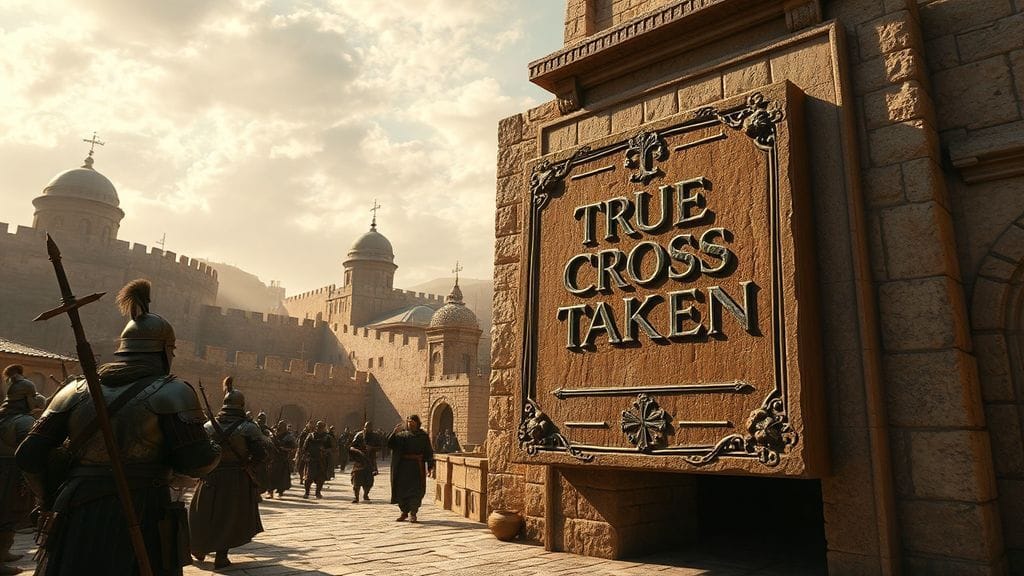
Perhaps the most enduring image etched into history from 614 is the capture of the True Cross. This relic, held within the Church of the Holy Sepulchre, was the spiritual and psychological heart of Byzantine Jerusalem. Its loss sent shockwaves through Christendom, a symbol that radiated power beyond the battlefield. For the Persians, seizing the True Cross was a trophy underscoring their dominance; for the Byzantines, it was a devastating spiritual wound. As chroniclers narrated the event, grief intertwined with fury, and the idea of recovering the precious relic became a rallying cry. The fate of the True Cross would resonate in liturgies, political speeches, and artistic expressions for centuries.
9. The Aftermath: Bloodshed, Hardship, and Transformation
The immediate aftermath of the siege was grim. Accounts speak of tens of thousands killed, enslaved, or displaced. The Christian population suffered greatly, with many churches desecrated or converted into Persian or Jewish places of worship. The city’s social fabric was ripped apart, replaced by a complex new order under Persian oversight. Despite promises of tolerance, the violence and upheaval left deep scars. Economically, Jerusalem suffered, with trade and pilgrimage disrupted. Yet paradoxically, the city also became a melting pot, a locus where Jewish communal life briefly flourished, and where Persian influence introduced new cultural elements.
10. The Role of Jewish and Christian Communities
The relationship between Jews and Christians during this era is fraught with complex layers. Some Jewish groups, long oppressed under Byzantine Christian rule, welcomed Persian rule as a liberation and supported the siege. The Persians, pragmatic and political, capitalized on this alliance. Yet, subsequent events demonstrated the fragility of such arrangements, as Persian policies fluctuated and Christian populations resisted occupation. The siege and occupation ruptured intercommunal relations, sowing seeds of mistrust. However, these events also highlight a rare moment when Jews briefly controlled parts of Jerusalem—an episode echoed in later historical and religious narratives.
11. Propaganda and Memory: Narratives of the Fall
How events were remembered and narrated reveals much about their significance. Byzantine chronicles depicted the siege as divine punishment for sins, emphasizing martyrdom and moral lessons. Persian sources framed conquest as justified and divinely sanctioned, while Jewish accounts, though scarce, hinted at complex participation. Over time, stories of the siege transformed through oral traditions, sermons, and art, each reframing the drama to suit contemporary agendas. This layering of memory shaped not just historical understanding but also religious identity, and fueled millennia-long narratives about Jerusalem’s sacred status and contested ownership.
12. The Byzantine Response: Attempts at Reconquest
Far from accepting defeat, the Byzantines mobilized to reclaim the lost city. Emperor Heraclius launched a vigorous campaign beginning in the late 620s, gradually turning the tide of war. His recapture of Jerusalem in 629 was hailed as a miraculous restoration, and the retrieval of the True Cross was celebrated with grand ceremonies. This military and symbolic victory rejuvenated Byzantine prestige, but it came at great cost. The protracted warfare had drained the empire, weakening it just as new threats—most notably the emerging Arab Muslim forces—loomed on the horizon. The 614 siege thus stands at a crossroads in history.
13. Persian Rule Over Jerusalem: Administration and Religion
During their brief stewardship, the Persians governed Jerusalem with pragmatic flexibility. Jewish leaders were granted certain autonomies; Persian administrators worked to integrate the city within their imperial framework. Religious policies were generally tolerant, if inconsistent, and efforts were made to maintain peace among diverse populations. However, the novelty of Persian rule in a city so steeped in Christian pilgrimage caused friction and complexities. Persian religious worldview, emphasizing Zoroastrianism, coexisted uneasily alongside Jewish and Christian traditions, reflecting the city's multicultural essence.
14. Cultural and Religious Consequences in the Region
Jerusalem’s fall signaled shifts far beyond its walls. It reshaped the religious landscape of the Levant, influencing Christian liturgy, Jewish messianism, and later Muslim perspectives on sacred geography. The dramatic loss and subsequent recovery of holy relics became woven into spiritual narratives and political rhetoric. The event intensified the ideological divide between Christian Byzantium and the Persian East, while consolidating Jerusalem’s stature as a prize worth fighting over. Pilgrimages adapted, theological debates sharpened, and religious communities reevaluated their identities amid turbulence.
15. The Long-Term Impact on Christian Imagination
For centuries after 614, the siege haunted Christian consciousness—a trauma and testament embedded in sermons, hymns, and iconography. The loss of Jerusalem and the True Cross symbolized vulnerability, martyrdom, and hope for divine justice. Crusaders, medieval theologians, and modern historians have all grappled with this legacy, reflecting on the event as a fulcrum of faith and conflict. The narrative of loss and restoration became a recurring motif, inspiring military expeditions and shaping Western attitudes toward the East and the Holy Land. The Persian capture reverberates in the very language of holy war and sacrifice.
16. Archaeological Evidence and Historical Debates
Despite its historic prominence, the siege of 614 remains a subject of scholarly debate. Archaeologists have uncovered layers of destruction consistent with a violent assault, while contemporaneous documents provide detailed, if sometimes contradictory, accounts. Debates persist regarding the precise role of Jewish forces, the extent of Persian destruction, and the accuracy of medieval chronicles. Recent findings of coinage, inscriptions, and architectural remnants help reconstruct events with greater nuance, though mysteries endure. The interplay of textual analysis and material culture continues to enrich understanding of this epochal siege.
17. The Event in Later Chronicles and Art
The drama of Jerusalem’s capture inspired vivid artistic and literary interpretations. Medieval painters depicted harrowing scenes of battle and loss; chroniclers infused the narrative with moral and mystical symbolism. The True Cross, in particular, became a focal motif in Christian art, echoing the trauma and triumph of its capture and return. Pilgrimage accounts revisited the event, while liturgical commemorations kept alive the memory of sacrifice and resilience. Such representations were not mere remembrance but active acts of shaping collective identity and historical consciousness.
18. The Path to Byzantine Recovery and the Rise of Islam
The Byzantine reconquest briefly restored Jerusalem’s Christian rule, but the region remained volatile. Within decades, the rapid rise of Islam swept across the Levant, introducing new religious and political dynamics. Jerusalem, captured peacefully by Muslim forces in 637, entered another chapter of pluralistic governance. The 614 siege, occurring just two decades earlier, underscored the fragility of empires and foreshadowed more profound transformations. It marked the twilight of classical imperial contests and the dawn of a new religious and cultural order in the Middle East.
19. Revisiting the 614 Siege in Modern Scholarship
Modern historians approach the event with critical scrutiny, unpacking biases and contextualizing narratives within broader geo-political frameworks. They examine not only military details but also the siege’s role in shaping interfaith relations, imperial propaganda, and collective memory. The siege challenges simplistic binaries of conqueror and victim, revealing a tapestry of alliances, betrayals, and cultural exchanges. Contemporary scholarship invites readers to consider the human experiences behind the grand sweep of history, reminding us that Jerusalem’s past is as complex as its sacred stones.
20. Conclusion: A Moment Frozen in Time, Echoes Through History
The Persian capture of Jerusalem in 614 CE was more than a military conquest; it was a crucible of faith, identity, and imperial ambition. Through blood, loss, and resilience, the city and its people endured a transformative ordeal that would ripple through the ages. The seizure of the True Cross symbolized a rupture in religious and political order, while the communal lives disrupted within the city’s walls paint a vivid portrait of humanity in crisis. As modern readers, we peer back across the centuries not just to recount facts, but to engage with the stories, struggles, and hopes of those who lived through a turning point that shaped the destiny of a city sacred to millions.
Conclusion
The siege of Jerusalem in 614 remains a singularly poignant episode in the turbulent history of the Near East. It encapsulates the intersection of faith, empire, and cultural survival—a story told through the cries of the wounded, the flight of refugees, and the triumph of a distant empire over one of the world’s most treasured cities. Yet, within this rupture lies also a tale of enduring spirit and the complex dance of coexistence between peoples torn by war but bound by geography and shared heritage. Standing at the confluence of empires and religions, Jerusalem in 614 reminds us that history is living memory—vivid, contested, and eternally resonant.
FAQs
Q1: What were the main causes behind the Persian siege of Jerusalem in 614?
A1: The siege was part of the broader Byzantine-Sassanian War fueled by territorial rivalry, religious differences, and strategic ambitions under King Khosrow II. Political instability and local alliances, especially with Jewish communities discontented by Byzantine rule, also played key roles.
Q2: Who were the key figures involved in the siege?
A2: King Khosrow II led the Persian campaign. On the Byzantine side, regional commanders and church leaders tried to defend the city, though specific names are less documented. Jewish leaders allied with the Persians, influencing the assault.
Q3: Why was the capture of the True Cross so significant?
A3: The True Cross was believed by Christians to be relic wood from Jesus Christ’s crucifixion, making it a powerful spiritual and political symbol. Its capture was a profound psychological blow to Byzantium.
Q4: How did the siege affect the local populations of Jerusalem?
A4: Many inhabitants were killed, enslaved, or displaced. Christian churches were looted, and Jewish communities briefly gained prominence. The city’s social and religious fabric was deeply altered.
Q5: How did the Byzantine Empire respond after losing Jerusalem?
A5: Emperor Heraclius launched campaigns to retake Jerusalem, eventually succeeding in 629. The recovery revitalized Byzantine morale but strained the empire’s resources.
Q6: What role did the siege play in shaping later religious and political events?
A6: The event deepened Christian perceptions of martyrdom and loss, influenced Jewish messianic hopes, and highlighted the shifting power dynamics that prefaced the Islamic conquests.
Q7: Is there archaeological evidence supporting accounts of the siege?
A7: Yes, excavations have uncovered destruction layers, coinage, and structures consistent with violent conflict, though some details remain debated among historians.
Q8: How is the 614 siege remembered today?
A8: It remains a poignant chapter in Christian, Jewish, and Near Eastern history, symbolizing both conflict and coexistence, and continues to be studied for its complex legacies.

