Table of Contents
- The Siege of Alexandria: A City Poised on the Brink
- A World in Flux: The Mediterranean in the Early 7th Century
- The Rashidun Caliphate’s Expansion: Ambition and Faith
- Egypt Before the Siege: Byzantine Bastion and Strategic Prize
- The Calm before the Storm: Political and Military Tensions in Alexandria
- Amr ibn al-As: The Commander with a Vision
- Alexandria’s Defenses: Walls, Garrison, and the Will to Resist
- The Landing: Rashidun Forces Arrive on Egyptian Shores
- The Siege Begins: Strategy, Skirmishes, and Psychological Warfare
- A City Caught Between Empires and Faiths
- The Role of the Alexandrian Population: Christians, Jews, and Others
- The Turning Point: Breaching the Walls
- The Fall of Alexandria: Chaos, Negotiations, and Surrender
- Amr’s Conquest: Integration, Administration, and Religious Tolerance
- The Aftermath: Egypt under the Rashidun Caliphate
- The Wider Impact: Alexandria’s Fall and the Shifting Mediterranean Balance
- Cultural and Economic Consequences: Alexandria’s Transformation
- Legacy and Memory: How the City’s Capture Reshaped History
- Conclusion: From Siege to Synthesis – The Dawn of a New Egypt
- FAQs: Clarifying the Siege of Alexandria in 641
- External Resource
- Internal Link
The Siege of Alexandria: A City Poised on the Brink
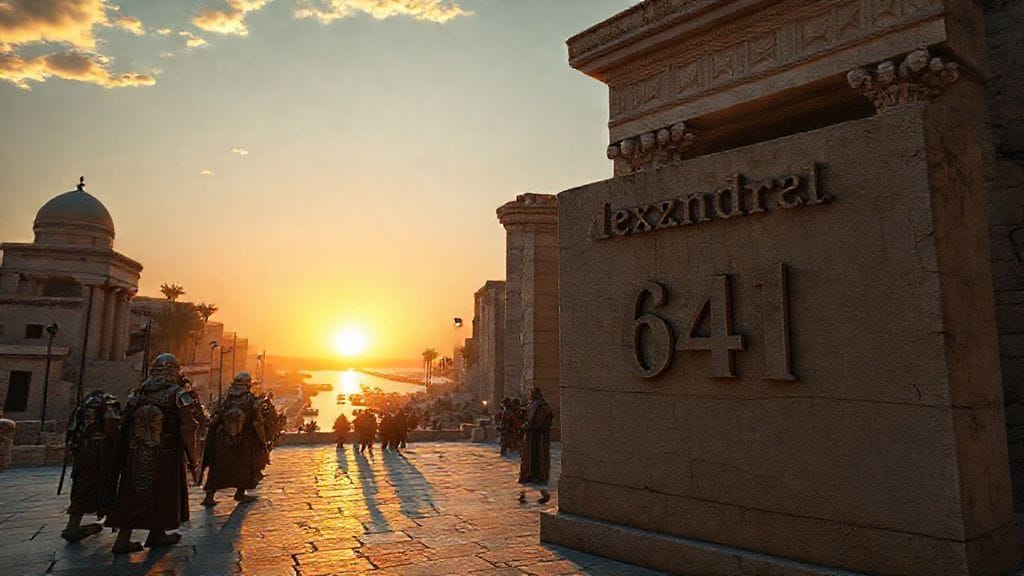
It was a Mediterranean jewel, a city that had stood proudly for centuries — Alexandria, a bastion of Hellenistic splendor, renowned for its legendary lighthouse and the august halls of the Great Library now faded to myth. By the year 641, the city’s towering walls, layered with history and defense, faced an unprecedented threat. From the east, the Rashidun Caliphate’s forces under the resolute command of Amr ibn al-As advanced, driven by conviction, faith, and political aspiration. The air hung heavy with anticipation and dread, as whispers of an impending siege stirred the markets and echoed through the narrow streets. This moment was not just a military confrontation; it was the crossroads of civilizations, the pivot between ancient legacies and the dawn of a new order.
The siege of Alexandria was more than a battle for territory. It was a clash of empires—and more poignantly—a collision of ideas, faiths, and futures. As the sun rose over the Mediterranean on that fateful day, the tides of history swelled to engulf this city of contrasts, culture, and contested destinies.
A World in Flux: The Mediterranean in the Early 7th Century
The 7th century Mediterranean was a mosaic of crumbling empires and emergent forces. The Roman Empire’s eastern remnant, the Byzantine Empire, struggled to preserve its ancient domains. Its hold over Egypt, one of its richest provinces, was precarious, battered by decades of warfare, plague, internal dissent, and religious schisms dividing Chalcedonian Christians and Monophysites alike.
To the south and east, the Arabian Peninsula simmered with transformations of its own. The newfound unity of Arab tribes under Islam heralded the rise of a force that would soon ripple across continents. Within a brief generation after Prophet Muhammad’s death in 632 CE, the Rashidun Caliphate emerged, rapidly pushing its frontiers from the Arabian heartlands toward the fertile lands of Egypt.
This era was one of transitions—of empire giving way to empire, of religious and cultural tides sweeping over enduring cities and landscapes. The fate of Alexandria, a city that embodied the classical world’s intellectual and commercial might, thus became a symbol of these much larger historical upheavals.
The Rashidun Caliphate’s Expansion: Ambition and Faith
The Rashidun Caliphate’s expansion was no mere territorial conquest. It was imbued with a profound zeal for spreading the message of Islam, yet also grounded in pragmatic considerations of governance and survival. Under Caliph Umar ibn al-Khattab, the consolidation of conquests and strategic incursions into Byzantine and Persian territories became imperative to securing the fledgling Islamic state's borders.
Amr ibn al-As, a brilliant yet sometimes controversial commander, was entrusted to lead the campaign into Egypt. His mission combined military genius with diplomatic tact—aiming to win not just battles but also hearts and minds. The campaign was designed not only to wrest control from the Byzantines but also to establish a new social and religious order that promised stability amidst upheaval.
Egypt Before the Siege: Byzantine Bastion and Strategic Prize
Egypt was the jewel of the Byzantine Empire’s African holdings, a vital granary that fed Constantinople with grain and a key axis controlling Mediterranean maritime routes. Alexandria, its centerpiece, was a densely populated metropolis with an economically diverse population—Greek-speaking Christians, Coptic Egyptians, Jews, merchants, and bureaucrats.
Byzantine control in Egypt was however weakening. The empire’s forces were worn thin after decades of conflict with Sassanid Persia and internal religious disputes that fractured loyalties. The governor Cyrus, an ambitious and ruthless administrator, had brutally suppressed dissent, particularly among the Coptic Christians, leaving the province vulnerable to external pressure and internal fractures.
The Calm before the Storm: Political and Military Tensions in Alexandria
As Rashidun forces approached, Alexandria was a city bracing for war yet divided on how to respond. The Byzantine military presence, though formidable, was stretched and partly demoralized. The city's fortifications, while imposing, were aged and in need of reinforcement.
Religious divisions further complicated the city’s defense. Many Coptic Christians viewed the Arab Muslim invaders less as enemies than potential liberators from Byzantine oppression. This fracturing of civic unity created a complex and volatile atmosphere as squadrons assembled for the inevitable siege.
Amr ibn al-As: The Commander with a Vision
Amr ibn al-As was a man whose name resonates throughout Islamic and Egyptian history. Known for his tactical brilliance and diplomatic acumen, Amr’s leadership was pivotal to the campaign’s success.
He understood that Alexandria was not just a city to be seized by force but a prize demanding negotiation and political subtlety. His approach combined relentless military pressure with offers of religious tolerance and protection for the conquered peoples—a strategy that would become a hallmark of Islamic conquests.
Alexandria’s Defenses: Walls, Garrison, and the Will to Resist
Alexandria’s walls were formidable—massive stone constructions that had withstood centuries of siege and storm. The Byzantine garrison was sizeable but under-resourced, commanded by Manuel, a general loyal to Byzantium but stretched thin by the larger strategic context.
The city's defenders included local militia and settlers, determined to protect their homes but weary from years of conflict and administrative neglect. The city’s strategic harbor was also a crucial asset, allowing for potential resupply and naval defense—though Byzantine naval power was waning.
The Landing: Rashidun Forces Arrive on Egyptian Shores
In earnest, the Rashidun forces landed on the Egyptian coast near Babylon Fortress, a strategic stronghold guarding the approach to Alexandria. The initial amphibious maneuvers displayed remarkable coordination, unfolding under the keen eyes of Amr and his officers.
The landing was met with cautious resistance, but the Rashidun forces, skilled in desert warfare and battle hardened, managed to establish a beachhead. This was a critical step, as securing a foothold was essential for the prolonged siege that would follow.
The Siege Begins: Strategy, Skirmishes, and Psychological Warfare
The siege was not a mere artillery bombardment or sudden assault; it was a protracted contest of wills. Amr’s forces encircled the city, cutting off supply routes and using a combination of direct attacks and strategic blockade.
Skirmishes flared along the walls as defenders attempted sorties. Psychological tactics—rumors sown to exploit religious tensions, offers of clemency, and displays of Rashidun resolve—played as much a role as sword and arrow. The city’s inhabitants lived each day under mounting pressure and uncertainty.
A City Caught Between Empires and Faiths
Within Alexandria, the siege illuminated the city's complex social fabric. Christians of the Chalcedonian and Coptic denominations viewed the invaders through different lenses, and the Jewish community, long established yet often marginalized, weighed its options cautiously.
This intricate matrix of loyalties meant the siege was as much a battle for hearts as for walls. Amr’s promises of religious tolerance and protection of churches aimed to fracture Byzantine unity and encourage surrender without needless bloodshed.
The Role of the Alexandrian Population: Christians, Jews, and Others
The population’s response was varied and layered. Many Copts suffered under Byzantine policies that favored Greek Orthodoxy, making the Rashidun forces’ promises appealing to some. Jews, meanwhile, found themselves in a liminal position—historically ostracized by Byzantine rulers yet often mistrusted by Muslims as well.
Desertion and collaboration with the Rashidun forces occurred, further weakening the city’s defense. Yet, pockets of resistance remained fiercely loyal to Byzantium, committed to preserving the city’s Christian identity and Byzantine heritage.
The Turning Point: Breaching the Walls
After weeks of siege, Rashidun engineers, alongside troops, exploited weaknesses in Alexandria’s defenses. Using ladders, siege towers, and perhaps insider assistance, the attackers breached key sections of the walls.
The fall of the outer defenses precipitated chaotic street battles. The Byzantines fought with desperate valor, but the strategic and numerical advantages of the Rashidun forces proved overwhelming.
The Fall of Alexandria: Chaos, Negotiations, and Surrender
As the city’s fall became imminent, negotiations ensued. The Byzantine leadership faced a grim calculus—fight to the last man or capitulate under terms that allowed the city’s inhabitants to survive and maintain their properties and faith.
Amr ibn al-As brokered terms that safeguarded religious freedoms, established a system of tribute (jizya), and promised limited autonomy under Rashidun rule. The peaceful surrender avoided the destructive sackings typical of conquests, preserving much of Alexandria’s infrastructure and population.
Amr’s Conquest: Integration, Administration, and Religious Tolerance
After victory, Amr set about integrating Alexandria into the rapidly expanding Rashidun Caliphate’s administration. A pragmatic leader, he allowed Christians and Jews to practice their religions freely in exchange for paying the jizya tax, embedding a policy of coexistence that would define Islamic rule in Egypt.
He reestablished trade links, repaired damages, and encouraged public order, laying foundations for the city’s transformation throughout the Islamic era.
The Aftermath: Egypt under the Rashidun Caliphate
Alexandria’s capture marked the completion of the Rashidun conquest of Egypt, shifting centuries-old power dynamics. Egypt ceased to be a Byzantine province and became a vital part of the Islamic world, bringing a new political order and cultural synthesis.
The transition wasn’t without its challenges—economic reorganization, population shifts, and religious adaptations unfolded over decades—but the siege’s conclusion set Egypt on an enduring path toward Islamic civilization.
The Wider Impact: Alexandria’s Fall and the Shifting Mediterranean Balance
The loss of Alexandria was a crippling blow to Byzantine prestige and power in the Mediterranean. It marked the beginning of the empire’s irreversible retreat from North Africa and underscored the rising tide of Islamic dominance, which would one day span from Spain to India.
Byzantium redirected its policies, focusing on defending Anatolia and the Balkans, while the Islamic Caliphate leveraged control of Egypt to expand further into North Africa and consolidate control over the Red Sea and Mediterranean trade routes.
Cultural and Economic Consequences: Alexandria’s Transformation
Alexandria’s economy adapted to the new rulers’ networks and legal frameworks. Trade flourished under the Caliphate, linking Egypt with Arabian, African, and Mediterranean markets. Cultural life transformed too—Arabic increasingly became the language of administration and scholarship, religious institutions evolved, and new architectural styles took root.
Though some ancient institutions declined, Alexandria remained a vital Mediterranean hub, blending its Greco-Roman heritage with new Islamic influences.
Legacy and Memory: How the City’s Capture Reshaped History
The capture of Alexandria in 641 resonates as a seminal moment. It epitomizes the spread of Islam beyond Arabia, the decline of Byzantine influence, and the complex interplay of war, religion, and culture.
For centuries, the siege shaped narratives in Christian and Muslim historiographies alike, symbolizing both loss and renewal. Alexandria’s Hebrew, Christian, and Muslim communities continued to weave their histories into a rich, if sometimes contested, tapestry—one still visible today in Egypt’s layered identity.
Conclusion: From Siege to Synthesis – The Dawn of a New Egypt
The capture of Alexandria was far more than a military triumph; it was the threshold of transformation. In the fall of its walls, the city entered a new chapter—one where empires clashed but also forged coexistence, where ancient stones bore witness to the birth of new cultural landscapes, and where the Mediterranean’s shimmering tides carried the echoes of revolution and continuity alike.
This event speaks not only to the mechanics of conquest but also to the tenacity of human societies, their capacity for adaptation, and the bittersweet nature of historical change. Alexandria’s fate in 641 was a beginning as much as an end, a story of resilience that still captivates the imagination.
FAQs
Q1: What triggered the Rashidun Caliphate’s campaign against Alexandria?
A1: The Rashidun Caliphate sought to consolidate and expand its territories after uniting Arabia under Islam, capitalizing on Byzantine weaknesses in Egypt, which included internal strife, religious conflict, and military overstretch.
Q2: Who was Amr ibn al-As and what role did he play?
A2: Amr ibn al-As was the commander of the Rashidun forces in Egypt. His leadership, combining military acumen and political diplomacy, was crucial in the successful siege and subsequent administration of Alexandria.
Q3: How did the city’s multi-religious population affect the siege?
A3: Religious divisions within Alexandria—between Chalcedonian Christians, Coptic Christians, and Jews—complicated defense efforts. The Rashidun offer of religious tolerance created divisions that undermined Byzantine unity and contributed to the city’s surrender.
Q4: Were there significant casualties during the siege?
A4: While detailed casualty figures are scarce, historical accounts suggest that the siege, after weeks of blockade and fighting, ended with negotiated surrender, avoiding large-scale slaughter typically associated with stormed cities.
Q5: What were the terms of Alexandria’s surrender?
A5: Terms included recognition of Rashidun political authority, payment of the jizya (tribute), and guarantees of religious freedom and protection of property for non-Muslims.
Q6: How did Alexandria’s fall affect Byzantine control of the Mediterranean?
A6: It marked a major blow to Byzantine power in North Africa, signaling the loss of a strategic and economic stronghold and accelerating the empire’s contraction in the region.
Q7: Did Alexandria retain its importance under Rashidun rule?
A7: Yes, Alexandria remained a key Mediterranean port and commercial hub, adapting its cultural and economic life under new rulers while continuing its historical legacy.
Q8: How is this event remembered today?
A8: The siege symbolizes the dawn of Islamic Egypt and the complex history of cultural and religious coexistence, interpreted variously in Muslim, Christian, and secular narratives.