Table of Contents
- Dawn Over the Euphrates: A Nation Divided
- The Death of Uthman and the Rise of Ali
- Muʿawiya: Ambition by the River
- The Seeds of Conflict: Political Fractures and Tribal Loyalties
- The March to Siffin: Armies Gather on the Desert Horizon
- The Battlefield Unfolds: Clashing Swords and Silent Prayers
- The Duel of Wills: Ali and Muʿawiya in the Heat of Battle
- The Turning Point: The Mysterious Proposal of the Quran Arbitration
- The Halt of Swords: From War to Debate
- The Arbitration: Between Hope and Betrayal
- After the Battle: The Fracturing of the Muslim Ummah
- The Emergence of the Kharijites: Voices from the Margins
- The Battle’s Political Fallout: From Unity to Civil War
- Memory and Myth: How Siffin Echoes Through Islamic History
- Lessons on Leadership and Legitimacy from the Euphrates Conflict
- The Battle of Siffin in Contemporary Thought
- Conclusion: The Battle That Changed Islam Forever
- FAQs: Common Questions on the Battle of Siffin
- External Resource: Explore More on Wikipedia
- Internal Link: Visit History Sphere
1. Dawn Over the Euphrates: A Nation Divided
The morning mist curled like a silver veil over the banks of the Euphrates River in Syria, blending seamlessly with the dry heat that soon would swallow the landscape whole. Under that rising sun in July 657 CE, thousands of men stood ready, their faces set with a fierce determination fueled by faith, honor, and the bitter scars of betrayal. The Battle of Siffin was about to begin—not merely a clash of armies, but a collision of ideas, loyalties, and the very soul of the Islamic community barely two decades after the Prophet Muhammad’s passing.
For many who watched from the arid hillsides, the approaching storm was unthinkable. How had the Ummah, once united by revelation and hope, found itself on the precipice of civil war? This was the great schism, the first significant rupture that would reverberate through centuries of Muslim history—between Caliph Ali ibn Abi Talib, the cousin and son-in-law of the Prophet, and Muʿawiya ibn Abi Sufyan, the powerful governor of Syria. At Siffin, on the banks of the great river, men’s swords and words would decide the fate of empires.
2. The Death of Uthman and the Rise of Ali
The story begins with the violent death of the third caliph, Uthman ibn Affan, in 656 CE. Uthman’s assassination by disgruntled rebels, embroiled in accusations of nepotism and mismanagement, plunged the nascent Muslim state into chaos. Amidst chaos, Ali ibn Abi Talib, cousin and closest companion of Muhammad, was called upon to lead as the fourth caliph.
But Ali’s authority was fragile. While he was accepted in Medina and among many Muslims as the rightful leader, opposition brewed, especially from the powerful Syrians who resented the shift of power away from the Umayyad clan and the growing influence of the newcomers.
Muʿawiya, Uthman’s kinsman and Syria's formidable governor, refused to acknowledge Ali’s caliphate until the killers of Uthman were brought to justice. What started as a call for vengeance swelled into outright rebellion.
3. Muʿawiya: Ambition by the River
Muʿawiya’s leadership was a study in political finesse. Son of Abu Sufyan—a staunch rival of Muhammad's mission before embracing Islam—he had inherited a position steeped in the ancient rivalries of the Quraysh tribe. His rule over Syria was consolidated by a solid military and administrative machine, and the people of Syria viewed him with loyalty born of shared tribal and regional identity.
Far from the spiritual heart of Medina, Muʿawiya’s pragmatic, sometimes ruthless, tactics turned Syria into the power base that challenged Ali. His rejection of Ali’s caliphate was no mere plea for justice—it was a bid for power wrapped in religious legitimacy.
4. The Seeds of Conflict: Political Fractures and Tribal Loyalties
As tensions simmered, one must understand the patchwork complexity of the early Muslim community. The unity that Muhammad forged was fragile in the absence of an uncontested leadership. Tribal affiliations often took precedence over religious unity.
Medina, the cradle of Islam and Ali’s stronghold, contrasted with the distant Syrian province, where Muʿawiya ruled with a quasi-independent authority. The Umayyad family represented the old Quraysh elite. Ali symbolized a return to the prophet’s closest kin.
The unresolved issue of Uthman’s murder became a potent symbol—not just of justice, but of power and legitimacy. Allegiances hardened; hopes for reconciliation faded.
5. The March to Siffin: Armies Gather on the Desert Horizon
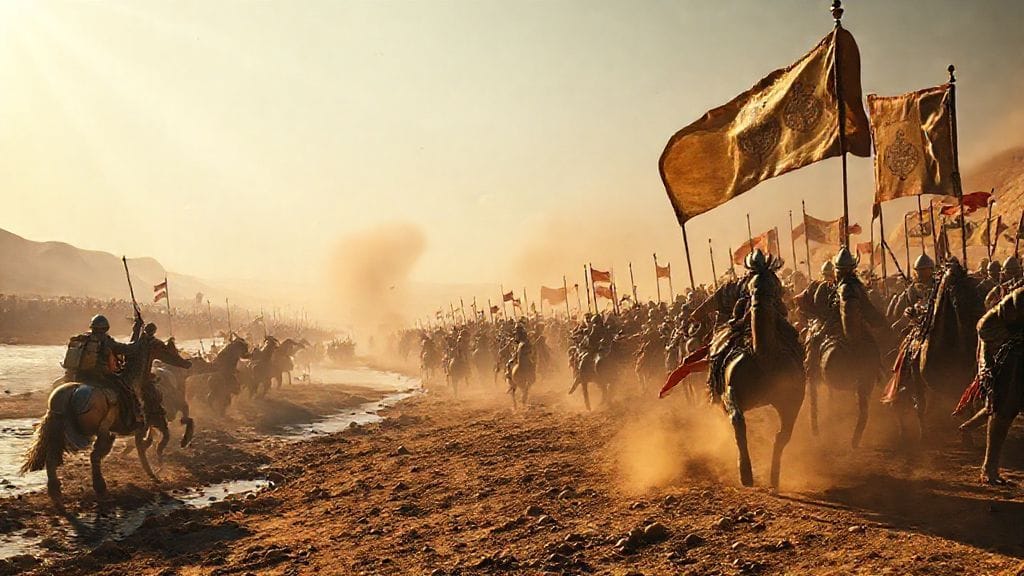
By mid-657 CE, two great forces marched toward the desert plains by the Euphrates near the town of Siffin. Ali’s army, composed mainly of enthusiastic supporters from Iraq and Medina, was smaller but known for their unwavering loyalty and deep conviction.
Opposite them stood Muʿawiya’s larger and better-equipped forces, veterans of the campaigns and seasoned Syrians. They encamped strategically along the flood plains, their banners fluttering in the oppressive heat.
This was more than a military standoff. It was a silent contest of wills, faiths, and political philosophies.
6. The Battlefield Unfolds: Clashing Swords and Silent Prayers
When battle finally broke out, it was a cacophony of clashing steel, thunderous hooves, and anguished cries. Early skirmishes saw brutal exchanges, with high casualties on both sides. The fighting dragged on for days, exhausting men and horses alike beneath the unrelenting Syrian sun.
Yet amid the violence, there were moments of humanity. Warriors on both sides saw former friends and tribesmen in the enemy ranks, turning the conflict from a simple war into an agonizing confrontation of brothers.
7. The Duel of Wills: Ali and Muʿawiya in the Heat of Battle
About midway through the conflict, Ali and Muʿawiya embodied more than mere commanders; they were living symbols of opposing visions for Islam.
Ali, known for his justice, piety, and courage, stood firm in his desire to unite the community under legitimate leadership. Muʿawiya’s tact and persistence reflected a more pragmatic philosophy, emphasizing order and dynasty.
Each side marshaled not only swords but words to inspire followers. Their speeches reflected control, hope, and resolve—the human drama unfolding behind the thunder of war.
8. The Turning Point: The Mysterious Proposal of the Quran Arbitration
Just as the battle seemed destined to continue indefinitely, a surprising development emerged. Muʿawiya’s forces, cornered and desperate, hoisted copies of the Quran on their spear shafts, calling for arbitration based on the sacred text.
In a moment fraught with symbolism, enemy soldiers appealed not to power, but to faith. Ali, a man deeply devoted to the Quran, was caught between honor and pragmatism.
The proposal sent ripples through the battlefield, halting the deadly clash. Soldiers who moments before had fought with fury now whispered prayers, caught in the quiet storm of uncertainty.
9. The Halt of Swords: From War to Debate
The decision to accept arbitration was both a relief and a point of contention. Ceasefires rarely bring comfort in civil war, particularly when the wounds are fresh.
Ali agreed, seeking to avoid more bloodshed and hoping the arbitration might heal rifts. Muʿawiya embraced the chance to delay defeat and shake Ali’s moral authority.
It was a battle paused—but the war for the soul of the caliphate was far from over.
10. The Arbitration: Between Hope and Betrayal
Representatives from both camps convened to arbitrate the leadership dispute. But the arbitration became mired in politics, ambitions, and betrayals.
Ali’s camp expected justice and recognition, but Muʿawiya’s maneuvering eroded trust. Supporters accused the arbitrators of bias and duplicity, deepening fractures.
The episode disillusioned many, convincing some that true justice would never emerge from human judgment. This fracturing paved the way for splinter groups and renewed conflict.
11. After the Battle: The Fracturing of the Muslim Ummah
The Battle of Siffin marked the beginning of the Fitna, the first Islamic civil war. The Ummah, once united under the Prophet’s banner, found itself divided irreparably, its people caught between competing claims.
Ali’s authority weakened, his supporters diminished, and dissatisfaction festered. Muʿawiya maintained control of Syria, setting the stage for dynastic rule.
In the chaos, warriors disillusioned by arbitration splintered off, marking the rise of the Kharijites—extremists with radical notions of leadership and piety.
12. The Emergence of the Kharijites: Voices from the Margins
The Kharijites arose from the ashes of Siffin’s failed arbitration, rejecting both Ali and Muʿawiya. Their uncompromising doctrine declared anyone guilty of sin or error unfit to rule.
Their violent purges and assassination attempts destabilized the region further, amplifying the turmoil sparked by the battle.
Though often condemned by mainstream Islam, their radical purity shaped later movements and ideologies.
13. The Battle’s Political Fallout: From Unity to Civil War
Siffin did not end with a conclusive victor on the field, but it was decisive in plunging the Muslim world into a prolonged struggle.
Ali’s position eroded, and Muʿawiya’s power solidified, heralding the dawn of the Umayyad Caliphate. This shift from elective leadership toward dynastic control forever altered Islamic governance.
The schism birthed the Sunni-Shia divide, with lasting theological and political consequences.
14. Memory and Myth: How Siffin Echoes Through Islamic History
Generations later, the Battle of Siffin is not merely a historical event, but a rich source of identity and memory.
In Shia narratives, Ali is the rightful imam betrayed by a flawed arbitration; in Sunni accounts, Muʿawiya’s pragmatism and statecraft are emphasized.
The battle’s lessons continue to resonate in theological debates, political discourse, and cultural stories across the Muslim world.
15. Lessons on Leadership and Legitimacy from the Euphrates Conflict
Siffin forces historians and readers to confront enduring questions: What defines legitimate leadership? How do faith and power intertwine?
The battle illustrates the dangers of factionalism and the complexity of governing a diverse religious polity.
Ali and Muʿawiya embody divergent approaches—principled idealism versus pragmatic authority—both with their virtues and fatal flaws.
16. The Battle of Siffin in Contemporary Thought
Modern scholars analyze Siffin as more than just an ancient conflict—it reflects universal challenges of governance, religious interpretation, and civil conflict.
In contemporary geopolitics, references to Siffin invoke issues of justice, rebellion, and legitimacy in Muslim societies.
The battle remains a potent symbol for movements seeking moral authority as well as political power.
17. Conclusion: The Battle That Changed Islam Forever
The sun set on Siffin not with a victorious shout, but a heavy, uncertain silence. The Euphrates carried the echoes of clashing blades and broken dreams downriver, where they mingled with history.
More than a military encounter, the battle was a crucible in which the Muslim Ummah’s future was forged—marked by division but also resilience.
Ali and Muʿawiya, two men tied by faith and blood yet separated by conviction, set a course whose winds still guide the unfolding story of Islam today.
In their story, we see reflected the eternal human struggle to balance justice, power, and faith.
FAQs
Q1: What was the main cause of the Battle of Siffin?
The primary cause was the political and religious dispute following Caliph Uthman’s assassination. Muʿawiya demanded justice before recognizing Ali’s caliphate, which Ali refused to concede, leading to armed conflict.
Q2: Who were Ali and Muʿawiya?
Ali was the fourth caliph, cousin and son-in-law of Prophet Muhammad, revered for his piety and justice. Muʿawiya was the Umayyad governor of Syria, known for his astute leadership and ambition.
Q3: Why was the arbitration after the battle controversial?
The arbitration was intended as a peaceful resolution but became politicized and divisive. Many of Ali’s supporters felt betrayed, believing the process favored Muʿawiya’s interests.
Q4: What were the Kharijites and how did they emerge?
The Kharijites were a radical faction that split from Ali’s forces after the arbitration, rejecting both leaders as illegitimate. They advocated strict religious purity and used violence against those they opposed.
Q5: How did the Battle of Siffin influence Islamic history?
It deepened political divisions, leading to the first Islamic civil war, the Umayyad dynasty’s rise, and the Sunni-Shia split, reshaping political and religious landscapes.
Q6: Is the Battle of Siffin still remembered today?
Yes, the battle is a significant symbol in Islamic thought, history, and sectarian memory, continuing to influence religious identity and political discourse.
Q7: What lessons does the battle offer about leadership?
It highlights the tension between idealism and pragmatism, the challenge of maintaining justice in governance, and the costs of political division.
Q8: Where did the battle take place?
Near the town of Siffin, on the banks of the Euphrates River in present-day Syria.

