Table of Contents
- The Dawn of a New Maritime Power: Setting the Stage for the Battle of the Masts
- Byzantium and the Arab World in the Mid-7th Century: An Uneasy Coexistence
- The Rise of the Rashidun Caliphate and Its Naval Ambitions
- Lycia’s Strategic Shores: Why the Mediterranean Became a Battleground
- Building the Fleets: Clash of Naval Technologies and Tactics
- The Day of Reckoning: The Battle Unfolds off the Coast of Lycia
- Commanders and Heroes: Profiles of Key Figures
- The Turning Tides: From Skirmishes to Decisive Actions
- Maneuvers and Mayhem: The Art of Mediterranean Naval Warfare
- The Sinking of the Byzantine Armada: Catastrophe and Chaos
- Aftermath on the Waves: Immediate Consequences for Byzantium
- The Arab Victory’s Ripple Effect Across the Mediterranean World
- The Battle’s Impact on Maritime Trade and Regional Power
- Memories Engraved in Stone and Text: Historical Narratives of the Battle
- Revisiting the Legacy: How the Battle Shaped Future Christian-Muslim Conflicts
- The Symbolism of the Battle: From Military Triumph to Cultural Milestone
- Echoes in Later Naval Engagements: Lessons Learned and Lost
- Political Intrigue and the Changing Balance of Power in the Mediterranean
- Naval Engineering and Innovations Stemming from the Battle
- The Battle in Popular Memory: Myths, Legends, and Historiography
- The Battle of the Masts and the Expansion of Islamic Naval Dominance
- Conclusion: A Watershed Moment in Mediterranean History
- FAQs: Unraveling the Mystery of the Battle of the Masts
- External Resource
- Internal Link
1. The Dawn of a New Maritime Power: Setting the Stage for the Battle of the Masts
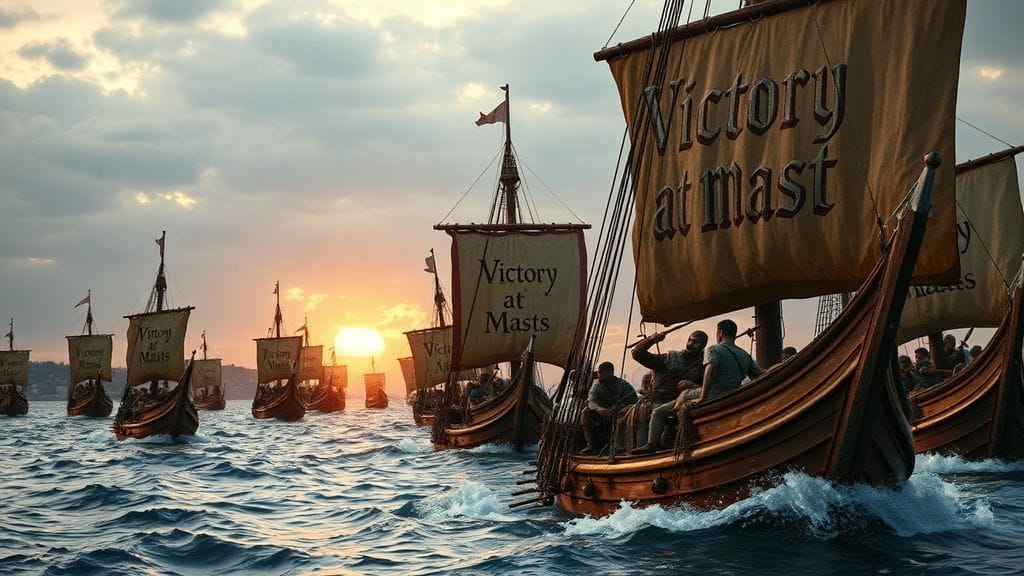
The year was 655 CE. Under the fiery Mediterranean sun, the waters off the coast of Lycia simmered with the pulse of an ancient conflict—a battle not only for control of the waves, but also for the soul of a region teetering on the verge of transformation. The horizon was dotted with the imposing silhouettes of warships, their sails taut and flags fluttering like war cries. Two mighty fleets faced each other: the tried-and-true naval armada of the Byzantine Empire and the emerging, boldly ambitious Arab fleet of the Rashidun Caliphate.
This confrontation, later immortalized as the Battle of the Masts (or Battle of Phoenix), was more than just a contest of ships; it was the crucible where centuries-old dominance met rising tides of change. For centuries, Byzantium had ruled the Mediterranean seas, but the sea was shifting—both literally and figuratively—toward a new power that challenged the Greek-speaking empire's unquestioned reign.
The battle enveloped the sea in chaos, cries, and smoke. It was a moment when the Mediterranean could have been different, when history could have shifted course, and, at last, it did.
2. Byzantium and the Arab World in the Mid-7th Century: An Uneasy Coexistence
By the mid-7th century, the Byzantine Empire was both a survivor and a remnant of the once-mighty Roman world. Despite its grandeur, the empire was beleaguered: territorial losses, religious schisms, and constant pressure from various enemies gnawed at its core. In the East, a new power surged—the Arab forces united under Islam had swept across the deserts, toppling the Sassanian Empire and carving into Byzantine provinces.
The rapid expansion of the Arab armies created a strategic dilemma for Byzantium. Traditionally a land power bolstered by formidable fleets, the empire now confronted an enemy adept at combining land conquest with nascent naval strategy. For Byzantium, whose prosperity depended on controlling Mediterranean trade routes, the stakes were enormous.
Tensions simmered: The Arabs began to attack coastal outposts and harbors with increasing boldness. The Mediterranean was no longer only a Byzantine lake—it was becoming contested waters, fraught with political and religious implications.
3. The Rise of the Rashidun Caliphate and Its Naval Ambitions
The Rashidun Caliphate, led first by Abu Bakr, and then by Umar ibn al-Khattab, had crafted an empire at lightning speed, profoundly changing the political map of the Middle East. While their initial victories gained vast tracts of land, control of the seas became the next frontier—a daunting task since Arab tribes were primarily desert dwellers with no strong naval tradition.
Yet, the caliphate understood the significance of the Mediterranean’s waters—trade routes, military corridors, and cultural exchange arteries. They began assembling a fleet, recruiting sailors from conquered coastal regions such as Egypt and parts of North Africa, and integrating their maritime knowledge.
This investment in naval power reflected an ambitious vision: not simply to raid but to secure lasting control of the Mediterranean littoral. The Arab fleet’s expansion was unprecedented for its time and, critically, it posed a new threat to the Byzantine maritime monopoly.
4. Lycia’s Strategic Shores: Why the Mediterranean Became a Battleground
Lycia, a rugged and scenic region along the southwestern coast of modern Turkey, was no accidental choice for the battle. Situated near key sea lanes, Lycia had long served as a maritime crossroads, its bays frequented by merchants and warships alike.
The proximity of Lycia to the Byzantine heartland and the paths of Arab raiders made it an ideal location for confrontation. Control of this coastal stretch meant influence over shipping lanes that fed into the vital ports of Constantinople and Alexandria.
Moreover, the deep harbors and steep cliffs of Lycia offered tactical advantages and challenges. For commanders accustomed to the Mediterranean’s open waters, engaging here required skill, courage, and innovation.
5. Building the Fleets: Clash of Naval Technologies and Tactics
When the two fleets faced off, they represented two different, yet equally determined maritime cultures. Byzantine naval power was anchored in traditions dating back to Rome, enriched by centuries of refinement. Their flagship asset was the dromon—a fast, maneuverable galley equipped with siphons that could spray the devastating incendiary substance known as Greek fire. This weapon, a state secret, filled the Byzantines with confidence.
The Arab fleet, however, was forging its own way. Drawing on the experiences of their newfound Mediterranean sailors and captured shipyards, they constructed galleys capable of matching the speed and agility of their adversaries. Their tactics leaned heavily on mass boarding actions, leveraging the fierce warrior spirit of their crews.
Technological nuances, ship design, and tactical doctrines were on full display. It was as if two worlds collided on the waves—Greek-engineered innovation against the energetic impetus of an emerging power.
6. The Day of Reckoning: The Battle Unfolds off the Coast of Lycia
Under a brooding sky pierced by summer sun, both fleets maneuvered towards each other. The sound of drums, shouted orders, and the clatter of rigging broke the ocean's stillness. The two armadas, numbering around 200 ships combined, closed in, preparing for one of the most decisive nautical confrontations of the era.
According to historical accounts by chroniclers such as Theophanes the Confessor, the Byzantines aimed to leverage their superior naval weaponry, especially Greek fire, while the Arabs pressed aggressively to board enemy vessels and fight hand-to-hand.
The battle was brutal, with ships locking side by side, warriors clashing with swords and spears, and fire and smoke filling the air. The Byzantines initially resisted fiercely, but the Arabs’ relentless boarding techniques and the sheer momentum of their fleet began to turn the tide.
7. Commanders and Heroes: Profiles of Key Figures
Two commanders rose to prominence in this clash. Emperor Constans II himself is said to have been present, commanding the Byzantine fleet with imperial gravitas. His leadership symbolized Byzantium’s desperate resolve.
Opposing him was the Arab admiral Abu al-A‘war, a seasoned commander who embodied the caliphate’s burgeoning naval expertise. Abu al-A‘war’s ability to coordinate a relatively young fleet and transform it into a fighting force capable of defeating Byzantium was legendary.
Their confrontation was as much about personality and leadership as about ships and weapons—each man a reflection of their distinct civilizations: one anchored in long tradition, the other fueled by dynamic expansion.
8. The Turning Tides: From Skirmishes to Decisive Actions
The battle moved from cautious maneuvers to fierce engagements. The deployment of Greek fire initially threatened to decimate the Arab ships, yet the Arabs adapted quickly. Some sources suggest they used wet sails or tar-soaked hides to resist the flames, while their ferocious boarding overwhelmed the Byzantine crews.
The fighting turned into a desperate melee, where ship captains and their men fought not from afar, but locked together in brutal hand-to-hand combat. The calm Mediterranean waters became a slaughterhouse, stained crimson with blood.
Slowly but surely, the Byzantine lines began to crumble; their ships were rammed, set ablaze, or sunk beneath the tireless assaults. The Arabs pressed their advantage, consolidating a victory that many did not see coming.
9. Maneuvers and Mayhem: The Art of Mediterranean Naval Warfare
This battle illustrated the complexities of pre-modern naval battles, where sheer numbers, technology, and tactics meshed unpredictably. Mediterranean naval warfare demanded not just superior ships but coordination, timing, and morale.
In the constrained waters near Lycia’s coast, the ability to control boarding, fire damage, and crew stamina proved critical. The Arabs’ transformation from land-based warriors to skilled mariners was on full display, reshaping the notion of Mediterranean power.
It was a lesson on adaptation and innovation amid the ever-shifting currents of military art.
10. The Sinking of the Byzantine Armada: Catastrophe and Chaos
By sunset, the Byzantine fleet lay shattered, more than half its ships sunk or captured. Thousands perished or were taken prisoner—a catastrophic blow to the empire’s naval strength. Emperor Constans II purportedly barely escaped with his life.
This defeat was not only a military loss; it was a psychological shock to an empire that had long viewed itself as invincible on the seas. The “Battle of the Masts” thus entered history as a testament to the fragile balance of power and the risks inherent in complacency.
11. Aftermath on the Waves: Immediate Consequences for Byzantium
The destruction of the Byzantine fleet left the empire dangerously exposed along its southern coasts. Arab raids escalated, spreading fear and instability throughout the Mediterranean basin.
Constantinople’s control over maritime trade routes weakened, while coastal cities reconsidered their defenses against this now-dominant naval force.
Though Byzantium survived, its aura of invulnerability had been punctured, inviting renewed challenges from both external enemies and internal dissent.
12. The Arab Victory’s Ripple Effect Across the Mediterranean World
Across the Mediterranean, the Arab victory signaled the dawn of a new power dynamic. North Africa, already under Arab control, now became a springboard for further naval expeditions.
Christian ports from Alexandria to Sicily worried about their security; alliances shifted, and new diplomatic efforts took shape.
This shift marked an acceleration in the intertwined religious, political, and cultural conflicts that would simmer and sometimes boil over for centuries.
13. The Battle’s Impact on Maritime Trade and Regional Power
Control of the sea lanes meant control of wealth. Following the battle, Arab merchants and pirates alike navigated the Mediterranean with greater freedom, disrupting Byzantine trade.
New trade routes developed favoring Muslim-controlled ports, impacting the Mediterranean’s economic map.
Consequently, the Battle of the Masts stood as a pivot point in the evolution of Mediterranean commerce, tying into broader patterns of Islamic expansion and Christian resilience.
14. Memories Engraved in Stone and Text: Historical Narratives of the Battle
The battle was recorded by Byzantine historians such as Theophanes and chronicled in Arab sources, each attributing different layers of meaning and heroism.
For Byzantines, it was a tragic defeat, a sobering lesson on the limits of their might. For Arabs, it was a glorious testament to faith-driven expansion and naval ingenuity.
Monuments and texts preserved the story, though often shrouded in myth and legend—illustrating how history and memory entwined.
15. Revisiting the Legacy: How the Battle Shaped Future Christian-Muslim Conflicts
The Battle of the Masts became a precursor to centuries of maritime struggle between Christian and Muslim powers—a struggle that spanned the Crusades, naval raids, and rival empires.
It cemented the Mediterranean not just as a strategic theater but as a cultural and religious fault line.
Understanding this battle enriches our grasp of medieval geopolitics and the enduring complexities of the region.
16. The Symbolism of the Battle: From Military Triumph to Cultural Milestone
More than military hardware or tactics, the victory symbolized the legitimacy and resilience of the Rashidun Caliphate.
It was a defining moment when the imperial sea gods of Byzantium seemed to lose their grip, passing the torch to a new, vibrant civilization.
This symbolism fueled pride and identity among Muslims and injected urgency into Byzantine reforms.
17. Echoes in Later Naval Engagements: Lessons Learned and Lost
Byzantine naval strategies underwent revision, seeking to rebuild fleets and devise countermeasures against Arab tactics.
The battle influenced future engagements across the Mediterranean, from the Reconquista to Ottoman expansion.
Yet, the ultimate lessons of adaptability and coordination remain timeless.
18. Political Intrigue and the Changing Balance of Power in the Mediterranean
The defeat intensified internal Byzantine political turmoil, as military failures sparked debates over leadership and policy.
Meanwhile, the Arab victory emboldened caliphal ambitions.
Mediterranean diplomacy became a precarious dance, weaving alliances and rivalries into a complex tapestry.
19. Naval Engineering and Innovations Stemming from the Battle
In the aftermath, both sides intensified naval innovation. Byzantine craftsmen refined Greek fire delivery; Arabs improved shipbuilding techniques.
These technological arms races shaped maritime warfare for decades.
Such innovations reflect how conflict becomes a catalyst for technological progress.
20. The Battle in Popular Memory: Myths, Legends, and Historiography
Stories circulated of heroic last stands, divine interventions, and sea monsters lurking beneath the waves.
These myths highlight human attempts to comprehend chaos and lend cosmic meaning to earthly struggles.
Historians sift through these layers to reconstruct the real amid the legendary.
21. The Battle of the Masts and the Expansion of Islamic Naval Dominance
The enduring impact lies in the fact that this battle marked the beginning of Muslim naval ascendancy in the Mediterranean.
From here, Islamic fleets would project power far beyond their origins.
This naval power enabled trade, cultural exchange, and military expeditions that reshaped Mediterranean civilization.
Conclusion
The Battle of the Masts off the coast of Lycia in 655 CE was far more than a clash of ships. It was a defining moment when the Mediterranean—the cradle of civilizations—witnessed a profound shift in power, culture, and history. The drowned hopes of Byzantium and the rising tide of the Arab fleet symbolize the ebb and flow of destiny that shapes nations.
This battle teaches us about the impermanence of empires, the audacity of human ambition, and the relentless pursuit of dominance on both land and sea. It is a story not only of military might but of innovation, courage, and change—a saga as deep and turbulent as the Mediterranean itself.
FAQs
Q1: Why was the Battle of the Masts significant in Mediterranean history?
A: It marked the first major naval defeat of the Byzantine Empire by the Arab fleet, signaling a shift in Mediterranean maritime dominance toward Islamic powers.
Q2: Who commanded the fleets during the Battle of the Masts?
A: The Byzantine fleet was led by Emperor Constans II, while the Arab fleet was commanded by Abu al-A‘war.
Q3: What role did Greek fire play in the battle?
A: Greek fire was a feared incendiary weapon used effectively by Byzantines, but the Arabs adapted their tactics to neutralize its impact.
Q4: How did this battle affect trade in the region?
A: The Arab victory allowed for greater control over Mediterranean trade routes, disrupting Byzantine commerce and expanding Islamic influence.
Q5: What sources recount the Battle of the Masts?
A: Byzantine chroniclers like Theophanes the Confessor and various Arab historians provide accounts, though details vary.
Q6: Did the battle lead to lasting dominance for the Arabs in the Mediterranean?
A: It initiated Islamic naval dominance that lasted for centuries, though control of the Mediterranean fluctuated with later powers.
Q7: How did the Byzantines respond to their defeat?
A: They rebuilt their fleet, sought to refine their naval tactics, and reinforced coastal defenses while navigating internal political challenges.
Q8: Is the Battle of the Masts remembered in popular culture or literature?
A: Mostly in specialized historical narratives and regional folklore, the battle inspired various legends emphasizing heroism and divine favor.

