Table of Contents
- The Gathering Storm: Setting the Stage for the Siege of Constantinople
- The City Between Two Worlds: Constantinople in the 7th Century
- The Rise of the Umayyad Caliphate and the Arab Expansion
- Byzantine Empire under Constantine IV: The Defender of Constantinople
- The Arab Advance: Early Campaigns and Strategic Objectives
- The Siege Begins: The First Arab Siege of Constantinople (674)
- A City under Fire: Life and Defenses during the Prolonged Siege
- Greek Fire: The Byzantine Secret Weapon that Changed History
- Naval Warfare on the Bosphorus: Epic Clashes on Water
- The Role of Geography and Fortifications: Theodosian Walls and Beyond
- The Human Cost: Siege, Starvation, and Resilience
- Diplomacy, Disease, and Harsh Winters: Factors Behind the Siege’s End
- The Aftermath: The Lifted Siege and the Byzantine Revival
- The Siege’s Impact on Christian-Muslim Relations
- The Legacy of the Siege: A Turning Point in Medieval History
- Historiographical Debates: What Do Contemporary Sources Tell Us?
- Constantinople’s Place in the Clash of Civilizations
- From Siege to Symbol: Constantinople in Later Cultural Memory
The Gathering Storm: Setting the Stage for the Siege of Constantinople
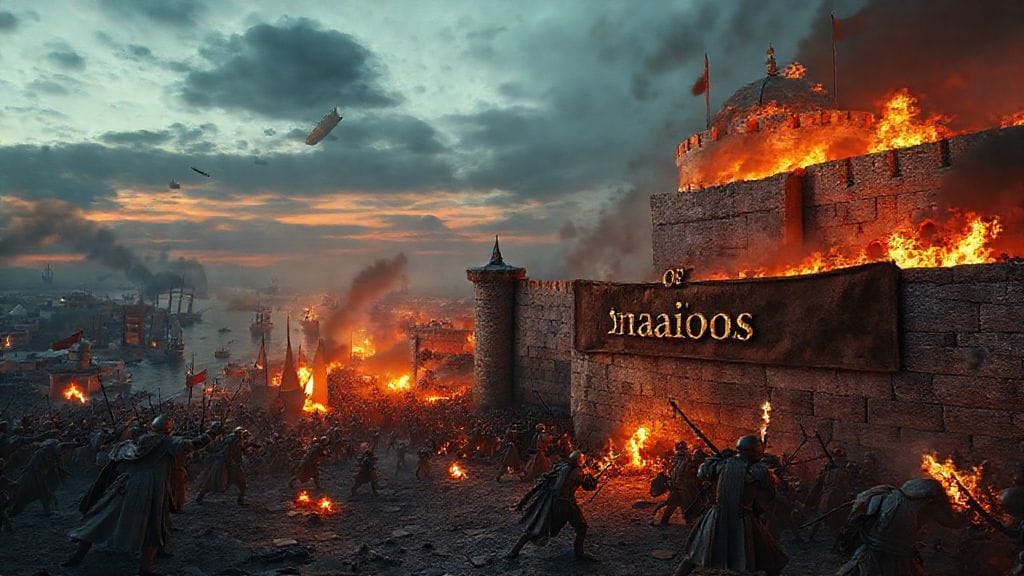
It was a time of tremors—not just in the earth but in the very fabric of empires. Imagine the ancient city of Constantinople, its walls standing proud against the horizon, a beacon of Byzantine strength and culture. The air, thick with the salty breeze of the Bosphorus, suddenly carried the murmur of a growing menace. Ships bearing the banners of the fierce Arab armies appeared on the skyline, their black sails cutting a shadow over the sea.
The year was 674 AD. The Arab forces, under the banner of the Umayyad Caliphate, were encircling the city to deliver a blow that would echo through history. This was the opening chapter of what came to be known as the First Arab Siege of Constantinople—a prolonged, grueling contest between two great civilizations that would reshape the destiny of the Mediterranean world.
The City Between Two Worlds: Constantinople in the 7th Century
Constantinople in the late 7th century was far more than a city; it was the nerve center of the Byzantine Empire—political, cultural, and economic heart all in one. Nestled along the Bosphorus Strait, it bridged Europe and Asia, commanding vital trade routes and military pathways.
Its formidable defensive fortifications, dating back over two centuries to the rule of Theodosius II, made it practically impregnable. The city was a tapestry of churches, palaces, bustling marketplaces, and a multi-ethnic population united by their faith in Orthodox Christianity and loyalty to the emperor.
Yet beneath this veneer of strength simmered tensions—external threats loomed from the rising Arab power in the south, and internal strains fermented from religious controversy and shifting political dynamics. It was a crossroads of empires, ideologies, and ambitions, poised on the edge of a historical turning point.
The Rise of the Umayyad Caliphate and the Arab Expansion
To understand the significance of the siege, one must look south—to the meteoric rise of the Umayyad Caliphate. Following the death of Prophet Muhammad in 632 AD, the new Muslim polities began a remarkable expansion, sweeping across the Arabian Peninsula and carving through Persia, North Africa, and into Byzantine territories.
By the mid-7th century, the Umayyads had established a vast empire stretching from Spain in the west to the Indus River in the east. This was not merely a military conquest but an ideological crusade rooted in the spread of Islam and the consolidation of Arab power.
Constantinople, the jewel of Byzantium, was the natural prize to secure dominion over the Mediterranean. Its fall would symbolize the eclipse of Byzantine dominance and the dawning of a new epoch under the Crescent.
Byzantine Empire under Constantine IV: The Defender of Constantinople
Amid this storm stood Emperor Constantine IV, a resolute leader inheriting a fragile empire. Coming to power in 668 AD, he was well aware of the existential threat posed by the Umayyads. Yet he was more than a mere survivor; he was a strategic mind determined to hold the city at all costs.
Constantine IV embarked on shoring up Constantinople’s defenses, reorganizing the military, and rallying his people around a shared cause. He capitalized on the city’s natural and architectural strengths but faced daunting odds as an enemy so vast in ambition bore down upon his walls.
The Arab Advance: Early Campaigns and Strategic Objectives
The Arab assault was neither haphazard nor impulsive. It followed decades of probing raids and territorial gains, culminating in a clear strategy: cut off Constantinople’s lifelines by sea, breach the Theodosian Walls, and force the city into submission.
Starting in 667 AD, Arab raids had already begun to contest Byzantine rule in Asia Minor, and by 674, a full-scale siege had been assembled. Commanded by an experienced and determined leadership, the Arab forces aimed to starve Constantinople into capitulation.
Many historians concur that the siege was as much psychological and economic warfare as it was military—demonstrating the Umayyads’ might and ambition, while pressuring Byzantium to the brink.
The Siege Begins: The First Arab Siege of Constantinople (674)
When the first Arab fleets appeared off Constantinople’s shores in 674, it marked the beginning of a siege that would span nearly five years. The attackers sought to encircle the city both on land and sea, blockading supplies and unloading troops to scale or undermine the city walls.
This siege was unlike a simple battle. It was a slow, grinding contest marked by skirmishes, naval duels, and days turned into months, and months into years. The citizens of Constantinople were thrust into an existential struggle—hope and despair intermingled with every ringing echo of the bells and cries from the ramparts.
A City under Fire: Life and Defenses during the Prolonged Siege
Behind the immense walls, life became a crucible. Food supplies dwindled; the city’s artisans, soldiers, and civilians alike took turns manning the defenses. Chroniclers like Theophanes the Confessor give vivid accounts of the fortitude of Constantinople’s residents, describing how walls were repaired nightly, and morale was kept up by church prayers and imperial proclamations.
Families huddled in cramped quarters, fearful of the battering ram and catapults, while lookout posts kept vigil over the horizon. Disease and starvation threatened to sap the city’s lifeblood, yet surrender was not in the hearts of these defenders.
Greek Fire: The Byzantine Secret Weapon that Changed History
One enduring legend from this siege is the deployment of the mysterious incendiary substance known as “Greek fire.” Said to burn even on water, this weapon was a game-changer in the naval battles that raged in the Bosphorus.
Though the exact composition remains a secret lost to time, accounts reveal how Greek fire was hurled in pots or sprayed through siphons, engulfing Arab ships in flames and breaking the siege’s naval blockade. It was a symbol of Byzantine ingenuity and the desperate struggle to preserve their city.
Naval Warfare on the Bosphorus: Epic Clashes on Water
The siege was not confined to land assaults alone. The Bosphorus Strait became a watery battlefield, with fleets from both sides vying for control. The Arabs sought to isolate the city, while the Byzantines used their knowledge of the sea and naval tactics, supported by Greek fire, to repel the attackers.
The courage of Byzantine sailors, manning triremes and dromons, often turned the tide of these encounters. Remarkably, despite being numerically outmatched, their expertise and the advantage of fortified harbors kept the city reachable.
The Role of Geography and Fortifications: Theodosian Walls and Beyond
Constantinople’s famed Theodosian Walls were the fortress’s backbone. Stretching over five miles, with double walls, fortified towers, and deep moats, they were among the most advanced defensive systems in the medieval world.
The natural geography—a peninsula flanked by sea on three sides and the narrow Bosphorus on the east—amplified the walls’ effectiveness. The attackers faced the daunting task of breaching these defenses under relentless counterattacks and with supply lines stretched thin.
The Human Cost: Siege, Starvation, and Resilience
The prolonged siege inevitably took a steep toll. Chroniclers record starvation, disease, and exhaustion haunting the city’s inhabitants. Yet the spirit of survival, forged by faith and patriotism, burned fiercely.
Stories tell of women and children contributing to the war effort, feeding soldiers, tending to the wounded, and bearing the weight of sacrifice. This resilience was not just a testament to Byzantine tenacity but a vivid human drama of survival against overwhelming odds.
Diplomacy, Disease, and Harsh Winters: Factors Behind the Siege’s End
As the siege dragged on through seasons, unexpected allies—nature and politics—emerged for Constantinople. Harsh winters crippled the Arab fleets; outbreaks of disease sapped their manpower and morale.
Meanwhile, internal divisions within the Umayyad leadership and threats on other fronts forced the attackers to reconsider their priorities. Diplomacy surfaced behind the scenes as the cost of the siege became unsustainable.
By 678, the Caliphate withdrew, acknowledging that the great city had withstood the storm.
The Aftermath: The Lifted Siege and the Byzantine Revival
The lifting of the siege was a psychological and strategic triumph for Byzantium. Emperor Constantine IV’s prestige rose dramatically, and the victory served as a rallying point for the empire’s resilience.
It halted the Arab advance into Europe for nearly a century, allowing Byzantium to regroup and stabilize. The empire’s military reforms and diplomatic ventures that followed owed much to the lessons learned during those arduous years.
The Siege’s Impact on Christian-Muslim Relations
This siege was more than a military encounter; it was an early flashpoint in the prolonged entanglement between the Christian Byzantine world and the Muslim Arab forces.
Its legacy influenced centuries of religious, cultural, and political interactions—waves of conflict punctuated by trade and exchange. The siege symbolized a boundary between civilizations, contested yet interlinked in complex ways.
The Legacy of the Siege: A Turning Point in Medieval History
In the grand sweep of history, the First Arab Siege of Constantinople marked a turning point. It preserved a bastion of Roman civilization, delayed the spread of Islamic power into Eastern Europe, and set the stage for medieval Christian and Muslim worlds’ evolving dynamics.
Historians highlight the siege as an early example of protracted combined military and naval warfare, as well as a testament to the power of fortifications and technological innovation.
Historiographical Debates: What Do Contemporary Sources Tell Us?
Our knowledge of the siege comes chiefly from Byzantine chroniclers, Arab historians, and later medieval sources. Yet discrepancies abound—questions about siege dates, the intensity of combat, and what exactly concluded the siege provoke scholarly debate.
Some modern historians question traditional narratives, proposing more nuanced readings that acknowledge the complexity of warfare and politics in this era.
Constantinople’s Place in the Clash of Civilizations
The siege epitomized the cultural and religious crossroads where East met West. It was a pivotal episode in the ongoing struggle for influence between two expansive empires—one Christian-Byzantine, the other Islamic-Arab.
This struggle transcended battlefields, shaping identity, ideology, and geopolitical realities in the centuries to come.
From Siege to Symbol: Constantinople in Later Cultural Memory
Over centuries, the memory of the siege became myth, legend, and inspiration. It illustrated the city’s indomitable spirit and divine protection in popular narratives.
From Orthodox liturgies to European medieval chronicles, the siege fed a collective imagery of resilience that resonated far beyond its immediate historical moment, marking Constantinople as a symbol of endurance against overwhelming foes.
Conclusion
The First Arab Siege of Constantinople was more than a military confrontation; it was a crucible where the fate of empires hung in delicate balance. The city, its walls, and its people stood as a bulwark against sweeping change—defying a rising power with courage born of faith and ingenuity.
This siege reveals the human dimensions behind grand history—the fear and hope, the suffering and sacrifice woven into the tapestry of time. It shaped the medieval world, preserved a civilization, and reminded us that sometimes, endurance itself is the greatest victory.
Through the smoke of Greek fire and the sound of clashing swords echoed a timeless narrative: that amidst conquest's shadows, humanity’s resilience shines brightest.
FAQs
1. Why was Constantinople so strategically important to the Umayyad Caliphate?
Constantinople controlled key trade routes and naval passages between Europe and Asia, including the crucial Bosphorus Strait. Capturing it would have allowed Umayyads dominance over the Mediterranean and a gateway into Eastern Europe.
2. What made the Theodosian Walls so effective against the Arab siege?
Built in the 5th century, the Theodosian Walls were a series of massive double walls with towers and moats, making direct assault extremely difficult. Their sheer size and complexity frustrated traditional siege tactics.
3. How did “Greek fire” influence the outcome of the siege?
Greek fire was a highly flammable liquid used by Byzantines to defend against naval attacks, particularly effective because it could burn on water. It destroyed many Arab ships, breaking the naval blockade and protecting supply lines.
4. What role did Emperor Constantine IV play during the siege?
As the emperor, Constantine IV was the primary organizer of the city’s defenses, reinforcing fortifications, commanding military responses, and maintaining morale. His leadership was a key factor in Byzantium’s resilience.
5. Were there any diplomatic efforts during or after the siege?
Yes, prolonged warfare and hardships led to diplomatic exchanges. Ultimately, political pressures and other military threats forced the Umayyads to lift the siege and negotiate with Byzantium.
6. How did this siege influence later Byzantine-Arab relations?
The siege set a precedent of intense military and political rivalry that lasted centuries, although periods of peace and trade also occurred. It galvanized Byzantine identity and military reforms.
7. How reliable are the historical sources about the siege?
Most surviving accounts come from Byzantine chroniclers like Theophanes, who may have biases. Arab sources exist but are less detailed. Modern historians cross-reference these while acknowledging gaps and potential exaggerations.
8. What is the broader historical significance of the First Arab Siege of Constantinople?
It marked the halt of Arab territorial expansion into Europe for decades, preserved Byzantine civilization, and shaped the medieval geopolitical landscape, affecting Christian-Muslim relations for centuries.

