Table of Contents
- The Echoes of Conflict: Setting the Stage for the Synod of Whitby
- Kingdom of Northumbria: A Land Divided in Faith
- Celtic Christianity vs. Roman Tradition: A Tale of Rival Doctrines
- King Oswiu’s Dilemma: Between Two Worlds
- Whitby Abbey: The Spiritual Heartbeat of Northumbria
- The Gathering Storm: Preparations for the Synod
- The Day of Reckoning: Whitby, 664 AD
- The Key Speakers: Wilfrid, Colman, and Bishop Agilbert
- The Debate Unfolds: Arguments, Theology, and Tradition
- The Crucial Turning Point: The Decision for Roman Easter
- Aftermath at Whitby: Immediate Reactions and Shifts
- Ecclesiastical Consequences: The Rise of Roman Authority
- Sociopolitical Ripples: Unity and Division in Northumbria
- Cultural Legacy: Liturgical Uniformity and Identity
- Long-Term Impact: Rome’s Influence on English Christianity
- Across the Channel: The Synod’s Continental Reverberations
- Chronicles and Memory: How History Remembers Whitby
- Controversies and Criticisms: Was Whitby a Religious Coup?
- Women of Whitby: Hilda and the Female Monastic Tradition
- Whitby and the Viking Age: The Abbey’s Later Role
- The Synod in Modern Imagination and Media
- The Lessons of Whitby: Unity, Diversity, and Faith
- Conclusion: Whitby as a Crossroads of Culture and Belief
- FAQs: Diving Deeper into the Synod of Whitby
- External Resources and Further Reading
- Internal Link: Explore More at History Sphere
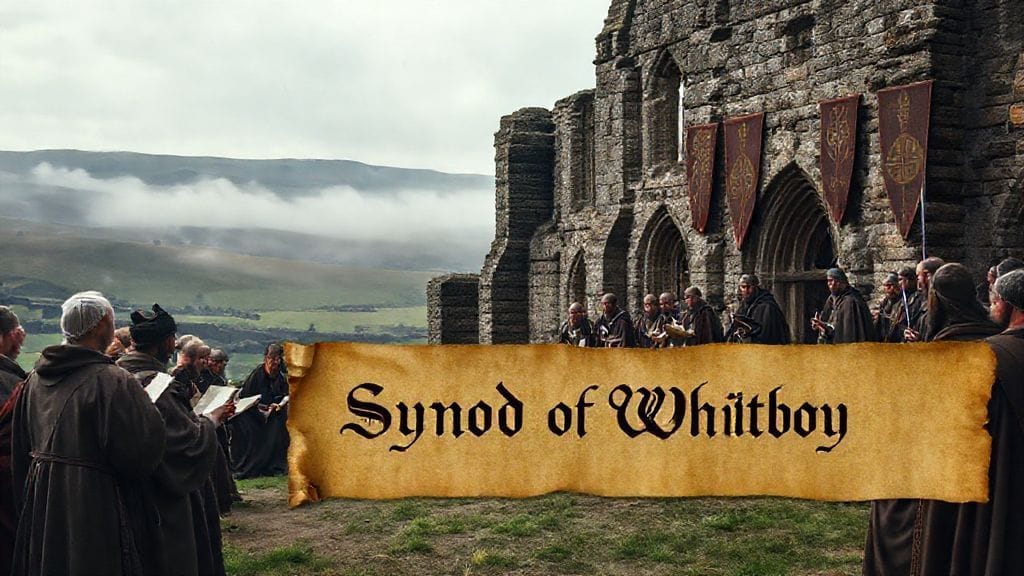
The gray skies hung heavy over the rugged cliffs of Whitby, where the North Sea crashed endlessly against ancient stone and earth. The air was thick with anticipation, a mix of faith and tension stirring among the gathered crowd. Nobles and monks, bishops and kings had come together under an overcast sky in 664 AD, a moment charged with more than just earthly concerns. This was a crossroads of belief, of power, and of identity—a synod that would carve the destiny of English Christianity for centuries to come.
The Synod of Whitby stands as one of the most pivotal events in the religious history of England, not just for its theological decisions but for how it reshaped the cultural and political landscape of a fledgling medieval kingdom. Yet, behind the austere council rooms and ecclesiastical debates lay human dramas of conviction and compromise, loyalty and rivalry. Here unfolds a story of how a kingdom—and a nation—found its spiritual compass.
1. The Echoes of Conflict: Setting the Stage for the Synod of Whitby
In the mid-7th century, the island of Britain had become a tapestry of competing Christian traditions, shaped by centuries of invasions, insular developments, and missionary zeal. Christianity was no longer a monolith but a mosaic, each strand woven with different rites, calendars, and ecclesiastical allegiances. By the time of the Synod of Whitby, two dominant Christian traditions had deeply rooted themselves in the English lands: the Celtic Church, fostered chiefly from the monasteries of Iona and Lindisfarne, and the Roman Church, whose influence emanated from the continent and the papacy.
What seemed superficially a dispute about how to calculate the date of Easter concealed, in truth, a profound tug-of-war between identities and powers.
2. Kingdom of Northumbria: A Land Divided in Faith
At the heart of this battleground lay Northumbria, arguably the most powerful Anglo-Saxon kingdom of the period. The kingdom had itself only recently emerged from a patchwork of smaller kingdoms and tribal alliances, unified by the early kings who dreamed of consolidating power. Within this volatile environment, religious affiliation was never just about spirituality; it was intricately linked with political allegiances.
Northumbria was unique. While its southern lands, influenced by Roman-educated clergy, tended toward the papal tradition, vast stretches in the north held tightly to Celtic customs introduced by Irish missionaries. The result was a kingdom spiritually divided, often disjointed—a situation King Oswiu found increasingly untenable.
3. Celtic Christianity vs. Roman Tradition: A Tale of Rival Doctrines
To modern eyes, the differences between Celtic and Roman Christian rites might seem arcane—details such as how to calculate Easter or how monks should wear their tonsures. Yet, these were not trivial disputes. For the Celtic Church, which traced its roots largely to Saint Columba’s mission in Iona, rituals had evolved in isolation, creating practices distinct from Rome and much of continental Europe.
The most prominent difference concerned the date of Easter—a festival central to the Christian liturgical year. The Irish and Northumbrian Celtic churches calculated Easter using a method different from that adopted by Rome, causing the two groups to celebrate the most important Christian feast on different dates.
Another contentious issue was the style of the monastic tonsure and the authority structure; the Celtic Church maintained a more monastic-centered ecclesiology, often with abbots wielding significant power, while Roman practice emphasized episcopal (bishop-led) leadership aligned with the papal hierarchy.
These differences came to symbolize larger questions: which Christian tradition would Northumbria—and eventually England—embrace as its spiritual and cultural identity?
4. King Oswiu’s Dilemma: Between Two Worlds
King Oswiu of Northumbria, a ruler of ambition and piety, found himself trapped in a religious impasse. Despite his personal leanings toward the Celtic practice, he was deeply pragmatic. His wife, Queen Eanfled, followed the Roman customs, inherited from her Kentish roots. This marital divide mirrored the kingdom’s spiritual split.
Oswiu understood that such religious disunity could undercut his efforts to solidify his authority and that Northumbria risked alienation from the wider Christian world, which increasingly looked to Rome as the religious center.
Faced with these tensions, Oswiu resolved to convene a synod—a meeting that would decide once and for all which Christian tradition would hold sway over Northumbria.
5. Whitby Abbey: The Spiritual Heartbeat of Northumbria
The location of the synod itself was laden with symbolic resonance. Whitby Abbey, perched on the cliffs overlooking the North Sea, was founded by the revered Abbess Hilda, a figure both political and saintly. The abbey was a hub of learning and spirituality, a seat where the Celtic tradition thrived.
By holding the synod at Whitby, Oswiu anchored the decision to a place ingrained in the religious memory and practice of his kingdom, perhaps seeking to imbue the event with gravity and sanctity.
6. The Gathering Storm: Preparations for the Synod
Preparations for the synod began months in advance. Delegates arrived from across the kingdom and beyond: bishops, abbots, monks, nobles, and kingsmen. Among the key figures were Bishop Colman, representing the Celtic tradition, and Wilfrid, a charismatic and learned Roman advocate.
The political stakes were as high as the theological ones. Ambassadors from the papacy, envoys from neighboring kingdoms, and envoys from the continent watched with vested interest.
7. The Day of Reckoning: Whitby, 664 AD
On a cool autumn day in 664 AD, the great council convened. The abbey’s austere halls were filled with murmurs. The air trembled with tension, for the future course of Northumbria’s Christian identity was about to be cast in stone.
King Oswiu, presiding over the assembly, opened the debate. For hours, arguments flew between the Celtic and Roman representatives, each defending their tradition with sacred texts, solemn appeals, and impassioned oratory.
8. The Key Speakers: Wilfrid, Colman, and Bishop Agilbert
Bishop Wilfrid emerged as a commanding voice for the Roman position. Educated in Frankish and Roman lands, he articulated the necessity of aligning with the universal Church centered in Rome, underscoring unity and uniformity.
Opposing him, Bishop Colman, a steadfast and eloquent proponent of Celtic Christianity, defended the prerogatives of his tradition, emphasizing spiritual heritage and indigenous practices.
Present also was Bishop Agilbert, an experienced churchman whose interventions underscored the broader European perspective on the importance of ecclesial unity.
9. The Debate Unfolds: Arguments, Theology, and Tradition
The core of the debate centered on the calculation of Easter, a technical yet deeply symbolic issue. Arguments drew upon Scripture, the authority of Saint Peter (whose authority was claimed by Rome), and appeals to ancient tradition.
Wilfrid famously appealed to Peter as the "rock" upon which Christ built his church, wielding this theological argument as a decisive blow to the Celtic position. The weight of papal authority loomed large in the assembly.
Yet the Celtic followers countered with appeals to tradition, monastic authority, and a spiritual lineage stretching back to Christ’s early Apostles.
As the day progressed, it was apparent that the tide was turning in favor of the Roman party, especially as King Oswiu himself approached a turning point.
10. The Crucial Turning Point: The Decision for Roman Easter
The moment of decision arrived when King Oswiu publicly declared that his kingdom would adopt the Roman method for calculating Easter and adhere to the Roman liturgical customs.
In his own words, Oswiu reportedly said: “I shall order all my subjects, whether they be Irish or English, to keep Easter together and to fast on the same days.”
This pragmatic and politically shrewd move positioned Northumbria firmly within the sphere of Roman Christendom and marked the eclipse of the Celtic practices in the region.
11. Aftermath at Whitby: Immediate Reactions and Shifts
The reaction was mixed and emotional. The Celtic clergy felt deeply wounded but were compelled to accept the verdict lest they be branded schismatic. Some, like Bishop Colman, chose voluntary exile rather than submission.
The decision catalyzed reforms within the church structures in Northumbria: Roman bishops assumed greater authority, and the Celtic-style monastic systems gradually gave way to diocesan governance consistent with Roman ecclesiastical hierarchy.
12. Ecclesiastical Consequences: The Rise of Roman Authority
The synod’s outcome reinforced the supremacy of papal authority in England. It paved the way for increased missions, closer diplomatic ties with Rome, and conformance to a universal Latin rite.
Moreover, it encouraged the rise of ecclesiastical figures steeped in Roman teaching, such as the future Archbishop Theodore of Tarsus, who further integrated English Christianity into the continental fold.
13. Sociopolitical Ripples: Unity and Division in Northumbria
Beyond religion, the decision strengthened the political unity of Northumbria. By embracing Roman customs, Oswiu secured advantages in diplomacy and internal cohesion.
Yet, it also alienated certain traditional sectors, highlighting tensions that echoed in future church and state disputes.
14. Cultural Legacy: Liturgical Uniformity and Identity
The unification under the Roman rite brought with it a cultural homogenization of Christian practice and helped shape the developing English identity.
Monasteries became centers not only of faith but of learning and art influenced heavily by Roman liturgy and continental models.
15. Long-Term Impact: Rome’s Influence on English Christianity
Whitby was a decisive step on the path to an English church fully integrated into Western Christianity, attending church councils, adopting canon law, and embracing papal reforms.
The ripple effects extended well beyond Northumbria, influencing the Christianization and unification processes in the rest of England.
16. Across the Channel: The Synod’s Continental Reverberations
Continental Europe regarded Whitby as a significant affirmation of Roman primacy in the West. This alignment strengthened cultural and religious bonds with the Frankish realms and solidified papal influence.
The synod’s resolution also contributed to the gradual decline of indigenous Celtic Christianity as a distinct force.
17. Chronicles and Memory: How History Remembers Whitby
Chroniclers such as Bede immortalized the synod as a moment of wisdom and unity. The “Ecclesiastical History of the English People” shaped the narrative, portraying the event as divinely guided.
Yet, later historians have debated its characterization as either a victory for orthodoxy or a political maneuver.
18. Controversies and Criticisms: Was Whitby a Religious Coup?
Some modern scholars question whether the synod represented genuine spiritual consensus or was effectively a forced submission to Roman dictates.
The burial of Celtic customs raises questions about cultural loss and the complexities of religious authority.
19. Women of Whitby: Hilda and the Female Monastic Tradition
Abbess Hilda, who had died shortly before the synod, cast a long shadow over Whitby. She had stewarded a powerful monastic community where women played vital roles.
The synod’s outcome shifted ecclesiastical power away from monastic communities like hers, marking a decline in female ecclesiastical influence.
20. Whitby and the Viking Age: The Abbey’s Later Role
In centuries following the synod, Whitby Abbey remained an influential religious center until Viking raids devastated it.
Its ruins today evoke the layered history of faith, conflict, and resilience in early medieval England.
21. The Synod in Modern Imagination and Media
Whitby’s dramatic story has inspired novels, films, and scholarly debate alike, symbolizing moments when faith and politics collide.
Its legacy continues to intrigue historians, theologians, and those fascinated by England’s early medieval past.
22. The Lessons of Whitby: Unity, Diversity, and Faith
The synod teaches us about the complexities of religious unity, the costs and benefits of conformity, and the human dimensions of theological disputes.
It is a reminder that the path to common identity often requires negotiation, sacrifice, and leadership.
23. Conclusion: Whitby as a Crossroads of Culture and Belief
The Synod of Whitby was far more than a debate over a date on a calendar. It was a moment when a kingdom’s identity, politics, and spirituality were recast in new form.
By choosing Rome, Northumbria set a course that would shape English Christianity and culture for a millennium, embedding itself in the soul of a nation still grappling with questions of faith and belonging.
Conclusion
Reflecting upon the Synod of Whitby, one cannot help but admire the gravity with which men of faith and power convened to reconcile divergent paths. It was a watershed, a fusion of conviction and pragmatism, casting a long shadow across English history.
Beyond doctrinal disputes, it was a tale of human aspirations—to forge unity amidst diversity, to find a common ground where culture and belief intertwined. Whitby was a crossroads where the past converged with the future, where identities clashed and merged.
Today, through the ruins and chronicles and debates, the spirit of Whitby endures—a testament to the enduring quest for coherence in a fragmented world.
FAQs
Q1: Why was the calculation of Easter such a contentious issue at Whitby?
A1: Easter marks the resurrection of Christ, the most important Christian feast. Divergent methods of calculating its date symbolized deeper theological and ecclesiastical differences between the Celtic and Roman churches, reflecting authority, tradition, and identity.
Q2: Who was King Oswiu and what was his role in the synod?
A2: King Oswiu of Northumbria was the monarch presiding over the synod. Though personally aligned more with Celtic practices, he pragmatically sought a religious solution to unify his kingdom, ultimately deciding in favor of Roman customs.
Q3: What were the consequences for Celtic Christianity in England after Whitby?
A3: The synod led to the gradual eclipse of Celtic Christian practices in England, the adoption of Roman liturgical norms, and the reinforcement of papal authority, though Celtic Christianity persisted longer in some peripheral areas.
Q4: How did the Synod of Whitby influence the political landscape of Northumbria?
A4: By aligning with Rome, Northumbria strengthened political ties with the continent, enhanced the king’s legitimacy, and moved toward greater internal religious and political cohesion.
Q5: Who was Abbess Hilda and why is she significant in the context of Whitby?
A5: Hilda was the founding abbess of Whitby Abbey, a prominent figure who fostered Celtic Christian monasticism and female religious leadership. She died shortly before the synod but her legacy shaped Whitby’s spiritual stature.
Q6: Did the synod immediately end all religious tensions in Northumbria?
A6: No, while the synod resolved the official question of Easter calculation and liturgical practice, religious and cultural tensions persisted, with some Celtic clergy leaving or resisting the new order.
Q7: What sources provide most of the historical information about the Synod of Whitby?
A7: The primary source is Bede’s “Ecclesiastical History of the English People,” written several decades later, along with various annals and hagiographies.
Q8: How is the Synod of Whitby remembered today?
A8: It is seen as a foundational event for English Christianity, symbolizing the complexities of religious change and cultural integration, and remains a subject of study and cultural interest.

