Table of Contents
- Introduction
- Strategic Importance of the Suez Canal
- Egypt Under British and French Influence
- Rise of Gamal Abdel Nasser
- The Nationalization Announcement
- Immediate International Reactions
- The Suez Crisis Unfolds
- Military Invasion by Britain, France, and Israel
- U.S. and Soviet Positions
- UN Involvement and Ceasefire
- Aftermath and Global Impact
- Legacy of the Suez Canal Crisis
- Conclusion
- External Resource
- Internal Link
1. Introduction
On July 26, 1956, Egyptian President Gamal Abdel Nasser stood before a crowd in Alexandria and declared the nationalization of the Suez Canal. That speech would send shockwaves around the world. The canal, once under Anglo-French control, was now to be operated and owned by Egypt. What followed was a fast-unfolding international crisis that brought old colonial powers face-to-face with the rising tide of nationalism in the post-colonial Middle East.
2. Strategic Importance of the Suez Canal
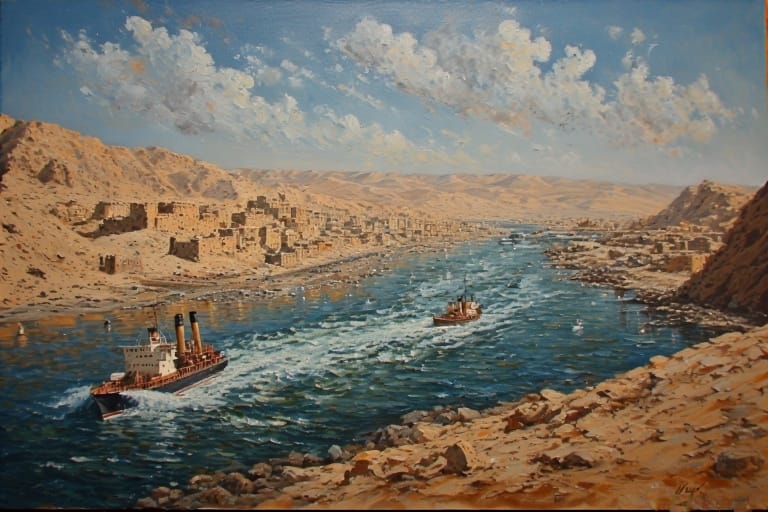
The Suez Canal, completed in 1869, is one of the most vital waterways in the world. It connects the Mediterranean Sea to the Red Sea, dramatically reducing maritime travel between Europe and Asia. For European colonial powers—particularly Britain and France—the canal was an artery of global commerce and a symbol of geopolitical control.
By the mid-20th century, about two-thirds of Europe’s oil passed through the canal. For the UK, especially, the route was integral to maintaining trade and influence with former colonies east of Suez.
3. Egypt Under British and French Influence
Though Egypt had formally gained independence in 1922, British military and economic influence remained deeply entrenched. The Anglo-Egyptian Treaty of 1936 allowed Britain to station troops around the canal zone. France, too, had significant stakes through the Suez Canal Company.
The canal’s operation and revenue largely benefited foreign shareholders, even as it cut through Egyptian soil. Nationalist sentiments in Egypt simmered, especially under the leadership of a new generation of assertive leaders.
4. Rise of Gamal Abdel Nasser
A former military officer, Nasser rose to power after leading the Free Officers Movement, which overthrew King Farouk in 1952. By 1954, he became President and soon emerged as a charismatic figure of Arab nationalism. Nasser envisioned a strong, independent Egypt free from Western meddling.
He also sought to modernize Egypt’s economy, including ambitious infrastructure projects like the Aswan High Dam—a major hydroelectric initiative. However, funding that vision required support from abroad.
5. The Nationalization Announcement
After negotiations with the U.S. and UK for dam funding broke down, Nasser took a dramatic step. On July 26, 1956, he nationalized the Suez Canal Company, declaring that canal revenues would be used to fund the Aswan Dam.
The announcement stunned the West. The manner was bold—Nasser even used the code name “de Lesseps” (after the French canal engineer) during his speech. The move was both political theater and strategic gambit.
6. Immediate International Reactions
Reactions were swift and polarized. In Egypt and across the Arab world, Nasser was hailed as a hero standing up to imperialism. In London and Paris, officials were furious. The loss of control over the canal was viewed not just as an economic blow but a direct affront to Western prestige.
Britain’s Prime Minister Anthony Eden compared Nasser to Mussolini and Hitler. France, meanwhile, blamed Nasser for supporting Algerian rebels fighting against French rule.
7. The Suez Crisis Unfolds
Behind the scenes, Britain and France began plotting military action. They found an unlikely partner in Israel, which had long-standing tensions with Egypt over border raids and blockades.
A secret plan was formed: Israel would invade the Sinai Peninsula, giving Britain and France a pretext to intervene under the guise of “separating the warring sides” and retaking control of the canal.
8. Military Invasion by Britain, France, and Israel
On October 29, 1956, Israel launched Operation Kadesh, advancing into Sinai. Two days later, British and French forces began bombing Egyptian targets. Paratroopers were dropped, and Port Said was occupied.
Egyptian forces resisted fiercely, and although militarily outmatched, the symbolic resistance rallied public support across the Arab world.
9. U.S. and Soviet Positions
What the Western allies didn’t anticipate was the reaction from the two global superpowers. The United States, under President Dwight D. Eisenhower, strongly opposed the invasion. The U.S. feared the crisis would push Arab nations toward Soviet influence.
The Soviet Union, meanwhile, threatened to intervene militarily if the Western forces did not withdraw. With Cold War tensions at a peak, the situation teetered dangerously.
10. UN Involvement and Ceasefire
Amid global outcry, the United Nations stepped in. On November 7, 1956, a UN-brokered ceasefire was agreed upon. Britain, France, and Israel eventually withdrew their forces. For the first time, a UN Emergency Force (UNEF) was deployed to supervise the withdrawal and ensure peace.
Egypt retained control of the canal, marking a significant diplomatic and political victory for Nasser.
11. Aftermath and Global Impact
The crisis deeply shattered British and French prestige. It signaled the end of their roles as primary global powers and showcased the rising influence of the U.S. and USSR. The conflict also reinforced the United Nations’ role as a mediator in global disputes.
Economically, the canal was briefly closed but resumed operation under full Egyptian control. Politically, Nasser’s stature soared, and the Suez Crisis became a rallying point for anti-colonial movements worldwide.
12. Legacy of the Suez Canal Crisis
The 1956 Suez Crisis stands as a watershed moment in the history of decolonization. It affirmed the right of post-colonial states to assert sovereignty over their resources and challenged Western dominance in the developing world.
It also demonstrated how Cold War geopolitics could override old colonial alliances. Most importantly, it inspired a new era of assertive, independent leadership across the Global South.
13. Conclusion
The nationalization of the Suez Canal on July 26, 1956, was far more than a financial decision. It was a symbolic assertion of independence, a direct challenge to colonial power, and a turning point in Middle Eastern and global history.
By taking back control of the Suez Canal, Egypt not only financed its own development but reshaped the international order. It was a bold move—risky and dramatic—but one that altered the course of the 20th century.