Table of Contents
- A Storm Brews in Byzantium: The Context of the Third Council of Constantinople
- From Monophysitism to Monothelitism: The Theological Landscape of the 7th Century
- The Byzantine Empire at a Crossroads: Politics, Religion, and Power
- The Rise and Spread of Monothelitism: An Attempt at Christian Unity?
- The Papal Opposition: Pope Honorius I’s Controversial Role
- Emperor Constantine IV and the Call for the Council
- Gathering the Fathers: Preparing for the Ecumenical Synod
- Constantinople in 680: A City on Edge, Awaiting Judgment
- The Opening Sessions: The Theological Battles Begin
- Defining God’s Will: One Will or Two?
- Key Figures and Voices at the Council: Triumphs and Tragedies
- The Condemnation of Monothelitism and the Anathema of Pope Honorius I
- Reactions Across Christendom: Unity or Schism?
- The Council’s Decrees: Creed, Canons, and Lasting Edicts
- The Political Aftermath: Byzantium and Rome Reassess Relations
- Theological Legacy: The End of Monothelitism and the Rise of Dyothelitism
- Cultural Impact: The Council’s Echo in Art, Liturgy, and Doctrine
- Human Stories: Clerics, Emperors, and Ordinary Believers
- Monothelitism’s Shadow: Later Heresies and Church Controversies
- The Council’s Place in Church History and Ecumenical Tradition
- Modern Perspectives: Scholarship and the Memory of the Third Council
- Conclusion: Faith, Power, and the Long Road to Unity
- FAQs: Deepening Understanding of the Third Council of Constantinople
- External Resource
- Internal Link
1. A Storm Brews in Byzantium: The Context of the Third Council of Constantinople
The year was 680, and Constantinople, the heart of the Byzantine Empire, throbbed with tension — political, religious, cultural. The summer sun glazed the golden domes of Hagia Sophia, yet inside those sacred walls, a storm was gathering. Bishops, theologians, and imperial envoys converged for what would become one of the most pivotal moments in the history of Christianity: the Third Ecumenical Council, better known as the Third Council of Constantinople. Its purpose was clear but daunting—to settle once and for all the bitter theological dispute over Monothelitism, a doctrine attempting to unify a fractured Christendom but instead dividing it even further.
This council was not merely a meeting of clerics debating obscure doctrine. It was the theater where faith, imperial politics, and the yearning for unity clashed in an epic confrontation. The reverberations would echo not only through the gilded halls of Constantinople but through the centuries of Christian history that followed.
2. From Monophysitism to Monothelitism: The Theological Landscape of the 7th Century
To grasp the urgency of the Third Council, we must journey back into the theological turmoil that had plagued the Christian world since the Council of Chalcedon in 451. That council had defined Christ as possessing two natures—fully divine and fully human—in one person, a doctrine known as Dyophysitism. But not everyone was convinced.
Many Eastern Christians, particularly in Egypt and Syria, held to Monophysitism, the belief that Christ had a single divine nature that absorbed his humanity. This divide led to centuries of schism and tension, weakening the unity of the Byzantine Empire and complicating relations with Rome.
Enter Monothelitism in the 7th century—a theological compromise proposing that although Jesus Christ had two natures, he operated with a single divine-human will. It sounded like a middle ground, intended to reconcile the Monophysites by acknowledging two natures but only one will.
Yet, this innovation ignited furious debates. Was it heresy to deny Christ a human will? Could God's incarnation be authentic without embracing full humanity, including will? For many, Monothelitism seemed to undermine the profound mystery of the Incarnation.
3. The Byzantine Empire at a Crossroads: Politics, Religion, and Power
The 7th century was a period of existential threat and transformation for Byzantium. Muslim conquests had captured much of the Near East, including regions where Monophysitism reigned. Emperor Heraclius, ruling earlier in the century, sought to preserve what remained of his empire and shore up religious unity as a bulwark against enemy advances.
In this tapestry of shifting allegiances and power struggles, religion was inseparable from politics. The emperor was not only a secular ruler but also the protector of orthodoxy, a role that made theological unity not just a spiritual concern but a matter of imperial survival.
Within this heated context, Monothelitism was promoted as a potential balm to religious division. It was a calculated political theology designed to heal the fractures that endangered the empire itself.
4. The Rise and Spread of Monothelitism: An Attempt at Christian Unity?
Monothelitism found powerful advocates in the Byzantine court and among certain theologians eager to reconcile the Monophysites and Chalcedonians. Its main appeal was inclusivity—it professed Christ’s two natures but one will, a notion hoped to bridge longstanding schisms.
The policy gained momentum especially under Emperor Heraclius and his successors. The imperial church began to teach Monothelitism, hoping to restore peace and deter the rebellion of Monophysite populations.
Yet, the monolithic simplicity of ‘one will’ to solve centuries of theological complexity was naïve. Both Romand and Eastern critics questioned the doctrine’s scriptural and patristic foundations. The seeds of an intense conflict were sown.
5. The Papal Opposition: Pope Honorius I’s Controversial Role
The papacy under Pope Honorius I (r. 625–638) found itself entangled in the Monothelite controversy in a way that would haunt it for centuries. Initially, Honorius appeared willing to accommodate the doctrine, perhaps viewing it as a diplomatic effort to unify Christians.
However, his vague wording and reluctance to categorically condemn Monothelitism created confusion, if not an implicit endorsement. This ambiguity would later be seized upon by both supporters and opponents to justify their stances.
The critical irony is that the Third Council of Constantinople would ultimately anathematize Honorius for his failure to refute Monothelitism clearly—a rare and stark condemnation of a pope’s theological position, with lasting implications for the doctrine of papal infallibility.
6. Emperor Constantine IV and the Call for the Council
Fast forward to 680. Emperor Constantine IV ascended the throne amid continued theological discord and external threats. Recognizing that the division risked imperial stability, he decided to convene a grand synod to confront the Monothelite heresy head-on.
The emperor’s call was both a gesture of spiritual responsibility and a strategy of political consolidation. He entrusted Patriarch George I of Constantinople with the orchestration of this monumental council.
Letters were sent out across the Christian world; bishops converged from East and West. What awaited in Constantinople was not merely a debate but a trial of faith and power.
7. Gathering the Fathers: Preparing for the Ecumenical Synod
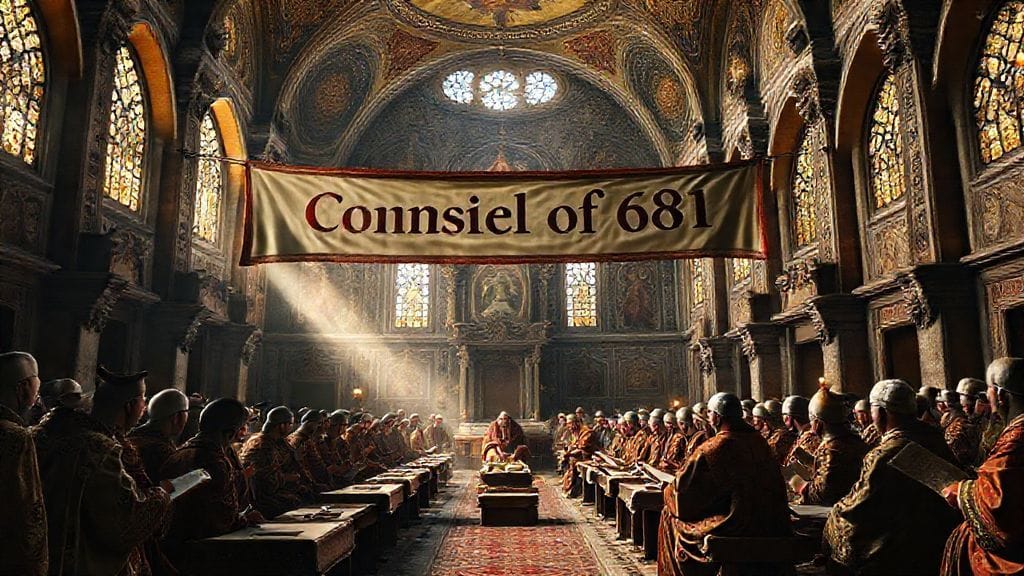
By the late summer of 680, the stage was set. Over 150 bishops, along with abbots, priests, and imperial officials, gathered beneath the soaring cupola of the Great Church.
Preparations were meticulous. Ahead of sessions, theological treatises circulated, and delegates exchanged whispered urgencies. The air was thick with resolve and apprehension. The council’s decisions would shape Christian doctrine for all eternity.
But the bishops also carried personal stakes, partisan loyalties, and political pressures. The ecumenical tone that convened the assembly belied fierce underlying conflicts.
8. Constantinople in 680: A City on Edge, Awaiting Judgment
Constantinople, with its shimmering palaces and bustling harbors, felt a palpable tension. Citizens observed the influx of bishops and clergy as whispers spread about the weight of the coming decisions.
Inside Hagia Sophia, the sense of solemnity was profound. Here, ancient liturgies echoed alongside heated theological disputations. The council hall became a crucible where centuries-long struggles boiled to a head.
For many attending, their faith—and indeed their survival—hinged on the outcome.
9. The Opening Sessions: The Theological Battles Begin
The council opened with prayers invoking the Holy Spirit’s guidance. Then began a series of sessions in which theological experts presented their arguments.
Opponents of Monothelitism laid out a comprehensive refutation grounded in scripture and patristic writings. They insisted—profoundly and insistently—that Christ must have two wills, divine and human, to be fully incarnate.
Monothelite defenders countered with appeals to unity and peace, stressing the dangers of division. Yet their arguments often faltered under rigorous questioning.
The debate was relentless, intricate, and at times passionate, revealing not only doctrinal concerns but the anxieties of an empire in flux.
10. Defining God’s Will: One Will or Two?
The crux of the council’s task was deceptively simple yet deeply complex: did Christ’s human nature possess a will distinct from his divine nature?
The council fathers affirmed the doctrine of Dyothelitism—two wills, divine and human, in the one person of Christ—each operating harmoniously but distinctly.
This definition underscored the fullness of the Incarnation: Jesus was truly God and truly man, including in his will.
Rejecting Monothelitism, they declared it a heresy that diminished Christ’s humanity and thus endangered salvation itself.
11. Key Figures and Voices at the Council: Triumphs and Tragedies
Among the vocal participants was Patriarch George I of Constantinople, a steadfast proponent of orthodoxy, who led the council with unwavering resolve.
Poignant also was the posthumous condemnation of Pope Honorius I, whose theological ambiguity became a lightning rod for accusations of heresy.
The bishops’ debates sometimes turned personal, but overall a shared commitment to preserving the faith sustained the assembly.
The triumph of Dyothelitism did not erase the human conflicts beneath; it marked, instead, a hard-won consensus through struggle and sacrifice.
12. The Condemnation of Monothelitism and the Anathema of Pope Honorius I
The council’s acts culminated in formal decrees anathematizing Monothelitism and labeling its defenders—past and present—as heretics.
Controversially, Pope Honorius I was among those anathematized for his failure to oppose clearly the Monothelite doctrine.
This unprecedented censure of a pope sparked centuries of theological debate about papal authority and infallibility, reverberating well into the modern era.
For the council fathers, distinguishing orthodox teaching from error was essential to saving the Church’s integrity.
13. Reactions Across Christendom: Unity or Schism?
The council’s decisions rippled through both East and West. Many welcomed the doctrinal clarity and saw hope for healing schisms.
Yet for some, especially Monothelite sympathizers and those politically aligned against Constantinople, the council represented a rejection of their aspirations.
The thorny question of Christian unity did not end with the council; instead, new challenges emerged as differing interpretations and loyalties persisted.
14. The Council’s Decrees: Creed, Canons, and Lasting Edicts
The formal documents issued laid out the new orthodox Christology, reaffirming the Chalcedonian Definition and explicitly endorsing Dyothelitism.
Canons reinforced ecclesiastical discipline and doctrinal conformity, signaling a clear line between faith and heresy.
The council became the sixth ecumenical council recognized by both Eastern Orthodox and Roman Catholic traditions, cementing its place in the annals of Church history.
15. The Political Aftermath: Byzantium and Rome Reassess Relations
Diplomatic tides shifted. Constantinople’s insistence on papal repentance strained relations but also reaffirmed imperial authority in religious affairs.
Emperor Constantine IV’s role enhanced the synergy between throne and altar, a characteristic Byzantine synthesis.
Rome’s acceptance, despite reservations about Honorius, helped maintain fragile unity, albeit with an undertone of tension that would resurface in later centuries.
16. Theological Legacy: The End of Monothelitism and the Rise of Dyothelitism
The council decisively ended Monothelitism’s prominence and established Dyothelitism as orthodox teaching.
This corrected Christological balance sustained subsequent theology and ecclesiastical teaching.
Yet, the debates illustrated the ongoing human struggle to comprehend divine mysteries—no easy victory but a continuous journey.
17. Cultural Impact: The Council’s Echo in Art, Liturgy, and Doctrine
The influence of the council extended beyond doctrine into liturgical texts, iconography, and devotional life.
Churches echoed with hymns celebrating Christ’s full humanity and divinity; images portrayed the incarnate Logos with renewed theological precision.
These cultural expressions fostered a deeper, lived faith reflecting the council’s resolutions.
18. Human Stories: Clerics, Emperors, and Ordinary Believers
Behind the grand theological debates were real people—bishops weary from travel, courtiers balancing faith and politics, and lay Christians seeking guidance amid uncertainty.
Personal letters and chronicles reveal moments of doubt, hope, and courage.
The council was not an abstract event but a profound human drama shaping lives across the empire.
19. Monothelitism’s Shadow: Later Heresies and Church Controversies
Though condemned, Monothelitism’s echoes and variants lingered.
Ongoing heresies tested the Church’s boundaries, challenging leaders to remain vigilant.
The Third Council’s firm stance became a model for confronting future doctrinal disputes.
20. The Council’s Place in Church History and Ecumenical Tradition
Recognized as the Sixth Ecumenical Council, its decisions shaped the contours of Christian orthodoxy.
It affirmed the principle that Christological doctrine was central to Christian identity.
Its legacy informed Catholic, Orthodox, and broader Christian theology, underscoring ecumenism’s fragile complexity.
21. Modern Perspectives: Scholarship and the Memory of the Third Council
Contemporary historians and theologians continue to study the council’s profound impact.
New manuscripts and critical analyses illuminate its nuances.
Modern ecumenical dialogues reflect on the council’s lessons, seeking unity through understanding.
22. Conclusion: Faith, Power, and the Long Road to Unity
The Third Council of Constantinople was more than a doctrinal ruling; it was a vivid testament to humanity’s quest to understand the divine mystery of Christ’s nature.
In a fractured world, it wielded faith as a tool to heal and unify, even as political and theological tensions simmered beneath the surface.
Its story is a reminder that the journey toward spiritual unity is complex, often painful, but profoundly human — echoing still in the pages of history and in the hearts of believers worldwide.
FAQs
Q1: What was Monothelitism, and why was it controversial?
Monothelitism held that Jesus Christ had two natures but only one will, divine-human combined. It was controversial because orthodox Christianity teaches that Christ has both a human will and a divine will, essential to the fullness of his incarnation.
Q2: Why did the Third Council of Constantinople anathematize Pope Honorius I?
Because Honorius failed to clearly reject Monothelitism and his ambiguous correspondence appeared to endorse it. This condemnation was unusual and has been debated concerning papal infallibility.
Q3: How did the council affect relations between the Byzantine Empire and the Papacy?
It reinforced imperial authority in religious matters but also underlined tensions in ecclesiastical relations due to the condemnation of a pope, complicating Rome-Byzantium diplomacy.
Q4: What is Dyothelitism, and why did the council endorse it?
Dyothelitism is the doctrine affirming two wills, divine and human, in Christ. The council declared it correct to uphold the true nature of Christ's incarnation.
Q5: How did the council influence Christian theology and practice?
It clarified key Christological doctrine, influenced liturgical texts, shaped church discipline, and became a benchmark for combating heresy.
Q6: Is the Third Council of Constantinople recognized by modern Christian churches?
Yes. It is regarded as the Sixth Ecumenical Council by both Roman Catholic and Eastern Orthodox churches.
Q7: Did Monothelitism completely disappear after the council?
Formally, yes; however, echoes and related heresies persisted sporadically, requiring continued vigilance from church authorities.
Q8: What lessons does the council offer for today’s ecumenical dialogues?
It highlights the need for theological clarity and respectful dialogue, recognizing that faith and politics often intertwine in unity efforts.

