Table of Contents
- The Dawn of Transformation: Syria Under Abd al-Malik's Rule
- A Shattered Caliphate: Context of the Late 7th Century
- The Rise of Abd al-Malik: From Crisis to Caliph
- Governance in Turmoil: Challenges in Early Islamic Syria
- The Necessity of Reform: Why Abd al-Malik Chose to Reshape the Administration
- Centralizing Power: The Vision Behind Administrative Overhaul
- The Bureaucratic Revolution: New Structures, New Officials
- Coinage Before Reform: A Patchwork of Symbols and Authority
- Minting Meaning: Abd al-Malik’s Introduction of Islamic Coinage
- The Iconoclasm of Currency: Removing Idols, Affirming Faith
- Damascus as a Political and Cultural Hub
- The Role of Arabic Language: Unifying Through Bureaucracy and Money
- The Impact on Islamic Identity and Sovereignty
- Economic Ramifications: Trade, Taxation, and State Revenue
- The Military and Administrative Nexus: Reforming Loyalty and Control
- How These Reforms Shaped the Umayyad Legacy
- Reforms as a Prelude to Expansion and Consolidation
- The Reactions: Resistance, Acceptance, and Adaptation
- The Wider Mediterranean and Near East: Echoes of Change
- Abd al-Malik’s Reforms in the Eyes of Later Historians
- Cultural and Religious Significance of the New Coinage
- Enduring Influence on Islamic Governance and Currency
- A Turning Point: The Inescapable Hand of Centralization
- The Silent Revolution: Administrative and Monetary Consequences
- Abd al-Malik’s Damascus: Heart of a Renewed Empire
The Dawn of Transformation: Syria Under Abd al-Malik's Rule
The sun was setting over the ancient city of Damascus, bathing its golden stone walls in a warm amber glow. The city, once a quiet provincial town, had blossomed into the nerve center of a sprawling empire. Yet beneath its calm facade, turmoil brewed—political fractures, fiscal chaos, and the pressing need for order tore at the fabric of the Umayyad Caliphate. In this crucible of uncertainty, Abd al-Malik emerged, a ruler whose vision and determination would redefine the very essence of governance and sovereignty in the Islamic world.
His reign, beginning in the waning years of the 7th century, marked a pivotal chapter. With the stroke of a pen and the clink of newly minted coins, Abd al-Malik set in motion a transformation that would ripple across centuries. His reforms in administration and coinage were not merely bureaucratic adjustments but declarations of identity, authority, and unity. They signaled the birth of an Islamic state with a centralized, cohesive vision—rooted in faith, language, and culture.
But how did this moment come about? What forces shaped Abd al-Malik’s determination to reshape the empire’s administration? And what stories do the echoes from those newly minted coins tell about power, politics, and faith? Journey with me now back to the tumultuous heart of early Islamic Syria, to witness the forging of an empire’s renewal.
A Shattered Caliphate: Context of the Late 7th Century
The 7th century was an era of seismic shifts across the Middle East. The rapid expansion of Islam under the Rashidun Caliphs and the nascent Umayyad dynasty had redrawn maps, toppled empires, and created new centers of power. Yet, by the 690s, the Umayyad Caliphate was far from stable.
Following the assassination of Caliph Yazid I and the bloody conflict known as the Second Fitna, the political fabric was frayed. Rival claimants, tribal factions, and provincial governors vied for power. The Levant, especially Syria, was both the dynastic heartland and a volatile battleground where legitimacy was contested. The schisms were not only political but also religious and ethnic, with the early Umayyads contending with Kharijite revolts, Alid claims, and Byzantine pressure on the frontiers.
This chaos brought into sharp focus the fragility of the administrative and fiscal systems inherited from the early Islamic period, which themselves were layered atop the Byzantine and Sassanian legacies. The empire suffered from inconsistent tax collection, fragmented authority, and a cavalcade of currency issued from various mints reflecting the patchwork of the empire’s reach.
Amidst this uncertainty, a figure stepped forward who understood that survival—and indeed dominance—required not just military might but an administrative and symbolic revolution.
The Rise of Abd al-Malik: From Crisis to Caliph
Abd al-Malik ibn Marwan ascended to the caliphate in 685 CE, at a moment when the empire seemed on the brink of dissolution. His early reign was defined by the struggle to consolidate power against formidable rivals like Ibn al-Zubayr, who controlled much of Iraq and the Hijaz, including the sacred cities of Mecca and Medina.
Born into the elite Umayyad family in Syria, Abd al-Malik brought with him a sharp intellect and a knack for political maneuvering. Unlike some of his predecessors who relied heavily on tribal loyalties and military force, Abd al-Malik recognized the power of institution-building and symbolism. He sought to unify his fractured realm under a central authority, anchored by Damascus, the dynasty’s capital.
His political acumen led to the eventual defeat of Ibn al-Zubayr in 692, reestablishing Umayyad rule over the Arabian Peninsula and securing his spiritual and political legitimacy as caliph. This victory, however, was only the first step of a far-reaching strategy to rebuild and modernize the caliphate’s core structures.
Governance in Turmoil: Challenges in Early Islamic Syria
Before Abd al-Malik’s reforms, the administrative apparatus of the Umayyad Caliphate was a bewildering mix of inherited Byzantine and Persian systems, Arab tribal customs, and nascent Islamic governance. This patchwork led to inefficiencies, factionalism, and confusion over authority.
Provincial officials often acted as semi-autonomous rulers. Tax collection was erratic, with much wealth slipping through the cracks. Currency was frequently minted with Christian iconography and inscriptions in Greek—symbols that undermined the Islamic identity of the ruling dynasty and risked alienating growing Muslim constituencies. The civil service was less a coordinated mechanism and more a loose network prone to corruption and bureaucratic inertia.
For Abd al-Malik, this disorder threatened not only administration but the legitimacy of his caliphate. A central question emerged: how to forge a coherent, centralized state that projected authority while respecting Islamic principles?
The Necessity of Reform: Why Abd al-Malik Chose to Reshape the Administration
Abd al-Malik’s decision to reform the administration was as pragmatic as it was ideological. On the practical side, a stronger administration meant better tax revenues—essential to maintain the army, fund public works, and stabilize the regime. The allegiances of local elites needed to be secured, and provincial disorder curtailed.
But beyond pragmatism lay a deeper concern: the assertion of Islamic identity and caliphal authority in every facet of governance. The existing fiscal apparatus and coinage system, which bore pre-Islamic Christian symbols and inscriptions, conflicted with the caliph’s claim to be the rightful leader of an Islamic empire.
By replacing these inherited elements with distinctly Islamic ones, Abd al-Malik could stamp his rule with a new legitimacy—one rooted not simply in tribal descent or conquest, but in religious and political symbolism recognized across his realm.
Centralizing Power: The Vision Behind Administrative Overhaul
At the heart of Abd al-Malik’s reforms was the vision of centralization. The fragmentation and autonomy of provincial officials had diluted the caliph’s power. His strategy involved tightening control through an expanded and better-organized bureaucracy, staffed increasingly by Arab Muslims loyal to the Umayyad house.
He established clearer hierarchies and standardized processes for tax collection, record-keeping, and governance. Arabic replaced Greek and Persian in administrative business, giving the caliphate a cohesive linguistic identity and simplifying communication across vast territories.
The capital, Damascus, was positioned as the nerve center—a symbol of unity and control, where officials worked not as regional agents but as servants of the unified Islamic state.
The Bureaucratic Revolution: New Structures, New Officials
The reforms brought about a bureaucratic revolution. Abd al-Malik invested in a new cadre of administrators who were thoroughly versed in the Islamic legal and cultural ethos. Traditional Jamahiris—tribal leaders and local notables—were gradually supplanted or integrated into a centralized civil service.
This shift was vital in ensuring tax revenues could be collected consistently and announced with clerical dignity. Documents and decrees bore Arabic script, often featuring Quranic verses and imperial titles referencing divine sanction.
This professionalization of the bureaucracy contributed to a more efficient, predictable administration, essential for governing a growing and diverse empire.
Coinage Before Reform: A Patchwork of Symbols and Authority
The monetary system of the early Islamic empire exposed its hybrid character. Coins were minted across various cities, many retaining Byzantine and Sassanian imagery—in particular, Christian crosses, busts of emperors, and Zoroastrian symbols. The inscriptions mingled Greek and Pahlavi alongside Arabic, often referring to “the king” rather than the caliph.
Such coins betrayed the transitional nature of the Islamic state, its reliance on inherited material culture that often clashed with the proclaimed faith and ideology. They also caused confusion in trade networks and challenged the notion of a unified Islamic polity.
Minting Meaning: Abd al-Malik’s Introduction of Islamic Coinage
In the 690s, Abd al-Malik undertook a bold monetary reform that would forever change the currency system in the Islamic world. He introduced a new series of gold dinars and silver dirhams bearing exclusively Islamic inscriptions and symbols.
The coins eschewed human or animal figures, replacing them with geometric designs and Quranic phrases. The Arabic inscriptions proclaimed the oneness of God (tawhid), the prophethood of Muhammad, and Abd al-Malik’s legitimate authority as caliph.
This was more than monetary policy; it was a declaration of identity and sovereignty. Coins—carried and exchanged by all—became mobile sermons, unifying distant provinces with a common religious and political message.
The Iconoclasm of Currency: Removing Idols, Affirming Faith
The removal of images from coinage reflected the caliph’s sensitivity to Islamic aniconism—the avoidance of idolatrous images which, in Islamic thought, could threaten the purity of faith.
This iconoclasm extended beyond coins, signaling a broader cultural shift. It distinguished Islam from its Christian and Zoroastrian neighbors, asserting an independent visual language that reinforced the spiritual mission of the caliph.
The transition was not merely cosmetic but deeply symbolic: the caliphate was not a continuation of previous empires but the rightful, divinely sanctioned order on earth.
Damascus as a Political and Cultural Hub
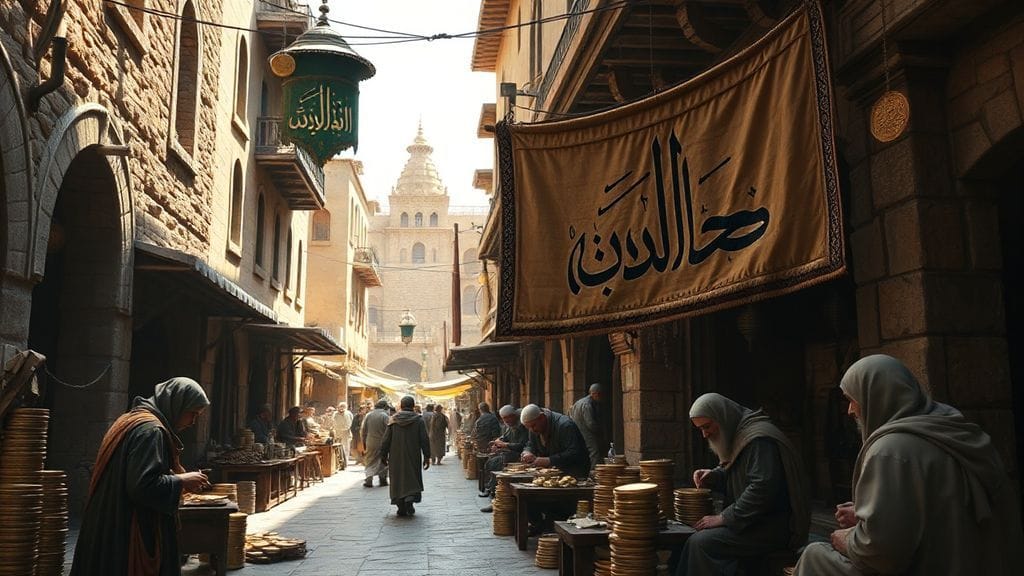
Damascus thrived as the physical and symbolic heart of Abd al-Malik’s caliphate. The city’s ancient streets echoed with the footsteps of officials drafting legal edicts in Arabic script and mint workers hammering out new dinars.
The Umayyad Mosque, built under Abd al-Malik’s patronage, was a monument to this new order—a spiritual and civic center combining worship with statecraft.
From here, the caliph exercised his power, projecting his will across the Levant and beyond, transforming Damascus from a provincial city into a cosmopolitan capital, emblematic of Islamic might and culture.
The Role of Arabic Language: Unifying Through Bureaucracy and Money
One of the most enduring legacies of Abd al-Malik’s reforms was the elevation of Arabic as the language of administration and coinage. By supplanting Greek and Persian, Arabic unified the empire culturally and politically.
This linguistic shift facilitated communication, legal coherence, tax collection, and cultural integration. Arabic script adorned coins, official correspondence, and architecture, knitting together diverse populations under a shared identity.
It was a masterstroke that reinforced the caliph’s authority and the empire’s ideological cohesion.
The Impact on Islamic Identity and Sovereignty
Abd al-Malik’s reforms crystallized what it meant to be an Islamic state. The administration and currency were no longer Byzantine holdovers but wholly Islamic institutions.
This transformation fostered a self-confidence among Muslims and positioned the Umayyads as legitimate heirs of both religious and political authority.
It helped resolve tensions between tribal loyalties and the wider ummah (Muslim community), framing governance as a sacred duty linked to divine will.
Economic Ramifications: Trade, Taxation, and State Revenue
The reform of coinage and administration had immediate economic consequences. Standardized currency facilitated trade across the Mediterranean and Indian Ocean worlds, moving commodities and money with ease.
Consistent taxation boosted state revenues, allowing Abd al-Malik to maintain a standing army, fund public projects, and ensure political stability.
Merchants, provincial governors, and everyday citizens all benefited from the predictability and trust engendered by this new system.
The Military and Administrative Nexus: Reforming Loyalty and Control
Abd al-Malik understood that reforms were inseparable from military power. A centralized administration enabled better funding for armies stationed on key frontiers facing Byzantium, Berber tribes, and rival Muslim factions.
By professionalizing governance and tying officials’ careers to the caliph’s favor, the regime built loyalty and discipline, reducing the risk of rebellions.
The reforms ensured that military force was backed by bureaucratic precision, securing the empire’s survival.
How These Reforms Shaped the Umayyad Legacy
The policies of Abd al-Malik laid the foundation for the Umayyad dynasty’s longevity and prestige. They transformed the caliphate into a durable imperial institution.
Though eventually supplanted by the Abbasids in 750 CE, the administrative and monetary systems Abd al-Malik established persisted, influencing subsequent Islamic governance.
His reign became a reference point for later rulers seeking to balance faith, power, and administration.
Reforms as a Prelude to Expansion and Consolidation
With internal order secured, Abd al-Malik’s caliphate could focus on expansion and consolidation. Stable finances and effective administration funded campaigns into North Africa, Central Asia, and the Iberian Peninsula.
The reforms facilitated control over newly conquered territories, ensuring they were integrated into the empire’s bureaucratic and economic systems.
This period set the stage for the golden age of Islamic civilization.
The Reactions: Resistance, Acceptance, and Adaptation
Change seldom comes without resistance. Some local elites chafed at the imposition of centralized authority and Arabic language.
Yet Abd al-Malik’s reforms proved adaptable, blending with local traditions while asserting the dominant political culture. Over time, the new coinage and bureaucratic practices gained acceptance, becoming normalized symbols of the caliph’s rule.
The process was gradual but decisive.
The Wider Mediterranean and Near East: Echoes of Change
Abd al-Malik’s monetary innovation resonated beyond Syria and the Islamic lands. Byzantine coins themselves underwent changes in response, adapting iconography and inscriptions.
Trade networks spanning Europe, Africa, and Asia encountered new standards, influencing economic behaviors. Diplomacy and cultural exchanges reflected a growing awareness of Islamic power and sovereignty.
In many ways, his reforms placed the Islamic caliphate on equal footing with older empires.
Abd al-Malik’s Reforms in the Eyes of Later Historians
Historians have praised Abd al-Malik as the architect of Islamic statehood. Early chroniclers like al-Tabari highlight his administrative genius and political acuity.
Modern scholars see his coinage reform as a milestone in cultural and political identity formation.
These achievements connect Abd al-Malik to the broader history of state formation globally.
Cultural and Religious Significance of the New Coinage
The new dinars and dirhams were more than currency—they were miniature works of art and faith. Etched with Quranic verses, they functioned as daily reminders of God’s sovereignty and the caliph’s role as His vicegerent.
The absence of figural imagery marked a conscious cultural break and a visual affirmation of Islamic principles.
This intertwining of material culture and religion was revolutionary.
Enduring Influence on Islamic Governance and Currency
Centuries later, Abd al-Malik’s reforms remain foundational. The Arabic inscriptions and Islamic symbolism introduced on coins endured in various Muslim polities.
His administrative reforms inspired state models in later dynasties, including the Abbasids and Ottomans.
The principles of centralized bureaucracy and currency standardized to reflect faith are part of his lasting legacy.
A Turning Point: The Inescapable Hand of Centralization
Abd al-Malik’s reign represents a turning point where the caliphate transitioned from a loosely held alliance of tribes and provinces to a centralized state apparatus.
This centralization was the key to political survival and cultural flourishing.
It redefined sovereignty not as tribal heritage but as regulated, symbolic, and bureaucratic power.
The Silent Revolution: Administrative and Monetary Consequences
Far from the battles and intrigues, Abd al-Malik’s reforms quietly revolutionized the state, ensuring that governance and economy mirrored the empire’s Islamic identity.
This silent revolution laid the groundwork for centuries of political and cultural dominance across a wide swath of the known world.
Abd al-Malik’s Damascus: Heart of a Renewed Empire
Finally, the city that witnessed the hammering out of new coins and the drafting of new edicts stands today as a testament to Abd al-Malik’s vision. Damascus became a beacon of Islamic civilization, its golden era inaugurated by reforms that combined faith, administration, and symbolism in a single grand design.
Conclusion
The story of Abd al-Malik’s reforms is one of transformation born from necessity, vision, and faith. In an age marked by conflict and fragmentation, this caliph recognized that power extended far beyond the battlefield. Authority needed to radiate through coins, written words, and administrative order.
By reshaping the empire’s bureaucracy and currency, Abd al-Malik did more than rule—he crafted an identity for an emerging Islamic civilization, foretelling a world where governance and faith were inseparable, and where every coin bore witness to divine sovereignty.
Today, as we gaze back at the minting chips struck thousands of years ago in Damascus, we glimpse the beating heart of a revolution that still resonates: the forging of a state, a faith, and a legacy.
FAQs
Q1: Why were Abd al-Malik’s reforms in administration necessary?
A1: The Umayyad Caliphate faced severe factionalism, inconsistent tax collection, and a fragmented bureaucracy. Abd al-Malik’s reforms centralized authority, standardized administration, and improved fiscal efficiency to stabilize his rule.
Q2: What was revolutionary about Abd al-Malik’s coinage reforms?
A2: He replaced coins bearing Christian and pre-Islamic symbols with pure Islamic inscriptions in Arabic, embedding Quranic verses and religious affirmations. This was a cultural and political assertion of Islamic sovereignty unprecedented at the time.
Q3: How did Arabic language reforms impact the caliphate?
A3: Making Arabic the sole administrative and monetary language unified diverse peoples, simplified governance, and bolstered Islamic identity across the empire.
Q4: How did these reforms strengthen Abd al-Malik’s political power?
A4: Centralized administration allowed better control over provinces, increased tax revenues to fund armies, and reinforced loyalty through an official bureaucracy tied to the caliph.
Q5: Were there any resistances to the reforms?
A5: Some local elites and populations resisted changes, especially linguistic and symbolic shifts, but over time these reforms became normalized and contributed to the caliphate’s cohesion.
Q6: What is the lasting legacy of Abd al-Malik’s reforms?
A6: His reforms laid the foundations for Islamic statehood, influencing bureaucratic practices and currency designs for centuries, and shaping the political identity of the Islamic world.
Q7: How did the reforms affect trade?
A7: Standardized Islamic coinage facilitated more predictable and extensive trade networks across the Mediterranean, Near East, and beyond, enhancing the empire’s economy.
Q8: Why is Damascus so significant in Abd al-Malik’s story?
A8: As the Umayyad capital, Damascus was the administrative, cultural, and spiritual hub where Abd al-Malik’s reforms were implemented and symbolized imperial unity.