Table of Contents
- The Dawn of a New Asturias: The Reign of Alfonso II
- Oviedo: From Modest Settlement to Royal Capital
- Setting the Stage: The Iberian Peninsula in the Late 8th Century
- Alfonso II’s Vision: A Kingdom Beyond Mountains
- The Political Landscape: Allies, Enemies, and the Moors' Shadow
- The Expansion Southward: Conquest and Consolidation
- The Role of the Church: Religion as a Unifying Force
- Life in Late 8th Century Asturias: People, Culture, and Society
- Military Campaigns: Strategy and Legacy
- The Significance of Oviedo’s Urban Development
- Alfonso II and Charlemagne: Diplomacy Across Borders
- The Birth of a Christian Kingdom in a Contested Land
- Asturias’ Influence on Later Reconquista Efforts
- The Myth and Reality of Alfonso II’s Achievements
- Economic Transformations: Agriculture, Trade, and Growth
- The Artistic and Architectural Flourishing Under Alfonso II
- Oral Traditions and Chronicles: Remembering the Expansion
- The Impact on Moorish Territories and Populations
- Asturias’ Role in Shaping Medieval Iberian Identity
- Long-Term Consequences: Cultural and Political Resonances
- Conclusion: Alfonso II’s Legacy in the Making of Spain
- FAQs: Unpacking Asturias’ Southern Expansion
- External Resource
- Internal Link
The Dawn of a New Asturias: The Reign of Alfonso II
The air was crisp in the mountainous lands of Asturias as Alfonso II ascended the throne in a time fraught with uncertainty but ripe for bold endeavors. In the late 8th century, his kingdom was a beacon of Christian resistance amidst the sprawling influence of al-Andalus to the south and the shifting alliances among local tribes and noble houses. Alfonso II, often called "the Chaste," was more than a king; he was a cultivator of identity, a witness to transformation, and above all, a formidable architect of expansion.
At a moment when much of the Iberian Peninsula had succumbed to Islamic rule since the early 700s, the tiny Christian enclave of Asturias clung to survival—and to hope. Alfonso II inherited a territory surrounded by formidable obstacles but poised to grow. His reign would see the kingdom not only defend its rugged frontiers but expand them, reaching further south beyond the Cantabrian Mountains toward the plateau and river valleys below.
Oviedo: From Modest Settlement to Royal Capital
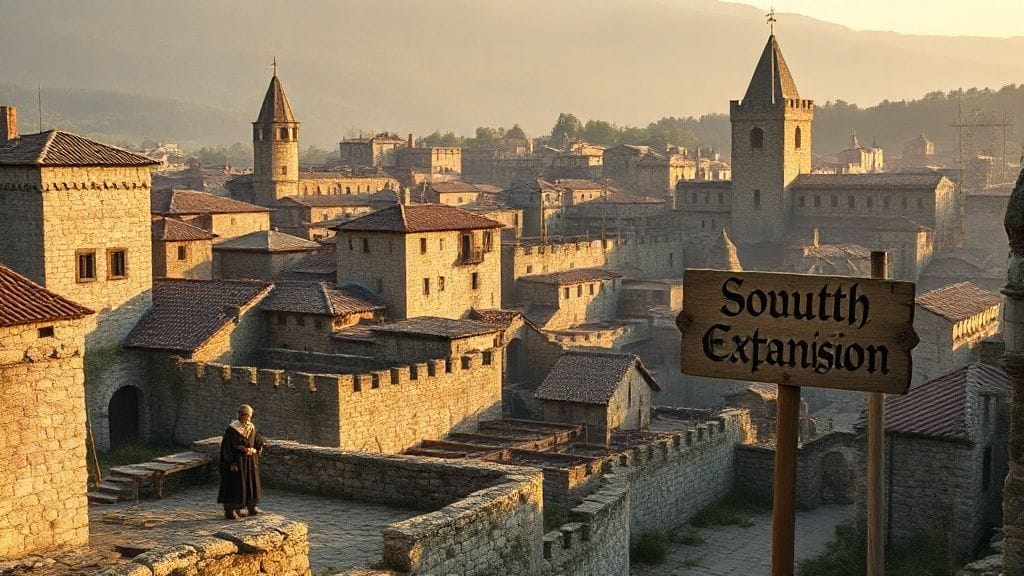
In 761, years before Alfonso II, a modest settlement named Oviedo was founded by monks and nobles, nestled within the fertile valleys of the Asturias. Yet, it was under Alfonso’s reign, starting approximately in 791, that Oviedo transcended its humble origins to become a political and spiritual heart of the kingdom. This transformation was no mere coincidence—it was the deliberate act of a ruler keen to unify his realm around a central locus of power.
Oviedo became a symbol of stability, a fortified seat where secular and religious authorities could converge. The city’s walls and palatial structures rose, marking a departure from a transient collection of villages to a permanent capital. Here, Alfonso II consolidated power, summoned councils, and fostered religious fervor by promoting the cult of Saint James and facilitating pilgrimage routes—threads that would weave Asturias into the wider Christian fabric of Europe.
The city’s transformation mirrored the ambitions of Alfonso II—a monarch intent on forging a lasting kingdom amid turbulent times.
Setting the Stage: The Iberian Peninsula in the Late 8th Century
The backdrop of Alfonso II’s reign was a peninsula fractured and layered with competing powers. Since the Umayyad conquest of Hispania in 711, much of the territory had fallen under Muslim control, establishing the Emirate of Córdoba as a dominant power with sophisticated administration and cultural richness.
At the same time, pockets of Christian resistance persisted in the northern mountainous regions. Asturias, because of its rugged terrain and remote position, served as a nucleus of Christian continuity. Yet even this kingdom was not insulated from external threats and internal challenges. Religious diversity, shifting tribal loyalties, and raids carved the political climate.
Farther north and east, the Frankish Empire under Charlemagne watched the Iberian question closely, concerned both by the expansion of al-Andalus and the fate of Christendom in its southwest frontier. It was in this context—the collision of faith, power, and geography—that Alfonso II’s policies operated.
Alfonso II’s Vision: A Kingdom Beyond Mountains
Alfonso II’s vision was audacious: to push Asturias beyond the natural obstacles that had shaped it—to forge a kingdom that could project power, protect its people, and influence the wider Christian world. The Pyrenees and Cantabrian Mountains were more than geographic features; they were barriers to political and cultural expansion.
But Alfonso II perceived opportunity. Control over the lands south of Asturias meant access to fertile plains, trade routes, and greater influence in the Iberian theater. His expansion was not merely military conquest but political diplomacy, building alliances with local Visigothic nobility displaced by the Muslim invasion and integrating them into Asturias’s growing polity.
This was a slow, incremental process, marked by the resettlement of frontier towns, fortification of castles, and administrative reforms—laying the groundwork for future generations to build upon.
The Political Landscape: Allies, Enemies, and the Moors' Shadow
The late 8th century was marked by an ambiguous balance of power. The Emirate of Córdoba, under the Umayyad emir Hisham I, was consolidating, while local Muslim governors jostled for authority amid occasional rebellions.
Asturias faced constant raids and the threat of reprisals. Yet Alfonso II was wise to the complexity of politics beyond sheer confrontation. He sought alliances with disaffected groups, including Christian nobles and even Muslim factions opposing Córdoba's central authority.
His court thrived as a diplomatic hub where emissaries came and went—each with their own agendas, but all recognizing that this remote Christian kingdom was becoming a crucial strategic player. Alfonso’s own claim to the Visigothic legacy added weight to his position as the successor of a Christian Iberia destined for renewal.
The Expansion Southward: Conquest and Consolidation
The heart of Alfonso II’s southern expansion lay in a series of military and colonizing campaigns pushing past the rugged northern ranges into the river basins below. These ventures required careful planning and a steady flow of settlers willing to inhabit and defend the frontier.
One can imagine the tense marches of men and horses through mountain passes, the establishment of watchtowers and fortresses, and the negotiation with local populations—some Christian, others Muslim, many simply caught between two worlds.
The historical records are sparse but persistent in naming the expansion as a sustained effort that secured strategic points, such as valleys along the Nalón and Navia rivers, transforming them into livable, productive lands beholden to Asturias. These successes laid the foundation that would ultimately feed into the broader Christian Reconquista centuries later.
The Role of the Church: Religion as a Unifying Force
The twining of church and state in Asturias was instrumental to its cohesion and legitimacy. Alfonso II nurtured the church’s authority, understanding that spiritual unity was as imperative as military might in a land fragmented by conflict and faith.
The promotion of the cult of Saint James (Santiago), whose supposed relics were "discovered" in nearby Compostela during his reign, sparked a Christian revival that rippled across Europe. Alfonso II championed pilgrimage routes that connected his kingdom to the Carolingian empire and beyond—a subtle yet profound means of fostering international support.
Monasteries flourished in Oviedo and beyond, serving as centers of learning, record-keeping, and cultural preservation. Through this ecclesiastical network, Alfonso II’s kingdom asserted itself as a bastion of Christian values amidst a Muslim-dominated peninsula.
Life in Late 8th Century Asturias: People, Culture, and Society
While kings and battles dominate the chronicles, the lives of ordinary Asturians were anything but static. Peasants, shepherds, artisans, and clergy lived amid forested hills and fertile valleys, enduring harsh winters and seasonal cycles.
The expansion meant new lands cultivated and a growing population increasingly tied to the land by tenure and custom. The fusion of Visigothic traditions with local Asturian culture created a distinctive social fabric. Traditional justice coexisted with ecclesiastic courts, and communal festivals were punctuated by the Christian liturgical calendar.
Women, while not prominent in political chronicles, played vital roles within kinship networks and economic life, preserving cultural norms and facilitating community resilience.
Military Campaigns: Strategy and Legacy
Alfonso II’s military undertakings were marked less by grand decisive battles and more by strategy, incremental gains, and adaptive tactics suited to rugged terrain. Guerrilla warfare, fortification building, and controlling mountain passes were favored over large pitched engagements.
The use of cavalry and knowledge of local geography conferred advantages against Moorish raiders, whose control was stronger on open plains and cities than in these resurgent borderlands.
This approach ensured not only survival but the ability to project power. Several strongholds founded during Alfonso’s reign persisted as centers of defense throughout the next centuries.
The Significance of Oviedo’s Urban Development
Transforming Oviedo into a true capital was an act with deep political symbolism. Alfonso II’s investments in urban planning and construction reflected the kingdom’s confidence and growing bureaucratic needs.
Palatial halls, churches, and defensive walls were erected with craftsmanship and ambition. The city became a magnet for artisans, clergy, and courtiers—its streets echoing with new ideas and reinforcing a distinct Asturian identity.
Oviedo’s urban growth under Alfonso II also had a practical dimension: it was a nerve center coordinating military, religious, and administrative activities that shaped Asturias' southern expansion.
Alfonso II and Charlemagne: Diplomacy Across Borders
Although distant, the Franks under Charlemagne represented an essential potential ally. Alfonso II is believed to have sent emissaries to the Frankish court, seeking recognition and possibly support for his Christian kingdom.
This early diplomacy presaged the later relationships between Christian Iberian kingdoms and the wider Carolingian world. Even without formal alliances, the sharing of cultural and religious practices linked Asturias to a European Christian identity beyond its mountain borders.
Such interactions underscored Alfonso II’s awareness that survival demanded more than arms—it demanded diplomatic finesse.
The Birth of a Christian Kingdom in a Contested Land
Asturias under Alfonso II was the seed of what would eventually become the Kingdom of León, then Castile, and finally modern Spain. His southern expansion marked a turning point from mere survival to territorial ambition.
This birth was fragile and incremental but imbued with symbolic weight. Alfonso II offered a vision of a Christian polity rekindling the legacy of the Visigoths and opposing the Muslim Al-Andalus.
His reign stands as a landmark in the complex process of carving out spaces of Christian rule on the Iberian Peninsula during the early Middle Ages.
Asturias’ Influence on Later Reconquista Efforts
Though the Reconquista would take centuries to unfold fully, the foundations laid under Alfonso II were crucial. His efforts in territorial consolidation, urban development, and alliances created a template for expansion.
Later kings built on his achievements, emboldened by the idea that Christian kingdoms could regain ground and influence. The narrative of Asturias as the cradle of reconquest entered into folklore and political ideology, inspiring future generations.
In this way, Alfonso II’s reign is more than a historical episode; it is a cornerstone of Spanish national memory.
The Myth and Reality of Alfonso II’s Achievements
Over centuries, Alfonso II’s persona merged with legend. He was often ascribed miraculous powers and credited with founding churches overnight. Chronicles penned centuries later painted him as a saintly king, pious and just.
Separating myth from reality requires sifting through sparse records and recognizing the blend of political propaganda, religious fervor, and oral traditions.
Yet beneath the embellishments lies the undeniable truth of a ruler who faced formidable challenges and left a lasting imprint on his kingdom, shaping the course of Iberian history.
Economic Transformations: Agriculture, Trade, and Growth
The expansion south opened new lands to agriculture. Terracing, irrigation, and the clearing of forests permitted increased production of oats, rye, and livestock pasturing.
Trade routes, both internal and external, connected Asturias to Cantabria, Galicia, and even the Frankish domains. While modest compared to Mediterranean hubs, these economic networks sustained the kingdom’s growth.
Mining of metals such as iron also took on importance, fueling the tools and weapons necessary for defense and expansion.
The Artistic and Architectural Flourishing Under Alfonso II
Asturias witnessed a distinctive artistic period, often called the Asturian Pre-Romanesque style. Churches built during Alfonso II’s reign combined Visigothic, Mozarabic, and local elements.
Structures like the Church of San Miguel de Lillo and Santa María del Naranco showcased innovative stone carving, unique layouts, and religious symbolism.
These monuments are tangible legacies of a kingdom asserting its identity visually and spiritually during the expansion southward.
Oral Traditions and Chronicles: Remembering the Expansion
The story of Asturias' expansion was kept alive partly through oral tradition. Minstrels and local bards recounted tales of heroic kings and battles, fortresses built overnight, and divine interventions.
Later medieval chronicles, such as the “Chronicle of Alfonso III,” compiled these stories with a Christianizing agenda. They served not only to record history but to inspire and legitimize the ruling dynasty.
These narratives helped cement Alfonso II’s memory as a heroic figure, making his reign a beacon for Asturias' cultural heritage.
The Impact on Moorish Territories and Populations
The southern expansion disturbed the established order of al-Andalus in these borderlands. Some Muslim communities sought accommodation with Asturias; others resisted fiercely.
Population movements included refugees fleeing conflict and settlers encouraged by Alfonso II to inhabit newly secured regions.
This interplay created zones of cultural contact and conflict, laying groundwork for the centuries-long dynamic between Christian and Muslim polities on the peninsula.
Asturias’ Role in Shaping Medieval Iberian Identity
The resistance and expansion under Alfonso II contributed to a fledgling regional identity that merged Gothic, Roman, and indigenous elements with Christian faith.
This early Asturian identity provided a foundation for the later formation of navarrese, leonese, and castellano identities.
In this sense, the expansion south under Alfonso II was not only territorial but profoundly cultural, influencing language, customs, and political concepts in medieval Iberia.
Long-Term Consequences: Cultural and Political Resonances
Alfonso II’s reign echoed far beyond his lifetime. The territorial gains increased the kingdom’s resources and political significance.
His policies established frameworks for future rulers who intensified Christian reclamation of the peninsula.
Moreover, Asturias’ survival and growth inspired legends that would galvanize medieval and modern Spain’s historical imagination, linking the mountains of the north to the eventual unity of Spain.
Conclusion
Alfonso II’s expansion of Asturias southward stands as a testament to the resilience of a people and a kingdom at a crossroads of history. It tells of a ruler not content with mere survival but driven to transform his homeland—turning rugged mountains into a springboard for growth, faith, and identity.
This chapter in Iberian history, though sparse in written records, resonates with enduring human truths: the yearning for belonging, the struggle against overwhelming odds, and the eternal hope for renewal. Asturias, through Alfonso II, not only expanded its borders but sowed seeds that would blossom into the Spain we know today.
It’s incredible to think that beneath the quiet hills of northern Spain, behind those ancient walls and stone churches, lay the fervent heartbeat of a nascent kingdom daring to reach southward, into history.
FAQs
Q1: Why was Alfonso II’s reign pivotal for Asturias?
A1: Alfonso II transformed Asturias from a defensive refuge into an expanding kingdom by consolidating internal authority, developing Oviedo as a capital, and pushing territorial boundaries southward, thereby laying foundations for the Reconquista.
Q2: What was the significance of Oviedo during Alfonso II’s reign?
A2: Oviedo became the political and religious center of Asturias, symbolizing the kingdom's unity and growth, hosting royal and ecclesiastical authority, and serving as a hub for cultural and administrative development.
Q3: How did Alfonso II manage relations with the Moors?
A3: Alfonso II employed both military defense against raids and diplomatic alliances with disaffected Muslim factions, utilizing strategic negotiation alongside conquest to secure his borders.
Q4: What role did religion play in Asturias’ expansion?
A4: Religion was central; promoting saints’ cults, building churches, and linking Asturias to European Christendom helped legitimize Alfonso II’s rule and united his subjects culturally and politically.
Q5: How did Alfonso II’s southern expansion influence the later Reconquista?
A5: His campaigns and settlements established critical footholds and political structures that future Christian kingdoms expanded from, shaping the ideological and territorial paths of the Reconquista.
Q6: What cultural legacies did Alfonso II leave behind?
A6: Alfonso II oversaw an artistic renaissance (Asturian Pre-Romanesque architecture), urban growth in Oviedo, and contributed to the formation of a distinctive Asturian Christian identity.
Q7: How reliable are the historical sources on Alfonso II?
A7: Many records were written centuries later, blending historical facts with legend; however, archaeological evidence and contemporary accounts support key aspects of his reign and expansion efforts.
Q8: What economic changes accompanied the expansion?
A8: New agricultural lands were developed, trade routes expanded, and mining activities increased, all of which boosted Asturias’ economic base and supported its growing military and administrative needs.

