Table of Contents
- The Dawn of a Turbulent Era: Setting the Stage for the Battle of Marcellae
- The Byzantine Empire in the Late 8th Century: Power, Politics, and Peril
- The Bulgarian Khanate under Kardam: A Rising Force in the Balkans
- The Geopolitical Chessboard: Byzantium and Bulgaria in the Balkans
- The Road to Marcellae: Incidents and Escalations Leading to War
- The Battlefield near Karnobat: Geography and Strategy
- Martial Preparations: Armies, Commanders, and War Technologies
- Dawn of 792: The Clash of Titans at Marcellae
- The Battle Unfolds: Tactics, Valor, and Turning Points
- Aftermath of the Defeat: Byzantine Retreat and Bulgarian Consolidation
- Kardam’s Victory: Political and Military Consequences
- The Impact on Byzantine Internal Affairs and the Reign of Constantine VI
- The Bulgarian Ascendancy: From Marcellae to Regional Dominance
- The Wider Balkan Context: How This Battle Shaped the Future of Southeast Europe
- Legacy and Memory: Marcellae in Historical Narratives and Bulgarian Identity
- Reflections on Power, Empire, and Survival in the Medieval Balkans
- The Battle of Marcellae in Modern Historiography and Popular Culture
1. The Dawn of a Turbulent Era: Setting the Stage for the Battle of Marcellae
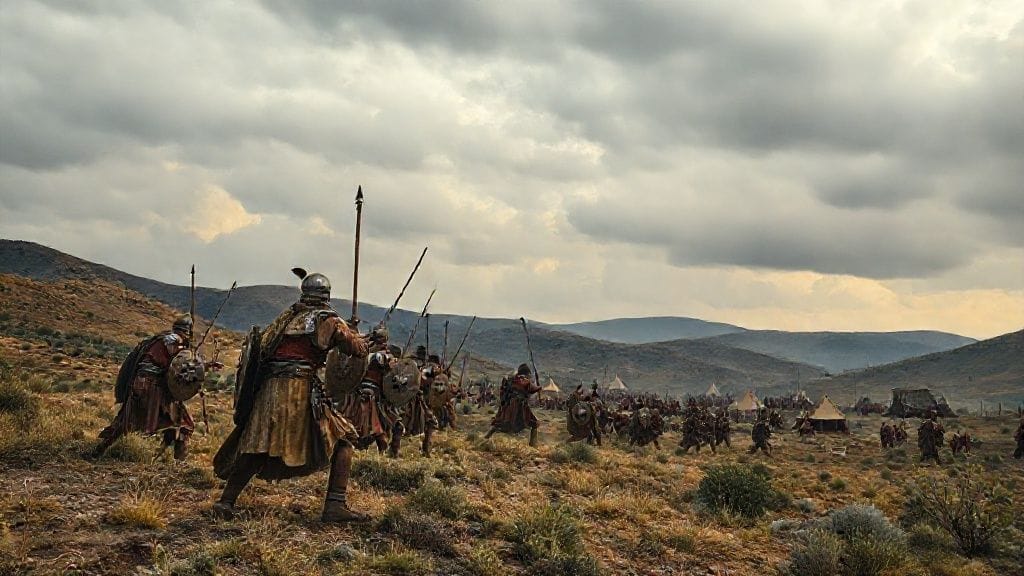
A cold dawn was breaking over the rolling hills near the small town of Karnobat in modern-day Bulgaria. The landscape, scarred by centuries of turmoil and conquest, bore silent witness to a gathering storm — two ancient peoples bracing themselves for a contest that would echo through history. In the year 792, the fields near the Marcellae fortress would become the proving ground of a fierce clash between the Byzantine Empire and the Bulgarian Khanate, a confrontation rich in strategic cunning, political ambition, and raw human will.
The battle was not merely a contest for territory; it was a confrontation of worlds — an old empire trying to reclaim its waning influence, and a rising power hungry for recognition and autonomy. The tensions had been simmering for decades, fueled by dynastic disputes, border skirmishes, and the inevitable collision of ambitions that shaped medieval Europe’s volatile southeastern frontier.
As dawn broke, the fog lifted slowly, revealing lines of armor glinting faintly in the cold light — the Byzantine troops under Emperor Constantine VI facing off against Kardam’s battle-hardened Bulgarians. Both armies knew what was at stake: not just the future of their peoples, but their own legacies. The clash at Marcellae would soon erupt into a violent ballet of swords and strategies that historians would recount for centuries.
2. The Byzantine Empire in the Late 8th Century: Power, Politics, and Peril
The late 8th century found Byzantium at a crossroads. Once the mightiest heir to Rome’s legacy, the empire was grappling with internal strife, powerful aristocratic factions, and an increasingly fragmented political landscape. Emperor Constantine VI, ascending the throne as a young ruler, struggled to assert firm control over the empire, which was still reeling from decades of iconoclastic controversy and military campaigns along its borders.
The Byzantine military, though formidable in tradition and numbers, was stretched thin by a range of crises. The empire faced not only external threats but also internal revolts and economic strains that sapped its vitality. Along the northern frontier, the emergence of the Bulgarian Khanate as a militant and politically savvy state posed one of the most significant challenges. Byzantium’s ambitions in the Balkans were complicated by shifting alliances and the enduring legacy of earlier defeats.
3. The Bulgarian Khanate under Kardam: A Rising Force in the Balkans
Meanwhile, the Bulgarians, led by Khan Kardam, were cementing their status as a powerful polity in Southeastern Europe. The Bulgar tribes had settled in the region in the 7th century but were gradually establishing a structured state that combined nomadic vigor with newly acquired Balkan administrative practices.
Kardam, ascending to power during turbulent times, was a leader forged by conflict and necessity. He inherited a fledgling realm contending for survival amid continuous Byzantine pressure. His reign symbolized a shift from mere raiding towards sustained military and political engagements — bold attempts to carve out a recognized and respected state.
This was a period of innovation and adaptation for the Bulgarians: their cavalry tactics, clever use of terrain, and coordination under charismatic leaders gradually challenged Byzantine hegemony. Kardam’s vision was clear — to defend Bulgar lands and assert a permanent stake in the regional power dynamics.
4. The Geopolitical Chessboard: Byzantium and Bulgaria in the Balkans
The Balkans in the late 8th century resembled a turbulent chessboard where empires and emergent powers dueled for influence. Byzantium sought control over the vital mountain passes, trade routes, and the fertile plains that linked Europe and Asia. Bulgaria, larger in ambition and increasingly confident, aimed to establish itself as the dominant force in the Balkans, bridging steppe nomadic traditions with the settled life of the region.
This dynamic was shaped not only by military confrontation but also religious and cultural factors: Byzantium promoted Orthodox Christianity and Greek culture, while the Bulgarians maintained a complex relationship with pagan traditions and, increasingly, Slavic cultural elements. The contest was thus ideological as well as corporeal.
Byzantine attempts at diplomacy were often undercut by mistrust and constant border raiding, while the Bulgarians capitalized on Byzantine weaknesses — especially the empire’s internal political disputes — to assert their autonomy and territorial claims.
5. The Road to Marcellae: Incidents and Escalations Leading to War
By the late 790s, the fragile peace that had intermittently held was fracturing rapidly. Minor border skirmishes gave way to larger raids, while diplomatic envoys failed to bridge widening divides. Kardam, growing in confidence and military strength, challenged Byzantine authority openly, testing the empire’s resolve.
In 791, the first serious confrontation near the fortress of Marcellae signaled that the simmering tensions were boiling over. Byzantium’s refusal to recognize Bulgar sovereignty and continued incursions prompted a build-up of forces on both sides. The stage was set for a decisive encounter.
The symbolic and strategic importance of Marcellae — perched on the routes between the interior Balkans and the Black Sea coast — made it a natural flashpoint. For Byzantium, controlling this point meant maintaining a foothold in the north; for Bulgaria, it was a gate to expansion.
6. The Battlefield near Karnobat: Geography and Strategy
The choice of battleground near Karnobat was no accident. This area, marked by rolling hills, river valleys, and densely wooded patches, offered natural advantages that could be exploited by a well-led force familiar with the terrain. The Byzantines, with their traditional infantry-heavy formations and heavy cavalry, sought to leverage disciplined lines and superior numbers.
The Bulgarians, on the other hand, relied on mobility, familiarity with the rugged landscape, and a mix of infantry and horse archers — a legacy of their steppe origins. Kardam’s strategy leaned on ambushes, flexible formations, and exploiting any Byzantine rigidity or hesitation.
Thus, the geography of Marcellae was as much an active participant in the battle as the men wielding swords and shields. The surrounding terrain encouraged cunning maneuvers and punishing counterattacks.
7. Martial Preparations: Armies, Commanders, and War Technologies
Byzantine forces were a composite of seasoned veterans and levied troops, arrayed under the personal command of Emperor Constantine VI. His desire for a decisive victory was as much about securing his throne at Constantinople as it was about subduing Bulgaria. Byzantine armaments included heavy cavalry known as cataphracts, shielded infantry, and archers, relying on a combination of discipline and heavy armor.
On the Bulgar side, Kardam commanded fewer men but ones intensely loyal and battle-hardened. Their weapons were lighter, their tactics flexible — composite bows, short swords, and versatile armor emphasized speed and surprise.
War technologies of the time were less about artillery, focusing more on mounted combat, shield walls, and close-quarter fighting. Both commanders understood that terrain and morale would prove decisive as much as numbers or equipment.
8. Dawn of 792: The Clash of Titans at Marcellae
At first light in the early spring of 792, the two armies faced off. The air was tense, heavy with the anticipation of bloodshed. Constantine VI, commanding from the center, hoped to smash the Bulgar lines with the weight of his cavalry, while Kardam held his forces in guarded formations, waiting to exploit any mistake.
As the sun rose, the silence was shattered by the clash of steel and the rallying cries of men thrown into mortal combat. The battlefield shook with the stamping of hooves and the roar of warriors determined to shape history with their valor.
The fight dragged on for hours. Byzantine attempts to envelop the Bulgarians were met with cunning counterattacks. Kardam’s cavalry used feigned retreats and sudden charges, wearing down the Byzantine formations.
9. The Battle Unfolds: Tactics, Valor, and Turning Points
The battle at Marcellae was a masterclass in strategic patience by the Bulgarians and a sharp lesson in Byzantine overconfidence. Despite their numerical advantage, the Byzantines struggled to adapt to the fluid tactics of their opponents.
Kardam seized a critical moment late in the day: a gap opened in the Byzantine left flank. Leading a decisive charge, the Bulgarians exploited this weakness, breaking through and sowing chaos. The imperial forces faltered, and Constantine VI was forced into a reluctant retreat.
Stories from the field tell of fierce individual combats, unexpected heroism, and devastating losses. One contemporary chronicler emphasized the “resolute courage of the Bulgar horsemen” amid a “disarrayed and broken Byzantine host.”
10. Aftermath of the Defeat: Byzantine Retreat and Bulgarian Consolidation
The Byzantine retreat from Marcellae was disorderly, revealing the empire’s fracture lines. Emperor Constantine VI returned humiliated and politically weakened to Constantinople, where unrest brewed.
Meanwhile, Kardam capitalized fully on his victory. He pressed his advantage by securing key border areas and negotiating from a position of strength. Bulgaria’s prestige soared, bolstered by a triumph against one of the world’s great empires.
The battle had demonstrated the limits of Byzantine power and the rise of a new Balkan equilibrium.
11. Kardam’s Victory: Political and Military Consequences
Kardam’s success at Marcellae was more than a battlefield triumph: it marked a turning point in Bulgar-Byzantine relations. The Bulgarians gained de facto recognition, while the Byzantines were forced to reconsider their Balkan policy.
For Kardam, the victory solidified his rule and strengthened the Bharugar political structure. Militarily, it encouraged further reforms and a confidence that Bulgaria could stand as a central player on the European stage.
Politically, the defeat delegitimized opponents of confrontation in Constantinople and underscored the empire’s vulnerabilities.
12. The Impact on Byzantine Internal Affairs and the Reign of Constantine VI
In the wake of defeat, Constantine VI faced mounting opposition. His prestige suffered, and his grip on power weakened, while intrigues within the imperial court intensified.
Some historians argue that Marcellae contributed to the eventual downfall of Constantine VI, who was deposed and blinded by his own mother, Empress Irene, in 797. The battle symbolized the fragility of imperial ambitions and the consequences of miscalculation.
The loss also prompted military and diplomatic reforms, as Byzantium sought to recalibrate after the shock.
13. The Bulgarian Ascendancy: From Marcellae to Regional Dominance
This victory paved the way for Bulgaria’s golden age under future rulers like Khan Krum. The consolidation of territory and influence enabled the Bulgarians to dominate trade routes, forge alliances, and develop their unique statecraft.
Marcellae was remembered as a foundational moment — the proof that Bulgaria could challenge Byzantium not just in raids but in open battle, reshaping the map of the Balkans.
The battle foreshadowed the cultural flowering and political strength Bulgaria would enjoy in the 9th and 10th centuries.
14. The Wider Balkan Context: How This Battle Shaped the Future of Southeast Europe
Marcellae’s consequences extended beyond Byzantium and Bulgaria. The battle influenced the balance of power among Slavs, Avars, and other Balkan peoples, encouraging shifts in loyalties and settlements.
The assertion of a powerful Bulgarian state introduced a new dynamic that would affect Byzantine diplomacy, the spread of Christianity, and the ethnic and political makeup of the region for centuries to come.
The contest near Karnobat was an early chapter in the complex history that shaped modern Southeast Europe’s borders and cultural identities.
15. Legacy and Memory: Marcellae in Historical Narratives and Bulgarian Identity
Over the centuries, the Battle of Marcellae became enshrined in Bulgarian national memory as a symbol of resilience and sovereignty. Chroniclers and later historians celebrated Kardam’s leadership as emblematic of the spirit that sustained the Bulgarian people.
Byzantine sources, though often dismissive of the defeat, could not hide the respect accorded to the Bulgarian military prowess. The battle narratives informed medieval chronicles, poetry, and later nationalist historiography.
Marcellae stands today not just as a historic event but as a metaphor for the continued struggle for identity and survival in a contested region.
16. Reflections on Power, Empire, and Survival in the Medieval Balkans
The Battle of Marcellae encapsulates the formidable challenges of empire-building and regional dominance in medieval times. It reminds us of the fragile nature of power, the importance of leadership, and the unpredictability of warfare.
Through this clash, the interaction between two civilizations — Byzantium and Bulgaria — emerges not as a simple story of conquest but as a complex dialogue marked by respect, rivalry, and adaptation.
Historical memory frames it as a testament to human courage and the relentless will of peoples to define their destiny.
17. The Battle of Marcellae in Modern Historiography and Popular Culture
Though overshadowed by more famous battles of antiquity and the middle ages, Marcellae has gained renewed interest among historians seeking to understand the nuanced relationship between Byzantium and its neighbors.
Modern Bulgarian historiography highlights the battle as a foundational myth of statehood, while archaeological research near Karnobat continues to shed light on military tactics and material culture.
In popular culture, Marcellae occasionally appears in historical novels, documentaries, and educational programs, reminding new generations of the enduring legacy of this ancient clash.
Conclusion
The Battle of Marcellae was more than a military confrontation — it was a defining moment in the intricate dance of empires and emergent nations on the Balkan stage. Between the rolling hills of Karnobat, two worlds collided, testing the mettle of emperors and khans alike.
Kardam’s victory, born from strategic insight and relentless courage, challenged an empire’s centuries-old dominion, opening a new chapter of Bulgarian ascendancy and Balkan remaking. For Byzantium, it was a humbling reminder of shifting fortunes and the cost of overreach.
As we reflect on Marcellae, it becomes clear that history is never static but a living narrative of peoples striving for identity, power, and survival. This battle, frozen in time yet bursting with life, teaches us about the resiliency of nations and the enduring human spirit amid the chaos of war.
FAQs
Q1: What were the main causes of the Battle of Marcellae in 792?
A1: The primary causes included long-standing territorial disputes between Byzantium and Bulgaria, escalating border skirmishes, and the ambition of Khan Kardam to assert Bulgar sovereignty. The Byzantine Empire’s internal political instability and refusal to recognize the rising Bulgarian state contributed to tensions spiraling into open conflict.
Q2: Who were the key figures involved in the battle?
A2: The two main leaders were Emperor Constantine VI of Byzantium and Khan Kardam of Bulgaria. Constantine VI sought to reinforce imperial dominance, while Kardam aimed to defend and expand Bulgarian interests.
Q3: What was the strategic significance of Marcellae?
A3: Marcellae was strategically located near vital mountain passes and trade routes in the Balkans. Controlling it meant commanding access between the interior Balkans and the Black Sea, critical for military and economic influence.
Q4: How did the battle influence Byzantine politics?
A4: The defeat weakened Emperor Constantine VI’s position, exacerbating internal dissent and contributing to his eventual deposition. It revealed vulnerabilities in the Byzantine military and cleaved doubts about imperial invincibility.
Q5: What were the long-term consequences of the Bulgarian victory?
A5: The Bulgarian triumph affirmed their status as a major Balkan power, leading to territorial expansion and increased political influence. It set the stage for Bulgaria’s cultural and political florescence in subsequent centuries.
Q6: How is the Battle of Marcellae remembered today?
A6: In Bulgaria, it is commemorated as a symbol of national strength and resilience. Historians regard it as a turning point in Byzantine-Bulgarian relations and a crucial moment in medieval Balkan history.
Q7: Did the battle affect Byzantine relations with other neighboring peoples?
A7: Yes, the Bulgarian rise after Marcellae influenced Byzantine diplomacy with other regional groups, including Slavic tribes and Avars, altering alliances and power dynamics in the Balkans.
Q8: What sources provide information about the battle?
A8: Much of what is known stems from Byzantine chronicles, Bulgarian medieval texts, and archaeological studies. While Byzantine accounts often underplay the defeat, Bulgarian sources celebrate Kardam’s leadership.

