Table of Contents
- The Dawn of a New Era: The Foundation of St. Gall
- The Geopolitical Mosaic of Early 8th Century Alamannia
- Saint Gall: The Man Behind the Name
- Carolingian Ambitions and Ecclesiastical Expansion
- The Birth of a Monastic Hub: From Hermitage to Abbey
- Life in St. Gall during the Carolingian Formative Years
- The Role of the Abbey in the Alamannic and Frankish World
- The Manuscripts and Intellectual Flame Kindled at St. Gall
- St. Gall’s Architectural Beginnings: Stones That Speak
- Carolingian Religious Reforms and the Abbey’s Growth
- Politics and Power: St. Gall and the Carolingian Dynasty
- Relations with Rome: A Hub in the Christian Network
- The Abbey as a Cultural and Economic Beacon
- Challenges and Threats: Viking Raids and Internal Struggles
- The Legacy of the Foundation: St. Gall’s Enduring Influence
- How St. Gall Shaped European Monasticism and Scholarship
- Today’s St. Gallen: Echoes of the Carolingian Past
- Conclusion
- FAQs
- External Resource
- Internal Link
The story of St. Gall’s foundation in the early 8th century is not simply about stones and prayers. It is a vivid tapestry woven from faith, politics, culture, and the determined spirit of a man who converted the untamed wilderness of Alamannia into one of medieval Europe’s most significant centers of power and learning. As the morning sun broke over the misty hills of what is today eastern Switzerland, a quiet revolution was underway—a monastic seed was planted that would one day flourish into an enduring symbol of the Carolingian Renaissance.
The Dawn of a New Era: The Foundation of St. Gall
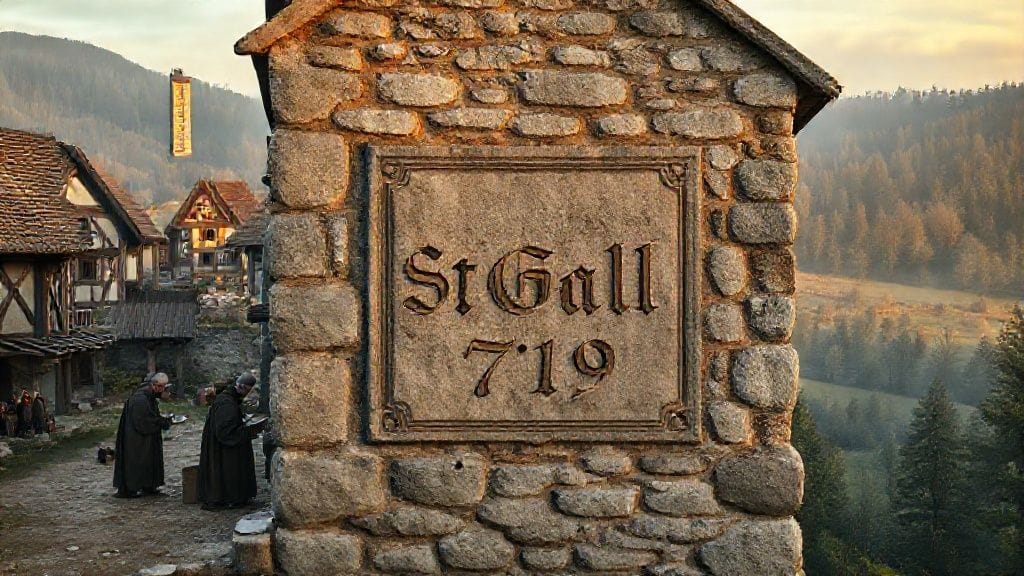
Imagine the dense forests and rolling hills of Alamannia around 719 AD, a borderland where the rugged slopes met the wild waters of the Steinach River. Into this landscape stepped Gall, an Irish monk searching for solitude and spiritual purity. His humble hermitage was rooted in peace but stood on the cusp of seismic historical shifts. The region was fragmented—an amalgam of tribal loyalties, feudal struggles, and the expanding shadow of the Frankish Empire.
But Gall was more than a solitary figure; he was a seed meant to bear fruit. Following his death in 646, his hermitage attracted disciples, and by the early 8th century, under the increasing influence of the Carolingian family, St. Gall was on its way to becoming a beacon for Christian learning and political power.
The Geopolitical Mosaic of Early 8th Century Alamannia
To fully grasp the importance of St. Gall’s foundation, we must first understand the volatile context of Alamannia in the early 700s. Nestled between the Frankish heartland and the Bavarian duchies, Alamannia was a land of fiercely independent tribes. The local Alamannic elite had complex relations with the Franks, oscillating between autonomy and submission.
The Carolingians, having supplanted the Merovingian kings as mayors of the palace, were eager to consolidate their widening realm. Monastic foundations became critical instruments of this policy. The political strategy was clear: monasteries served as outposts of both spiritual influence and territorial control, sanctifying conquest and pacifying frontier regions.
Saint Gall: The Man Behind the Name
Gallus, or Saint Gall, was an Irish missionary of the Hiberno-Scottish tradition, born likely in the late 6th century. Legend tells us he was a disciple of Saint Columbanus, the fiery Irish monk known for spreading Christian monasticism across Europe. According to hagiographies, Gall came to Alamannia seeking solitude, living as a hermit in a wild, uncultivated area near a spring.
But Gall was also a symbol—a spiritual pioneer whose life embodied the ascetic ideals of Irish monasticism, emphasizing prayer, manual labor, and scholarship. His sanctity and reputation would attract followers and, more importantly, the support of the Carolingian rulers decades later.
Carolingian Ambitions and Ecclesiastical Expansion
The early 8th century was a time of transformation for the Frankish realm. The Carolingians, particularly Charles Martel, were consolidating power to face threats from both pagan tribes and internal rivals. Monastic institutions became instruments to bind diverse peoples to the growing empire.
In this light, the development of St. Gall was not accidental. The Carolingians perceived monasteries as beacons of order, education, and religious orthodoxy. Establishing a monastery in the borderlands of Alamannia helped solidify Carolingian dominance, ensuring loyalty and enhancing cultural integration.
The Birth of a Monastic Hub: From Hermitage to Abbey
Following Gall’s death, his followers established a monastic community in his hermitage. By the early 700s, this community began to flourish. Around 719, under the protection of the Carolingians, the hermitage evolved into a formal monastery.
The monastery was dedicated to Gall's legacy but also quickly became a nexus for religious, political, and economic activity. The abbey attracted monks from diverse regions, blending Irish ascetic traditions with Frankish monastic reforms.
Life in St. Gall during the Carolingian Formative Years
Life within the early St. Gall community was a blend of spirituality and rigorous discipline. The Rule of Saint Benedict was introduced, emphasizing a structured daily routine of prayer, work, and study.
Far from being a secluded spiritual prison, the abbey was a hub of education. Monks painstakingly copied manuscripts, cultivated vineyards and fields, and managed the complex estate systems that sustained the monastery.
The mix of manual labor, scholarship, and governance reveals the holistic vision behind Carolingian monasticism.
The Role of the Abbey in the Alamannic and Frankish World
St. Gall quickly established itself as a central player in the political life of the region. The abbey’s leaders forged alliances with local nobles and Carolingian rulers, serving as mediators, advisors, and administrators.
Monasteries often wielded immense secular power, owning vast lands and exercising jurisdiction over nearby populations. St. Gall was no exception—its influence extended beyond the spiritual realm into the very secular heart of Alamannia.
The Manuscripts and Intellectual Flame Kindled at St. Gall
One cannot discuss the early abbey without mentioning its invaluable contribution to medieval scholarship. By mid-8th century, St. Gall became renowned for its rich manuscript tradition.
The scribes of St. Gall preserved and copied classical texts, biblical scriptures, and liturgical works. The famous St. Gall choir books and the earliest examples of the Carolingian minuscule script originate from this period. The intellectual flame ignited here helped fuel the broader Carolingian Renaissance, a revival of learning that shaped Europe for centuries.
St. Gall’s Architectural Beginnings: Stones That Speak
Though today’s magnificent cathedral arose centuries later, the foundations of St. Gall’s architecture were laid during its earliest years. The initial structures were humble wooden buildings surrounding a church, set amid a tightly organized monastic enclosure.
Archaeological and textual evidence shows an evolution from simple hermitage cells to a more complex compound featuring sleeping quarters, refectories, libraries, and chapels. This early expansion mirrors the abbey’s growing religious and political stature.
Carolingian Religious Reforms and the Abbey’s Growth
Under the Carolingian rulers, religious uniformity became a priority. The reform movement encouraged codification of liturgy, discipline among monks, and adherence to standardized monastic rules.
St. Gall embraced these reforms, aligning itself with the wider networks of the Church. These reforms laid the groundwork for the abbey's rapid development throughout the 8th century and beyond.
Politics and Power: St. Gall and the Carolingian Dynasty
The abbey’s fortunes were closely tied to the Carolingian dynasty. In return for protection and patronage, the abbots of St. Gall often found themselves entwined in the empire’s political intrigues.
The Carolingian rulers viewed the abbey as a cornerstone of their frontier policy, enhancing their presence in the often fractious Alamannia. In turn, St. Gall became a trusted outpost exerting spiritual and temporal influence.
Relations with Rome: A Hub in the Christian Network
St. Gall’s establishment also signaled the increasing integration of Alamannia into the Latin Christian world. The abbey maintained communications with Rome, aligning its liturgy and doctrine with papal standards.
Papal recognition was crucial for Saint Gall’s legitimacy, connecting this remote monastic community to the broader Christian Church and its hierarchy.
The Abbey as a Cultural and Economic Beacon
Beyond spiritual wealth, St. Gall was a flourishing economic center. The monastery managed vast tracts of land, collected tithes, and engaged in trade.
Its vineyards, farmlands, and artisan workshops contributed to local prosperity. Monastic wealth funded education, artistic production, and the expansion of its libraries—turning St. Gall into a beacon of Carolingian cultural achievement.
Challenges and Threats: Viking Raids and Internal Struggles
The abbey was not immune to the tumults of its age. While the greatest Viking raids on European monasteries occurred later in the 9th century, early threats from local warlords and internal succession disputes tested the community's resilience.
Yet time and again, St. Gall endured, adapting to political changes and emerging as a steady institution despite challenges.
The Legacy of the Foundation: St. Gall’s Enduring Influence
From its humble beginnings in a simple hermitage, St. Gall blossomed into a model of monastic life and learning. The abbey’s traditions influenced countless monastic communities beyond Alamannia.
Its manuscript collections would eventually become critical sources for medieval scholars, and its cultural imprint extended across the emerging European medieval order.
How St. Gall Shaped European Monasticism and Scholarship
The intellectual traditions nurtured in St. Gall helped define the Carolingian Renaissance—an era marked by the revival of classical knowledge and standardization of Christian liturgy and education.
The abbey's pioneering script, its preservation of ancient texts, and its scholarly activities were blueprints for later monastic centers throughout Europe.
Today’s St. Gallen: Echoes of the Carolingian Past
Modern St. Gallen proudly carries the legacy of its Carolingian foundation. The UNESCO World Heritage-listed abbey complex stands as a reminder of the city's ancient spiritual and cultural roots.
It remains a living testament to a time when faith, knowledge, and political vision converged to forge Europe’s medieval civilization.
Conclusion
The foundation of St. Gall as a Carolingian center was not merely an act of religious piety; it was a foundational moment where divine aspiration met worldly ambition. Through the vision of Saint Gall and the transformative power of Carolingian reform, a remote hermitage evolved into a beacon of faith, learning, and political might.
More than a monastery, St. Gall was a microcosm of early medieval Europe—a place where ideas were preserved and spread, where spiritual and secular power intertwined, and where the seeds of European civilization were lovingly tended. It reminds us that history is not just shaped by kings and battles but profoundly by places of quiet reflection that endure beyond the tumult of centuries.
FAQs
Q: Why was the foundation of St. Gall significant in the Carolingian context?
A: St. Gall served as a strategic religious and political center to extend Carolingian influence into Alamannia, forging links between spiritual authority and territorial control.
Q: Who was Saint Gall, and why is he important?
A: Saint Gall was an Irish monk and disciple of Saint Columbanus. His ascetic hermitage became the nucleus of the great abbey that bore his name, symbolizing the spread of Irish monastic ideals on the continent.
Q: How did the Carolingian dynasty benefit from St. Gall?
A: The dynasty used the abbey as a frontier outpost to consolidate territorial control, promote Christian reforms, and nurture intellectual revival tied to their imperial ambitions.
Q: What role did St. Gall play in the medieval intellectual revival?
A: St. Gall was a repository of classical and religious manuscripts and a center for manuscript production, catalyzing the Carolingian Renaissance that shaped medieval scholarship.
Q: What architectural heritage from the foundation period remains today?
A: While much of the original wooden structures are lost, the abbey's development set architectural precedents and the site’s layout influenced later monumental construction culminating in its Romanesque and Baroque phases.
Q: How did St. Gall’s foundation influence European monasticism?
A: It became a model combining Irish asceticism with Carolingian reforms, influencing monastic rules, liturgy, scholarship, and the organization of abbeys across Europe.
Q: Did St. Gall face threats during its early years?
A: Yes, the abbey navigated regional conflicts, internal disputes, and later threats from Vikings, yet it endured, illustrating the resilience of monastic institutions.
Q: How is the legacy of St. Gall perceived today?
A: It is celebrated as a symbol of cultural and spiritual continuity, its abbey complex recognized by UNESCO and its manuscripts treasured as windows into medieval civilization.

