Table of Contents
- The Dawn of an Era: Setting the Stage for the Synod of Chelsea
- Mercia’s Rising Influence in Anglo-Saxon England
- The Spiritual Landscape: The Church and the Crown Before 787
- The Papal Connection: Rome’s Growing Reach Across the Seas
- The Summons to Chelsea: Calling the Synod
- Key Figures Assemble: Kings, Bishops, and Royal Envoys
- The Synod’s Atmosphere: A Gathering of Faith and Power
- Doctrinal Decisions and Ecclesiastical Reforms
- The Affirmation of Royal-Papal Policy: What It Meant and Why
- The Role of King Offa of Mercia: Architect of the Alliance
- The Influence of Papal Authority in Anglo-Saxon Politics
- The Synod's Impact on Church Organization and Governance
- The Aftermath: Immediate Political and Religious Ripples
- Mercian Ambitions and the Consolidation of Power
- Long-Term Legacy: The Synod’s Place in Medieval English History
- The Synod’s Reflection in Contemporary Chronicles and Letters
- Anecdotes and Symbolism: What the Synod Tells Us About Identity
- The Broader European Context: Papal Relations Beyond England
- The Synod and the Shaping of Medieval English Monarchy
- Conclusion: The Enduring Echo of the Anglo-Saxon Synod of Chelsea
- FAQs: Unpacking the Synod’s Mysteries and Significance
- External Resource: Wikipedia Link for Further Exploration
- Internal Link: Visit History Sphere for More Historical Insights
The Dawn of an Era: Setting the Stage for the Synod of Chelsea
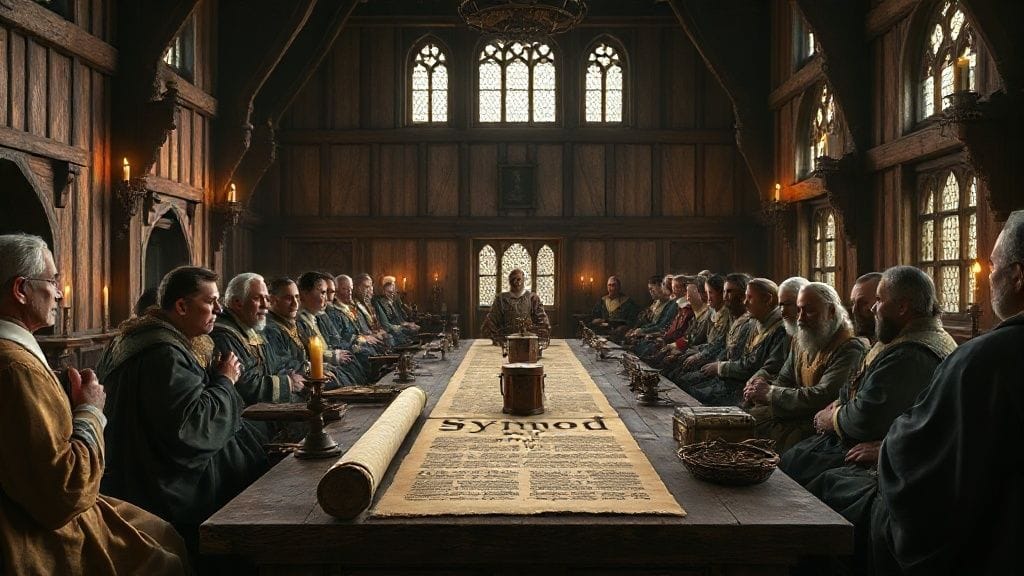
The year was 787. Across the rolling hills and patchwork fields of Mercia, the air was thick with anticipation and quiet intensity. Chelsea, a township straddling the ancient roads, had become a gathering place where kings and bishops would soon weigh the tides of power — both spiritual and secular. It was here, amid austere wooden halls and the murmurs of learned men, that an event unfolded with far-reaching consequences: the Anglo-Saxon Synod of Chelsea. This was no mere ecclesiastical meeting; it was a crucible where royal authority, papal ambition, and the destiny of a nascent English polity would intertwine irrevocably. The echoes of that gathering resonate still through the corridors of history, revealing a time when the future of England hung delicately between sword and cross.
Mercia’s Rising Influence in Anglo-Saxon England
Before the council convened, Mercia had already carved its identity as one of the dominant powers in Anglo-Saxon England. Under the leadership of King Offa, who ruled from 757 to 796, Mercia’s influence stretched wide, dominating rivals such as Northumbria and Wessex. Offa, a shrewd and determined ruler, understood that power required more than military strength; it demanded religious legitimacy.
Mercia’s ambitions were not parochial. They reflected a vision of England unified under a political and religious order modeled partly on continental Christian monarchies. Yet, Mercia was not just flexing muscle. It sought to embed itself within the spiritual authority that Rome symbolized, recognizing that the church’s blessing could sanctify kingship in a way swords never could.
The Spiritual Landscape: The Church and the Crown Before 787
At this juncture, the Anglo-Saxon church was both deeply local and increasingly cosmopolitan. Missionaries from Roman Oblates and Celtic traditions vied for influence, bishops sought favor with kings, and monastic communities flourished with varying degrees of autonomy. However, the absence of a clearly unified or centralized ecclesiastical authority left kings like Offa wary and restless.
The church often mirrored political fault lines, and without a firm anchoring in papal authority, regional leaders could claim both religious and secular independence. Offa’s desire was to integrate Mercian rule with the broader Christian world by affirming the supremacy — both spiritual and temporal — of the king under papal sanction.
The Papal Connection: Rome’s Growing Reach Across the Seas
The late eighth century was a pivotal moment for the papacy itself. Recently emerging from the turbulence of early medieval Europe and seeking to assert its authority more broadly, popes looked to extend influence beyond the Italian peninsula. England, fragmented and freshly evangelized, became a prime candidate for papal diplomacy.
Correspondence between Pope Adrian I and Offa illuminates a mutual desire to deepen ties. Rome sought reliable allies and evangelistic partners; Offa sought sacred endorsement to solidify claims to kingship and religious stewardship. The stage was set for the formalization of this relationship, and the Synod of Chelsea would be the crucible.
The Summons to Chelsea: Calling the Synod
Choosing Chelsea as the venue was symbolic and practical. Situated in the south of Mercian territory, it was accessible and traditionally significant for gatherings of nobility and church leaders. The formal summons brought nobly appointed bishops, abbots, and royal representatives into dialogue not only about faith but governance.
Historical accounts suggest the summoning was deliberate and strategic — a signaling of Mercia’s readiness to assume a central role in England and to align itself firmly with the Roman church. The synod was more than a religious council; it was a political theatre aimed at reshaping loyalties and affirming hierarchies.
Key Figures Assemble: Kings, Bishops, and Royal Envoys
Foremost among the attendees was Offa himself, whose presence underscored the close interplay of secular and sacred power. Bishop Hygberht of Lichfield, who would be heavily involved in the synod’s deliberations, represented a minor but rising ecclesiastical see strategically elevated by Offa to counterbalance Canterbury’s dominance.
Other notable figures included archbishops from Canterbury, the pivotal episcopal see in England, and papal legates dispatched to ensure that the synod followed the protocols and affirmed the policies dear to Rome.
These men, cloaked in embroidered tunics and bespoke episcopal robes, spoke different dialects but shared in a language of power expressed through canon law, ritual, and iconography.
The Synod’s Atmosphere: A Gathering of Faith and Power
Imagine the wooden meeting halls alive with the hum of voices debating theology interspersed with pointed political demands. Candles flickered against darkened walls, casting shifting shadows on faces marked by years of piety and ambition.
The air was charged not just with incense but with the palpable tension of men aware that their decisions would ripple across kingdoms and centuries. Every phrase in Latin was a thread weaving together faith and politics, while the exchange of blessings and affirmations was a performance in authority.
Doctrinal Decisions and Ecclesiastical Reforms
One of the synod’s primary functions was to articulate clear doctrinal stances aligning English practice with Roman orthodoxy. This involved clarifying liturgical uniformity, episcopal jurisdictions, and clerical discipline — all underpinned by the growing supremacy of papal prerogatives.
A remarkable outcome was the endorsement of the division of ecclesiastical sees to reinforce royal control. Notably, Offa’s successful elevation of Lichfield to archiepiscopal status challenged Canterbury’s historic monopoly and reshaped the hierarchical map of the English church.
The Affirmation of Royal-Papal Policy: What It Meant and Why
The synod declared an explicit alliance between the monarch and the papacy, affirming royal requests for papal privileges and the pope’s confirmation of Mercian ecclesiastical reforms. This cemented a novel relationship: the king as a protector and enforcer of the faith, holding legitimacy not only by birthright or conquest but by divine sanction through Rome.
This royal-papal policy heralded a precedent that kings in England would emulate for centuries – a fusion of spiritual endorsement and political rule that transformed governance itself.
The Role of King Offa of Mercia: Architect of the Alliance
Offa emerges from this history as a towering figure, not merely a warrior king but a diplomat and visionary who read the shifting sands of European power astutely. His insistence on the papal relationship was revolutionary.
Offa’s willingness to negotiate ecclesiastical structure and affirm papal authority was a calculated gamble that paid dividends. It reinforced his status, curtailed rivalries, and planted seeds for the English monarchy’s eventual self-perception as a divinely appointed institution.
The Influence of Papal Authority in Anglo-Saxon Politics
Before Chelsea, papal interventions in England were sporadic and limited. The synod marked a crucial inflection point — Rome’s voice was no longer distant but authoritative in determining local church matters and by extension influencing kingship.
This influence helped mediate internal disputes, inspired reforms, and occasionally empowered the papacy to act as an arbiter of conflicts between English rulers.
The Synod's Impact on Church Organization and Governance
Post-Chelsea, the ecclesiastical map of England was imprinted with new lines of power. The church’s organization became more hierarchical, and diocesan boundaries were redrawn to better fit political aspirations.
The synod also reinforced clerical discipline, harmonized liturgical texts, and fostered closer ties between monastic institutions and royal patronage. These changes stabilized church governance and aligned it firmly with Mercian political goals.
The Aftermath: Immediate Political and Religious Ripples
The weeks and months following the synod saw shifts in alliances and power dynamics across England. Offa’s enhanced prestige made rivals more cautious, while internal church reforms curtailed clerical dissent.
However, tensions simmered. Canterbury’s demotion bred resentment, and the delicate balance between royal power and ecclesiastical autonomy continued to be negotiated in episodic conflicts.
Mercian Ambitions and the Consolidation of Power
Armed with the legitimacy the synod provided, Mercia reached the zenith of its power. Offa embarked on extensive building projects, minted coins bearing his effigy, and conducted marriage alliances that expanded Mercia’s reach.
The synod had granted political theology — the philosophical and religious justification for Offa’s rule. This fusion helped Mercia dominate England throughout the late eighth century.
Long-Term Legacy: The Synod’s Place in Medieval English History
Though the detailed records are sparse, the Synod of Chelsea’s long shadow falls over English political theology for centuries. It paved the way for later medieval concepts of kingship rooted in divine right and papal connection.
The elevation of Lichfield was reversed later, but the principle of royal-papal alliance endured, influencing medieval kings and even shaping England’s complex relationship with the Catholic church through the ages.
The Synod’s Reflection in Contemporary Chronicles and Letters
Contemporary annals and letters, such as those of Alcuin of York, provide rare glimpses of the synod’s proceedings and significance. Alcuin’s cautious praise reveals both respect for Mercia’s rise and wariness about centralized power.
These writings humanize the event, illustrating how participants viewed their place in history amid theological debates and political gambits.
Anecdotes and Symbolism: What the Synod Tells Us About Identity
Legends hint at Offa commissioning the famous Offa’s Dyke — a monumental earthwork marking Mercia’s western boundary. While not directly connected to the synod, such symbols echo the era’s spirit of assertion and identity-building fostered at the council.
The synod became a symbol of English Christianity aligning with Rome, a cultural pivot reflected in art, law, and monarchy for generations.
The Broader European Context: Papal Relations Beyond England
The Synod of Chelsea was part of a larger papal strategy to consolidate Christian Europe under Rome’s aegis. Similar synods and reforms were underway in Francia and Lombardy, reflecting Pope Adrian I’s ambitious vision.
England’s inclusion in this network signaled its increasing integration into continental Christendom and its importance on the geopolitical chessboard.
The Synod and the Shaping of Medieval English Monarchy
By asserting papal recognition and restructuring ecclesiastical governance, the synod modeled a form of kingship that was both temporal and spiritual. This hybrid authority became the blueprint for future monarchs, including the Anglo-Normans and Plantagenets.
Thus, the 787 synod was more than a meeting; it was the birth of a political theology that anchored kingship within the Christian world order.
Conclusion
The Anglo-Saxon Synod of Chelsea in 787 stands as a remarkable testament to the interplay between faith and power at a formative moment in English history. It encapsulates the ambition of King Offa, the strategic assertiveness of the papacy, and the delicate dance of ecclesiastical and royal authority. Beyond dusty tomes and fractured records, the synod's story is one of human striving — the yearning to find legitimacy and identity amid shifting tides.
Through alliances sealed in councils and decrees writ in Latin, the foundations of medieval English monarchy were laid, merging sword and cross in a legacy that would endure well past Mercia’s twilight. It reminds us how moments of convergence, where spirituality and politics meet, have forged civilizations, shaping identities that resonate millennia later. The Synod of Chelsea is not merely history but a narrative of power, belief, and the timeless quest for meaning.
FAQs
1. Why was the Synod of Chelsea convened in 787?
The synod was called to address ecclesiastical reforms, affirm royal authority in church matters, and strengthen ties between Mercia and the papacy. King Offa sought papal endorsement to legitimize his political and religious aspirations.
2. Who was King Offa, and what role did he play in the synod?
Offa was the powerful Mercian king who orchestrated the synod as part of his strategy to consolidate power and legitimize his rule through royal-papal alliance.
3. What was the significance of elevating Lichfield to an archbishopric?
This move reduced Canterbury's monopoly, giving Mercia greater ecclesiastical independence and increasing Offa’s control over church affairs within his territory.
4. How did the synod affect the relationship between England and the papacy?
It formalized and deepened England’s ecclesiastical connection to Rome, making the papacy a key player in English religious and political life.
5. What were the political consequences of the synod for Mercia?
The synod boosted Mercia's prestige, helping Offa dominate other Anglo-Saxon kingdoms and securing his legacy as a ruler backed by divine sanction.
6. Did the decisions of the synod last beyond Offa’s reign?
While some reforms, like Lichfield’s archbishopric, were later reversed, the principle of royal-papal alliance continued to influence English monarchy for centuries.
7. How is the Synod of Chelsea documented?
Contemporary sources include chronicles, letters (notably by Alcuin), and papal correspondence, though detailed records are limited.
8. Why is the synod considered a turning point in medieval English history?
It marked the formal intertwining of political and spiritual authority under the aegis of Rome, laying groundwork for medieval kingship concepts and English church organization.

