Table of Contents
- The Dawn of the Viking Age: Setting Sail into Unknown Waters
- Frisia in the Early 9th Century: A Prosperous Coastal Hub
- The Rise of the Danish Seafarers: Warriors and Traders
- The First Assaults: Viking Raids on Frisia Begin
- Dorestad: A Jewel on the Rhine, a Prime Target
- Tactics and Technology: How the Vikings Mastered Coastal Raids
- The 810s Campaigns: A Sequence of Strikes and Conquests
- The Role of Leadership Among the Danish Raiders
- Reactions in the Carolingian World: Defiance and Adaptation
- Economic Impact: The Decline of Dorestad’s Commercial Glory
- The Human Toll: Stories from Both Sides of the Shore
- Cultural Exchanges Amidst Conflict: Viking and Frisian Interactions
- The Evolution of Viking Raiding Strategies Through the 9th Century
- Legends and Chronicles: How the Raids Were Remembered
- The Long Shadow of the Viking Attacks on Western Europe
- Conclusion: The Lasting Legacy of the Danish Viking Raids on Frisia
- FAQs: Untangling the Myths and Realities of Viking Frisia
- External Resource
- Internal Link
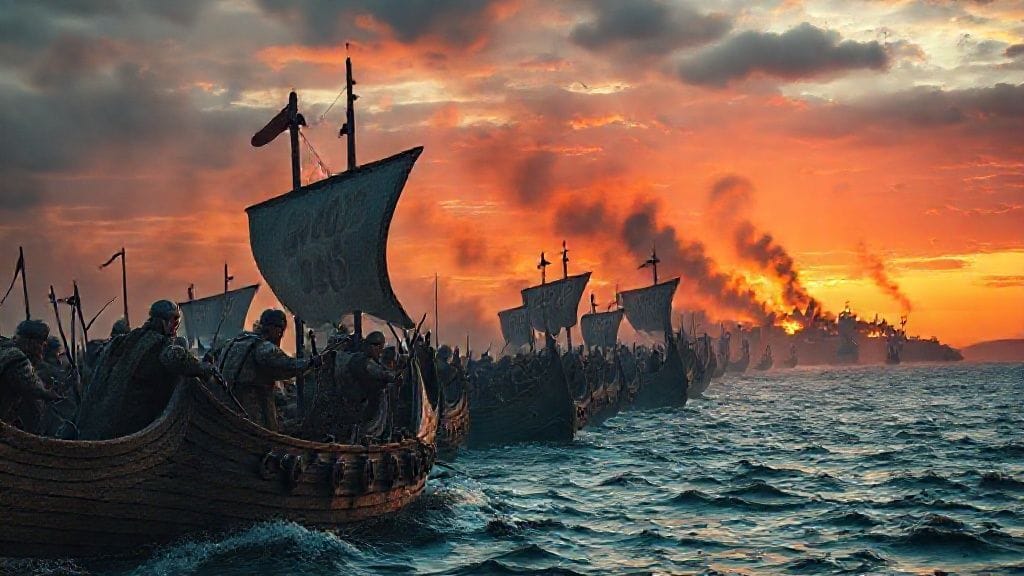
The salty spray of the North Sea whipped fiercely across the weather-beaten faces of the Danish longship crews. Ahead, the low-lying marshes and fertile fields of Frisia shimmered under a cold sunrise, the bustling trading hub of Dorestad looming as a beacon of untold wealth. These were not humble fishermen or mere wanderers, but hardened warriors bent on seizing fortune and glory. The clanging of shields, whispered prayers, and the rhythmic pounding of oars set a pulse as commanding as the waves themselves. It was the dawn of a new, terrifying chapter in the 810s: the Danish Viking raids on Frisia.
The Dawn of the Viking Age: Setting Sail into Unknown Waters
The early 9th century marked a seismic shift in European history. For centuries, coastal communities had traded goods and ideas, but seldom had the northern frontiers unleashed such unprecedented violence. The Vikings—seafaring Norsemen from modern Denmark, Norway, and Sweden—began venturing out into the waters surrounding the North Atlantic and Baltic Seas, propelled by a mixture of ambition, famine, political upheaval, and opportunity.
This era was about more than mere plundering. It was a transformative era when the structure of European borders, politics, and cultures would be challenged and recast. The Danish Vikings, in particular, were spearheading these early missions into the Frankish territories.
Frisia in the Early 9th Century: A Prosperous Coastal Hub
Frisia, nestled between the North Sea and the Rhine River, was a complex mosaic of sparsely populated marshlands, river islands, and thriving towns. By the 800s, it had become an important commercial crossroads bridging the Frankish Empire and the Scandinavian North.
Dorestad, a town on the Rhine’s estuary, was one of the most important trading centers north of the Alps. It thrived on the exchange of goods like salt, wine, textiles, and slaves. Merchants from all over Europe passed through its docks, making it an obvious yet lucrative target. Its prosperity—combined with its relatively defenseless state—made it an irresistible prize.
The Rise of the Danish Seafarers: Warriors and Traders
The Danes, originally farmers and fishers, had developed remarkable nautical skills. Their longships were masterpieces of engineering: swift, shallow-draft vessels capable of navigating both open seas and shallow rivers. These ships could carry 40 to 60 warriors and strike quickly before any resistance could mount.
By the 810s, the Danes had forged a fierce reputation. They were not mere raiders but seasoned maritime strategists who combined swift violence with calculated intimidation. Their society placed great importance on warrior honor and loyalty, often led by powerful chieftains who used raiding as a means of wealth accumulation and social elevation.
The First Assaults: Viking Raids on Frisia Begin
The 810s witnessed the first recorded large-scale Danish Viking incursions into Frisia. Around the year 810, reports speak of a fleet of longships appearing suddenly along the Frisian coast, striking with such ferocity that fear quickly spread inland.
The Vikings targeted not only Dorestad but smaller villages and Christian monasteries alike—gifts of loot, food, and slaves fueling their campaigns. These initial assaults revealed the vulnerabilities of the coastal defenses, as the Carolingian rulers struggled to mobilize effective countermeasures.
Dorestad: A Jewel on the Rhine, a Prime Target
Dorestad’s importance in these years cannot be overstated. Often described by contemporary chroniclers as a “rich market” (mercatus dives), it possessed invaluable warehouses, a bustling port, and a series of infrastructures supporting trade.
When the Danish fleets hit, they descended swiftly on the town, looting warehouses, burning docks, and carrying off goods and prisoners. The attack was not just a military strike but also a psychological blow to the Carolingian empire, symbolizing its inability to protect vital economic arteries.
Tactics and Technology: How the Vikings Mastered Coastal Raids
The success of these raids stemmed largely from innovation. The Vikings’ ability to navigate shallow rivers allowed them to penetrate deep into territory previously considered safe. Their longships could beach gracefully, allowing rapid strikes with minimal loss or preparation time.
Moreover, their hit-and-run tactics contrasted sharply with the more rigid, slower Frankish military structures. The element of surprise was king: dawn attacks, swift retreats, and the ability to strike multiple locations in quick succession frustrated the defenders.
The 810s Campaigns: A Sequence of Strikes and Conquests
The decade saw a pattern emerge. Viking fleets sailed into Frisian waters during the warmer months, culminating in raids against Dorestad and outlying settlements. Some years saw more intensive assaults, punctuated by moments of uneasy peace.
These campaigns tested the Carolingian ability to defend its frontiers. Yet, while the Vikings could overpower poorly defended towns, large-scale occupation was rare—raiding wealth and returning to Scandinavia remained the preferred strategy.
The Role of Leadership Among the Danish Raiders
Each expedition was often led by powerful jarls or chieftains, whose ambitions and rivalries shaped the scale and nature of warfare. These leaders balanced brutal efficiency with the need to maintain cohesion among their followers.
Historical accounts hint at legendary figures behind these raids—names now lost to time but whose legacies live on in saga and song. Their leadership was crucial in forging early Viking identity as more than mere pirates: as agents of political change.
Reactions in the Carolingian World: Defiance and Adaptation
The Frankish response to the Danish incursions was initially slow and inadequate. Local militias were often overwhelmed; imperial resources stretched thin by other internal and external pressures.
Yet, this spurred significant adaptations: fortifications were hastily improved, naval patrols experimented with Viking-style vessels, and alliances forged to resist the northern threat. The raids accelerated discussions on military reform and border control within the Carolingian court.
Economic Impact: The Decline of Dorestad’s Commercial Glory
The Viking raids destabilized the delicate economic balance in Frisia. Trade disrupted, merchants fled, and the once-vibrant markets of Dorestad declined sharply by the mid-9th century.
Historical economic data and archaeological finds show a steep drop in imported luxury goods, signaling a shift in trade routes and centers of power. This decline heralded a broader reorientation of European commerce during the later Middle Ages.
The Human Toll: Stories from Both Sides of the Shore
Beyond the grand narratives of kings and warriors, the raids deeply affected ordinary lives. Frisian farmers lost homes and livelihoods; children were taken as slaves; communities scattered or fortified themselves behind wooden palisades.
On the Viking side, the campaigns were brutal undertakings, marked by hardship and risk. Each return with plunder meant survival and status; each defeat, exile or death. These human stories remind us of the era’s complexity beyond mere conquest.
Cultural Exchanges Amidst Conflict: Viking and Frisian Interactions
Despite violence, not all was hostility. The continuous contact led to exchanges in language, art styles, and technology. Some Vikings settled in Frisian lands, marrying locals and integrating customs.
Runic inscriptions and Frisian place names bear witness to these subtle but lasting cultural intertwinings that shaped the northwestern European identity for centuries.
The Evolution of Viking Raiding Strategies Through the 9th Century
The raids on Frisia were but the beginning. Over the following decades, the Vikings refined their techniques, expanding into England, Ireland, and the Frankish heartlands.
These campaigns reveal a learning curve: from opportunistic strikes to targeted military campaigns and eventual settlement. The 810s illustrate the nascent phase of a movement that would define medieval northern Europe.
Legends and Chronicles: How the Raids Were Remembered
Medieval annals and later sagas portray the Viking menace with a mixture of fear, admiration, and myth. Frisian chroniclers lamented the destruction but also recorded instances of bravery and resilience.
These narratives helped shape European perceptions of the Vikings for centuries: as ruthless plunderers, capable sailors, and complex cultural actors.
The Long Shadow of the Viking Attacks on Western Europe
The Danish raids on Frisia were the opening salvo in the great Viking Age, signaling the vulnerabilities of early medieval Europe and the dawn of new political dynamics.
Their impact can be traced to the eventual development of feudal defense systems, naval innovation, and the reshaping of Europe’s linguistic and ethnic map.
Conclusion
The Danish Viking raids on Frisia in the 810s represent more than just violence on a remote coastline. They mark a moment of profound transition—a collision of cultures, economies, and power structures at a pivotal time in European history.
Through the mist of battle cries and burning towns emerges a tale of human ambition and adaptation, where warriors sought glory, merchants faced ruin, and societies were forced to rethink survival. The echoes of these raids resonate still, reminding us how history is forged amid chaos and opportunity.
FAQs
Q1: Why did the Danish Vikings target Frisia in the 810s?
A: Frisia’s wealth, strategic coastal location, and relatively weak defenses made it an attractive target for Danish Viking longships seeking quick access to riches and slaves.
Q2: How did the Vikings manage to raid so effectively along the Frisian coast?
A: Their longships’ shallow draft allowed them to navigate rivers and coastal marshes that larger ships couldn’t, enabling surprise attacks deep into territory.
Q3: What was the role of Dorestad in the Viking raids?
A: Dorestad was a major commercial hub on the Rhine, and its wealth made it a prime target, whose repeated attacks symbolized the vulnerability of Carolingian trade networks.
Q4: How did the Carolingian Empire respond to the Danish incursions?
A: Initially inadequate, the empire eventually ramped up coastal defenses, deployed naval patrols, and reformed military strategies to resist Viking raids.
Q5: Did the Viking raids lead to lasting settlements in Frisia?
A: While the early raids were primarily hit-and-run, some Vikings settled and integrated over time, influencing Frisian culture and genetics.
Q6: What economic impact did the raids have on Western Europe?
A: They disrupted trade routes, caused the decline of key markets like Dorestad, and contributed to the shift of commercial power centers.
Q7: Are there any surviving contemporary accounts of the Danish raids?
A: Yes, Frankish annals such as those by Einhard and the Royal Frankish Annals mention Viking attacks, though often with limited details.
Q8: How did these raids influence later Viking expansion?
A: The success in Frisia emboldened the Danes to extend raids further afield, refining tactics that would characterize the Viking Age for the next century.

