Table of Contents
- The Dawn of a New Order: Paris in 829
- Francia on the Edge: Political and Religious Tensions in the Early 9th Century
- The Carolingian Realm under Louis the Pious: A Fragile Unity
- The Role of the Church in Frankish Society
- Why Paris? The Symbolic Heart of Francia
- Convening the Synod: Actors and Stakes at Play
- Opening Decrees: Setting the Tone of Reform
- Regulating Clerical Life: Discipline and Morality in Focus
- Balancing Power: The Synod’s Vision for Church and Secular Authorities
- Property and Wealth: Church Assets under Scrutiny
- The Royal Chaplains and Their Influence
- Lay Investiture and the Boundaries of Authority
- The Synod’s Participants: Bishops, Abbots, Nobles, and the King
- The Struggle Against Simony and Corruption
- The Role of Monasticism and Its Regulation
- Women in the Church: New Norms and Social Ramifications
- The Synod’s Canons: A Revised Corpus of Ecclesiastical Law
- Immediate Reactions: Acceptance and Resistance
- The Synod’s Place in the Broader Reform Movement
- Legacy of the 829 Paris Synod: A Turning Point for Church-State Relations
- Long-Term Impact on European Medieval Politics
- The Synod’s Influence on Later Ecclesiastical Councils
- A Mirror of the Carolingian Renaissance Ambitions
- Remembering and Forgetting: Historical Memory of the Synod
- Conclusion: Paris 829, Where Church and Realm Found New Equilibrium
The Dawn of a New Order: Paris in 829
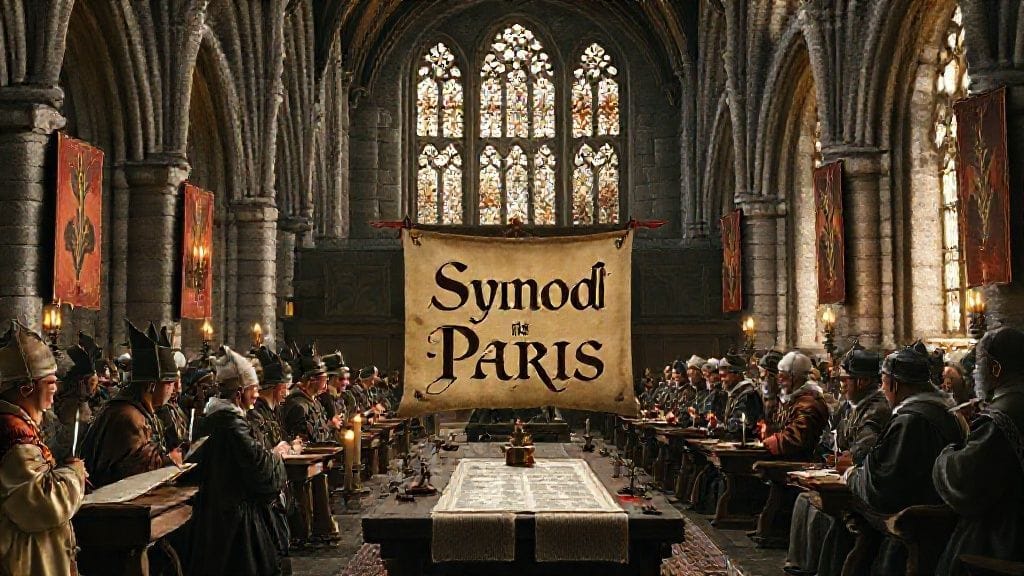
The early morning mist rolled over the Seine, fastening the city of Paris in a spectral embrace as dawn broke on a decisive year, 829 AD. Within the stone walls of the royal palace and the great ecclesiastical centers, whispers and footsteps quickened, converging toward a singular purpose: a grand assembly— a synod—that would shape not only the lives of prelates and princes but also the countless souls under their charge.
Paris, poised at the crossroads of tradition and transformation, was about to become the stage upon which the church and the realm would negotiate terms of coexistence, discipline, and authority. The air was tense with hope and uncertainty. Would this gathering clarify the tangled mandates of power, or deepen fractures in an already fragile empire? This was no mere regional council; it was a crucible moment in early medieval Christendom.
Francia on the Edge: Political and Religious Tensions in the Early 9th Century
To grasp the significance of the Synod of Paris in 829, one must first step back into a world teetering between collapse and renewal. Francia, ruled by the Carolingians, was an empire forged by Charlemagne’s sword and Christian zeal. Yet by the time of his son and heir, Louis the Pious, cracks had begun to appear.
Political tensions simmered between secular nobles and ecclesiastical leaders, each vying for influence in a rapidly evolving order. The church was not just a spiritual institution—it was an immense landed powerholder, custodian of education, law, and culture. Such breadth of control invited conflict, especially over issues of discipline and property.
In addition, Louis the Pious sought to maintain the unity of the empire by reinforcing both royal authority and religious orthodoxy—a precarious balancing act. The church played a critical role, with its leaders holding allegiance to both the throne and the papacy, a duality often fraught with competing loyalties.
The Carolingian Realm under Louis the Pious: A Fragile Unity
Louis I, crowned Emperor in 813, inherited an empire radiant yet unresolved. His reign aimed at consolidation, but political realities—divisions among his sons, rebellious magnates, and clerical dissent—often undermined his vision.
The church, under episcopal scrutiny, was expected to be both a pillar of moral rectitude and a partner in governance. Yet instances of simony, neglect of clerical duties, and blurred lines between sacred and secular authority challenged these expectations.
Louis, deeply pious but also pragmatic, frequently convened synods to address these issues. The Synod of Paris in 829 emerged from these efforts as a moment to recalibrate the partnership between church and realm in the capital itself, away from the more peripheral assemblies.
The Role of the Church in Frankish Society
In the early medieval period, the church permeated every facet of life—from the baptismal fonts in village chapels to the illuminated scripts copied in monastic scriptoriums. Bishops sat in councils, wielded judicial power, and often advised or confronted kings.
The church’s vast network of monasteries also served as centers of literacy, charity, and spiritual authority. Yet with such influence came challenge: clerical misconduct, secular encroachment, and the tension of reform. The Synod of Paris sought to address these issues head-on.
Why Paris? The Symbolic Heart of Francia
By the ninth century, Paris had grown beyond a mere trading hub into a symbol of royal ambition and ecclesiastical prestige. Situated on the Seine, it was geographically central and politically charged.
Choosing Paris for the synod elevated the assembly from a local affair to an imperial statement. It underscored the intention of Louis the Pious to assert control and foster unity, positioning the capital as where church law met royal will.
Convening the Synod: Actors and Stakes at Play
The call for the synod reached the ears of all Frankish prelates, abbots, and royal officials. Bishops from distant dioceses journeyed into the city, bringing with them a mixture of anticipation and apprehension.
Among them were towering figures such as Archbishop Ebbo of Reims and Benedictine abbots whose monasteries sat astride vast estates. Royal functionaries, too, observed carefully, aware that decisions reached here would ripple through their spheres of influence.
Opening Decrees: Setting the Tone of Reform
The synod opened with solemn prayers and an address by Louis the Pious himself. The emperor framed the gathering as a sacred duty to restore order and piety within the church and by extension, the realm.
Canons were read from previous councils—particularly those of Nicaea and Chalcedon—tying contemporary efforts to the venerable tradition of ecclesiastical discipline. But this synod aimed not only to recall the past but to legislate practical measures for the present crisis.
Regulating Clerical Life: Discipline and Morality in Focus
The behaviors of the clergy formed the synod’s core preoccupation. Several canons addressed clerical celibacy, prohibiting marriages and concubinage among priests and bishops—a contested and gradually enforced norm.
The synod mandated the proper conduct of liturgy and sacramental duties, emphasizing pastoral care over worldly concerns. Clerics found neglecting their flocks or engaging in secular business were to be disciplined.
Balancing Power: The Synod’s Vision for Church and Secular Authorities
One of the most delicate topics tackled was the boundary between ecclesiastical and secular jurisdiction. The Frankish model did not yet sharply divide church and state. Instead, Louis sought a symbiosis.
The synod clarified that while bishops owed loyalty to the emperor and performed administrative roles, their spiritual authority was autonomous. Yet abuses where clerics exacted fines or wielded secular powers without royal sanction were condemned.
Property and Wealth: Church Assets under Scrutiny
The wealth of the church was immense. Monasteries and cathedrals held large tracts of land, sometimes in conflict with nobles or royal estates.
The synod enacted rules to prevent the alienation of church property, forbidding sales or gifts without consent of ecclesiastical authority. This aimed to secure the church’s economic foundation while restraining greedy lords or clerics from profiteering.
The Royal Chaplains and Their Influence
Close to the emperor, royal chaplains acted as religious advisors and sometimes as intermediaries between the court and the church hierarchy.
The synod recognized their importance but also underscored that such positions must be earned through piety rather than favoritism. This was a subtle nudge against courtly corruption.
Lay Investiture and the Boundaries of Authority
Though the investiture controversy would explode centuries later, seeds of the debate on who held spiritual appointments began here.
The Paris synod tentatively affirmed royal input in episcopal appointments but stressed the ultimate spiritual authority of the church. This prefigured later tensions that shaped medieval Christendom.
The Synod’s Participants: Bishops, Abbots, Nobles, and the King
As the debates unfolded, the room swelled with voices from different estates of power. Bishops with long ecclesiastical careers, hardened abbots managing both spiritual and worldly concerns, secular nobles wary of losing influence.
Louis’s presence lent gravitas but also a political edge. The synod functioned at the intersection of theology and realpolitik—each maneuvering to safeguard interests while professing Christian unity.
The Struggle Against Simony and Corruption
A key concern was simony—the buying and selling of church offices. The synod issued stern condemnations and penalties, aiming to purify clerical ranks.
This was not mere moralizing but a political campaign to align church appointments with genuine calling, strengthening both religious integrity and imperial control.
The Role of Monasticism and Its Regulation
Monasteries, as centers of spiritual renewal, were also scrutinized. The synod called for observance of Benedictine rules and disciplined behavior, pushing back against laxity.
Ensuring monks adhered to prayer, work, and poverty was intended as a model for clerical reform at large.
Women in the Church: New Norms and Social Ramifications
Though largely absent from official hierarchies, women—especially in convents—were affected by new regulations.
The synod reiterated vows of chastity and enclosure for nuns, reflecting broader Carolingian anxieties about social order and female piety.
The Synod’s Canons: A Revised Corpus of Ecclesiastical Law
The final decrees passed formed a revised legal framework, synthesizing previous canon law with new directives suited to Carolingian realities.
This legal corpus would be referenced in later councils and shaped ecclesiastical governance for decades.
Immediate Reactions: Acceptance and Resistance
The synod’s rulings did not meet universal approval. Some bishops embraced reforms eagerly; others grumbled privately or sought ways to circumvent constraints.
Nobles, too, assessed whether their privileges were under threat. Yet the emperor’s backing ensured broad institutional compliance at least outwardly.
The Synod’s Place in the Broader Reform Movement
The Paris Synod was part of a wave of Carolingian reform efforts seeking to restore royal and clerical authority after years of laxity.
It reflected both religious zeal and political calculation—a flashpoint in the ongoing dialectic of power and faith that defined medieval Europe.
Legacy of the 829 Paris Synod: A Turning Point for Church-State Relations
Though lesser-known than later councils, the Synod of Paris in 829 laid foundational precedents. Its attempt to delineate spheres of influence prefigured later medieval debates.
It revealed the complexities of governing overlapping institutions and underscored the centrality of law in shaping Christian society.
Long-Term Impact on European Medieval Politics
The model forged here rippled through successor kingdoms, influencing how medieval monarchs related to their clerics and subjects.
By asserting a regulated coexistence, the synod helped stabilize a fragile empire and charted trajectories for church-state relations.
The Synod’s Influence on Later Ecclesiastical Councils
Later assemblies, both regional and ecumenical, echoed its canons, particularly on clerical discipline and property.
It contributed to a growing body of normative ecclesiastical law that would culminate in later medieval canonical traditions.
A Mirror of the Carolingian Renaissance Ambitions
The synod reflected the broader Carolingian Renaissance—an era of cultural, administrative, and religious revival.
It was as much about intellectual renewal as practical governance, expressing a vision of ordered Christendom underpinned by learned law and devout leadership.
Remembering and Forgetting: Historical Memory of the Synod
Though overshadowed by more famous councils, the 829 Paris Synod remains a critical episode for historians seeking to understand Carolingian polity and ecclesiastical reform.
Its memory lingers faintly in manuscripts and chronicles, a testament to the slow and arduous project of melding sacred and temporal power.
Conclusion
Paris in 829 was more than a city bathed in dawn light; it was a nexus where history, faith, and power intertwined. The Synod held within its stone halls embodied the hopes and tensions of a burgeoning Christian empire striving for order amid diversity and dissent.
Its decrees danced on the delicate edge between reform and control, carving new pathways for church discipline, property rights, and imperial authority. Through the voices of bishops, monks, nobles, and the emperor, a fragile yet enduring consensus emerged—one that shaped Europe’s medieval trajectory.
The Synod of Paris was not a triumphant revolution but a cautious step toward equilibrium. Still, its legacy endures as a foundational moment when church and realm sought, with imperfect grace, to regulate their entwined destinies.
FAQs
Q1: What prompted the Synod of Paris in 829?
A1: The Synod was convened to address growing concerns over clerical discipline, church corruption, and the ambiguous relationship between church authority and royal power within the Carolingian Empire.
Q2: Who were the main figures participating in the Synod?
A2: Participants included Emperor Louis the Pious, bishops from key Frankish dioceses, abbots of powerful monasteries, and royal officials—each representing different facets of power and piety.
Q3: What were the major reforms enacted at the Synod?
A3: The reforms targeted clerical celibacy, opposition to simony, regulation of church property, clearer delineation of secular and ecclesiastical authority, and stricter monastic discipline.
Q4: How did the Synod influence church-state relations?
A4: It established precedents for shared yet distinct authority, balancing royal influence with ecclesiastical autonomy, a dynamic that would shape medieval politics and ecclesiastical governance.
Q5: Was the Synod’s impact immediately felt across Francia?
A5: While some reforms met resistance, the emperor’s support ensured broad institutional acceptance, though implementation varied by region and over time.
Q6: How does the 829 Synod relate to later church councils?
A6: Many of its canons and principles were integrated into later canonical law and echoed in subsequent medieval councils, contributing to the evolution of ecclesiastical discipline.
Q7: What role did women have in the Synod’s decrees?
A7: Although women were not formal participants, the Synod issued regulations affecting nuns, emphasizing chastity and enclosure, reflecting concerns over female religious life.
Q8: Why is the Synod of Paris 829 less well-known today?
A8: Larger and more dramatic councils, such as those later in the medieval period, overshadowed it. Nonetheless, historians recognize its importance in early medieval reform and governance.

