Table of Contents
- Dawn of a New Era: The City Awakens in 843
- The Shadow of Iconoclasm: A Century of Conflict
- The Rise of Empress Theodora: From Regent to Restorer
- Political Turmoil and Religious Struggles on the Eve of Restoration
- The Patriarch Methodios: A Symbol of Orthodoxy’s Resilience
- The Great Procession: A Moment Frozen in Time
- Iconoclasm’s Last Stand: Opposition and Support
- Theological Battles: Why Icons Mattered So Much
- The Ceremony in Hagia Sophia: Triumph and Tears
- The Role of Monastic Communities in Preserving Icons
- The Legacy of Empress Theodora’s Decree
- The Repercussions Across the Byzantine Empire
- From Constantinople to the Provinces: The Spread of Orthodoxy
- How the Restoration Shaped Byzantine Art and Culture
- The Political Aftershocks: Power, Legitimacy, and Faith
- Remembering the Triumph: The Feast of Orthodoxy
- Theodora’s Place in History: Saint or Sovereign?
- Echoes in the Modern Orthodox Church
- Comparing Iconoclasm to Other Religious Conflicts
- Human Voices: Chronicles, Poems, and Personal Accounts
- The Material Culture: Icons as Living History
- The Triumph of Orthodoxy in the Wider Christian World
- The Restoration and Its Impact on East-West Christian Relations
- Conclusion: A Legacy of Faith and Resilience
- FAQs: Understanding the Restoration of Icons under Empress Theodora
- External Resource
- Internal Link
Dawn of a New Era: The City Awakens in 843
The sun rose over Constantinople on March 11, 843, casting golden light over the domes of Hagia Sophia and the silver waters of the Bosporus. But this dawn was unlike any other before it. Ecstatic crowds, tearful and jubilant, thronged the streets. Clad in their best robes, mothers held their children close, monks chanted hymns in unison, and soldiers lowered their weapons in reverence. For decades, the city had been gripped by turmoil—not a battle against foreign invaders but a war over images, faith, and identity. And today, at last, the icon—the painted face of the sacred—was restored as the heart of Byzantine piety.
Theodora, the widow of Emperor Theophilos and mother to Michael III, had ascended not just the throne but the annals of history. Through her quiet strength and unshakable determination, she had guiding the empire from darkness to light. This was the Triumph of Orthodoxy—the restoration of sacred images after nearly a century of iconoclastic strife. Emotions overflowed. Tears mingled with cheers. But this was only the beginning of a story that would shape Byzantine spirituality and culture for centuries to come.
The Shadow of Iconoclasm: A Century of Conflict
To grasp the magnitude of the 843 restoration, one must journey back into the turbulent century that preceded it. Iconoclasm—that fierce rejection and destruction of religious images—had rocked Byzantium in two deadly waves, stretching from 726 to 787 and again from 814 to the very eve of Theodora’s regency. It was not merely a debate over art but a profound struggle questioning how humans related to the divine.
The first outbreak followed Emperor Leo III’s decree banning the veneration of icons, a move driven by theological, political, and military anxieties. Was sacred art a form of idolatry contrary to the Ten Commandments? Did the empire’s misfortunes—plagues, raids, natural disasters—signal divine displeasure? Yet the opposition was equally potent, marshaling defenders from monks to patriarchs who believed icons were windows to heaven, vital conduits of divine grace.
This fracturing tore the empire’s religious fabric. Churches were cleansed of mosaics, frescoes were whitewashed, priceless icons smashed. Families were divided, communities polarized. Yet despite repression, underground veneration persisted, embedding icons deeper into Byzantine spirituality. The second bout of iconoclasm under Emperor Leo V and successors fanned the flames anew, only intensifying resistance in monastic strongholds.
The Rise of Empress Theodora: From Regent to Restorer
Into this atmosphere stepped Theodora, a woman of remarkable resolve who proved that quiet power could shake the foundations of an empire. When her husband, Emperor Theophilos’, died in 842, their young son Michael III was only two years old. Theodora became regent, tasked with guiding a fractious court, political factions, and a deeply divided church.
Unlike her late husband, who had zealously continued iconoclastic policies, Theodora found herself in a unique position to reverse course. Theodora, steeped in Orthodox sympathies and encouraged by a circle of monks and clergy, saw the restoration of icons not just as a religious act but a political one: it could unify a fractured empire and legitimize her regency.
Her boldness was remarkable, especially in a male-dominated world. She moved carefully but decisively. Negotiating palace intrigues, calming army generals, and wielding the influence of church leaders, Theodora orchestrated an event that would resonate for ages—the formal end of iconoclasm.
Political Turmoil and Religious Struggles on the Eve of Restoration
Theodora’s path was not assured. Political tensions simmered beneath the surface. Iconoclast factions lingered in the bureaucracy and military, mourning the loss of reforms they believed protected the empire. Meanwhile, patrons of icon veneration, often from monastic orders and urban populations, clamored for change.
Religious leaders played crucial roles. Patriarch Methodios, who had suffered exile and imprisonment under iconoclast emperors, had emerged as a spiritual beacon. His return from exile symbolized the turning tide. Meanwhile, foreign powers such as the Frankish Empire watched with curiosity; alliances in Christendom could hinge on such doctrinal shifts.
Theodora’s political savvy was evident in her careful staging of the restoration. Theodora held councils with bishops and monks, ensuring theological arguments were settled. She secured the loyalty of her son’s regency council and took pains to prevent bloodshed or conspiracies.
The Patriarch Methodios: A Symbol of Orthodoxy’s Resilience
Central to the restoration’s spiritual life was Patriarch Methodios. Once a victim of persecution for his defense of icons, his life was the embodiment of the Orthodox cause’s long suffering and ultimate triumph. After years of unwelcome exile in Asia Minor, his call to return in 843 rang through Constantinople.
Methodios represented the hopeful synthesis of theology and politics. His sermons, delivered during the Great Procession, acknowledged the pain endured while urging forgiveness and unity. His theological writings laid the groundwork for the understanding of icons that endures in Orthodoxy today.
The Great Procession: A Moment Frozen in Time
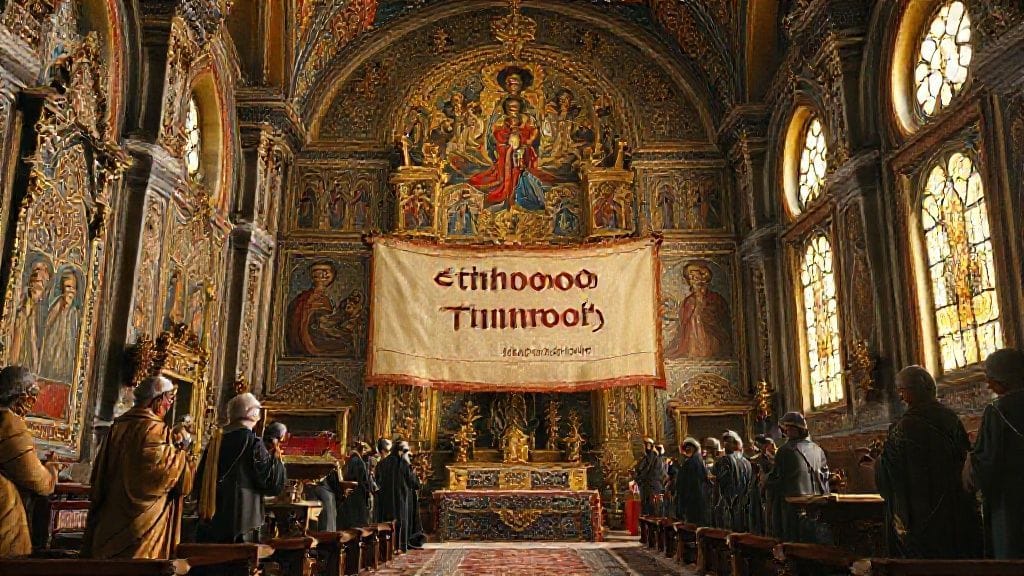
On the first Sunday of Lent in 843, Constantinople’s streets overflowed with citizens pushing toward the majestic Hagia Sophia. The Great Procession, led by Empress Theodora and Patriarch Methodios, was a spectacle of faith and power interwoven. Clad in imperial purple, Theodora clasped an icon—a symbol of redemption and victory.
The crowd’s emotion was palpable: tears streamed freely, hymns filled the air, and the air itself seemed charged with hope. The destruction of icons was publicly condemned. Images were unveiled in churches, their colors a rescue from darkness. Theodora’s voice, steady and resolute, proclaimed the resumption of sacred veneration.
Accounts from chroniclers like Theophanes Continuatus and Symeon Metaphrastes capture the intensity of that day. One witness wrote, “The city wept for joy, as if the Son of God himself had returned.”
Iconoclasm’s Last Stand: Opposition and Support
Though Theodora’s restoration marked the decisive turning point, opposition did not vanish overnight. Loyal iconoclasts voiced dissent in the imperial court and among some military officers. Some feared that the return to icon veneration would invite divine wrath.
Yet, support for Orthodoxy swelled in church communities, urban centers, and among the artistic intelligentsia. The restoration tapped into a collective yearning for stability and spiritual connection, after decades of turmoil.
Theological Battles: Why Icons Mattered So Much
At the heart of the conflict lay a profound theological question: could an image be a vessel for the divine? Iconoclasts argued that venerating images risked idolatry, contradicting commandments against graven images.
Defenders of icons cited both scripture and tradition, emphasizing the incarnation of Christ. If God became flesh, then depicting Christ in painting was not forbidden but celebrated. Icons, they argued, were not idols but windows—a means for the faithful to glimpse the holy.
This debate connected to broader issues: how humans experience God, the role of sensory perception in worship, and the nature of sacred art. The 843 restoration thus was not merely political—it affirmed a vision of faith that embraced materiality and transcendence.
The Ceremony in Hagia Sophia: Triumph and Tears
The grand liturgy inside Hagia Sophia on that historic day combined solemnity and joy. The cathedral, recently freed from purging by iconoclasts, was resplendent with reinstated mosaics and icons glimmering under candlelight.
Theodora and Methodios led the prayers, invoking mercy and thanksgiving. The chants echoed through vast domes, saturating the crowd with awe. Tears flowed freely—not only for relief but for remembrance of suffering.
This ceremony echoed through history, marking a moment where faith reasserted itself in Byzantine life with unmatched clarity.
The Role of Monastic Communities in Preserving Icons
Monks were often the unsung heroes of icon veneration. Monasteries like those on Mount Athos and in Constantinople served as repositories for hidden icons and theological knowledge. Many monks endured torture, exile, or execution rather than renounce their beliefs.
Their preservation of icons—both physically and spiritually—provided the foundation upon which Theodora could rebuild Orthodoxy. It was through their chants, writings, and resilience that iconography survived the fires of destruction.
The Legacy of Empress Theodora’s Decree
After the restoration, Theodora issued edicts condemning iconoclasm and promoting Orthodoxy as the imperial faith. Her decree was not just religious but legal and cultural, mandating the protection of sacred images.
This set Byzantine Christianity on a new trajectory, reconciling faith and imperial authority. The tragedy of iconoclasm was not forgotten but transformed into a story of resilience.
The Repercussions Across the Byzantine Empire
Beyond Constantinople, the restoration rippled through the empire’s provinces, from Anatolia to the Balkans. Local churches rejoiced while some regions reevaluated their political and religious allegiances.
It reinvigorated ecclesiastical unity and allowed the flourishing of iconography, contributing to a surge in artistic creativity. The restoration also bolstered the monarchy’s legitimacy as defender of the faith.
From Constantinople to the Provinces: The Spread of Orthodoxy
With the center restored, Orthodoxy spread outward. Missionaries carried icon veneration into Slavic lands, notably shaping the Christianization of Bulgaria and Kievan Rus’.
This cultural diffusion fortified Byzantine influence and crafted a spiritual identity resonant beyond imperial borders.
How the Restoration Shaped Byzantine Art and Culture
The artistic impact was profound. Iconoclasm’s destruction paradoxically renewed interest in sacred art. After 843, mosaicists, painters, and goldsmiths crafted icons of unparalleled beauty and symbolism, blending innovation and tradition.
This golden age of Byzantine religious art left a legacy that still shapes Orthodox aesthetics and worship.
The Political Aftershocks: Power, Legitimacy, and Faith
Politically, Theodora’s restoration stabilized the empire at a precarious time. By aligning imperial authority with Orthodoxy, she strengthened the dynasty’s claim and quelled dissident factions.
Yet tensions remained; the empire’s enemies watched cautiously, and court intrigues persisted. Still, faith became a binding force.
Remembering the Triumph: The Feast of Orthodoxy
To commemorate the restoration, the Orthodox Church established the “Feast of Orthodoxy”—celebrated on the first Sunday of Lent. This annual event not only honors the return of icons but embodies the victory of faith over despair.
It continues as one of Orthodoxy’s most significant liturgical moments, a living memory of Theodora’s courageous act.
Theodora’s Place in History: Saint or Sovereign?
Empress Theodora occupies a dual place in tradition—as a holy figure and a pragmatic ruler. Canonized by the Orthodox Church for her defense of icons, she is venerated as a saint.
Yet her legacy as regent reveals a shrewd political mind capable of shaping history through faith and diplomacy—a rare and remarkable woman in a male-dominated world.
Echoes in the Modern Orthodox Church
The events of 843 resonate today. Icon veneration remains central in Orthodox worship, theology, and identity. Theodora’s restoration is invoked as a model of resilience and fidelity.
Modern iconographers draw inspiration from the renewed traditions her reign helped solidify.
Comparing Iconoclasm to Other Religious Conflicts
Iconoclasm shares traits with other historic religious conflicts—the Protestant Reformation’s debate over images or Islamic aniconism, for example—illustrating universal tensions between image, faith, and power.
Yet its uniquely Byzantine context offers unparalleled insights into imperial-religious dynamics.
Human Voices: Chronicles, Poems, and Personal Accounts
Historical chronicles like those of Theophanes, as well as later poetic homilies, preserve the human dimension of this restoration. We hear the voices of monks, soldiers, and citizens who lived through exile, persecution, and finally triumph.
Their testimonies give life to a story often reduced to politics.
The Material Culture: Icons as Living History
Today, surviving icons—their gold leaf, vivid colors, and sacred symbols—are more than art. They are living links to Byzantine spirituality, frozen moments of faith that speak across centuries.
Each brushstroke carries stories of suffering, hope, and redemption.
The Triumph of Orthodoxy in the Wider Christian World
The Restoration reverberated beyond Byzantium. It affirmed Eastern Orthodoxy’s distinct path, often contrasting with Western practices where icon veneration remained debated.
This moment planted seeds for centuries of East-West religious dialogue and conflict.
The Restoration and Its Impact on East-West Christian Relations
The renewed commitment to icon veneration widened theological divides with the Latin West, contributing—indirectly—to tensions culminating in the Great Schism of 1054.
Yet it also enriched the Christian mosaic, offering diverse expressions of faith.
Conclusion: A Legacy of Faith and Resilience
Empress Theodora’s restoration of icons in 843 was far more than a religious act—it was a leap of hope, a reweaving of Byzantium’s spiritual and political fabric after decades of fracture. Standing in the bustling streets of Constantinople that spring day, one could feel the pulse of an empire reborn by faith and courage.
Theodora’s triumph speaks to a universal human longing—the need to connect the seen with the unseen, to give form to the sacred, and to find unity amidst conflict. Her legacy endures not only in stained glass and gilded mosaics but in the hearts of millions who, century after century, celebrate the radiant power of faith against the shadows.
FAQs: Understanding the Restoration of Icons under Empress Theodora
Q1: What triggered the original wave of iconoclasm in the Byzantine Empire?
A: The first phase began under Emperor Leo III in 726, motivated by a mix of religious concerns against idolatry, military setbacks seen as divine punishment, and political efforts to consolidate imperial power and appease Muslim neighbors who condemned images.
Q2: Why was Empress Theodora able to restore icons after so many decades of iconoclasm?
A: Theodora, as regent for her young son, held power at a critical juncture. Her Orthodox sympathies, support from key church figures like Patriarch Methodios, and political acumen allowed her to reorient imperial policy despite lingering opposition.
Q3: Who was Patriarch Methodios, and why was his role important?
A: Methodios was an outspoken defender of icons who suffered exile during iconoclasm. His return to the patriarchate symbolized the spiritual vindication of Orthodoxy and lent theological authority to the restoration.
Q4: How did the restoration affect Byzantine art?
A: The end of iconoclasm ushered a golden age of religious art, including the renewal of mosaics, frescoes, and icons, combining classical heritage with Christian symbolism that defined Byzantine aesthetics.
Q5: What is the Feast of Orthodoxy, and why does it matter today?
A: Established to commemorate the 843 restoration, the Feast of Orthodoxy is celebrated annually on the first Sunday of Lent, serving as a testament to the victory of true faith and unity in the Orthodox Church.
Q6: Did the restoration impact relations between Eastern Orthodox and Western Christian churches?
A: Yes. While the West was generally more accepting of images, the firm Orthodox stance sharpened theological distinctions, contributing over centuries to the East-West Schism.
Q7: How did the restoration influence other Christian lands?
A: It shaped missionary activity into Slavic territories, contributing to the spiritual foundations of countries like Bulgaria and Russia, which adopted Byzantine Orthodoxy and its icon tradition.
Q8: Was Theodora venerated as a saint?
A: Indeed, Empress Theodora is canonized in the Orthodox Church for her courageous defense of icons and is celebrated as a saintly regent who restored Orthodoxy.

