Table of Contents
- The Dawn Before the Storm: Damietta on the Eve of 853
- The Byzantine Empire in the Ninth Century: Power and Ambition
- Egypt’s Strategic Importance: The Jewel of the Mediterranean
- A Tense Sea: Byzantium’s Naval Challenges and Rivalries
- The Prelude to Devastation: Byzantine Motives and Preparations
- The Fleet Assembles: Commanders, Ships, and Strategy
- Crossing the Mediterranean: The Journey towards Damietta
- The Siege and Sack of Damietta: A Night of Fire and Fury
- The Human Cost: Lives Torn Apart and Cities Ablaze
- The Aftershock in Egypt: Political and Economic Reverberations
- The Byzantine Triumph: Propaganda, Glory, and Myth
- Islamic World’s Response: The Abbasid Caliphate and Local Powers
- Naval Warfare Transformed: Lessons from the Damietta Raid
- The Long Shadow: Impact on Mediterranean Trade Routes
- Cultural Exchanges Amidst Conflict: Artifacts, Stories, and Memories
- The Forgotten Battle? How History Remembered the Sack
- Secondary Ripples: Damietta in Later Crusades and Conflicts
- The Changing Face of Byzantium: Naval Doctrines Post-853
- Personal Stories: Commanders and Survivors Speak through Chroniclers
- The Legacy of the 853 Raid: A Turning Point in Medieval Warfare
- Conclusion: Damietta’s Ruin as a Mirror of Empire and Ambition
- FAQs: Unraveling the Sack of Damietta
- External Resource
- Internal Link
The Dawn Before the Storm: Damietta on the Eve of 853
The golden sun spilled its warm glow over the bustling port city of Damietta, its shimmering harbor dotted with fishing boats and merchant vessels. Narrow, winding streets thrummed with the chatter of traders exchanging spices, textiles, and tales from distant lands. Children played under the watchful eyes of minarets piercing the sky, while fishermen hauled in the day's catch along the Nile’s estuary.
But beneath this vibrant life lay an undercurrent of anxiety. Tales of looming threats had reached Damietta’s walls. The Mediterranean, once a thoroughfare of peaceful commerce and cultural exchange, was again a cauldron of tension. Whispers spoke of a cloud of warships from Byzantium, a fleet with a harboring grudge and eager for plunder.
On August’s edge in the year 853, this port city in Egypt, a crucial gateway between Africa and the Levant, was about to experience devastation unlike any it had seen before. The Byzantine fleet, seasoned and battle-hardened, was prepared to descend with an ambition that would leave its mark for centuries. The vibrant streets would know fire, and the lives within would know a relentless upheaval. But none could foresee that the sack of Damietta would echo beyond the sands of Egypt into the grand narrative of medieval Mediterranean history.
The Byzantine Empire in the Ninth Century: Power and Ambition
The mid-ninth century was a complex epoch for the Byzantine Empire. Embattled yet resilient, Byzantium stood as the bulwark of Christian Orthodoxy and Hellenistic culture amidst the fractured remnants of the Roman world. Emperor Michael III, who reigned during the early 850s, faced internal dissent, border threats, and the rising challenge of the Arab caliphates.
Military ambition, especially naval power, became a focus for asserting dominance in the eastern Mediterranean. The Byzantine navy, once the terror of the seas, had seen fluctuations in strength. Yet, faced with the growing naval prowess of Muslim powers—particularly the Abbasid Caliphate and its Egyptian governorates—Byzantium sought to reclaim its maritime hegemony.
Damietta, a city under the control of the Abbasid Caliphate’s Egyptian province, was not a random target but a symbol of commercial wealth and strategic influence. The sack of such a city would not merely be an act of plunder but a tactical blow against Byzantium’s Muslim adversaries—turning the tide of a centuries-old conflict that oscillated between warfare and uneasy truce.
Egypt’s Strategic Importance: The Jewel of the Mediterranean
To understand the significance of Damietta, one must appreciate Egypt’s unique role in the medieval world. The Nile’s lifeblood bore fertile lands that fed empires, while its cities acted as crossroads of trade and culture. The port of Damietta, located on the Mediterranean’s eastern edge where the Nile branches into its delta, was a treasure trove.
Control of Damietta meant access not only to rich agricultural goods but to trade routes extending to the Levant, North Africa, and beyond—spices from Arabia, fabrics from India, and gold from sub-Saharan Africa coursed through its markets.
Moreover, Damietta was a crucial military outpost for the Abbasids, anchoring their naval presence in the Mediterranean. To Byzantine eyes, reducing this outpost was tantamount to striking at the heart of Egypt’s defenses, crippling trade revenues, and destabilizing Abbasid authority in the region.
A Tense Sea: Byzantium’s Naval Challenges and Rivalries
The Mediterranean in the mid-ninth century was a theater of constant naval clashes. The rise of Muslim navies challenged Byzantine sea power. The rivalry was as much about control of commerce as about political dominion, trading blows in piracy, raids, and blockades.
Byzantine ships, crafted for agility and equipped with the famed “Greek fire,” possessed technological and tactical advantages. However, Muslim fleets had grown in number and sophistication, employing fast, nimble vessels suitable for the shallow, complex waters near Egypt.
Byzantium’s desire to project power—both to protect its own shores and strike at its enemies—hinged on disrupting this balance. The attack on Damietta was conceived as a strategic masterstroke, a mix of diplomacy’s failure and military opportunism.
The Prelude to Devastation: Byzantine Motives and Preparations
Planning the assault on Damietta was no spur-of-the-moment decision. Months of intelligence gathering, maritime reconnaissance, and diplomatic maneuvering preceded the advent of the fleet.
Sources suggest that internal pressures in Byzantium, including factions at court vying for military glory and the emperor’s inclination toward asserting dominance, propelled the expedition. Reports of weakening Abbasid naval defenses and growing factional strife in Egypt encouraged Byzantine strategists to seize a moment of relative vulnerability.
The fleet was assembled in Constantinople’s Golden Horn, a hive of shipbuilding and naval expertise. Leaders known for their daring and tactical astuteness commanded the vessels—families with legacies intertwined with the Empire’s fate.
The ships themselves were a blend of war galleys, built to maximize speed and firepower, equipped with Greek fire siphons and archers ready to rain death upon Damietta’s walls.
The Fleet Assembles: Commanders, Ships, and Strategy
Byzantians chose not one but several commanders for the operation, a decision which would prove both a strength and a challenge. The commander-in-chief, perhaps strategos Niketas Ooryphas, was renowned for his naval prowess and past successes against Arab fleets. His men called him decisive but tempered by pragmatism—a vital combination for a high-stakes assault.
The fleet itself was an impressive armada. Several dozen dromons, the characteristic Byzantine galleys, formed the core, supported by smaller boats bearing infantry for boarding and landing. The ships were laden with siege equipment, supplies, and reserves, preparing for a sustained operation.
Their strategy was precise: rapid arrival, sudden siege, overwhelming the city’s defenses before the Abbasids could respond. The fleet avoided protracted engagement at sea, focusing on surprise and swift, decisive action.
Crossing the Mediterranean: The Journey towards Damietta
The crossing from Constantinople to Damietta was perilous. The fleet had to negotiate weather, potential encounters with hostile vessels, and the endless contours of Mediterranean geography. The men on board lived with a mixture of steely resolve and quiet dread.
Chroniclers recount nights filled with the scent of salt, the endless creaking of wood, and whispered prayers to saints for victory. The anticipation bristled as the familiar shape of Egypt’s delta emerged on the horizon, mingling hope with the looming terror of battle.
Upon reaching Damietta’s coast, the Byzantines circled out of sight, probing the city’s defenses under cover of darkness. It was clear that the element of surprise was their greatest ally—a fragile advantage soon to be tested.
The Siege and Sack of Damietta: A Night of Fire and Fury
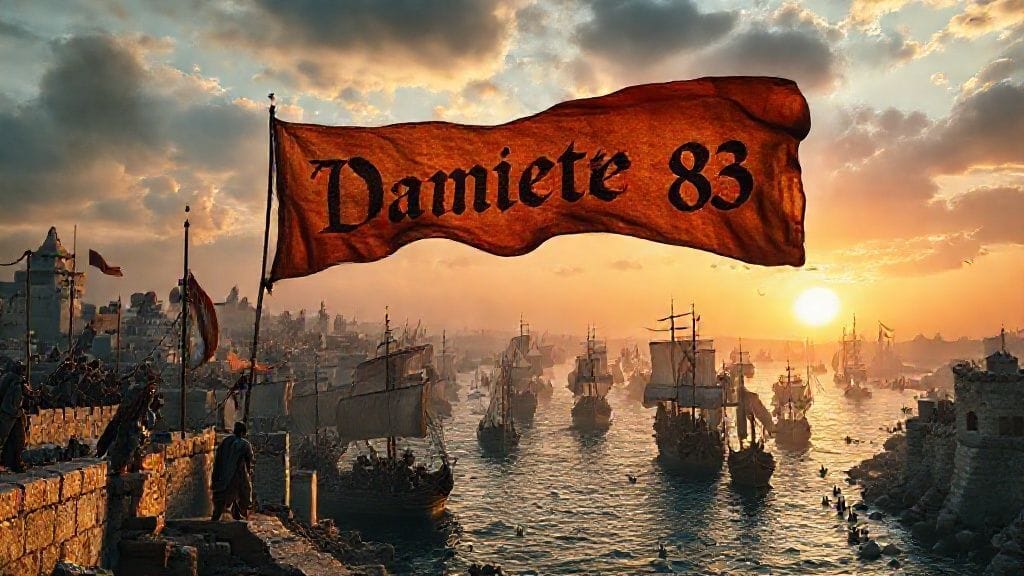
The attack unfolded with brutal swiftness. Byzantine vessels approached under a moonless sky, their oars silent, their soldiers poised. Initial volleys of Greek fire burned fiercely along the docks, setting ablaze warehouses and warships moored within the harbor.
Damietta’s defenders, caught unprepared, scrambled to respond. Yet Byzantine archers on the ships and soldiers landing on the shore overwhelmed the outposts. Walls were breached not by lengthy siege engines but by sheer momentum and tactical surprise.
Narratives speak of streets flooded with firelight, cries echoing amid collapsing buildings, and the devastating chaos of an ancient city breached from sea to land. Markets, temples, homes fell under the fierce hand of the invaders. Loot was taken where it could be found. Lives were lost in the hundreds, civilians displaced by the carnage.
The Human Cost: Lives Torn Apart and Cities Ablaze
Behind every breached wall was a human story—families torn asunder, merchants losing fortunes, children orphaned by war. Contemporary Arab chroniclers convey a scene of unimaginable grief and despair.
The sack disrupted the rhythm of Damietta’s society; food supplies were destroyed or stolen, survivors fled or faced captivity. The physical and psychological scars ran deep. Hospitals treated wounds not only of the body but of spirit.
The Byzantines, meanwhile, sustained losses too. Combat and disease claimed sailors and soldiers alike. Yet their resolve was undimmed, driven by the spoils and the strategic triumph.
The Aftershock in Egypt: Political and Economic Reverberations
Damietta’s fall was a shockwave through Egypt’s political fabric. The Abbasid governorate, embarrassed and weakened, scrambled to regroup. Military forces were redeployed to shore up coastal defenses, trade was disrupted, and trust in local officials waned.
Economically, the loss destabilized local markets and diminished tax revenues. Merchants rerouted trade, wary of future raids. The sack did not annihilate Egypt’s grip on the region but starkly illuminated vulnerabilities.
The Byzantine Triumph: Propaganda, Glory, and Myth
Back in Constantinople, news of the sack ignited celebrations. The imperial court amplified the victory as a sign of divine favor and imperial resurgence. Coins were minted, poems composed, and records glorified the raid as a testament to Byzantine courage and ingenuity.
For the empire weary from external pressures, this victory injected morale and prestige. Yet beneath the pomp, imperial advisors knew this was but one battle in a long contest, with risks not yet exhausted.
Islamic World’s Response: The Abbasid Caliphate and Local Powers
The Abbasids reacted swiftly to the sting of their loss. Naval reforms were enacted, fortifications along the Nile delta reinforced, and the office of military governor strengthened. Local rulers, including the rulers of Tulunid Egypt who gradually asserted autonomy from the Abbasids, saw the sack as a rallying point for their own legitimacy and defense.
Religious scholars framed the Byzantine raid as an assault not only on land but on the Islamic community’s honor. Calls for jihad and unity spread, contributing to a renewed vigor in some quarters of the Muslim world’s military efforts.
Naval Warfare Transformed: Lessons from the Damietta Raid
The attack forced all sides to reconsider naval tactics and defense. The Byzantines leveraged surprise and incendiary technology; Muslim naval commanders sought swifter ships and improved harbor defenses.
Damietta became a case study in the effectiveness of combined naval and amphibious operations, inspiring innovations in ship design, coastal fortifications, and intelligence gathering that resonated throughout the medieval Mediterranean.
The Long Shadow: Impact on Mediterranean Trade Routes
Trade between East and West, already fraught with competition and danger, was deeply affected. Merchants diverted routes to avoid exposed Egyptian ports, leading to shifts in economic centers.
The sack signaled that no port, no matter how prosperous or well-defended, was impervious to naval power struggles—a warning etched into the memories of traders and rulers alike.
Cultural Exchanges Amidst Conflict: Artifacts, Stories, and Memories
Though borne of violence, the raid triggered exchanges framed by the spoils and captures. Artifacts from Damietta found their way into Byzantine collections; stories of heroism and tragedy traveled both east and west.
Chroniclers on both sides depicted the event with varying hues—heroes, villains, victims, and victors—while cultural memories immortalized Damietta as both a symbol of loss and a testament to resilience.
The Forgotten Battle? How History Remembered the Sack
Though momentous in its time, the sack of Damietta in 853 did not secure a lasting place in popular historical imagination. Overshadowed by later, more renowned conflicts—such as the Crusades’ siege of Damietta centuries later—this event lingered mostly in specialist chronicles.
Yet for historians, it offers a prism into medieval geopolitics, warfare, and society, a vivid chapter brimming with lessons on the fragility of power and the costs of empire.
Secondary Ripples: Damietta in Later Crusades and Conflicts
The city’s repeated targeting in later centuries reveals its continued strategic value. During the Fifth and Seventh Crusades, Damietta again figured as a critical objective, the memory of the 853 sack echoing in the minds of commanders and chroniclers.
These later conflicts often referenced the earlier raid, underscoring how the medieval Mediterranean remained a patchwork of competing claims and enduring rivalries.
The Changing Face of Byzantium: Naval Doctrines Post-853
The sack of Damietta proved a milestone for Byzantine naval doctrines. It prompted greater emphasis on offensive amphibious raids, flexible fleets, and mastery of incendiary technology.
At the same time, Byzantium retooled its intelligence networks and nurtured alliances with coastal Arab lords, aiming to soften fronts and secure maritime dominance.
Personal Stories: Commanders and Survivors Speak through Chroniclers
Among the fragmented voices that reach us, commanders like Niketas Ooryphas come alive as tactical geniuses balancing caution with daring. Survivors evoked the horror of the sack in letters and poems, weaving a tapestry of personal grief and resilience.
These human stories individualize the event beyond military maneuvers, making history palpable and poignant.
The Legacy of the 853 Raid: A Turning Point in Medieval Warfare
Ultimately, the Byzantine sack of Damietta symbolizes a turning point in medieval warfare—a reminder that warfare was not confined to land but extended dynamically to sea and shore. It presaged later conflicts that would reshape the Mediterranean world for centuries.
Byzantium’s daring maritime assault, despite its temporary nature, demonstrated the evolving nature of empire, threat, and survival.
Conclusion
The sack of Damietta in 853 stands as a vivid tableau of medieval power struggles, ambition, and human endurance. It was more than a military strike—it was a clash of civilizations marked by fire, blood, and sorrow, woven into the fabric of Mediterranean history.
From the embers of a city’s ruins rose lessons in resilience and strategy, while the waves carried tales of glory and lament across seas and generations. This event encapsulates the eternal dance of empire and survival, reminding us that history’s tides shift with both ferocity and fragile hope.
FAQs
Q1: Why was Damietta such an important target for the Byzantine Empire in 853?
A1: Damietta was vital due to its strategic location controlling access to the Nile Delta and Mediterranean trade routes. By attacking it, Byzantium aimed to disrupt Abbasid maritime power and trade.
Q2: Who commanded the Byzantine fleet during the sack of Damietta?
A2: While exact names are debated, military leader Niketas Ooryphas is often credited as the chief commander, recognized for his naval expertise in this period.
Q3: What impact did the sack have on the Abbasid Caliphate’s control of Egypt?
A3: The sack exposed vulnerabilities, prompting military reforms and shifting political dynamics within Egypt, contributing to rising local autonomy and defensive measures.
Q4: How did the sack influence naval warfare in the Mediterranean?
A4: It highlighted the effectiveness of surprise amphibious raids and the use of Greek fire, leading to innovations in ship design and harbor defense on both sides.
Q5: Did the sack of Damietta affect later conflicts during the Crusades?
A5: Yes, Damietta remained a contested port, and the memory of its earlier sack influenced Crusader strategies during sieges in the 12th and 13th centuries.
Q6: What personal accounts survive from the sack of Damietta?
A6: While few firsthand accounts exist, chronicles from Byzantine and Arab historians, along with poetic laments, provide poignant glimpses into the event.
Q7: How is the sack of Damietta remembered today in historical scholarship?
A7: It is studied as a significant example of medieval naval warfare and Byzantine military strategy, though it remains less known to the general public compared to other conflicts.
Q8: What role did technology play in the Byzantine victory?
A8: Greek fire was a decisive factor, enabling effective attacks on ships and fortifications, contributing to the terror and success of the operation.

