Table of Contents
- The Spark of Revolt: The Zanj Rebellion Ignites in Basra
- Life on the Margins: Who Were the Zanj?
- The Abbasid Caliphate: A Towering Empire Under Strain
- The Cauldron of Basra and Wasit: Economic and Social Turmoil
- The Leadership of Ali ibn Muhammad: Vision and Charisma
- Early Clashes: From Discontent to Open Rebellion
- The Siege of Basra: A City in Flames and Fear
- Revolutionary Governance: The Zanj State Emerges
- The Abbasid Response: Military Campaigns and Strategic Challenges
- The Geography of Rebellion: Marshes, Deserts, and Oases
- The Human Cost: Lives, Slavery, and Stories from the Revolt
- The Role of Agriculture and Economy in Sustaining the Revolt
- Political Intrigue and Abbasid Divisions During the Uprising
- The Turning Tide: Abbasid Resurgence and the Decline of the Rebellion
- The Death of Ali ibn Muhammad: Collapse of a Revolt
- Legacy of the Zanj Rebellion: Echoes Through Persian Gulf History
- Impact on Slavery and Labor in the Islamic World
- Cultural Reflections: Literature and Memory of the Revolt
- The Rebellion in Historical Perspective: Lessons on Power and Resistance
- Conclusion: The Lasting Marks of a Forgotten Uprising
- FAQs: Understanding the Zanj Rebellion
- External Resource: Wikipedia on the Zanj Rebellion
- Internal Link: Visit History Sphere → https://historysphere.com/
1. The Spark of Revolt: The Zanj Rebellion Ignites in Basra
It was a blistering summer day in 869 AD in the bustling port city of Basra, the southern jewel of the Abbasid Caliphate. The air was thick with salt from the nearby Persian Gulf and the oppressive heat that clung to every stone and palm frond. In the narrow alleys, market noises blended with sharp commands from overseers and cries of laborers battling exhaustion. Amidst the groans and sweat of men chained in the vast salt marshes nearby, a dangerous storm brewed—a storm of rebellion born from unbearable suffering and relentless oppression.
The Zanj Rebellion, lasting from 869 to 883 AD, was no ordinary uprising. It challenged one of the most powerful empires of the medieval Muslim world—the Abbasid Caliphate—and nearly brought the empire’s southern provinces to their knees. This massive slave revolt not only illuminated the harrowing conditions and complexities of medieval slavery but also exposed the fault lines within the Abbasid economic and political systems. Yet, in the grand panorama of history, the story of the Zanj is often relegated to footnotes, despite its dramatic scale and enduring implications.
This is the story of men and women who dared to defy an empire, of leadership and strategy amidst desperation, of rivers burning and cities trembling, and ultimately, of a rebellion that etched an unforgettable chapter in the chronicles of the Islamic world.
2. Life on the Margins: Who Were the Zanj?
The term "Zanj" originally meant "land of the blacks," referring to the southeast African coast from which the majority of the slaves came. These enslaved peoples were predominantly Bantu speakers, uprooted from their homelands and transported across the Indian Ocean to serve in harsh labor on the Arabian Peninsula and Iraq. Their lives in Basra and the salt marshes were grueling and brutal. Forced to clear salt flats, tend date palms, and engage in backbreaking agricultural toil under scorching heat and often inhumane conditions, the Zanj were viewed as expendable labor by their owners and the Abbasid elite.
Yet, the Zanj were not a homogenous group of passive victims. Despite the chains binding their hands, they nurtured a shared cultural identity, language, and a fierce desire for freedom simmering beneath the surface. Their status as both slaves and foreigners made them outsiders in Abbasid society, inciting intense prejudice but also breeding secret solidarities and networks. It was this fragile but potent community that became the backbone of the uprising.
3. The Abbasid Caliphate: A Towering Empire Under Strain
At the height of its power, the Abbasid Caliphate (750–1258 AD) was a sprawling empire stretching from North Africa to Central Asia, a beacon of cultural, scientific, and economic flourishing. Baghdad, the capital, dazzled as a cosmopolitan hub of learning, art, and administration. But beneath this golden veneer lay tensions that the rebellion revealed in stark relief.
The Abbasids’ rapid expansion brought with it challenges: overextended bureaucracies, rising internal dissent, and fragile control over diverse populations and regions. The southern provinces of Basra and Wasit were vital economic centers, hubs for trade and agriculture linking the Caliphate to the Indian Ocean trade routes. To sustain these operations, the empire depended heavily on slave labor—especially the Zanj—to maintain vital agricultural yields and salt production.
The oppression of this slave labor class, alongside endemic corruption and mismanagement, created fractures in the social order. Economic desperation and a weakening of central authority created an environment where rebellion was not just possible—it became almost inevitable.
4. The Cauldron of Basra and Wasit: Economic and Social Turmoil
Basra and Wasit, cities perched on the edges of the alluvial plains of southern Iraq, had been vibrant centers of trade and culture for centuries. But by the late 9th century, the wealth that flowed in also carried a heavy toll. Landowners and plantation elites exploited natural resources, relying increasingly on slave labor to drain marshes and cultivate crops—and the amount of labor demanded was staggering.
The vast salt marshes along the delta were especially valuable, but clearing and farming these deadly environments exacted a high price in human life. Many Zanj succumbed to physical exhaustion, disease, or outright violence. The social structure was lopsided: master and overseer on one end, enslaved workers on the other, with little room for social mobility or justice.
This socio-economic divide deepened when agricultural productivity faltered due to ecological challenges, droughts, and mismanagement. Discontent simmered quietly in the shadows—an undercurrent waiting for a voice and a spark.
5. The Leadership of Ali ibn Muhammad: Vision and Charisma
Into this volatile landscape stepped Ali ibn Muhammad, a man of enigmatic origins and magnetic charisma. His precise background remains debated by historians—some portray him as a mystic, others a survivor of earlier political upheavals. What is certain is that he possessed the rare ability to articulate the frustrations and hopes of the Zanj while blending religious and revolutionary fervor.
Claiming prophetic insight and promising liberation from bondage, Ali ibn Muhammad harnessed the scattered resistance of enslaved people and disenfranchised groups into a cohesive movement. His leadership transcended mere rebellion; it forged a vision of a new social order where the marginalized could wield power.
His strategic acumen was equally impressive: he combined guerrilla tactics in marshlands with establishing administrative centers for governance, turning the rebellion into a proto-state challenging Abbasid rule.
6. Early Clashes: From Discontent to Open Rebellion
The initial spark of open revolt flared in 869, when brutal treatment and unsustainable demands on the Zanj labor force finally pushed them beyond endurance. Early skirmishes with Abbasid forces were characterized by their ferocity and the rebels’ intimate knowledge of the marshy terrain, which gave them a tactical advantage.
The revolt quickly gained momentum as Ali ibn Muhammad’s calls echoed through the camps and towns surrounding Basra and Wasit. His followers cut their chains figuratively and literally, and many urban poor, disenfranchised peasants, and other minorities joined their ranks, swelling the rebel armies.
But this was no simple slave revolt; it was a complex social uprising, built on alliances, ideological fervor, and the desire to overturn an exploitative system. The early victories emboldened the rebels, who began capturing towns and disrupting trade, sending shockwaves through the Abbasid administration.
7. The Siege of Basra: A City in Flames and Fear
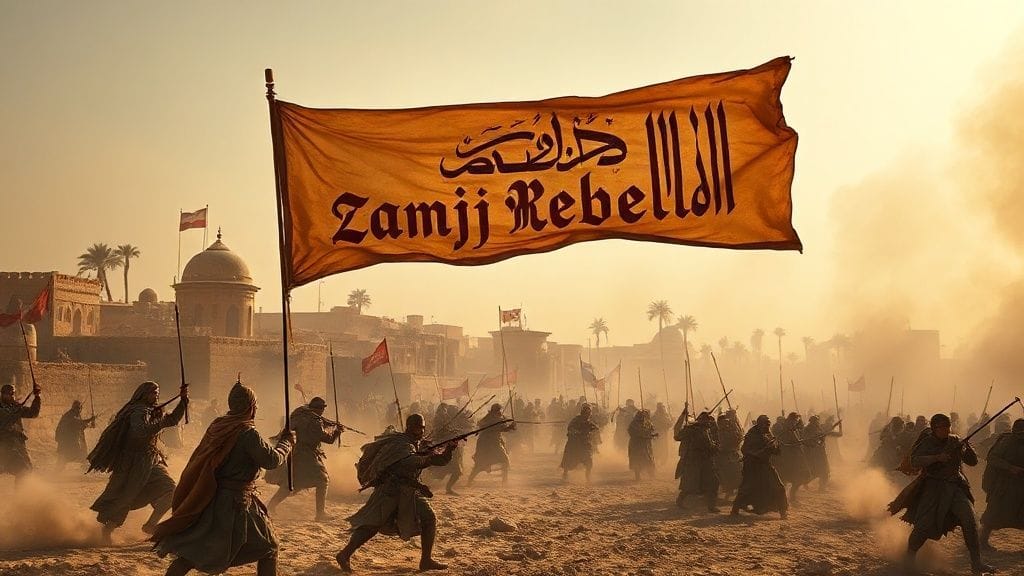
The climax of the early rebellion came in 871 when the Zanj laid siege to Basra, a critical port and commercial center. For nearly a year, the city endured isolation and attacks that brought famine and disease to its inhabitants. Streets once filled with commerce twisted into battlegrounds.
Accounts from the time evoke vivid images of desperation: merchants hiding precious goods, families fleeing to safer quarters, and the Abbasid garrison's faltering resolve. The Zanj fighters, many former slaves familiar with hardship, fought with an unexpected ferocity steeped in a sense of righteous purpose.
Basra's fall was a psychological and strategic blow to the Abbasids and a symbolic victory for the rebels. Yet, it also deepened the conflict’s brutality and horror, as reprisals and repression escalated in the wake of the siege.
8. Revolutionary Governance: The Zanj State Emerges
Following the capture of Basra and other strongholds, the Zanj transformed from a rebellious faction into an emergent political entity. Ali ibn Muhammad declared himself leader of a new society, issuing decrees and forming an administrative structure that attempted to provide security, justice, and order to those under rebel control.
This proto-state managed agricultural production, trade routes, and even minted coins, an act symbolizing sovereignty. It was an extraordinary achievement given the rebels’ origins and the continual threat from Abbasid counterattacks.
Social relations were also reimagined in Zanj-controlled areas, with expectations of equality and participation replacing formerly rigid hierarchies. This experiment in governance was both promising and precarious, representing one of the earliest radical social revolutions in medieval Islamic history.
9. The Abbasid Response: Military Campaigns and Strategic Challenges
The Abbasid caliphs, initially slow and underestimating the rebellion, gradually marshaled extensive military resources to crush the uprising. Commanders were dispatched, allies recruited, and punitive expeditions launched into the marshes and rebel territories.
Yet, the Abbasid armies struggled severely against the guerrilla tactics employed by the Zanj. The marshy landscape was a nightmare for heavy infantry and cavalry, and rebel fighters struck swiftly before slipping back into the labyrinth of swamps and canals.
Political instability within the Caliphate also weakened the response. Court intrigues, succession disputes, and competing factions drained attention and resources. The rebellion exposed vulnerabilities in the Abbasid state apparatus, shaking confidence across the empire.
10. The Geography of Rebellion: Marshes, Deserts, and Oases
One cannot understand the Zanj Rebellion without appreciating the geographic nightmare it posed. The southern Iraqi marshlands are a complex ecosystem of waterways, reeds, and mudflats—a natural fortress that favored the rebels intimately familiar with its every bend.
The rebels used their knowledge to evade Abbasid patrols, establish bases, and supply lines in otherwise inhospitable terrain. These marshes frustrated conventional armies, slowing advances and often turning attackers into the attacked.
Beyond the marshes, the deserts and oases of the region shaped campaign logistics, forcing both sides to grapple with scarcity of water, food, and manpower. The environment itself was an active player in this historical drama.
11. The Human Cost: Lives, Slavery, and Stories from the Revolt
Behind the grand narratives of strategy and power lies the profound human tragedy of the Zanj Rebellion. Estimated casualties number in the hundreds of thousands, a staggering toll for the 9th-century world.
Many Zanj fighters died in battle or from hardships; countless others suffered reprisals or were re-enslaved. Families were torn apart, cities destroyed, and entire communities shattered. Yet, within the calamity, stories emerge of courage, resilience, and dreams of freedom.
The rebellion forced the Islamic world to confront the realities of slavery’s human toll, sparking debates that would echo for centuries on justice, human dignity, and the limits of power.
12. The Role of Agriculture and Economy in Sustaining the Revolt
The Zanj Rebellion was not only a military struggle but also an economic confrontation. The rebels controlled vast swathes of fertile lands and marshes, where they resumed agricultural production and captured crucial trade routes.
Their ability to sustain the revolt relied heavily on managing these resources—growing crops, collecting taxes, and controlling commerce. This economic base allowed the rebellion to endure for over a decade, challenging the Abbasids’ resource monopoly.
This interplay between economic control and political power highlights how transformative the revolt was: it disrupted the very foundations of Abbasid wealth in the region.
13. Political Intrigue and Abbasid Divisions During the Uprising
The Abbasid court was rife with factionalism, intrigue, and shifting loyalties during the Zanj Rebellion. While the empire’s might was legendary, internal division severely hampered coordinated responses.
Some factions favored harsh repression, others advocated negotiation; generals competed for command, and provincial governors acted autonomously. This paralysis extended the rebellion’s life, as central authority waxed and waned.
The rebellion thus revealed not only the strength of the rebels but also the fragility of Abbasid rule in this period—a paradox of imperial grandeur overshadowed by internal collapse.
14. The Turning Tide: Abbasid Resurgence and the Decline of the Rebellion
After nearly fifteen years of struggle, the Abbasid caliphate adapted. New military leaders emerged, such as Al-Muwaffaq, who implemented a combination of siege warfare, streamlining command, and cutting supply lines.
The Abbasid armies gradually regained lost territory. The Zanj movement, despite its early successes, began fracturing under pressure, suffering losses and desertions. Ali ibn Muhammad’s leadership waned as Abbasid forces closed in.
This protracted campaign gradually turned the tide, culminating in decisive defeats that marked an endpoint for the rebellion’s hopes.
15. The Death of Ali ibn Muhammad: Collapse of a Revolt
In 883, the rebel leader Ali ibn Muhammad was captured and executed. His death symbolized the collapse of the Zanj rebellion’s central authority.
Without their charismatic leader and facing overwhelming military pressure, the rebel forces rapidly disintegrated. The Abbasid state reasserted control over Basra, Wasit, and surrounding territories, exacting brutal punishments and restructuring local governance.
Yet the rebellion had already left a profound impression on the empire’s psyche and history—proof that even mighty empires could be shaken from within.
16. Legacy of the Zanj Rebellion: Echoes Through Persian Gulf History
The Zanj Rebellion’s echoes resound through centuries of Middle Eastern history. It exposed the dangers of overreliance on slave labor, prompting changes in agricultural practices and labor deployments.
The revolt remains a potent symbol of resistance against oppression, inspiring later movements in the Islamic world and beyond. Its ramifications reached into social, political, and cultural domains, prompting scholars to reconsider the role of marginalized peoples in shaping history.
Moreover, the insurgency’s scale and ambition remind us that history is often made on the margins, in places and by people too frequently forgotten.
17. Impact on Slavery and Labor in the Islamic World
In the aftermath of the rebellion, the Abbasid Caliphate and successor states became wary of large-scale reliance on imported slave labor, especially for critical infrastructure projects. Policies evolved to diversify labor sources; smaller-scale slavery continued, but with increased social controls.
Intellectual debates about slavery’s morality and legality flourished in Islamic jurisprudence, partly influenced by the memorable disruptiveness of the Zanj revolt.
The story prompted reflections on human rights and authority that resonate through Islamic thought even today.
18. Cultural Reflections: Literature and Memory of the Revolt
Despite its magnitude, the Zanj Rebellion is sparsely recorded in the canonical literature of the period, but echoes survive in poems, chronicles, and folk tales.
Some later historians portrayed Ali ibn Muhammad as a heretic or rebel, while others hailed him as a prophet and liberator. This divergent legacy reflects competing political and religious agendas over time.
Modern historians and writers have revived interest in the rebellion, recognizing it as a rare window into the lives and struggles of enslaved peoples and the underclasses of medieval Islamic society.
19. The Rebellion in Historical Perspective: Lessons on Power and Resistance
The Zanj Rebellion teaches enduring lessons about the fragility of power built on exploitation, the capacity of marginalized people to assert agency, and the complex interplay of social, economic, and political forces.
It challenges simplistic narratives of empire and exposes the human costs of inequality. Furthermore, it illustrates how geography, leadership, and ideology can converge to create seismic historical shifts.
As an episode of resistance, it holds continuing relevance in discussions on social justice, rebellion, and human dignity.
20. Conclusion: The Lasting Marks of a Forgotten Uprising
The Zanj Rebellion was not just a slave revolt; it was a loud, defiant cry echoing across the marshes of southern Iraq and beyond. It disrupted an empire’s sense of invulnerability and exposed the often invisible human stories underlying medieval Islamic society.
Though the rebellion was eventually crushed, its memory survives—as a reminder of the power of hope, the complexities of human endurance, and the consequences of injustice.
To study the Zanj Rebellion is to look deeply into history’s shadows and find there a profound narrative of resistance, transformation, and the relentless pursuit of freedom.
FAQs: Understanding the Zanj Rebellion
Q1: What caused the Zanj Rebellion?
The revolt was chiefly caused by the brutal conditions faced by enslaved East African laborers (the Zanj) working in the salt marshes and plantations around Basra and Wasit. Economic exploitation, harsh physical labor, and social marginalization fueled widespread unrest.
Q2: Who led the Zanj Rebellion?
Ali ibn Muhammad was the charismatic and controversial leader who united the Zanj and other marginalized groups under a common revolutionary cause, asserting both religious and political authority during the uprising.
Q3: How long did the rebellion last?
The rebellion lasted approximately 14 years, from 869 AD to 883 AD, making it one of the longest and largest slave revolts in world history.
Q4: What areas did the rebellion affect most?
The revolt primarily affected the southern regions of the Abbasid Caliphate in Iraq, notably the cities of Basra and Wasit and the surrounding marshlands.
Q5: What were the consequences of the rebellion for the Abbasid Caliphate?
The uprising exposed serious weaknesses in Abbasid governance and military capacity. It caused significant economic disruption and forced the empire to reconsider the use of slave labor in strategic sectors.
Q6: Did the rebellion have a lasting impact on slavery in the Islamic world?
Yes, it led to more cautious approaches regarding slave labor and spurred theological and legal debates surrounding slavery within Islam, influencing subsequent labor policies.
Q7: How is the Zanj Rebellion remembered today?
Often overlooked in mainstream historical narratives, the rebellion is now studied as a critical example of resistance against oppression and as a revealing episode about slavery in the medieval Muslim world.
Q8: What lessons does the Zanj Rebellion offer for understanding power and resistance?
It highlights how marginalized peoples can organize and challenge entrenched authority, the importance of leadership and geography in rebellion, and the human cost of systemic exploitation.
External Resource: Wikipedia on the Zanj Rebellion
https://en.wikipedia.org/wiki/Zanj_Rebellion

