Table of Contents
- The Tumultuous Dawn at Constantinople: The Stage Is Set for the Council
- The Life and Rise of Photius: A Controversial Patriarch
- A Church Divided: The Tensions Between Rome and Constantinople
- Prelude to the Council: Political Intrigue and Ecclesiastical Power Struggles
- The Opening of the Fourth Council of Constantinople: A Gathering Amidst Crisis
- The Proceedings Begin: Debates and Accusations in the Imperial City
- The Deposition of Photius: A Dramatic Fall from Grace
- The Role of Pope Hadrian II: Rome's Influence Asserted
- The Council’s Canons and Decisions: Shaping Ecclesiastical Authority
- Repercussions through the Empire: Immediate Reactions across Christendom
- The Eastern Response: Photius' Legacy Lives On
- The Council’s Impact on East-West Church Relations
- Beyond Theology: Cultural and Political Ramifications in Byzantium
- The Council’s Place in the Broader Great Schism Narrative
- The Historical Debates: Interpreting the Council Through the Centuries
- Unforgotten Figures: Voices and Anecdotes from the Council
- Lessons from the Council: Power, Faith, and Identity in the Medieval World
- Conclusion: The Echoes of Constantinople, 869–870
- FAQs: Understanding the Fourth Council of Constantinople
- External Resource
- Internal Link
The air in Constantinople in the bleak winter of 869 was heavy with more than just the chill; it reeked of tension, suspicion, and a fracture within one of the oldest ecclesiastical structures known to Christendom. Palatial halls and sacred basilicas alike buzzed with whispered prayers, fierce political maneuvering, and the anguished voices of a church torn apart. Somewhere between the gold-leaf mosaics and imposing domes, history itself was about to be reshaped. At the heart of this storm was a figure equally venerated and vilified—Photius, the Patriarch of Constantinople—who stood defiant, yet vulnerable beneath the weight of accusations that rippled through the empire and beyond.
The Tumultuous Dawn at Constantinople: The Stage Is Set for the Council
To understand the gravity of the Council convened in 869–870, we must first journey into the complexities of the Byzantine capital—a city where spiritual authority and imperial power collided. Constantinople was not only the jewel of the Eastern Roman Empire but a spiritual battleground. The very city bore witness to the layered struggles between tradition and reform, between East and West, and between an emperor’s will and the independence of a church.
But at this moment, the flashpoint was Photius. Elevated under extraordinary circumstances in 858, his patriarchate was contested by factions loyal to his predecessor, Ignatius, and fiercely opposed by the Roman papacy. Photius was a scholar, a statesman, but also an enigma wrapped in the political ambitions of his time.
The Life and Rise of Photius: A Controversial Patriarch
Photius was no ordinary man. Born into a noble family around 810, his learning spanned theology, rhetoric, and classical literature. He stood not merely as a cleric but as a beacon of Byzantine intellectual revival. Yet his ascent to the patriarchate—bypassing many traditional ecclesiastical steps—cast a long shadow from the outset.
When Ignatius, the sitting Patriarch, was deposed by imperial decree in 858, Photius was hurriedly installed in his place. This act sent shockwaves far beyond Constantinople’s walls. The Roman Church, under Pope Nicholas I, viewed this as an affront to canonical law and ecclesiastical order, deriding Photius as an intruder.
A Church Divided: The Tensions Between Rome and Constantinople
The conflict was more than an internal Byzantine affair. It revealed the deepening rift between the Latin West and Greek East. Rome’s insistence on canonical propriety clashed with Byzantium’s imperial traditions where the emperor wielded significant influence over ecclesiastical appointments.
Moreover, theological disputes simmered beneath the surface. The Filioque controversy—whether the Holy Spirit proceeds from the Father alone or from the Father and the Son—was a theological powder keg waiting to explode, feeding into the tensions between the two patriarchates.
Prelude to the Council: Political Intrigue and Ecclesiastical Power Struggles
By the late 860s, the schism had widened irreparably. Emperor Basil I sought a semblance of unity, while Pope Nicholas I pushed for the restoration of Ignatius, whom he considered the rightful patriarch. Diplomatic negotiations, letters, and excommunications flew back and forth like arrows across a battlefield.
Against this backdrop entered the Fourth Council of Constantinople, convened under Basil I’s auspices. Intended as a solution, it turned into a decisive confrontation.
The Opening of the Fourth Council of Constantinople: A Gathering Amidst Crisis
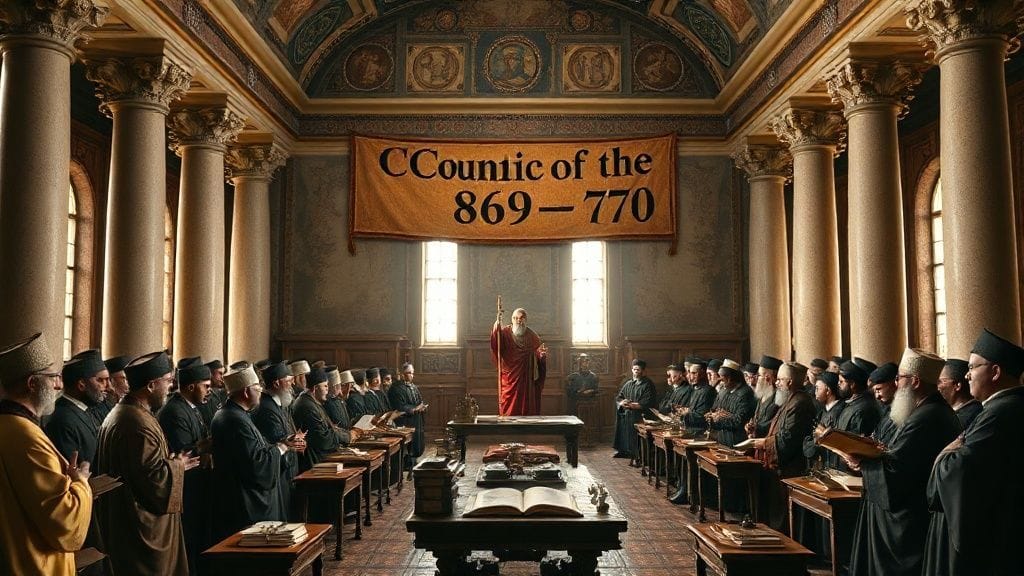
When the council assembled in late 869, it was a heterogeneous gathering of bishops and clerics representing a fragile coalition. The air was thick with anticipation and uncertainty. Was this to be the forum where peace was forged, or where deeper divisions would be carved?
The very choice of Constantinople, the seat of the contested patriarchate, underscored the power dynamics at play. Roman legates attended, but the emperor’s influence loomed large over proceedings.
The Proceedings Begin: Debates and Accusations in the Imperial City
The council quickly revealed itself as a trial as much as a synod. Photius was in absentia but represented through political allies and theological arguments. His opponents, advocates of Ignatius and of Roman primacy, levied charges of illegitimacy and heresy.
Deliberations were intense, often acrimonious. Questions of canonical law, imperial authority, and papal jurisdiction intertwined with personal rivalries and doctrinal disputes in a complicated mosaic of conflict.
The Deposition of Photius: A Dramatic Fall from Grace
Ultimately, the council declared Photius deposed and anathematized, reaffirming Ignatius as the rightful Patriarch of Constantinople. This was a crushing blow to Photius, who faced exile and disgrace, though history would later see his restoration.
This decision was both a religious judgment and a political statement—an assertion of Rome’s authority and a challenge to Byzantine sovereign influence in ecclesiastical matters.
The Role of Pope Hadrian II: Rome's Influence Asserted
Notably, the Council was held under the papacy of Pope Hadrian II, successor to Nicholas I. Hadrian II's legates played critical roles in not merely condemning Photius but in shaping the council’s canons, enhancing papal prestige.
Rome, long grappling with Eastern autonomy, made a clear statement: the bishop of Rome held primacy, and the rebellious patriarch would not be tolerated.
The Council’s Canons and Decisions: Shaping Ecclesiastical Authority
Beyond the deposition, the council promulgated thirty canons addressing a variety of ecclesiastical issues—from reaffirming clerical discipline to procedural rules for councils. These canons sought to regulate the fractious Church more tightly, embedding Roman-centric ecclesiology.
Yet, many provisions focused on affirming papal authority over the Eastern church, signaling an attempt to reassert Rome's theological and administrative dominance.
Repercussions through the Empire: Immediate Reactions across Christendom
The ripple effects were immediate and visceral. Supporters of Photius lamented the decision as an imperial and Roman imposition. In contrast, Western Latin churches hailed the council as a triumph of ecclesiastical orthodoxy.
The Byzantine Emperor himself sought to navigate a delicate balance, fearing domestic instability but acknowledging Rome’s strength. The council, though decisive, did not heal the underlying fissures.
The Eastern Response: Photius' Legacy Lives On
Remarkably, Photius' story did not end with this council. A decade later, shifting political tides and imperial favor restored him to power, and he continued to shape the Eastern Church vigorously. His theological works, diplomatic missions, and cultural patronage left an enduring imprint.
For the East, the council became emblematic of Western interference, deepening mistrust toward Rome.
The Council’s Impact on East-West Church Relations
The Fourth Council of Constantinople stands as a pivotal moment foreshadowing the Great Schism of 1054. Although temporary, its decisions crystallized the ecclesiastical division and marked a point of no return.
Questions of primacy, jurisdiction, and theological authority—intensified in this council—would ferment for centuries.
Beyond Theology: Cultural and Political Ramifications in Byzantium
This council did not unfold in a vacuum of religious doctrine alone. The Byzantine imperial culture, already fragile under external threats and internal strife, absorbed the reverberations of the council’s resolutions.
The delicate dance between church and state was tested; the emperor’s role as protector of orthodoxy was questioned. Meanwhile, the Byzantine people witnessed the patriarchal office as a tangible symbol of their identity and imperial grandeur.
The Council’s Place in the Broader Great Schism Narrative
Historians often position this council as the “Eastern” Fourth Council of Constantinople in contrast to the “Western” Fourth Council convened later, reflecting competing narratives. This duality underscores the complex layering of historical memory and ecclesiastical politics.
Understanding this council is crucial to grasping the eventual formal split between Eastern Orthodoxy and Roman Catholicism.
The Historical Debates: Interpreting the Council Through the Centuries
From Eastern Orthodox and Roman Catholic scholars to modern historians, interpretations of the council vary dramatically. Was it a legitimate synod affirming rightful order, or a politically motivated show trial?
These debates illuminate as much about contemporary ecclesiastical identities as about medieval realities.
Unforgotten Figures: Voices and Anecdotes from the Council
Amid the grand narratives, personal stories shine through: bishops who wept at the deposition, scribes who preserved fragile documents, and envoys who journeyed across empires bearing letters of condemnation or support.
These human moments bring the abstract conflict to life, reminding us that history is never only about institutions but about people.
Lessons from the Council: Power, Faith, and Identity in the Medieval World
The Fourth Council of Constantinople teaches us about the potent mixture of faith and power. It reveals how theological disputes are entwined with political ambition, and how spiritual office can become a crucible for national and cultural identity.
The council reflects the perennial struggle of tradition grappling with change, authority confronting dissent.
Conclusion: The Echoes of Constantinople, 869–870
Standing amidst the ancient stones of Constantinople, one cannot help but feel the weight of the Fourth Council’s legacy. Its decisions cast long shadows over the Byzantine world and the entire Christian cosmos. Far from resolving the divisions that plagued the Church, it crystallized them, setting the stage for centuries of rivalry, mistrust, and, ultimately, schism.
Yet beneath the formal condemnations and political maneuvers lies a profound human story—a tale of ambition, conviction, and the complexities of faith caught in the gears of history. Photius, condemned but never truly silenced, symbolizes the resilience of the Eastern Church and the enduring questions about authority that continue to resonate today.
The Fourth Council of Constantinople reminds us that history is a living dialogue between past and present, urging us to understand not just what was decided, but why those decisions mattered—and continue to matter—with all their passion and pain.
FAQs: Understanding the Fourth Council of Constantinople
Q1: Why was Photius such a controversial figure?
Photius was controversial due to his unprecedented elevation to the patriarchate, bypassing traditional ecclesiastical steps, and because he represented Byzantine imperial interference in church affairs. His intellectual prowess and political influence made him a formidable, polarizing figure.
Q2: What were the main causes leading up to the 869–870 council?
The causes included the contested deposition of Ignatius, struggles for ecclesiastical authority between Constantinople and Rome, and broader theological disputes, notably over papal primacy and the Filioque clause.
Q3: How did Pope Hadrian II influence the council?
Pope Hadrian II’s legates ensured that the council’s decisions favored Roman primacy and supported the deposition of Photius, asserting the authority of the bishop of Rome in Eastern ecclesiastical matters.
Q4: What were the consequences of the council for East-West relations?
The council deepened distrust and division between the Eastern and Western Churches, contributing significantly to the eventual Great Schism in 1054.
Q5: Did Photius ever regain his position?
Yes, Photius was restored to the patriarchate in 877, illustrating the ongoing volatility of Byzantine ecclesiastical politics.
Q6: How does the Eastern Orthodox Church view this council today?
Many Eastern Orthodox reject the council’s legitimacy, seeing it as a politically motivated Roman attempt to impose authority and discredit Photius, whom they consider a saint.
Q7: What is the significance of the council’s canons?
The canons attempted to enforce ecclesiastical discipline and assert papal supremacy, impacting church law and governance for generations.
Q8: Why is this council called the “Fourth Council of Constantinople”?
It is labeled so because it was one of several significant councils held in Constantinople, though its acceptance as ecumenical varies between Eastern and Western traditions.

