Table of Contents
- Dawn of the Norse in Ireland: The Year 841
- Dublin’s Birth: From Raiding Camp to Thriving Settlement
- The Vikings’ First Arrival: Fear and Fury on the Irish Coast
- The Strategic Choice of Dublin’s Location
- Life under the Norse: A City Between Two Worlds
- The Rise of Norse Kings: Power Struggles and Alliances
- Trade Networks That Stretched Across Europe
- Clashes with the Gaels: Battle for Supremacy and Survival
- The Cultural Fusion: Norse and Gaelic Interactions
- The Ecclesiastical Impact: Churches, Monasteries, and Pilgrims
- Dublin’s Economic Boom: Markets, Crafts, and Currency
- The Era of Cycles: Waves of Conflict and Reconciliation
- The Great Siege of 902: Temporary Fall and Resilience
- The Return and Reassertion: Norse Revival from 914 to 917
- The End of Viking Autonomy: The Battle of Clontarf’s Foreshadowing
- Legacy of the Norse in Dublin: Language, Urbanism, and Identity
- Archaeological Discoveries: Unearthing the Norse Past
- Myths, Legends, and the Viking Spirit in Irish Memory
- Historiographical Debates: Interpreting the Norse Era Today
- Conclusion: Dublin, Cradle of Norse and Irish Histories Intertwined
- FAQs about the Norse Settlement in Dublin
- External Resource: Wikipedia Link to the Norse Settlement in Dublin
- Internal Link: Visit History Sphere
1. Dawn of the Norse in Ireland: The Year 841
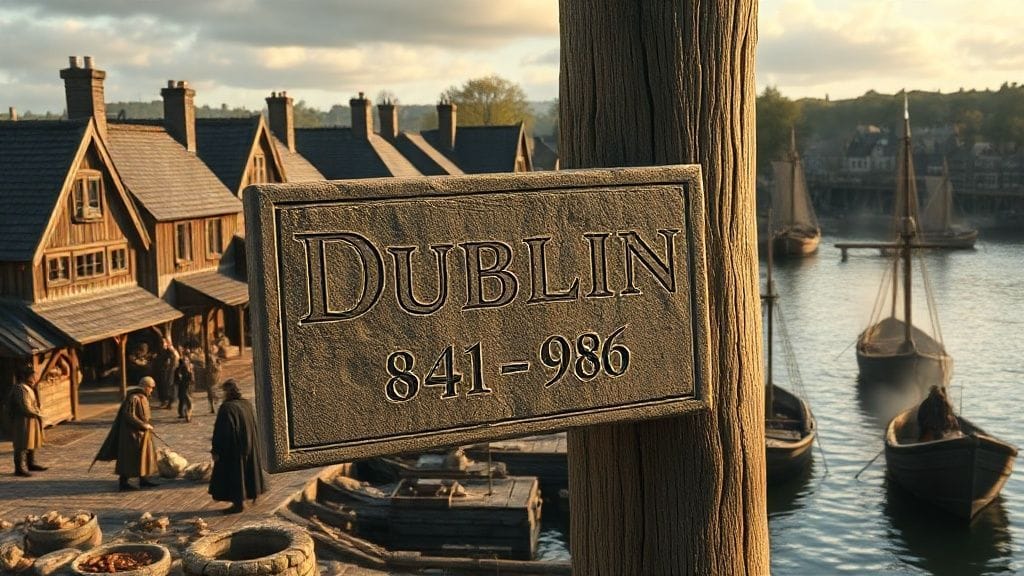
The year 841 dawned like any other on the green shores of Ireland, but it was soon to mark the beginning of a profound transformation. For centuries, Ireland had lived in relative isolation, its patchwork of Gaelic kingdoms ruled by local chieftains, steeped in ancient Celtic traditions and monastic piety. But the skies darkened with unfamiliar sails, and the serenity of the Irish coast was shattered by the thunderous arrival of the Vikings — fierce warriors from the north. It was in this tumultuous year that a group of Norsemen established a modest outpost, which would morph into the city of Dublin, a name now synonymous with Irish history but forever tied to its Norse roots.
The winds that carried these men were laden with more than just salt spray; they bore the promise of new beginnings, conquests, trade, and cultural amalgamation. Dublin's Norse settlement was not a mere footnote in Ireland’s past—it was a pioneering episode that would leave echoes for centuries.
2. Dublin’s Birth: From Raiding Camp to Thriving Settlement
Imagine a ragged fleet of longships, their dragon-headed prows slicing through the chilly Irish Sea, seeking not just plunder but permanence. What began as a raiding camp near the River Liffey grew rapidly into a fortified town, a hub of commerce and a melting pot of rival tribes and cultures. The Norse traders and warriors swiftly recognized the advantage of this strategic enclave: access to inland routes, a defensible position, and proximity to fertile lands.
By the mid-9th century, this nascent settlement stretched beyond a mere military outpost. It had become the jewel in the Norse crown, a gateway from Ireland to the wider Viking trading world. The transformation of Dublin was astounding: from a place of destruction emerged a bustling city pulsing with life.
3. The Vikings’ First Arrival: Fear and Fury on the Irish Coast
The initial Norse incursions were terrifying. Riots erupted, monasteries suffered devastating raids, and the Christian Irish kingdoms grappled with a threat unlike any other. The Vikings, with superior seafaring technology and ruthless tactics, infiltrated the island’s coasts with brutal precision.
The Irish annals paint a grim picture: “The heathens came from the northward, they ravaged the lands and laid waste to the churches.” This was a time when sacred places, symbols of Irish spiritual and cultural identity, were vulnerable. Yet, the malevolence of the first decades eventually gave way to something unexpectedly complex—coexistence and hybridization.
4. The Strategic Choice of Dublin’s Location
Dublin’s location was no accident. Situated at the mouth of the River Liffey, weaving into the inland heartlands, the site was ideal. The tidal inlet offered protection, a deep harbour for the Norse longships, and access to the rich agricultural hinterlands.
This tactical choice reflected Viking sophistication. Unlike their reputation as mere marauders, the Norse demonstrated deep understanding of geography, politics, and trade. Dublin became the linchpin of their Atlantic expansion, a city designed for both war and commerce.
5. Life under the Norse: A City Between Two Worlds
Within Dublin's ochre ramparts, life unfolded in a confluence of Norse order and native Irish rhythms. Streets echoed with the clang of smiths, the shout of merchants, and mingled tongues speaking Old Norse and early Irish.
Daily life in the settlement was harsh but vibrant. Wooden houses, workshops, and markets created a bustling urban atmosphere. Norse women and men mingled with native inhabitants—sometimes as allies, sometimes as adversaries—but always shaping a shared destiny. Religion, law, and culture intertwined in complex patterns, revealing a society neither purely Viking nor Irish, but a synthesis of both.
6. The Rise of Norse Kings: Power Struggles and Alliances
Leadership in Dublin was volatile. Norse kings and chieftains vied for supremacy, alternating between brutal killings and fragile alliances. Figures such as Amlaíb Conung emerged, blending Viking tradition with Irish customs.
These rulers negotiated with neighboring Gaelic kings, sometimes waging war, other times forging matrimonial and political bonds. The saga of Dublin’s Norse kings is a story of ambition and survival, underscoring the fluid nature of power in this borderland world.
7. Trade Networks That Stretched Across Europe
Dublin was no isolated Viking enclave. It participated in vast trade networks that touched Iceland, Continental Europe, and even the Mediterranean. Salt fish, slaves, furs, silver, and amber traversed its docks, exchanged for luxury goods, weapons, and coins.
These economic arteries made Dublin one of medieval Europe’s most exciting trade hubs, connecting Ireland to the currents of a rapidly changing world. It was a crossroads, threading local resources into global markets centuries before the modern age.
8. Clashes with the Gaels: Battle for Supremacy and Survival
The Norse presence provoked fierce resistance. Gaelic kingdoms united sporadically to repel the invaders, resulting in prolonged warfare that shaped Irish political geography.
Yet, battles like those recorded at Glenn Máma and Dublin’s numerous sieges were more than mere conflict; they were episodes in a century-long negotiation of identity and power. The struggle between Norse and Gaelic forces was one of attrition, adaptation, and unexpected cooperation.
9. The Cultural Fusion: Norse and Gaelic Interactions
Despite enmity, Norse and Irish cultures blended in profound ways. Language borrowed terms. Artifacts combined Celtic knot patterns with Scandinavian motifs. Marriages linked families across former divides.
This fusion gave rise to a distinctive Hiberno-Norse culture, visible in everything from city architecture to myths and legal practices. The Norse settlement was a crucible where new identities were forged amid ancient traditions.
10. The Ecclesiastical Impact: Churches, Monasteries, and Pilgrims
Religion remained a contested yet pivotal sphere. Norse conversion to Christianity was gradual, often pragmatic. Churches were built; monasteries sometimes enjoyed Norse patronage or were destroyed during initial raids.
By the 10th century, Dublin housed notable Christian centers, attracting pilgrims and clergy. This ecclesiastical evolution reflected broader transformations—how the pagan North integrated into a Christian Europe.
11. Dublin’s Economic Boom: Markets, Crafts, and Currency
Growth was visible in bustling marketplaces, where craftsmen peddled textiles, weapons, jewelry, and pottery. Dublin minted its own silver pennies, evidence of a sophisticated economy.
The city thrived not only on plunder but entrepreneurship. Markets attracted Irish farmers, Norse traders, and visitors from afar, fueling urban expansion that laid the foundation for the later capital of Ireland.
12. The Era of Cycles: Waves of Conflict and Reconciliation
From 841 to around 917, Dublin experienced oscillations—intense battles followed by uneasy truces, destruction succeeded by rebuilding. These cycles were not merely political but represented cultural dialog, the push and pull of coexistence.
Each return from exile, each new siege, added layers to Dublin’s growing complexity, gradually reshaping Irish society.
13. The Great Siege of 902: Temporary Fall and Resilience
A dramatic turning point was the siege of 902, when combined Irish forces forced the Norse out of Dublin, scattering the settlers. Yet, the city’s fall was temporary.
This expulsion sent the Vikings into diaspora across Ireland and beyond, but few could imagine that within a decade, the Norse would return with greater strength, determined to reclaim their prize.
14. The Return and Reassertion: Norse Revival from 914 to 917
The Norse did not vanish. Around 914, a second wave arrived, led by ambitious leaders like Sihtric Cáech, reinvigorating the settlement.
By 917, Dublin had re-emerged as a dominant power center, able to defend itself and project influence. This revival underscored Norse resilience and Dublin’s strategic allure.
15. The End of Viking Autonomy: The Battle of Clontarf’s Foreshadowing
Though the Viking period in Dublin persisted beyond 917, the seeds of its decline were sown in the years that followed. The famous Battle of Clontarf in 1014 symbolized the waning of Norse autonomy.
This conflict concluded a long era of cohabitation, warfare, and cultural mingling, ultimately integrating Dublin fully into the Irish polity.
16. Legacy of the Norse in Dublin: Language, Urbanism, and Identity
Today, Dublin’s streets trace the shadows of Norse walls, and its name whispers of a Viking past. Many Irish words and place names bear Norse roots. The city’s early urban form influenced Ireland’s shift toward urbanity.
The Norse legacy is neither purely conqueror nor victim—it is a shared heritage that continues to shape Irish identity.
17. Archaeological Discoveries: Unearthing the Norse Past
Recent excavations have revealed Norse houses, workshops, and graves beneath modern Dublin, attesting to the settlement’s scale and sophistication.
Findings like the “hogback” stones and silver hoards have illuminated daily life and beliefs, transforming understanding of the Viking age in Ireland.
18. Myths, Legends, and the Viking Spirit in Irish Memory
Old tales recount the Norse as both villains and heroes. Figures like Ivar the Boneless enter Irish legend, while folklore remembers alliances and betrayals.
This rich narrative tapestry reflects how the Norse remain vivid protagonists in Ireland’s collective imagination.
19. Historiographical Debates: Interpreting the Norse Era Today
Scholars continue to debate the true nature of Norse settlement — invaders or settlers, disruptors or integrators.
Modern interdisciplinary research blends history, archaeology, linguistics, and genetics to reassess this pivotal chapter, revealing its nuanced complexity.
20. Conclusion: Dublin, Cradle of Norse and Irish Histories Intertwined
The Norse settlement of Dublin from 841 to 917 was more than a fleeting occupation—it was the birth of a city, a crossroads of cultures, and a catalyst for change.
Its story embodies resilience, adaptation, and fusion, reminding us that history is seldom a tale of simple conquest but a dynamic narrative of human encounters.
Conclusion
The saga of the Norse settlement in Dublin is a story of transformation—of fear giving way to familiarity, war woven into peace, and isolation blossoming into connection. From the thunderous raids that shook monasteries to the bustling markets lining the Liffey, the Vikings left an indelible mark on Ireland’s history and identity.
But more than the stones and swords, it is the human story—of individuals caught between worlds, who adapted and thrived—that resonates most deeply. Dublin’s Norse era challenges us to rethink notions of conquest, to see cultural blending as a source of strength, and to recognize the city as a living palimpsest where Irish and Viking legacies merge.
As the sun sets over modern Dublin, the ghosts of those first longships still linger, weaving their tales into the city’s eternal fabric.
FAQs
1. Why did the Vikings choose Dublin as their settlement site?
Dublin’s location at the mouth of the River Liffey provided natural defense, easy access to inland trade routes, and a sheltered harbor, making it an ideal base for both raiding and commerce.
2. How did the Norse settlers interact with the native Irish population?
Interactions were complex and ranged from violent conflict to alliances, intermarriage, cultural exchange, and economic cooperation, leading to the emergence of a unique Hiberno-Norse identity.
3. What economic impact did the Vikings have on Ireland?
The Vikings introduced urban markets, minted coins, and linked Ireland to wider European trade networks, significantly boosting the local economy and catalyzing urban development.
4. How did religion evolve during the Norse period in Dublin?
Initially pagan, many Vikings eventually converted to Christianity, building churches and monasteries, reflecting a gradual integration into the predominantly Christian Irish society.
5. What was the significance of the siege of 902?
The siege by Irish forces temporarily expelled the Vikings from Dublin, illustrating the ebb and flow of power, though the Norse would return stronger within a decade.
6. How is Norse heritage visible in modern Dublin?
From place names and linguistic influences to archaeological remains and urban layout, the Viking legacy endures as a foundational chapter in Dublin’s development.
7. Who were some key Norse leaders in Dublin?
Figures like Amlaíb Conung and Sihtric Cáech played pivotal roles in establishing and reestablishing Norse control over Dublin during this period.
8. How do historians today view the Norse settlement?
Contemporary scholarship presents it as a multifaceted phenomenon involving conquest, settlement, cultural integration, and the transformation of Irish society.

