Table of Contents
- The Roar of the Fjord: Scene-Setting at Hafrsfjord, 872 AD
- Norway Before the Storm: Fragmented Kingdoms and Fierce Loyalties
- The Rise of Harald Fairhair: Ambitions of a Young King
- The Gathering Storm: Prelude to the Battle of Hafrsfjord
- Armies on the Horizon: The Leaders and Their Forces
- The Clash of Titans: The Battle Unfolds
- Bloodied Waters and Broken Shields: The Turning Points
- The Last Stand: Resistance and Surrender in the Fjord
- After the Smoke Clears: Immediate Consequences of the Battle
- The Making of a Kingdom: Harald’s Quest for Norse Unity
- The Saga Speaks: Oral Histories and Medieval Chronicles
- Norse Identity Forged in Battle: Cultural and Social Impact
- The Viking Age Transformed: New Political Realities
- The Legacy of Hafrsfjord: Symbolism in Modern Norway
- Myths, Legends, and Realities: Distinguishing Fact from Fiction
- Archaeological Discoveries: Unearthing the Battlefield
- Reflection: What the Battle Teaches Us About Power and Unity
- The Battle in Popular Culture: From Sagas to Screen
- Conclusion: The Lasting Echo of the Battle of Hafrsfjord
- FAQs: Answering Essential Questions About Hafrsfjord
- External Resource: Wikipedia Link
- Internal Link: Visit History Sphere
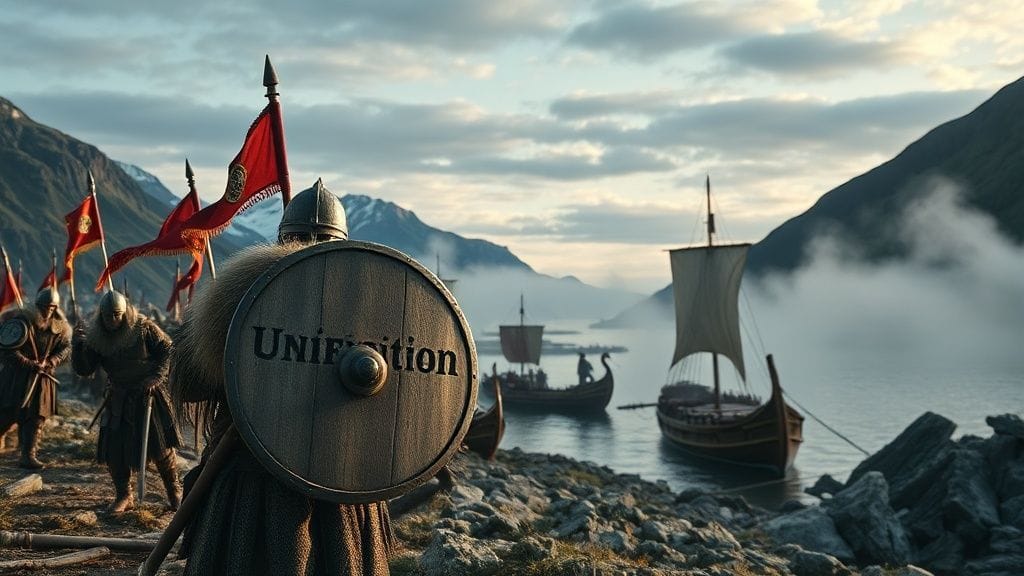
The roar of the waves crashing against jagged rocks—the salty air thick with the cries of warriors and the clang of iron meeting iron—this is Hafrsfjord in the year 872 AD. It was here, in this narrow inlet just outside what is now Stavanger, that the fate of Norway was irrevocably altered. The Battle of Hafrsfjord, a bloody and decisive confrontation, saw a tapestry of Viking chiefs and kings clashing in an epic struggle not just for territory, but for the soul of a fragmented land.
To understand the true magnitude of this battle, one must imagine the fjord that day: vessels lined up like rows of fierce predators ready to tear into one another, men bracing themselves against the biting cold and the anticipation of a violent future. The tension was palpable, woven from years of rivalry, ambition, and the unyielding desire to consolidate power over the long-scattered Norwegian clans. It was not merely a skirmish, but the harbinger of a new era—the forging of a nation under one crown.
Norway Before the Storm: Fragmented Kingdoms and Fierce Loyalties
In the decades leading up to 872, Norway was not a single kingdom but a mosaic of petty chieftains, local rulers, and throne-claimants all vying for dominance. The landscape itself—mountainous, deeply carved by fjords, and dotted with isolated settlements—fostered a culture of fierce independence and fierce loyalty to local lords rather than distant kings. Yet, these fragmented realms also bred simmering conflict that spilled into raiding, alliance-making, and constant jockeying for power.
The Icelandic sagas, though written centuries later, paint a vivid image of this divided Norway. "Each chief was a king in his own right," one saga is reported to say, "but none could rule a land wide enough to be called a kingdom." Such was the landscape into which young Harald Fairhair stepped—an ambitious leader with a vision that extended well beyond local power struggles.
The Rise of Harald Fairhair: Ambitions of a Young King
Harald Fairhair (Harald Hårfagre) emerges from legend as both a warrior prince and a visionary unifier. His epithet “Fairhair” is said to come from a youthful vow to marry only after his hair grew long enough to cover his shoulders, a symbol of patience and steadfast resolve. His journey toward unification started with small victories in southwestern Norway, where he began to amass influence and supporters.
Harald’s growing power did not go unchallenged. Rival chieftains and families who thrived on the fractious political landscape viewed his ambitions as threats to their centuries-old rights. Still, Harald was relentless, reportedly promising that one day all Norway would be under his rule—a claim that many dismissed as mere boasting, until Hafrsfjord shattered those doubts.
The Gathering Storm: Prelude to the Battle of Hafrsfjord
Tensions rose steadily in the year leading up to the battle. Minor skirmishes escalated into open hostility as factions prepared for confrontation. Harald took time to consolidate forces, gathering warriors not only from his own holdings but also allies drawn by promises of spoils and new power structures. His fleet swelled, reflecting a carefully orchestrated campaign rather than random violence.
Opposing him was a coalition of regional kings—fierce warriors themselves—who sought to resist Harald’s centralization. Among them, figures like Kjotve the Rich emerged, representing the entrenched elites of Rogaland and other western realms. Such was the high stakes of this battle—more than land, it was about preserving a way of life and shedding the shackles of tradition.
Armies on the Horizon: The Leaders and Their Forces
As the dawn broke over Hafrsfjord in the summer of 872, two fleets converged with the precision and menace of storms colliding at sea. Harald’s forces, estimated by some sources to number in the thousands, lined the western shore, ready and confident. The opposition was equally formidable, their crews seasoned fighters with intimate knowledge of the local waters.
The leaders were not faceless generals but monarchs and chiefs with names etched deep in Norse memory—proud, defiant, and aware that this battle would seal their fates. Harald himself stood tall on his flagship, the wind tangling through his flowing hair, his gaze fixed on the enemy vessels massing like shadowy beasts in the fjord’s embrace.
The Clash of Titans: The Battle Unfolds
Hafrsfjord erupted into chaos as arrows flew, axes swung, and shields splintered. The narrowness of the inlet forced combat into brutal, close quarters engagements—men grappling not only for supremacy but for survival. The cries of the dying mingled with the roar of the sea, painting a visceral scene that would reverberate through generations.
Harald’s tactical genius became apparent as he exploited the fjord’s geography, maneuvering his fleet to trap the enemy and isolate key leaders. Fierce hand-to-hand combat ensued on decks slick with blood and saltwater. The battle was not merely one fought with weapons, but with wills and cunning.
Bloodied Waters and Broken Shields: The Turning Points
As hours dragged on, the tide began to turn. Harald’s superiority in numbers and strategic acumen wore down the coalition forces. Key leaders fell, and with them, the resolve of their men. One contemporary poem recalled how the fjord turned “redder than the setting sun,” as the bodies of the slain sank beneath the waves.
The casualty lists were heavy; entire clans faced decimation. But amidst the carnage emerged moments of heroism and legend: warriors who refused to surrender, others who fought to the bitter end protecting their families’ future. It was a crucible of transformation, forging a new order from the fiery depths of conflict.
The Last Stand: Resistance and Surrender in the Fjord
By late afternoon, the opposition’s lines crumbled. Some fled the fjord in despair, while others, trapped and outnumbered, surrendered. The victory was complete but hard-won. Harald’s triumph would come to define his reign and the emerging Norwegian kingdom.
Yet, not all were subdued. Some lords retreated to the hinterlands, vowing rebellion. These pockets of dissent ensured that Harald’s unification was a process, not a finished work. Still, the Battle of Hafrsfjord had decisively changed the political landscape.
After the Smoke Clears: Immediate Consequences of the Battle
Harald Fairhair emerged as the undisputed ruler of a united Norway—at least in name. His dominion stretched further than any before, consolidating power in ways that would last centuries. The battle effectively ended the age of petty kings and heralded a new era of centralized monarchy.
Political restructuring followed as Harald imposed tribute systems and fortified loyalty among former rivals. However, this did not end Norway’s turbulent history; instead, it redirected that energy towards building a cohesive society with a shared identity.
The Making of a Kingdom: Harald’s Quest for Norse Unity
Harald’s victory was both an endpoint and a beginning. The saga tradition credits him with founding the first true Kingdom of Norway, an idea that had seemed impossible before. This unification changed how Norwegians saw themselves—from a patchwork of clans to a people bound by common leadership and destiny.
One poignant anecdote tells how Harald refused to cut his hair until the kingdom was united—a personal sacrifice representing his commitment. He kept this vow, and his long hair became a symbol of Norway’s newfound unity.
The Saga Speaks: Oral Histories and Medieval Chronicles
Much of what we know about the battle comes from the Icelandic sagas, composed centuries later but rooted in oral tradition. These stories blend fact with poetic license, casting Harald and his adversaries as larger-than-life figures.
The “Heimskringla” by Snorri Sturluson remains the most significant source, depicting the battle as a divine mandate fulfilled by Harald. Though imbued with myth, these sagas provide invaluable insight into how the event was understood by medieval Norse society—and how it shaped national memory.
Norse Identity Forged in Battle: Cultural and Social Impact
The repercussions of Hafrsfjord went beyond politics. It laid the groundwork for a shared Norse identity—a cultural consolidation that included language, laws, and customs. The dominance of a singular king facilitated the spread of Christianity centuries later and opened Norway to broader European influence.
The idea of the warrior-king, embodied by Harald, became a central motif in Norse culture, inspiring poetry, art, and subsequent rulers. The battle also marked a pivotal moment in the Viking Age, symbolizing not only conquest but the dawn of a new societal order.
The Viking Age Transformed: New Political Realities
Hafrsfjord signaled a shift away from fragmented raiding parties toward structured kingdoms. Viking expansion continued, but political coherence at home allowed Norway to pursue more coordinated initiatives abroad—colonization, trade, and alliances that changed the course of Northern Europe.
The battle’s aftermath laid the foundation for Norway’s medieval monarchy, influencing governance structures and diplomatic relations for centuries. It was a transformation echoing beyond its time, still visible in modern Scandinavian history.
The Legacy of Hafrsfjord: Symbolism in Modern Norway
Today, the battle’s memory endures as a cornerstone of Norwegian national identity. Monuments, celebrations, and education commemorate Hafrsfjord as the cradle of the nation. The exact location of the battle has been marked by statues and cultural sites that draw tourists and scholars alike.
This legacy reminds Norwegians of unity born from conflict and the importance of visionary leadership. The story of Harald and his battle resonates as a metaphor for resilience, determination, and the complex path toward national cohesion.
Myths, Legends, and Realities: Distinguishing Fact from Fiction
Separating myth from history is an ongoing challenge. While Harald and the battle are factual, many details—exaggerated troop numbers, divine interventions, and heroic speeches—belong to legend.
Historical-critical methods and archaeology strive to paint a clearer picture, acknowledging the sagas’ cultural value without accepting them wholesale. This balanced approach enriches our understanding of Hafrsfjord as both historical event and mythological saga.
Archaeological Discoveries: Unearthing the Battlefield
Modern archaeological efforts have sought evidence of the battle’s scale and precise location. Finds of weapons, ship remains, and settlement ruins near Hafrsfjord have begun to corroborate saga accounts, though much remains debated.
These discoveries deepen our connection to the past, offering tangible links to the warriors who fought and died in these waters. They remind us that history is not just stories but a physical reality imprinted on the land.
Reflection: What the Battle Teaches Us About Power and Unity
The Battle of Hafrsfjord is more than a violent episode—it is a study in leadership, vision, and the costs of unity. Harald’s achievement came at great human expense, but also brought stability to a land long divided.
It challenges us to consider how societies balance ambition with tradition, and how conflict can both destroy and create. The battle stands as a testament to the complexities of power and the enduring human desire for belonging under a shared banner.
The Battle in Popular Culture: From Sagas to Screen
From medieval manuscripts to modern novels, films, and documentaries, the Battle of Hafrsfjord continues to captivate imaginations. Its dramatic narrative, heroic figures, and profound consequences have inspired countless retellings.
These cultural representations serve to keep the memory alive, adapting and reinterpreting the battle for new generations while honoring its foundational place in Norwegian heritage.
Conclusion
The Battle of Hafrsfjord was not simply a military encounter—it was the crucible in which the Norwegian nation was born. Amidst the roar of crashing waves and the clamor of clashing swords, Harald Fairhair forged a unified kingdom from fragmented clans, altering the course of Scandinavian history forever.
This monumental battle underscores the perennial tension between division and unity, chaos and order. It reveals how visionaries, amid turbulence and bloodshed, shape the destinies of peoples. The echoes of Hafrsfjord still reverberate through Norway’s hills and fjords, a reminder that even the coldest waters may bear witness to fiery courage and enduring hope.
FAQs
1. What were the main causes of the Battle of Hafrsfjord?
The battle stemmed from Harald Fairhair’s ambition to unite the fragmented Norwegian territories under his rule, challenging a coalition of regional kings defending their independence. The political landscape was marked by rivalries, local loyalties, and competing visions for Norway’s future.
2. Who was Harald Fairhair, and why is he significant?
Harald Fairhair is traditionally regarded as the first king to unify Norway. His reign marked the shift from a land of petty kingdoms to a centralized monarchy, shaping Norwegian identity and governance for centuries.
3. How reliable are the saga accounts of the battle?
While the Icelandic sagas are invaluable cultural treasures, they were written centuries after the event and mix historical facts with legend. Modern historians use these alongside archaeological evidence to piece together a more accurate picture.
4. What were the political consequences of the battle?
The battle established Harald as the dominant ruler in Norway, ending the era of fragmented chieftains. It laid the foundation for the Norwegian kingdom, influencing political structures and regional stability.
5. How did the battle impact Norse society culturally?
It helped forge a cohesive Norse identity, promoting unified social customs, laws, and eventually influencing the Christianization of Norway. The warrior-king archetype became central to Norse cultural expression.
6. Where exactly did the battle take place?
The battle occurred in Hafrsfjord, a fjord near modern-day Stavanger in southwestern Norway. Archaeological efforts continue to refine the exact battle sites.
7. Is the Battle of Hafrsfjord commemorated today?
Yes, it is commemorated through monuments, cultural events, and educational programs in Norway, underscoring its importance in national history and identity.
8. What lessons can modern readers draw from the Battle of Hafrsfjord?
The battle exemplifies how determination and vision can change the course of history but also reminds us of the human costs that often accompany political unification and nation-building.

