Table of Contents
- The Birth of Normandy: A Defining Moment in 911
- The Winds of Change: Europe on the Brink at the Dawn of the 10th Century
- The Viking Menace: Raids, Pillages, and the Fear of the Northmen
- King Charles the Simple: A Monarch Seeking Stability
- Rollo: The Viking Chieftain Emerging from the Shadows
- Negotiations at Saint-Clair-sur-Epte: An Unlikely Accord
- The Treaty’s Terms: Land, Loyalty, and Legacy
- Normandy Takes Shape: From Viking Raiders to Feudal Lords
- The Role of the Church: Baptism and Christianization as Tools of Power
- Economic and Social Transformation under Norman Rule
- Military Consequences: Normandy as a Bulwark and Springboard
- Cultural Synthesis: The Fusion of Norse and Frankish Traditions
- Rollo’s Dynasty: The Foundations of Norman Leadership
- The Wider Implications for West Francia and Europe
- Myth, Legend, and Historical Memory of the Treaty
- Normandy’s Later Destiny: From the Treaty to the Norman Conquest of England
- Conclusion: The Treaty of Saint-Clair-sur-Epte as a Turning Point
- FAQs: Unpacking the Treaty’s Mystery and Legacy
- External Resource
- Internal Link
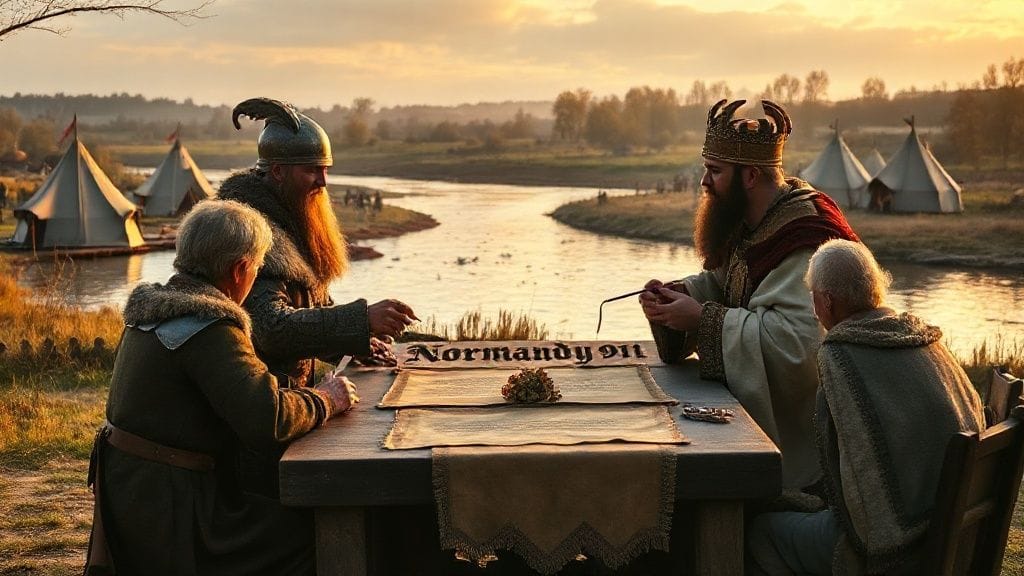
The morning mist clung to the fields surrounding the small village of Saint-Clair-sur-Epte, hiding the nerves and ambition swirling quietly in the hearts of two men who would forever change the map of Europe. The year was 911, and on this day, a remarkable accord was about to be forged — a treaty that would lay the foundation for what we know today as Normandy. In the shadow of Viking longships and the fading power of Carolingian kingship, King Charles the Simple and Rollo, a fierce Viking leader, engaged in a negotiation that would transform their worlds. This was not simply a diplomatic document signed on parchment; it was a daring gesture of peace carved out amid chaos and fear, a new beginning amidst centuries of turmoil.
The Birth of Normandy: A Defining Moment in 911
At first glance, the Treaty of Saint-Clair-sur-Epte might seem a modest agreement between a Frankish king and a Norse chieftain. But beneath its surface lay a profound recalibration of power and identity. For centuries, the Seine Valley and its surrounding lands had suffered under the relentless Viking incursions—swift, brutal, and seemingly unstoppable. By granting Rollo and his men land in exchange for loyalty and protection, Charles the Simple embraced a bold strategy: to turn enemies into allies, invaders into feudal vassals.
This treaty didn't just mark a pause in raids; it seeded the rise of a new political entity that would reshape European history. It birthed Normandy, a land where Norse and Frankish cultures intertwined, and where a Viking leader transformed into a legitimate European lord.
The Winds of Change: Europe on the Brink at the Dawn of the 10th Century
The 10th century was a turbulent era for Western Europe. The once-mighty Carolingian Empire was fractured, plagued by internal strife and weakening central authority. Around it, ambitious warlords filled the vacuum, carving their own territories and sometimes challenging royal power directly.
Meanwhile, from the North came the Vikings—seafarers renowned both for their merciless raids and their extraordinary skills as traders and settlers. They struck deep into the heartlands of Francia, from monasteries to towns along the Seine River, instilling terror but also shaping new patterns of settlement.
The incessant attacks culminated in an existential dilemma. Was it possible to contain Viking aggression? Could diplomacy and integration offer an alternative to endless warfare? In this atmosphere of uncertainty, King Charles III, known as Charles the Simple, sought innovative solutions.
The Viking Menace: Raids, Pillages, and the Fear of the Northmen
To contemporaries, the term “Viking” evoked images of fast-moving warbands descending from their dragon-headed longships, delivering swift destruction. The years leading to 911 had been marked by sustained attacks on West Francia's river systems, and the Seine was repeatedly targeted.
Villages burned, abbeys looted, and towns forced to pay tribute became grim realities. Norse warriors such as Rollo capitalized on this turmoil, establishing bases along rivers that allowed them to strike swiftly before melting back into the wilds or the sea.
The fear was not abstract. Chroniclers spoke of the destruction in vivid terms: “The land wept under the axe; the people fled before the scourge of the North.” The political leadership struggled to respond effectively amid fragmented power and limited resources.
King Charles the Simple: A Monarch Seeking Stability
Charles III ascended the throne in 898 during a precarious time. Despite his epithet “the Simple,” which some interpret as symbolic of his straightforwardness rather than intellectual capacity, Charles was a shrewd ruler determined to preserve his realm from collapse.
His options were limited. Military victories against Vikings were rare, and costly. The king increasingly recognized that a new approach was needed—one involving negotiation rather than confrontation alone.
It was under his reign that the Norman solution emerged: to grant land to Viking leaders who pledged fealty and protection—thus creating a buffer zone safeguarding the heartland from further raids.
Rollo: The Viking Chieftain Emerging from the Shadows
Rollo remains one of history’s enigmatic figures. Chronicled first as a fearsome Viking raider and chieftain, he was baptized with the Christian name Robert following his acceptance of lands in Francia, a symbolic act cementing his new role.
Historians surmise his origins were likely in Norway or Denmark, but by the early 10th century, he had emerged as a formidable leader controlling a band of Norse warriors in the Seine region.
Strategically astute and ambitious, Rollo recognized the opportunity the treaty represented—not just for peace but for establishment and power within the Frankish system.
Negotiations at Saint-Clair-sur-Epte: An Unlikely Accord
The meeting at Saint-Clair-sur-Epte was a turning point. Accounts suggest tense but pragmatic discussions, with both men aware of the stakes.
Charles offered Rollo a substantial tract of land—stretching roughly from the mouth of the Seine upstream—on the condition of his loyalty to the king and protection of the realm against other Viking raiders.
For Rollo, the offer was appealing. It promised legal recognition, land ownership, and, crucially, a foothold in European nobility, turning raiders into protectors.
The Treaty’s Terms: Land, Loyalty, and Legacy
The Treaty of Saint-Clair-sur-Epte stipulated several key conditions: Rollo and his men were granted the land as a fief, they had to swear loyalty to Charles, and Rollo was to defend the Seine's estuary against other Viking invaders.
Additionally, Rollo agreed to convert to Christianity—a transformative gesture with religious, political, and social implications.
This fusion of military pragmatism and religious symbolism was typical of medieval diplomacy but carried unique significance in this context.
Normandy Takes Shape: From Viking Raiders to Feudal Lords
With land secured, Rollo and his followers set about establishing defensive structures and founding settlements. Over time, they shifted from opportunistic raiders to feudal lords, integrating into Frankish society.
Fortifications rose, agricultural development intensified, and the region's social fabric evolved to blend Norse and Frankish elements.
This transformation was neither immediate nor smooth, involving repeated conflicts but also cultural adaptation—a true fusion of identities.
The Role of the Church: Baptism and Christianization as Tools of Power
Christian conversion was more than a spiritual act; it was political theater. Baptism symbolized Rollo’s acceptance into the Christian world order, crucial for legitimacy in Frankish eyes.
The Church actively supported this process, seeing an opportunity to extend its influence and convert the Viking population.
Monasteries and churches soon flourished across Normandy, anchoring the new duchy’s place within Christendom.
Economic and Social Transformation under Norman Rule
The establishment of Normandy ushered in economic revival. The once devastated lands flourished anew with agriculture, trade, and crafts.
Normandy’s location—straddling important river trade routes—made it a commercial hub linking the North Sea and the continent.
Socially, the gradual fusion of Norse and Frankish peoples forged a unique Norman identity characterized by adaptability, martial prowess, and administrative skill.
Military Consequences: Normandy as a Bulwark and Springboard
Normandy quickly evolved into a critical defensive buffer protecting West Francia from Scandinavian incursions.
Its warriors, descended from Vikings, became renowned for their fighting skills and also served as mercenaries or allies in broader European conflicts.
This martial tradition would later be central to the Norman expansionist ambitions, notably the conquest of England in 1066.
Cultural Synthesis: The Fusion of Norse and Frankish Traditions
The Normans did not simply abandon their Viking roots; instead, they fused Norse customs with Frankish governance, language, and law.
This cultural synthesis produced unique art, architecture, and legal traditions that distinguished Normandy from neighboring regions.
Over generations, the Norman identity became a bridge between Scandinavia and medieval Europe.
Rollo’s Dynasty: The Foundations of Norman Leadership
Rollo established a lineage that would endure for centuries. His descendants consolidated power, increasing territorial control and prestige.
This dynasty would produce figures of immense historical impact, including William the Conqueror, whose 1066 invasion altered the course of English and European history.
The treaty thus marks the crucial origin story of this influential dynasty.
The Wider Implications for West Francia and Europe
Beyond Normandy, the treaty signaled a new diplomatic paradigm—incorporating former enemies through feudal bonds.
It contributed to stabilizing volatile borderlands and encouraged other rulers to seek similar arrangements.
Normandy’s rise also introduced a new political actor whose ambitions reshaped medieval geopolitics.
Myth, Legend, and Historical Memory of the Treaty
The story of Saint-Clair-sur-Epte became legendary, often romanticized in chronicles and later histories.
Rollo’s baptism and the birth of Normandy have been the subjects of myth-making, blending fact and fiction.
Yet beneath legend lies a concrete, transformative moment that historiography continues to explore.
Normandy’s Later Destiny: From the Treaty to the Norman Conquest of England
The roots laid in Saint-Clair-sur-Epte flourished dramatically across the 10th and 11th centuries.
Normandy became a launching point for the conquest of England in 1066, fundamentally altering European history.
This trajectory began with a pragmatic treaty, a seed that grew into a political and military powerhouse.
Conclusion
The Treaty of Saint-Clair-sur-Epte represents more than a simple land agreement; it is a testament to humanity’s capacity to transform conflict into collaboration. At a time when Viking terror seemed inexorable and West Francia’s future uncertain, two leaders—one a king seeking order, the other a Viking warrior seeking opportunity—crafted a bold solution.
Their accord planted the seeds for Normandy, a dynamic duchy that bridged cultures and shaped the medieval world. It reminds us that history often turns on moments of negotiation and courage, where enemies become allies, and borders become beginnings. More than a treaty of land, it was a treaty of trust, and a foundation for a legacy that still echoes through Europe’s landscape and memory.
FAQs
Q1: What prompted King Charles the Simple to negotiate with the Vikings rather than fight them?
A1: Charles faced relentless Viking raids and lacked the military strength to repel them effectively. Granting land and seeking their loyalty presented a pragmatic way to secure peace and protect his realm.
Q2: Who was Rollo and why was he chosen as the leader to negotiate with?
A2: Rollo was a powerful Viking chieftain who controlled raiding bands in the Seine region. His military prowess and influence made him key to controlling the Viking threat.
Q3: What were the key terms of the Treaty of Saint-Clair-sur-Epte?
A3: The treaty granted Rollo land in exchange for loyalty and protection of the kingdom from other Vikings, along with Rollo’s acceptance of baptism and conversion to Christianity.
Q4: How did the treaty influence the culture of Normandy?
A4: It led to a fusion of Norse and Frankish traditions, blending Viking martial culture with Christian and feudal institutions, creating a distinct Norman identity.
Q5: What was the significance of Rollo’s baptism?
A5: Baptism symbolized Rollo’s acceptance into the Christian world, legitimizing his rule and helping to integrate Normandy into European Christendom.
Q6: How did Normandy evolve following the treaty?
A6: Normandy transformed from a Viking settlement into a powerful duchy, with economic growth, military strength, and political influence in medieval Europe.
Q7: What long-term impact did the treaty have on European history?
A7: It laid the foundation for Norman power, which led to significant events like the Norman Conquest of England, reshaping the political landscape of Europe.
Q8: Is the Treaty of Saint-Clair-sur-Epte still visible or commemorated today?
A8: While no original document survives, Saint-Clair-sur-Epte is remembered as the treaty’s historic site, with local commemorations and historical scholarship celebrating its importance.

