Table of Contents
- The Stormy Arrival of Eric Bloodaxe in York
- A Viking Legacy in English Soil
- Northumbria before the Bloodaxe Era
- Eric Bloodaxe’s Claim: A Son of the Sea-King
- The Political Landscape of 10th-Century England
- Battles for Power: Vikings and English Kings Clash
- Eric’s First Reign Begins: The Context of 947
- York’s Strategic and Symbolic Importance
- The Nature of Eric’s Rule: Intermittent and Contentious
- Allies and Enemies: Key Players in the Bloodaxe Saga
- The Chronicles Speak: Archaeology and Literary Sources
- The Struggles for Control: 947–954
- The Role of Æthelstan and Later Kings
- Eric Bloodaxe’s Final Days in York
- The Legacy of a Viking King in England
- The Impact on Anglo-Scandinavian Relations
- York’s Transformation under Viking Influence
- Remembering Eric Bloodaxe: Myth, History, and Legend
- Modern Interpretations and Historical Debates
- York’s Viking Heritage Today
- Conclusion: The Complex Tapestry of Viking Rule in England
- FAQs about Eric Bloodaxe’s Rule in York
- External Resource
- Internal Link
Eric Bloodaxe Rules York Intermittently, York, England | 947–954
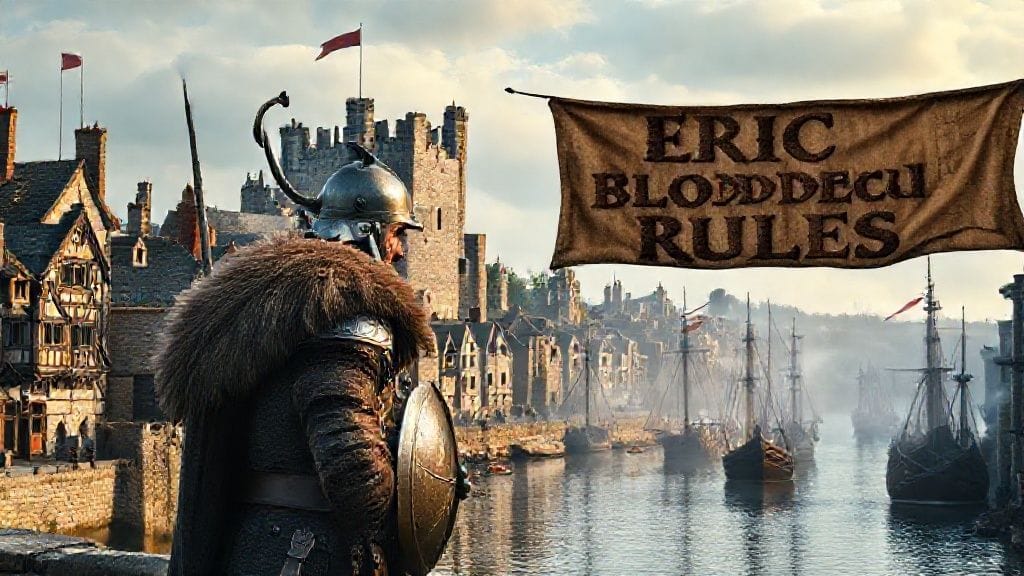
It was a city caught in the throes of fate—York, 947 AD—storm-washed skies overhead, the pungent scent of smoke and salt thick in the air. The streets, shadowed by the looming walls of the old fortress, whispered tales of conquest and resilience as the waves of Viking longships had returned to Thames’ northern cousin. In the midst of this, Eric Bloodaxe, a man whose name sent shivers through the northern reaches, took his place on the rough-hewn throne of York. His reign was not a story of quiet kingship but one of intermittent dominance, rebellion, and survival—a violent symphony played on the edge of fading Viking empires and rising English kingdoms.
To understand Eric’s tumultuous rule, one must travel through the mists of a changing England. This was a land divided and reborn; Anglo-Saxons and Norsemen intertwined in conflict, commerce, and culture. Eric Bloodaxe, son of the famous Harald Fairhair—though some sources dispute his exact lineage—was a Viking warrior-king who wore his past like a shield, but whose future in the Viking kingdom of York was anything but certain.
This narrative embarks on a journey through that turbulent decade, revealing how Eric’s reign in York from 947 to 954 marked a critical fault line in the history of Viking integration into English society—the clash of old Viking raiders with the forging of what would become a unified England.
The Stormy Arrival of Eric Bloodaxe in York
The year was 947, and the winds carried more than the chill of autumn. They carried the echo of long-blackened dragons—the longships—bearing Eric Bloodaxe and his retinue to the walls of York. A city that had once been the heart of the Danelaw, York was the jewel of Viking ambition in England. Eric’s arrival was less a quiet ascendance than a challenge hurled at the Anglo-Saxon kings who sought to reassert control over the North.
Eric Bloodaxe’s nickname alone spoke volumes—“Bloodaxe.” It evoked images of a ruthless fighter, a man hardened by countless battles, his axe stained with the blood of enemies and kin alike. Yet, behind this gruesome sobriquet lay a story of exile, return, and a fierce contest for power in a region that had seen centuries of storm and conquest.
This was more than a military campaign; it was the rebirth of Viking rule in York, after decades where the city had carved a precarious place between Viking and Anglo-Saxon rulers. And for Eric, the prize was not merely a throne but the survival of a Viking legacy on English soil.
A Viking Legacy in English Soil
York—known to the Vikings as Jórvík—was once a bustling Norse kingdom carved out during the 9th century. This city, perched on the River Ouse, had become a nerve center in a tangled web of Viking settlements that stretched across northern England. Since the Viking invasions that began in the late 8th century, York had been conquered, lost, and reconquered; it bore marks of Viking culture, language, and law.
The very stones of York echoed with stories of Norse kings and earls who had ruled with the thunder of swords and the wisdom of sagas. It was a kingdom where cultural fusion occurred between Norse settlers and Anglo-Saxon natives, but it was also a place where power was fiercely contested. Here, Viking legacy did not only mean pillage and warfare but an enduring cultural footprint—trade, craft, and governance that would reverberate for centuries.
Yet by the mid-10th century, the grip of Viking rulers was loosening. English kings, particularly the House of Wessex, were pushing to reclaim and consolidate territories once lost. It was in this fragile balance that Eric Bloodaxe’s arrival disrupted the dimming power structures of York.
Northumbria before the Bloodaxe Era
Before Eric’s intermittent rule, Northumbria was a land at the crossroads of tumultuous power struggles. It had oscillated between English and Viking dominions since the late 9th century, with kings and earls rising and falling almost as rapidly as the tides.
In the years leading to 947, Northumbria was largely under the influence of English rulers from Wessex, particularly under King Edmund and his predecessors, who sought to reassert royal authority after the exhaustion from earlier Viking incursions. Yet, Norse culture and political ambitions simmered beneath the surface, ready to resurge.
Local earls and leaders often straddled two identities, sometimes warlords for Norse traditions, at times loyal subjects of the English crown. It was this fractured loyalty and a landscape peppered with fortified sites that made the rocky ascent for Eric Bloodaxe both possible and perilous.
Eric Bloodaxe’s Claim: A Son of the Sea-King
Eric’s heritage is tangled in saga and history. Likely a son of Harald Fairhair, the legendary first King of Norway who united much of the Norwegian territories, Eric himself had been exiled from Norway, forced into dangerous exile following fraternal rivalry and court intrigues.
Thus, the exile of a prince became an opportunity. Eric’s ambition was fueled not only by survival but by the deeply ingrained Viking drive for conquest and honor. His return to York was part of a larger saga—a Viking prince’s quest to carve out a kingdom far from his native land.
This personal history lent Eric’s rule a dramatic tension—he was both a foreigner and a native son of the Viking world, coming to reclaim lost honor and to reign in a city that had once been the jewel of Norse England.
The Political Landscape of 10th-Century England
England in the mid-10th century was a land transforming rapidly—from fragmented kingdoms wracked by Viking raids to a budding unified realm under the House of Wessex. Kings like Edmund I and later Eadred were tirelessly campaigning to restore control over the territories lost during earlier invasions, and especially keen on Northumbria.
The Viking world was no longer the wild marauding force it once was. Instead, Norse leaders were often engaged in politics, marriage alliances, and urban mercantilism. Yet, tensions remained high as old loyalties, ethnic identities, and power contests ran deep.
Into this complex political terrain stepped Eric Bloodaxe, who would navigate a perilous web of alliances, betrayals, and battles as he sought to maintain fractured control over York.
Battles for Power: Vikings and English Kings Clash
The intermittent nature of Eric’s reign was largely due to the ebb and flow of power between him and English kings. Each seizure of York required brutal fightbacks, negotiations, and sometimes temporary truces.
Battlefields were not just physical but also diplomatic stages where allegiances could change overnight. Eric Bloodaxe faced the forces of English kings who were determined to bring York back under Anglo-Saxon rule. The confrontations were fierce and unrelenting, with violence leaving scars on the landscape and in the psyche of the inhabitants.
The pulse of these clashes reverberated beyond the North—each victory or defeat tipping the balance of hope or despair for Viking rule in England.
Eric’s First Reign Begins: The Context of 947
When Eric Bloodaxe first seized York in 947, he stepped into a maelstrom. The city was already an expensive prize, coveted by the English crown and various Norse factions.
His hold on the city was tenuous but symbolically powerful. It was a declaration that Viking kingship was not yet extinguished in England. Eric’s first reign was marked by consolidation efforts and the intricate management of competing Viking and Anglo-Saxon interests.
Yet the city was a powder keg. The inhabitants included English, Danish, and mixed Norse populations, each harboring their own loyalties and grudges, making Eric’s task that much more complicated.
York’s Strategic and Symbolic Importance
York was not merely a city; it was a bastion of power. Controlling York meant access to trade routes along the English east coast and up the River Ouse, commanding military advantages and cultural prestige.
For Vikings, it was a foothold on English soil—an anchor point from which raids, trade, and governance could operate. For English kings, regaining York meant restoring the territorial integrity of a nascent England.
Thus, Eric Bloodaxe’s intermittent rule of York was more than an episode of urban control—it was a symbol of the shifting balance of power between the old world of Viking rule and the emerging English monarchy.
The Nature of Eric’s Rule: Intermittent and Contentious
Eric’s control over York was never permanent. His reign was punctuated by periods of power interspersed with his expulsion and return, revealing the instability of Viking rule in an England increasingly dominated by strong centralized kingship.
Sources suggest Eric was deposed and reinvested multiple times between 947 and 954, struggling against both English forces and rival Norse claimants. This episodic power highlighted the fragile nature of Viking rule, dependent on military success and alliances rather than institutional strength.
These cycles of rise and fall were brutal. They eroded the city, sowed distrust among inhabitants, and underscored the danger of a throne earned by the sword but never fully secured.
Allies and Enemies: Key Players in the Bloodaxe Saga
Eric’s story was not his alone. Other figures loomed large: English kings like Edmund and Eadred, whose military campaigns relentlessly pressured Northumbria; local Norse nobles who sometimes supported Eric, sometimes plotted his downfall; and rival Vikings who had their own designs on York.
These complex relationships shaped Eric’s rule. Some Norse earls viewed him as a rightful king, while others coveted his throne. Meanwhile, English rulers used both diplomacy and might to undermine him.
The saga was never a simple binary of Viking versus English, but a tangled web of shifting loyalties, betrayals, and shared bloodlines that defined this era.
The Chronicles Speak: Archaeology and Literary Sources
Much of Eric Bloodaxe’s story is pieced together from chronicles like the Anglo-Saxon Chronicle and Norse sagas—sources that blend history, legend, and political bias.
Archaeological findings around York reveal a city vibrant with Scandinavian craftsmanship and varied cultural influences, highlighting the diversity of the population over which Eric tried to rule.
Yet the chronicles paint a violent, often murky picture where fact and fiction intertwine, challenging historians to separate the man from the myth and to understand the true nature of Eric’s reign.
The Struggles for Control: 947–954
From 947 to 954, each year added a new chapter of contestation. Eric Bloodaxe was deposed around 948 and appears to have retaken the city subsequently, only to be forced out again by forces loyal to the English crown or rival Viking factions.
This intermittent rule underscored the lack of stability in northern England, where power was a prize continually seized and lost through warfare and shifting alliances.
The final years of Eric’s reign were grim. Sources imply violent confrontations, culminating in his death around 954, an event that marked the effective end of independent Viking kingship in York.
The Role of Æthelstan and Later Kings
Though Æthelstan’s reign predates Eric’s rule by a few decades, his establishment of English dominance over the Danelaw set the stage for the political environment Eric entered.
Later kings like Edmund I and Eadred actively campaigned to dislodge Viking rulers like Eric, employing military tactics and political strategies aimed at consolidating English control over Northumbria.
Their successes, and Eric’s ultimate failure, symbolized the rising power of the English monarchy and the fading era of Viking independence in the region.
Eric Bloodaxe’s Final Days in York
The end of Eric Bloodaxe is cloaked in uncertainty and legend. Some accounts say he was killed in battle; others suggest assassination or betrayal by those close to him.
What is certain is that by 954, Eric’s death marked the cessation of direct Viking kingship over York. The city increasingly came under English rule, and with it, a gradual transformation in culture and politics.
Eric’s demise, violent and perhaps solitary, encapsulated the brutal realities of power struggles in 10th-century England.
The Legacy of a Viking King in England
Eric Bloodaxe’s story did not fade with his death. His turbulent reign became emblematic of the Viking struggle to maintain influence in England.
To some, he was a fierce hero, a warrior king standing against the tide of Anglo-Saxon expansion. To others, a brutal usurper whose reign brought chaos.
His name echoes in history and legend, a symbol of Viking resilience and the complex cultural interactions that shaped early medieval England.
The Impact on Anglo-Scandinavian Relations
Eric’s rule highlighted the changing nature of Anglo-Scandinavian dynamics. Warfare gave way slowly to negotiation, while cultural exchange flourished in cities like York.
The end of Eric’s reign coincided with increasing integration of Norse settlers into English society, blending languages, laws, and customs.
Thus, his reign marked both the last stand of Viking kingship and the gradual synthesis of two worlds that shaped the future of England.
York’s Transformation under Viking Influence
Long after Eric’s death, York retained a strong Scandinavian character. Archaeological finds reveal Norse-style buildings, artefacts, and urban planning.
York became a melting pot—a testament to Viking influence on trade, governance, and culture in medieval England, its Viking past woven indelibly into the fabric of the city.
Remembering Eric Bloodaxe: Myth, History, and Legend
Through centuries, Eric Bloodaxe’s figure has moved through mythic tales and historical studies. Sometimes demonized, sometimes romanticized, he remains an enigmatic figure.
Sagas, chroniclers, and modern historians debate his nature—warrior, tyrant, exile, or king—each lens coloring the narrative with distinct shades.
His enduring legacy challenges us to reflect on the theme of power, identity, and survival in a world forever changed by Viking ambition.
Modern Interpretations and Historical Debates
Historians today grapple with scarce and sometimes contradictory sources. Was Eric Bloodaxe truly Harald Fairhair’s son, or is that a later embellishment?
Was his rule predominantly violent and destructive, or did he contribute to the urban and economic development of York?
Modern archaeology and linguistic studies continue to shed light, revealing a multi-faceted king whose story is far from simple.
York’s Viking Heritage Today
York’s Viking past is celebrated in museums, festivals, and public memory. The Jórvík Viking Centre brings Eric Bloodaxe’s era to life, inviting visitors to step into a world of swords, markets, and sagas.
His story forms a vital chapter in York’s identity—a bridge from past struggles to present revival and pride in a shared heritage.
Conclusion: The Complex Tapestry of Viking Rule in England
Eric Bloodaxe’s intermittent reign in York was more than just a period of conflict; it was a pivotal moment in the weaving of England’s complex tapestry of cultures and powers. His violent yet heroic saga encapsulates the twilight of Viking kingship and the dawn of a unified English kingdom. The echoes of his axe and footsteps still resonate in York’s streets—a testament to the resilience and turbulence of history itself.
FAQs about Eric Bloodaxe’s Rule in York
Q1: Who was Eric Bloodaxe really, and what was his background?
A1: Eric Bloodaxe was likely a son of Harald Fairhair, the first king to unite Norway. Exiled from Norway due to family strife, he sought power in England, specifically York (Jórvík), aiming to maintain Viking influence in the region.
Q2: Why was Eric's rule in York intermittent rather than continuous?
A2: Eric’s reign was marked by constant conflict with English kings and rival Viking factions. Control of York went back and forth due to military defeats, political intrigue, and fluctuating alliances, leading to a fractured and contested kingship.
Q3: What was the significance of York during Eric’s time?
A3: York was a vital economic, political, and military hub, serving as the capital of the Viking kingdom in England. Its location on the River Ouse made it strategically important for trade and military control.
Q4: How did Eric Bloodaxe’s rule affect Anglo-Scandinavian relations?
A4: His reign symbolized the last significant Viking attempt to control English territories before Norse settlers integrated more fully into English culture and governance, marking a shift from conflict to coexistence.
Q5: What sources do historians rely on to study Eric Bloodaxe?
A5: The main sources include the Anglo-Saxon Chronicle, Norse sagas, and archaeological evidence from York. These sources often conflict or romanticize events, requiring careful interpretation.
Q6: How is Eric Bloodaxe remembered in modern times?
A6: Today, Eric is both a figure of Viking legend and historical study. He features prominently in York’s Viking heritage celebrations, reflecting the city’s rich Nordic past.
Q7: What led to Eric Bloodaxe’s death and the end of Viking rule in York?
A7: Eric likely died in battle or through betrayal around 954, after which York came firmly under English rule, ending the era of independent Viking kingship in the city.
Q8: Did Eric Bloodaxe contribute to the development of York beyond military conquest?
A8: While primarily remembered as a warrior-king, the Viking presence under his rule fostered trade and cultural exchanges that influenced York’s urban and economic growth.