Table of Contents
- The Dawn of August 10, 955: The Calm Before the Storm
- Europe on Edge: The Rising Threat of the Magyars
- Otto I: The Ascendant King Shaping a New Empire
- The Magyars: Fearsome Raiders of the Continent
- Political and Religious Turbulence in 10th Century Europe
- Gathering the Forces: Preparations for the Battle of Lechfeld
- The Strategic Landscape: Geography and Deployment at Lechfeld
- The Morning Clash: First Encounters on the Battlefield
- Tactical Brilliance: How Otto’s Forces Outmaneuvered the Magyars
- The Turning Point: Death and Disorder Among the Magyars
- Aftermath on the Field: Captives, Spoils, and Silent Plains
- The Immediate Consequences: A Broken Magyar Threat
- Otto’s Rise Cemented: Foundations of the Holy Roman Empire
- Cultural Resonances: Battle of Lechfeld in European Memory
- Ripple Effects: Shaping Central European Identity and Borders
- Lessons From Lechfeld: Military, Political, and Religious Legacy
- From Raiding to Permanency: The Magyar Transition to Hungary
- The Decline of Viking and Magyar Raids in Europe
- The Holy Roman Empire’s Role in Medieval Christendom’s Defense
- Otto’s Legacy: The Emperor Beyond the Battlefield
- Battle of Lechfeld in Modern Scholarship and Popular Imagination
The Dawn of August 10, 955: The Calm Before the Storm
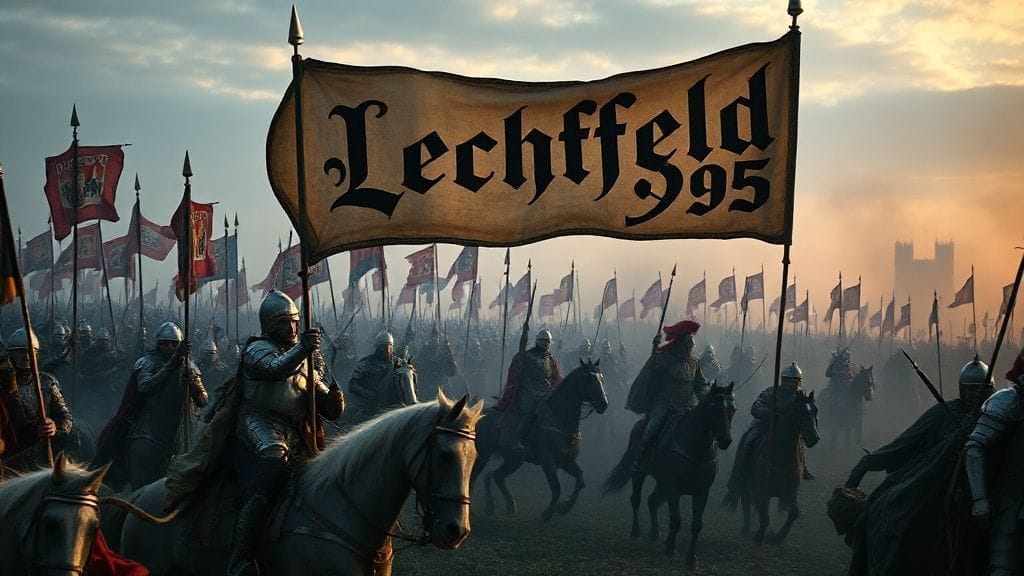
It was a late summer morning near the broad floodplain of the Lech River, just south of the ancient city of Augsburg, where destiny was about to unfold. The sky hung heavy, low with clouds that threatened rain, as the fields bore the long shadows of armoured warriors poised for battle. Yet in this stillness was a tense silence, a breath held by two clashing worlds about to collide—one defined by restless nomadic fury, the other by the iron will of a king determined to defend his lands.
From one side, the Magyars, swift horsemen armed with bow and sabers, their eyes glowing with the confidence borne of years of unchecked raids across Europe’s heartlands. From the other, the well-disciplined troops of King Otto I of Germany, rallying behind the banner of a nascent empire, determined not only to repel but to end the Magyar menace once and for all.
This was no mere skirmish. It was a battle with consequences to shape the trajectory of Europe’s political and cultural landscape for centuries to come.
Europe on Edge: The Rising Threat of the Magyars
The mid-10th century found Europe caught in an age of uncertainty. The twin shadows of Viking marauders from the north and Magyar raiders galloping across from the east had darkened the hopes of peaceful communities and fledgling states alike. The Magyars, a people of Uralic origins who had migrated into the Carpathian Basin in the late 9th century, had transformed from settlers into terrorizing horse archers. Their raids penetrated deeply into Germanic lands, France, Italy, and the Pyrenees, striking fear into every stratum of society.
Yet these raids were more than mere pillaging. They were symptoms of a transient epoch where Europe’s borders were fluid, fragmented kingdoms vied for dominance, and the future was anything but secure. Behind these raids lay a struggle over the soul and survival of Christian Europe against pagan forces perceived as existential threats.
Otto I: The Ascendant King Shaping a New Empire
Otto I, King of Germany since 936 and later to be crowned Holy Roman Emperor, was a leader forged by the chaos of his age. The son of Henry the Fowler, who had previously restrained the Magyars with tentative victories, Otto inherited a realm still vulnerable to foreign incursion and internal disarray. Known as “Otto the Great,” his reign featured determination to consolidate the German duchies, strengthen royal authority, and secure Christendom’s frontiers.
His vision was clear: unite the fractious Germanic peoples and erect a bulwark against pagan enemies while reviving the imperial ideal of the ancient Romans under Christian auspices. Yet this vision required that he triumph decisively against the Magyars, whose raids threatened the very heart of the empire’s stability.
The Magyars: Fearsome Raiders of the Continent
To the Magyars, Europe was a vast hunting ground; swift raids, lightning retreats, and deadly archery tactics defined their warfare. Their incursions in the first half of the 10th century were devastating—villages burned, churches plundered, and local lords humbled.
Despite their nomadic roots, the Magyars adapted quickly, exploiting their mounted mobility and guerrilla tactics to outmaneuver heavier European forces. But their success bred arrogance, a sense that the Holy Empire was broken and ripe for continued exploitation.
Yet the Magyars faced a dangerous foe in Otto, who had learned from past mistakes and was ready to meet them with a deadly combination of discipline, allied forces, and strategic ingenuity.
Political and Religious Turbulence in 10th Century Europe
Europe in 955 was not just a battlefield of swords and arrows but a theater of political intrigue and religious transformation. Christianity had become the ideological foundation of emerging kingdoms, offering a unifying vision against the pagan “others.” The Church and the monarchy were intertwined, each reinforcing the other’s legitimacy.
Otto’s close alliance with the papacy heralded the fusion of spiritual and temporal power that would define medieval Europe. Yet this alliance was fragile; noble factions within Germany challenged Otto’s consolidated authority, and the Kingdom of Italy was a powder keg of competing interests.
Within this fraught atmosphere, a decisive victory against the Magyars would not only secure borders but strengthen the ideological and political foundation of a new European order.
Gathering the Forces: Preparations for the Battle of Lechfeld
Months before the fateful day, intelligence of a massive Magyar raid had spread through the royal court. Otto mobilized an impressive coalition force, drawing troops from his German heartlands, as well as allied contingents from Bavaria, Franconia, Swabia, and beyond. His army was an embodiment of his political reach and ability to rally diverse groups under a single banner.
Training, drilling, and logistical preparation took precedence. Otto achieved what many before him could not: he forged a reliable, efficient command structure with trusted nobles and church leaders who balanced loyalty and competence. This coordination would prove critical on the day of battle.
The Strategic Landscape: Geography and Deployment at Lechfeld
The Lechfeld plain, a broad alluvial basin beside the Lech River, was a landscape both open enough for cavalry maneuvers and strategically advantageous for the defenders. Otto selected this battleground carefully, recognizing the need to control river crossings and set ambushes within the seemingly simple terrain.
Deployments were arranged meticulously: infantry to hold the line, heavy cavalry ready for charges, and archers to provide covering fire. The Magyars, used to raiding on open lands, relied on quick strikes; Otto planned to break their formations and deny them mobility.
As the armies faced each other under the brooding August sky, every man knew that the fate of realms would be decided on this plain.
The Morning Clash: First Encounters on the Battlefield
With the first light, the roar of warcry shattered the morning calm. The Magyars initiated their familiar strategy: rapid feigned retreats meant to draw Otto’s forces into disorder. But the king’s troops, disciplined and prepared, held firm.
The initial skirmishes tested nerves and formations, with arrows whistling through the air and horses pounding the turf. It was a high-stakes game of timing and feints, a dance between deadly precision and brute force.
Otto’s leadership shone as he commanded reinforcements to the most threatened sectors, countering the Magyar mobility with coordinated responses.
Tactical Brilliance: How Otto’s Forces Outmaneuvered the Magyars
Otto’s key innovation lay in his use of combined arms—heavy cavalry charges supported by infantry squares and archers in synchronized fashion. The Magyars, though nimble, found their usual hit-and-run tactics blunted by this structured defense.
The king personally led a decisive cavalry charge that shattered the Magyar center and routed their commanders. The psychological effect of Otto’s steadiness contrasted sharply with the dispersing Magyar ranks.
Moreover, local knowledge of terrain allowed Otto’s forces to trap the retreating Magyars against the riverbanks, converting their fleeing maneuvers into a desperate struggle for survival.
The Turning Point: Death and Disorder Among the Magyars
The death of Bulcsú, the chief Magyar leader and prince, was a crushing blow to Magyar morale. Caught in the mêlée, he was captured and executed shortly after the battle, symbolizing the definitive end of Magyar invincibility.
Without coordinated command, the Magyar forces fragmented, fleeing in disarray. Many were killed, others taken prisoner; the pride of the horse archers lay broken on the fields of Lechfeld.
This turning point was not just military but existential for the Magyars. Their era of unchecked raids was irrevocably ended.
Aftermath on the Field: Captives, Spoils, and Silent Plains
The battlefield, once thunderous with clash of arms, grew eerily quiet as the dust settled. Otto’s soldiers tended to the wounded, collected prisoners, and divided the spoils. Stories would later testify to the grim spectacle of captured Magyar war banners and broken weapons piled under the Christian standards.
Local civilians, who had lived in dread for decades, emerged cautiously, witnessing the victory that promised peace. Yet beneath the relief lay the sorrow of countless lives lost or uprooted.
The Immediate Consequences: A Broken Magyar Threat
The defeat at Lechfeld shattered the Magyars’ capacity for large-scale raids into Western Europe. The fractured bands retreated to the Carpathian Basin, where a new chapter awaited them—as settlers forging a permanent homeland.
For Otto, the battle was a vindication of his policies, a clear demonstration that centralized power and strategic coordination could defend Christendom’s borders.
Otto’s Rise Cemented: Foundations of the Holy Roman Empire
The victory at Lechfeld was a springboard for Otto’s imperial ambitions. In 962, he would be crowned Holy Roman Emperor in Rome by Pope John XII, a crowning achievement that symbolized the rebirth of a Western empire combining secular and spiritual authority.
The battle thus represented not just a military success, but a foundational moment in European history, shaping political structures for centuries.
Cultural Resonances: Battle of Lechfeld in European Memory
Lechfeld entered the collective memory as a pivotal crusade — a defense of Christendom against pagan daring. Chronicles, poems, and later historiography celebrated the event as divine favor manifest on the battlefield.
This cultural legacy endured, inspiring later generations to view the battle as a decisive stand between civilization and chaos.
Ripple Effects: Shaping Central European Identity and Borders
The repercussions of Lechfeld extended beyond the military. The Magyars' transition from raiders to settled rulers established the basis for the Kingdom of Hungary—an enduring political and cultural entity.
Meanwhile, German realms consolidated into more coherent territorial units, setting the stage for modern nation-states.
Lessons From Lechfeld: Military, Political, and Religious Legacy
The battle illuminated key lessons for medieval warfare: the importance of discipline, combined arms, and terrain knowledge. Politically, it underscored how military success could legitimize rulers and unify fractious polities.
Religiously, the triumph reinforced the role of the Christian Church as a central arbiter of Europe’s destiny.
From Raiding to Permanency: The Magyar Transition to Hungary
Post-Lechfeld, the Magyars abandoned large-scale raiding campaigns and began state-building under Árpád’s dynasty. This shift was transformative—from nomadic warriors to Christian kingship, merging steppe traditions with European institutions in a unique synthesis.
The Decline of Viking and Magyar Raids in Europe
Lechfeld was part of a wider European movement to end the centuries-long scourge of Viking and Magyar raiders. Through kingship reinvention and church alliances, Europe moved toward stability, opening paths for cultural Renaissance.
The Holy Roman Empire’s Role in Medieval Christendom’s Defense
Otto’s empire became the primary defender of Christendom’s frontier, advising and directing military campaigns that protected not only German lands but those of allied kingdoms.
This defense shaped medieval geopolitics and the conceptual framework of Europe as a Christian community.
Otto’s Legacy: The Emperor Beyond the Battlefield
Beyond war, Otto’s reign fostered administrative reforms, religious renewal, and artistic patronage. His legacy was not only in his sword but also in the institutions he nurtured, which influenced European governance for centuries.
Battle of Lechfeld in Modern Scholarship and Popular Imagination
Today, historians regard Lechfeld as a pivotal moment that set a course toward modern Europe. Scholarly debates analyze its military tactics and political implications, while popular culture often invokes it as a symbol of heroic resistance and decisive leadership.
Conclusion
The Battle of Lechfeld stands as a monumental chapter in the grand narrative of Europe’s transformation from fragmented chaos to a coherent civilization. Otto I’s decisive victory did more than silence the thunder of Magyar hooves—it crystallized the power of centralized authority, affirmed the divine mission of Christendom’s rulers, and planted the seeds for emerging nations.
The fields of Lechfeld, once ravaged by war, became the ground where the future of Europe was written—not only in blood and bravery but in hope and renewal. It teaches us that even in the darkest hours of uncertainty, leadership anchored in vision and courage can alter the course of history. For Otto and his contemporaries, this victory was both an end and a beginning—a testament to resilience and the enduring human yearning for peace and order in a tumultuous world.
FAQs
1. What were the main causes leading to the Battle of Lechfeld?
The Battle of Lechfeld was primarily caused by ongoing Magyar raids threatening the stability of the German kingdom and wider Europe. Otto I aimed to decisively end these incursions and consolidate his authority amid political fragmentation.
2. Who was Otto I and why was he significant?
Otto I, known as Otto the Great, was King of Germany and later Holy Roman Emperor. He was significant for uniting Germanic states, defending Europe against pagan threats like the Magyars, and laying foundations for the Holy Roman Empire.
3. What tactics did Otto’s army employ to defeat the Magyars?
Otto’s forces combined disciplined infantry, heavy cavalry, and archers in coordinated moves that neutralized the Magyars’ mobility. Strategic use of terrain and steadfast formations halted the Magyar feigned retreats and led to their rout.
4. What happened to the Magyars after their defeat?
After Lechfeld, the Magyars retreated to the Carpathian Basin and gradually transitioned to a settled, Christian kingdom, becoming the Kingdom of Hungary. Their raiding era was over.
5. How did the Battle of Lechfeld impact the Holy Roman Empire?
The victory cemented Otto’s claim to imperial power, leading to his coronation as Holy Roman Emperor. It strengthened the empire’s political structure and its role as defender of Christendom.
6. Why is the Battle of Lechfeld important in European history?
Lechfeld marked the end of major Magyar invasions, stabilized Central Europe, and set a precedent for military organization and royal authority that shaped medieval Europe’s political and cultural development.
7. How is the Battle of Lechfeld remembered today?
The battle is remembered as a defining moment of medieval Europe’s defense against nomadic threats. It is studied for its military innovation and symbolic importance in the formation of European states.
8. Did the alliance between the Church and Otto influence the battle’s outcome?
Yes. The Church provided ideological support for Otto’s reign, framing the battle as a defense of Christianity, which helped unify his forces and justify his imperial authority.

