Table of Contents
- The Tide of the Tenth Century: England on the Brink
- Sweyn Forkbeard: The Viking Who Would Change England
- The Political Landscape of England Before Sweyn
- Viking Incursions: From Raids to Ambitions
- The Growing Pressure of the Norsemen on Southern England
- The Year of Reckoning: Sweyn's Initial Campaigns in the 990s
- The Tactical Genius of Sweyn Forkbeard
- The Making of an Alliance: Submission and Tribute
- Southern England Under Viking Influence: Economic and Cultural Impacts
- The Role of King Æthelred the Unready
- The Payment of Danegeld: A Costly Peace
- Sweyn's Control: Beyond Tribute to Governance?
- The Chronicles Speak: Contemporary Views on Sweyn’s Campaign
- A Kingdom in Flux: Reactions from Anglo-Saxon Nobility
- The Christian Angle: Church Responses to Viking Domination
- The Legacy of Sweyn’s Southern England Campaigns
- How Sweyn’s Strategies Shaped Future English Politics
- The Seeds of Conquest: Prelude to the 11th Century English Throne Claim
- The Human Cost: Lives, Livelihoods, and Land
- Myth and Reality: The Romanticizing of Viking Rule
- England’s Patchwork: Resistance, Collaboration, and Survival
- The Dawn of a New Era: Cultural Blends from Norse to Anglo-Saxon
- Conclusion: Tribute, Transition, and Transformation
- FAQs on Sweyn Forkbeard’s Campaigns in England
- Further Reading and External Resources
- Internal Connection: Explore More at History Sphere
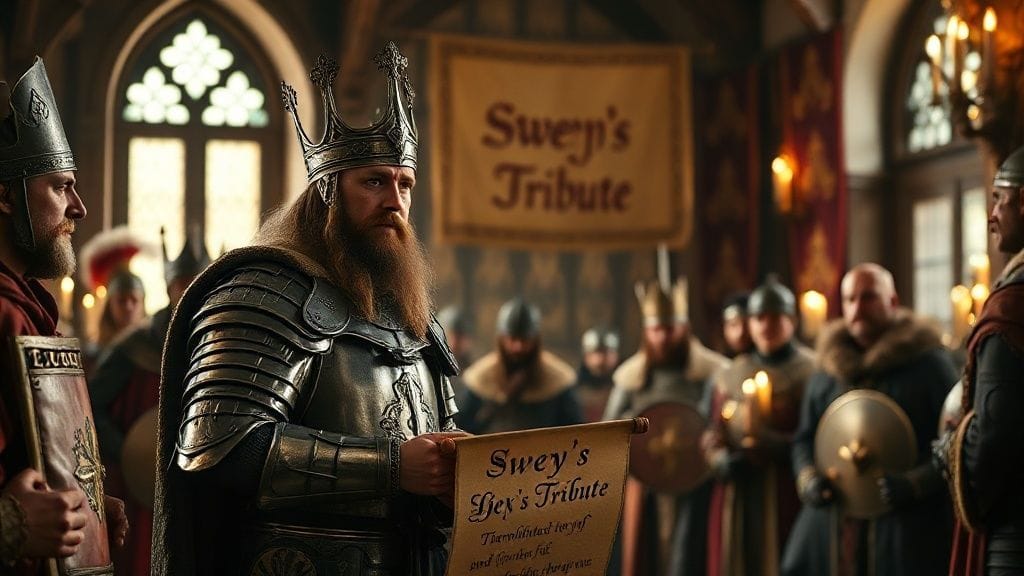
The cold wind whipped across the southern English coast, carrying with it the scent of salt, smoke, and tension. From the mists of the near-century-old Viking raids, a new figure stepped into the unfolding drama — Sweyn Forkbeard, the towering Danish chieftain whose iron will and shrewd tactics would carve his name into the annals of England's tumultuous history. In the 990s, southern England trembled beneath his shadow as he pressed his claims, coercing kings to pay tribute, and pushing the boundaries of Viking influence from mere raiding toward semi-permanent power.
This was not a simple story of pillage. It was a narrative of political ambition, cultural clash, and the relentless struggle for survival and supremacy. As the thrones in England wobbled and mercenary fleets appeared on the horizon, the era was reshaped forever by the iron hand of a Viking king who dared to claim a destiny beyond the traditional Norse frontier.
1. The Tide of the Tenth Century: England on the Brink
The end of the first millennium was a time of seismic shifts—politically fragmented, culturally dynamic, and militarily volatile. England, under the rule of the House of Wessex, had experienced a century embroiled in defense against Norse incursions that had evolved from hit-and-run raids to sustained invasions and occupation efforts.
The Danes were no longer outsiders; they had embedded themselves into the very fabric of England’s northern and eastern territories. Yet the south, the richer and more densely populated region, remained a coveted prize—economically vital and strategically indispensable.
2. Sweyn Forkbeard: The Viking Who Would Change England
Born into the famous Viking dynasty, Sweyn Haraldsson, known in history as Sweyn Forkbeard, combined fierce warrior instincts with political savvy. Son of King Harald Bluetooth of Denmark, Sweyn had the heritage and the armor for conquest, but it was his unique ambition that set him apart.
Unlike many Viking leaders content with seasonal plunder, Sweyn had learned that power lay in governance, tribute, and recognition. His forays into England were not mere raids but calculated campaigns aimed at extracting tribute and asserting overlordship.
3. The Political Landscape of England Before Sweyn
England by the 990s was a patchwork of kingdoms effectively unified under Æthelred II, known derisively in later times as “the Unready” (meaning 'ill-advised'). His reign was marked by internal strife, nobles divided between rival factions, and a kingdom weakened by intermittent warfare and Viking pressure.
The Wessex monarch struggled to consolidate power while defending a realm besieged from outside and within. Viking influence in the north and east challenged traditional Anglo-Saxon rule, and the southern coast faced increasing Viking fleets aiming to breach its defenses.
4. Viking Incursions: From Raids to Ambitions
For nearly a century, Viking activity in England was characterized by swift, brutal raids, with coastal monasteries and towns targeted for their riches. Yet by the 990s, patterns changed. Settlers arrived, and political pieces shifted from plunder to occupation.
Sweyn Forkbeard’s campaigns signaled the transition of Vikings from marauding bands to organized political actors, with aims more nuanced than mere plunder. Tribute payments, such as the infamous Danegeld, underscored this shift—an uneasy peace forged through extortion.
5. The Growing Pressure of the Norsemen on Southern England
Though the north and east had seen Viking settlement, southern England remained a bastion of Anglo-Saxon identity and relative stability. For Sweyn, pressing into the south meant cracking the heart of English power.
His fleets navigated the Channel coasts, exerting pressure with a mix of force and negotiation. Towns from Kent to Hampshire faced the brunt of these incursions, their leaders forced to weigh resistance against submission to preserve their lands and people.
6. The Year of Reckoning: Sweyn's Initial Campaigns in the 990s
Records show that Sweyn’s incursions escalated significantly in the mid-990s, when his forces moved deeper into English territory. The campaigns of this period involved a combination of fast livestock raids, sieges of key strongholds, and strategic demands for tribute.
Fierce battles took place near important towns, towns whose wealth could fill the coffers of Viking leaders and whose submission symbolized political dominance. Yet Sweyn was tactical, often withdrawing after securing payments, leaving behind uneasy truces rather than extended occupations.
7. The Tactical Genius of Sweyn Forkbeard
What distinguished Sweyn was not just brute strength but his adaptability. Unlike earlier Viking leaders focused solely on plunder, Sweyn balanced force with diplomacy. He understood the value of treaties, alliances with disgruntled English nobles, and even manipulation of local rivalries.
By capitalizing on divisions within Æthelred’s court and leveraging naval superiority, Sweyn compelled English rulers into accepting the payment of tribute, serving both as ransom and recognition of his overlordship.
8. The Making of an Alliance: Submission and Tribute
The payment of Danegeld during this period was emblematic: more than a bribe, it was an institutionalized mechanism to appease Viking threats. Southern English rulers, weary of unceasing raids and the devastation of their lands, acquiesced, offering gold and silver — political currency that acknowledged Sweyn’s supremacy.
This uneasy peace was fraught, however; it placed heavy burdens on the populace and sowed seeds of resentment among the Anglo-Saxon elites who saw their authority undercut.
9. Southern England Under Viking Influence: Economic and Cultural Impacts
Though Vikings pressed claims and gained tribute, their influence also penetrated the economic life of southern England. Trade routes adapted, new crafts and currencies spread, and some Scandinavian settlers integrated into local communities.
Archaeological finds reveal a cultural blending: Norse art motifs mingled with Anglo-Saxon designs, while place names bore marks of Norse tongues—a testament to the complexities beyond mere conquest narratives.
10. The Role of King Æthelred the Unready
The moniker “Unready” is somewhat misleading; Æthelred’s strategies, while flawed, reflect the difficulties of the era. His responses to Sweyn’s pressures were inconsistent but reveal a ruler caught between defending his realm and managing internal dissent.
Æthelred’s resort to Danegeld payments was controversial but arguably pragmatic, designed to buy time and preserve the core of his kingdom—though it also projected weakness among his subjects.
11. The Payment of Danegeld: A Costly Peace
Danegeld was a heavy tax levied upon the English population to pay off Viking armies. The 990s saw these payments increase substantially, draining resources and undermining economic stability.
Yet Danegeld also reflected a grim reality: the inability to defeat Viking forces outright compelled kings to negotiate from a position of weakness, cementing Sweyn’s image as a dominant power broker in England.
12. Sweyn's Control: Beyond Tribute to Governance?
Though Sweyn gained civil recognition by tribute, historians debate to what extent he exerted genuine governance before his eventual kingship after 1013. Some accounts suggest he installed local administrators or leveraged existing structures to enforce his will, blurring lines between conqueror and overlord.
This ambiguous sovereignty set the stage for deeper Viking involvement in English political life.
13. The Chronicles Speak: Contemporary Views on Sweyn’s Campaign
Anglo-Saxon chronicles and later medieval historians paint a complex portrait: Sweyn is alternately villain, tyrant, and formidable warrior-king. Contemporary voices capture the fear, devastation, and pragmatism of the age.
One chronicler lamented, “The Danes came with fire and sword, yet the gold poured out from trembling hands to preserve what little peace remained.”
14. A Kingdom in Flux: Reactions from Anglo-Saxon Nobility
Not all Anglo-Saxon nobles opposed Sweyn; some viewed collaboration as a means to preserve power or gain advantage over rivals. These shifting loyalties complicated the resistance and allowed Viking leaders to exploit English fractures.
This collaboration would influence subsequent political landscapes, proving that conquest was as much about alliances as battlefields.
15. The Christian Angle: Church Responses to Viking Domination
The Church, an influential institution, was caught in the crossfire. Viking attacks had decimated monasteries earlier, but Sweyn's tribute campaigns forced ecclesiastical leaders to negotiate uneasy peace.
Some clergy advocated resistance, others pragmatism, while the Church itself sometimes contributed to the levying of Danegeld, caught between spiritual authority and political survival.
16. The Legacy of Sweyn’s Southern England Campaigns
Sweyn’s 990s campaigns laid the groundwork for the 11th century transformations. They weakened the Anglo-Saxon fabric, introduced new power dynamics, and prepared England for his later full conquest.
Tribute paid in gold was not only wealth transferred but a symbolic bowing to Norse influence that no English king could ignore.
17. How Sweyn’s Strategies Shaped Future English Politics
Sweyn Forkbeard’s blend of military pressure, political subtleties, and economic strategies became a template for later Viking rulers. His insistence on tribute carried the tacit message that Viking power was not fleeting but permanent.
English kings who followed would grapple with his legacy—a cautionary tale of divided defense and the cost of underestimating external threats.
18. The Seeds of Conquest: Prelude to the 11th Century English Throne Claim
The 990s campaigns were not an isolated episode but a prologue. They marked Sweyn’s first claims that would culminate in his eventual acceptance as king of England in 1013, a shocking turn in a land long defended against Norse invasion.
This gradual marathon of pressure and submission underscored the fragile balance of power in medieval England.
19. The Human Cost: Lives, Livelihoods, and Land
Beyond royal courts and tribute, the story belongs to ordinary people—farmers, fishermen, clergy, and merchants—whose lives were disrupted by war, taxation, and shifting rulers.
Villages were burned, families scattered, and the soil of southern England bore scars that would take generations to heal. Yet resilience was equally present: communities adapted, rebuilt, and survived amid adversity.
20. Myth and Reality: The Romanticizing of Viking Rule
In later centuries, the Viking presence was romanticized as heroic or tragic, overshadowing the harsh realities faced in the 990s.
Sweyn’s campaigns, often simplified as mere brutality or conquest, are more nuanced—demonstrating a complex interplay of war, diplomacy, and cultural exchange that defies simplistic tales.
21. England’s Patchwork: Resistance, Collaboration, and Survival
Southern England in the 990s was a mosaic of defiance and accommodation, where some fought Viking overlords and others sought to turn them into allies.
This patchwork reflected the pragmatic choices of a fragmented society under strain, showing that history’s grand narratives are composed of countless individual decisions.
22. The Dawn of a New Era: Cultural Blends from Norse to Anglo-Saxon
The years after Sweyn’s campaigns saw gradual synthesis: linguistic influences, art forms, legal customs.
This cultural osmosis enriched England’s heritage, leaving marks still visible today in place names, folklore, and even parliamentary traditions born from contesting rule.
23. Conclusion: Tribute, Transition, and Transformation
Sweyn Forkbeard’s pressing of claims in southern England during the 990s was a defining moment—one where Viking ambition collided with Anglo-Saxon resilience to redefine the course of English history. The payment of tribute was both a symbol of subjugation and a survival strategy, underscoring the complexity of domination that was as much political negotiation as warfare.
The era was marked by uncertainty, bravery, and adaptability, and while Sweyn did not yet claim the English throne outright, his campaigns crept ever closer to that ultimate prize. His legacy reminds us that history’s turning points are forged in the messy intersection of conflict, compromise, and cultural fusion—a human story unfolding across generations.
Conclusion
The saga of Sweyn Forkbeard’s campaigns against southern England in the 990s invites us to see beyond the stereotypes of Viking marauders and to comprehend a leader orchestrating a calculated political strategy. Beneath the thunder of axe and shield lay a tale of diplomacy, cultural negotiation, and the pursuit of power through multifaceted means.
In the crucible of these turbulent decades, England was not merely a victim of Viking wrath but an evolving polity, negotiating survival and transformation amid external pressures and internal challenges. Sweyn’s legacy is a testament to the complex dance of history—where conquest is not only about seizing land but about securing hearts, crafting alliances, and shaping identities. Today, as we walk through English fields and towns marked by Norse influences, we remember a millennium-old chapter where tribute turned into transition, and threat into transformation.
FAQs on Sweyn Forkbeard’s Campaigns in England
Q1: Who was Sweyn Forkbeard, and why was he significant to England?
Sweyn Forkbeard was the Danish king and son of Harald Bluetooth who led Viking expeditions into England in the 990s. His significance lies in pressing claims over England, coercing tribute, and laying the groundwork for later Viking conquest, becoming king of England in 1013.
Q2: What was Danegeld, and why was it important during Sweyn’s campaigns?
Danegeld was a tax levied on the English population to pay off Viking raiders to prevent further attacks. During Sweyn’s campaigns, it became both a practical means of buying peace and a symbol of Viking power.
Q3: How did Æthelred the Unready respond to the Viking threat posed by Sweyn?
Æthelred used a combination of military resistance and large payments of Danegeld. His attempts were often seen as ineffective, partly due to internal political divisions, but were aimed at delaying Viking domination.
Q4: Did Sweyn Forkbeard establish lasting control over southern England in the 990s?
While Sweyn gained tribute and some political dominance, full governance and control over southern England remained limited during the 990s. His influence was more coercive than administrative until later.
Q5: What were the broader cultural impacts of Viking incursions in southern England?
The Viking presence introduced Norse cultural elements—language, art, customs—that blended with Anglo-Saxon traditions, influencing place names, trade, and social dynamics.
Q6: How did the English nobility react to Sweyn’s campaigns and tribute demands?
Reactions varied: some nobles resisted fiercely, others collaborated for political advantage. This division weakened unified English resistance and facilitated Viking pressure.
Q7: What human cost accompanied the Viking pressures in England at the time?
Communities suffered from destruction, displacement, and economic hardship due to raids and tribute taxation. Yet many showed resilience by adapting to the volatile circumstances.
Q8: How did Sweyn’s 990s campaigns influence future English history?
They set a precedent for Viking claims on the English throne, destabilized Anglo-Saxon rule, and paved the way for Sweyn’s son, Cnut the Great, to eventually rule a North Sea empire incorporating England.

