Table of Contents
- The Dawn of a New Era: Egypt on the Brink in the 10th Century
- The Fatimid Vision: Ambitions Beyond Borders
- Cairo’s Genesis: The Battle of Fustat and the Birth of al-Qāhira
- Jawhar al-Siqilli: The General Who Shaped a Capital
- The Strategic Selection of the Nile’s Eastern Bank
- Foundations in Sand and Stone: Urban Planning of the New City
- Al-Mu’izz li-Din Allah: The Caliph Who Commanded the Rise
- Construction Chronicles: From Desert Wilderness to Imperial Epicenter
- Architectural Innovations and Symbolic Geometry
- Religious Identity and Political Messaging in al-Qāhira’s Design
- The City Walls: Defense and Diplomacy in Stone
- Early Life in Old Cairo: Society, Culture, and Power
- From Capital to Cosmopolis: Cairo’s Growth in the Fatimid Era
- Cairo’s Place in the Islamic World: Rivalry and Relations
- The Fatimid Legacy: How Al-Qāhira Shaped Egypt’s Future
- Enduring Monuments: What Remains of the Fatimid City Today
- Echoes Through Time: Cairo as a Cultural and Political Beacon
- Conclusion: The Birth of a City That Would Rule the Ages
- FAQs: Understanding the Founding of Cairo
- External Resource
- Internal Link
The Dawn of a New Era: Egypt on the Brink in the 10th Century
In the heart of the 10th century, the ancient lands of Egypt simmered with transformation. The once illustrious and heavily populated Nile valley was again poised for rebirth. The city of Fustat, a bustling urban center founded centuries earlier in the wake of the Islamic conquest, had flourished but now seemed constrained—both literally and figuratively—by walled limits and a fractious political landscape. Raids, shifting allegiances, and internecine struggles for control marked the region. Egypt, strategically cradled between Africa and the Arab world, was magnetized by powers seeking dominance in the Islamic Middle East.
Amid this crucible emerged a force whose ambition would not merely control Egypt, but reshape its destiny. The Fatimids, a rising Shi'a dynasty claiming descent from the Prophet’s daughter Fatimah, were poised to assert a new vision, one that would alter not only Egypt’s geography but its entire historical trajectory. Emboldened by divine right and military might, they sought to craft a capital that symbolized their spiritual and temporal mission: al-Qāhira — “The Victorious.” The sparkling jewel rising from the desert sands on the Nile’s eastern bank was not simply a city; it was a bold proclamation to the world.
But this victory was hardly preordained. The birth of Cairo was as much a tale of military precision and political foresight as of religious ideology and urban grandeur. Let us journey step-by-step into the story of this city’s founding, exploring the people, events, and ambitions that forged what would become one of the world’s greatest metropolises.
The Fatimid Vision: Ambitions Beyond Borders
By the mid-10th century, the Fatimid Caliphate had already embedded itself firmly in North Africa, establishing a power base in modern-day Tunisia and parts of Algeria. Yet their eyes were fixed eastward — towards Egypt. Egypt was the true prize: fertile, wealthy, and, crucially, home to the Abbasid Caliphate’s rival, the Sunni power center in Baghdad. Controlling Egypt would not only yield immense resources, but also create a strategic chokehold on the eastern Mediterranean and the Red Sea trade routes.
The Fatimids also envisioned their caliphate as the rightful spiritual leaders of the Muslim world, contesting the legitimacy of the Abbasids. Their Shi'a Isma'ili ideology distinguished them sharply from the predominantly Sunni regions they aimed to govern. In this dual mission — religious and political — a new capital was essential, one that could physically and symbolically eclipse existing centers of power.
Cairo’s Genesis: The Battle of Fustat and the Birth of al-Qāhira
The decisive moment came in 969 AD when the Fatimid general Jawhar al-Siqilli led a meticulously planned invasion into Egypt. After swift military campaigns overcame the Ikhshidid dynasty, the Fatimid forces entered Fustat without heavy destruction—a strategic move. Rather than occupying the ancient city, Jawhar chose to establish a new city just north of Fustat on the eastern bank of the Nile.
The reason was clear: Fustat, laden with layers of old settlements, was insufficient for the grand designs of the Fatimids. They needed a blank canvas, a city forged from the dust where their reign could start afresh. This marked the moment when al-Qāhira—“The Victorious”—was founded in 970 AD, its name a direct reflection of the Fatimid triumph and their destiny.
Jawhar al-Siqilli: The General Who Shaped a Capital
Jawhar al-Siqilli’s role in the founding of Cairo cannot be overstated. Born in Sicily to a slave family and rising through the Fatimid military ranks, his story is a testament to the possibilities of merit and vision within the Fatimid system. He was not just a commander but a master strategist and urban planner.
Jawhar personally oversaw the layout of the new city, combining military pragmatism with ideological symbolism. The city’s design reflected classical principles of fortification alongside the Fatimids’ Isma'ili religious values. His ability to blend realism with visionary ambition made al-Qāhira not simply a fortress but a thriving seat of empire.
The Strategic Selection of the Nile’s Eastern Bank
Why build a new city along the eastern bank of the Nile, overshadowing Fustat? The answer lies in a combination of geography, defense, and symbolism. The east bank provided easier access to Sinai and the Levant, crucial for military campaigns. It was also higher ground—less susceptible to flooding by the Nile’s annual inundations, crucial to urban preservation.
More subtly, the choice of location had a symbolic resonance. This was the side of the river associated with the rising sun, symbolizing victory, renewal, and divine favor. The city was not only physically triumphant but was intended to be a metaphysical beacon heralding the Fatimid’s enlightened rule.
Foundations in Sand and Stone: Urban Planning of the New City
Building a city in the desert was no trivial task. Jawhar orchestrated a rapid but careful urban design featuring perpendicular streets surrounding a central plaza, which would eventually house the Fatimid palace and administrative buildings.
The city was initially planned as a fortified enclosure—a royal city separate from the common populace and surrounding towns. Massive walls were erected quickly, creating a formidable defense network that legendarily included massive gates, towers, and moats. The use of local building materials, expert artisanship, and a modular plan allowed for quick expansion.
Al-Mu’izz li-Din Allah: The Caliph Who Commanded the Rise
Though Jawhar laid the physical foundations, it was under Caliph al-Mu’izz li-Din Allah that the full potential of al-Qāhira was realized. The caliph’s move from Ifriqiya (North Africa) to Egypt in 973 AD marked the beginning of unified Fatimid governance from the new capital.
Al-Mu’izz’s court attracted scholars, artists, and religious leaders, cementing Cairo’s role as both a political and cultural hub. The city grew rapidly under his patronage, expanding northward and integrating older districts, while maintaining strict control over religious orthodoxy and political loyalty.
Construction Chronicles: From Desert Wilderness to Imperial Epicenter
The transition from barren land to imperial capital was nothing short of miraculous. Legend recounts that the entire city was raised within months, a feat achievable through vast mobilization of labor, resources, and the Fatimid administrative machine.
Archaeological records confirm extensive earthworks, fortifications, and early mosques dating from this era. The city’s rapid rise sparked awe throughout the region and established Cairo as a new locus of power unlike any other in Islamic history.
Architectural Innovations and Symbolic Geometry
Al-Qāhira’s urban design was not solely pragmatic; it was suffused with layers of intellectual meaning. The layout of streets, gates, and palaces incorporated astrological alignments, numerological symbolism, and references to Quranic verses.
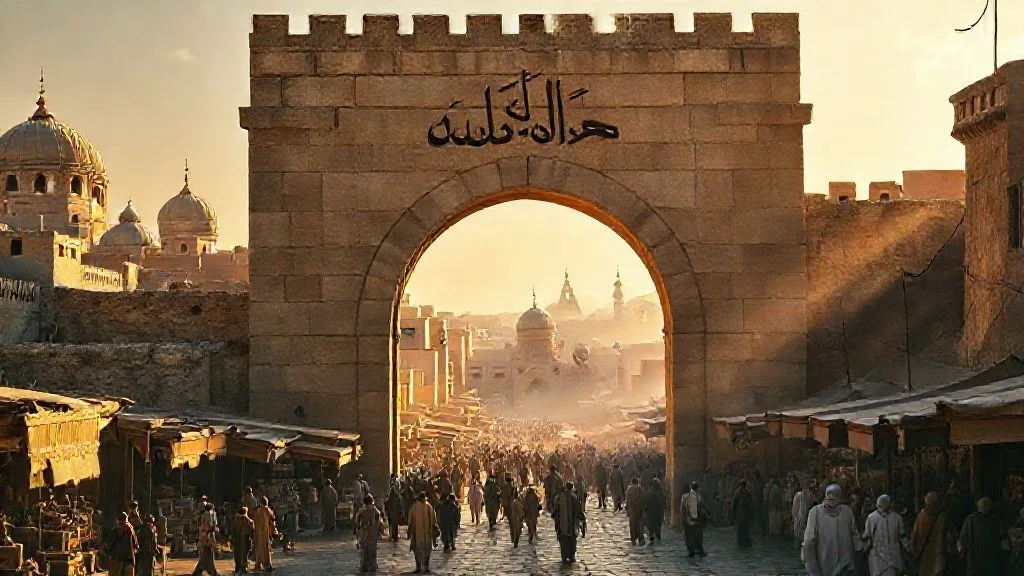
The city’s main gate, Bab al-Futuh, became an architectural prototype influencing subsequent Islamic urban fortifications. The use of alternating colours in masonry, calligraphic inscriptions, and muqarnas reflected a fusion of Fatimid aesthetic mastery and religious symbolism designed to impress visitors and intimidate enemies.
Religious Identity and Political Messaging in al-Qāhira’s Design
The Fatimids imbued the city itself with religious significance. As Isma’ili Shi’a rulers, they contrasted their capital with Sunni centers by embedding Shi’a symbolism in the very fabric of the city.
Mosques, palaces, and madrasas were built to promote Fatimid teachings, fostering a distinct spiritual atmosphere. Processions, public rituals, and festivals further reinforced Cairo’s status as a holy place destined to rival Mecca, Baghdad, and Damascus.
The City Walls: Defense and Diplomacy in Stone
Al-Qāhira’s ramparts were legendary, a daunting barrier that spoke to the volatility of the age but also to the Fatimids’ commitment to permanence. The walls were designed not merely to hold back invaders, but to impress diplomacy with the message of an unassailable power.
Each gate was heavily fortified, adorned with inscriptions that claimed divine protection. This physical and metaphorical security fostered a confidence that allowed the Fatimid state to flourish economically and politically.
Early Life in Old Cairo: Society, Culture, and Power
Life in early Fatimid Cairo balanced tradition and innovation. The city’s population was a tapestry of ethnicities and classes: Arab elites, Berber soldiers, Sicilian mercenaries, Jewish and Christian artisans, and native Egyptians.
Markets buzzed with exotic goods, scholars debated theology, and art and literature blossomed. Yet the city’s governance remained tight: loyalty to the caliph and adherence to Fatimid doctrine were non-negotiable.
From Capital to Cosmopolis: Cairo’s Growth in the Fatimid Era
Al-Qāhira quickly outgrew its island of foundations, expanding north and west as the economy prospered. It became a key node in trade networks connecting Africa, the Mediterranean, and the East.
The Fatimid rulers invested in infrastructure: aqueducts, bridges, and caravanserais. Cultural institutions like libraries and universities cemented its role as a cradle of learning.
Cairo’s Place in the Islamic World: Rivalry and Relations
The founding of al-Qāhira shifted the balance of power in the Muslim world. Rival caliphates in Baghdad resented Fatimid claims to spiritual leadership, while the local Sunni elites in Egypt chafed under Shi’a rule.
Yet the city also became a place of dialogue and exchange. Scholars and travelers noted its vibrant markets and relative tolerance, even in an age of sectarian division.
The Fatimid Legacy: How Al-Qāhira Shaped Egypt’s Future
The establishment of Cairo laid the groundwork for nearly a millennium of urban dominance. Even after the Fatimid dynasty fell in 1171, subsequent rulers including the Ayyubids and Mamluks retained Cairo as their capital.
The city became an unrivaled center of culture, learning, and politics—its origin story a testament to strategic vision and indomitable will.
Enduring Monuments: What Remains of the Fatimid City Today
Many of Cairo’s iconic historic monuments trace their roots to Fatimid foundations. The original city walls, gates like Bab al-Futuh and Bab al-Nasr, and the Al-Azhar Mosque (founded in 970) survive as living testaments.
These structures link today’s bustling metropolis to its 10th-century birth, providing tangible resonance of the Fatimid moment that shaped the Arab world.
Echoes Through Time: Cairo as a Cultural and Political Beacon
From medieval chronicles to modern travelogues, Cairo’s founding as al-Qāhira remains a pivotal story. It symbolizes the interplay of faith and power, of conquest and culture, in the history of the Islamic civilization.
In the city’s labyrinthine streets and monumental architecture, one can trace the aspirations of a dynasty that envisioned not just victory, but immortality.
Conclusion: The Birth of a City That Would Rule the Ages
The founding of Cairo as the Fatimid capital was more than a military victory or an architectural feat. It was a grand narrative of ambition, faith, and statecraft fused into stone and earth. From a sweeping vision and strategic genius rose al-Qāhira—"The Victorious"—a city destined to become one of history’s greatest capitals.
Its story teaches us about the power of place in human history, and how geography, ideology, and leadership converge to shape worlds. Cairo’s sands have long since settled, but its pulse continues to echo across centuries, a living monument to the Fatimid dream.
FAQs
Q1: Why did the Fatimids choose Egypt as the location for their new capital?
Egypt was economically vital, strategically located, and symbolic as the heart of the ancient world. Controlling Egypt allowed the Fatimids to challenge Abbasid power and dominate Mediterranean trade routes.
Q2: Who was Jawhar al-Siqilli, and what role did he play?
Jawhar was a Fatimid general of Sicilian origin who led the conquest of Egypt and oversaw the founding and initial construction of al-Qāhira.
Q3: What does the name “al-Qāhira” mean?
It means “The Victorious” or “The Conqueror,” named to commemorate the Fatimid military success and symbolize their power.
Q4: How was the city of Cairo designed and planned?
Al-Qāhira was built as a fortified royal city with strategic military defenses, symbolic urban geometry, and designated palaces and mosques reflecting Fatimid ideology.
Q5: What architectural features from the Fatimid era still exist today?
Notable surviving structures include city gates such as Bab al-Futuh, Bab al-Nasr, and the Al-Azhar Mosque.
Q6: How did the founding of Cairo influence Islamic history?
It shifted the political and religious center of the Fatimid Caliphate, challenged Sunni dominance, and established Cairo as a cultural and economic hub for centuries.
Q7: Were there any tensions between the Fatimids and the existing Egyptian populations?
Yes, primarily due to sectarian differences and political changes, but the Fatimids also integrated many local groups and maintained relative economic stability.
Q8: How quickly was Cairo built after the Fatimid conquest?
The initial fortress city was constructed within months (969–970 AD), an impressive achievement reflecting strong leadership and mobilization.