Table of Contents
- Introduction
- Astronomy Before Kepler
- Who Was Johannes Kepler?
- The Copernican Revolution’s Influence
- Kepler’s Work with Tycho Brahe
- The Astronomia Nova (1609)
- First Law: Elliptical Orbits
- Second Law: Equal Areas in Equal Times
- How the Laws Defied Ancient Beliefs
- Reaction from the Scientific Community
- The Third Law (Published in 1619)
- Impact on Newton and Future Physics
- Legacy of Kepler’s Planetary Laws
- Conclusion
- External Resource
- Internal Link
1. Introduction
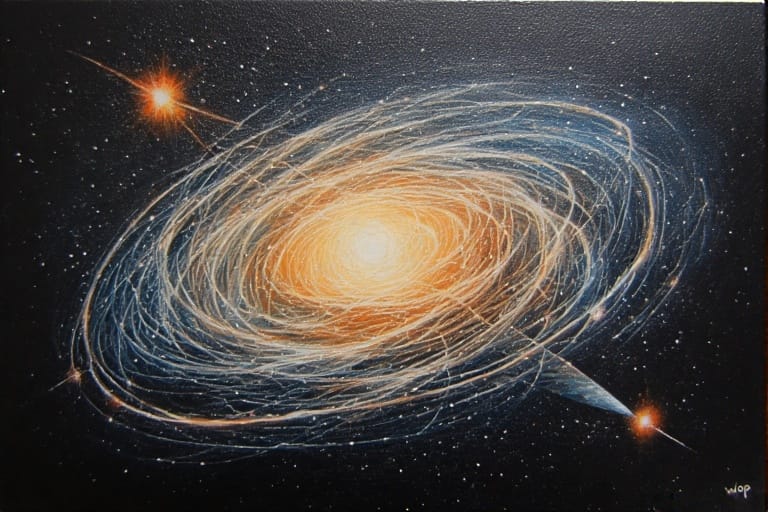
On January 1, 1609, a monumental shift occurred in the way humanity viewed the heavens. In Germany, Johannes Kepler published his groundbreaking work Astronomia Nova, revealing the first two laws of planetary motion. These weren’t minor tweaks to astronomical models—they overturned centuries of circular assumptions, literally. Kepler showed that planets move in elliptical orbits and sweep out equal areas in equal times, a stunning deviation from the long-accepted idea of perfect circles.
This wasn’t just a victory for science. It was a victory for perseverance, curiosity, and a little bit of celestial obsession.
2. Astronomy Before Kepler
Before Kepler, astronomy was dominated by the ancient models of Ptolemy and the more recent revolutionary ideas of Copernicus. The Ptolemaic model, with the Earth at the center of the universe and planets moving in epicycles (circles within circles), had held sway for over a millennium.
Nicolaus Copernicus changed the game in the 16th century by proposing that the Sun, not the Earth, was at the center. But even Copernicus clung to the idea that planets moved in perfect circles. That belief made the math… well, messy.
3. Who Was Johannes Kepler?
Kepler was not born into wealth or prestige. Born in 1571 in Weil der Stadt, Germany, he was often sickly and struggled with poor eyesight. But his mind was a universe of its own.
Originally studying theology, Kepler found his passion in astronomy and mathematics. He believed deeply in a divine mathematical harmony in nature and saw science as a way to understand God’s design.
His faith in cosmic order drove his relentless quest to decode the planetary dance.
4. The Copernican Revolution’s Influence
Kepler was a die-hard Copernican. He believed in the heliocentric model and wanted to improve it—not just accept it blindly. What if, he wondered, the planets didn’t move in circles at all? What if nature preferred ellipses, not perfection?
At the time, this idea was radical. Circles were considered divine and perfect. But Kepler wasn’t afraid to challenge orthodoxy in pursuit of truth.
5. Kepler’s Work with Tycho Brahe
Enter Tycho Brahe, a Danish nobleman with a gold nose (yes, really) and the most precise astronomical data in Europe. Tycho had spent decades charting the positions of planets without a telescope. When Kepler joined him in Prague in 1600, the two clashed—Tycho was aristocratic, and Kepler was idealistic.
But Kepler knew that Tycho’s data was the key to solving the planetary puzzle. After Tycho’s death in 1601, Kepler inherited this treasure trove of measurements, especially Tycho’s detailed records of Mars’ orbit.
6. The Astronomia Nova (1609)
Published in 1609, Astronomia Nova (The New Astronomy) was Kepler’s magnum opus. It wasn’t easy reading. Packed with technical descriptions, theological reflections, and raw mathematical reasoning, it chronicled Kepler’s years-long journey analyzing Mars’ motion.
In that book, he announced two revolutionary laws that changed astronomy forever.
7. First Law: Elliptical Orbits
Kepler’s First Law of Planetary Motion stated:
“The orbit of a planet is an ellipse with the Sun at one of the two foci.”
Boom. Goodbye perfect circles. This simple yet profound statement fit Tycho’s data far better than circular models ever had. Mars, with its noticeably non-circular orbit, was the perfect case study.
8. Second Law: Equal Areas in Equal Times
Kepler’s Second Law was equally elegant:
“A line segment joining a planet and the Sun sweeps out equal areas during equal intervals of time.”
This law explained why planets move faster when they’re closer to the Sun and slower when they’re farther away. It hinted at something deeper—forces and dynamics—not just geometry.
9. How the Laws Defied Ancient Beliefs
These laws were heresy to some. How could God’s creation operate with such imperfection? But to Kepler, ellipses weren’t imperfect—they were divinely elegant.
He had thrown away millennia of belief in celestial circles. Instead, he embraced observational data and let the math guide him, even if it led to uncomfortable truths.
10. Reaction from the Scientific Community
At first, Kepler’s work didn’t make massive waves. It was complex and difficult to grasp. But as telescopic observations improved and Galileo’s discoveries supported heliocentrism, Kepler’s laws began to gain traction.
Eventually, they became cornerstones of classical astronomy, paving the way for Newton.
11. The Third Law (Published in 1619)
Kepler’s Third Law, published a decade later in Harmonices Mundi (The Harmony of the Worlds), stated:
“The square of the orbital period of a planet is proportional to the cube of the semi-major axis of its orbit.”
This law revealed a mathematical harmony between a planet’s distance from the Sun and the time it takes to orbit. It unified the planetary system into one elegant formula.
12. Impact on Newton and Future Physics
Kepler’s laws laid the groundwork for Isaac Newton, who would later explain why planets move the way they do. Newton’s law of universal gravitation mathematically proved that Kepler’s laws were not just empirical—they were inevitable.
This connection between geometry and force revolutionized physics and set the stage for classical mechanics.
13. Legacy of Kepler’s Planetary Laws
Kepler’s three laws are still taught in schools today. They are simple, powerful, and profound. They showed that observation, logic, and mathematics could unlock the mysteries of the cosmos.
Kepler’s legacy goes beyond astronomy. He was a model of perseverance, a believer in both faith and reason, and a trailblazer who listened to nature even when it whispered contradictions.
14. Conclusion
The publication of Kepler’s first two laws on January 1, 1609, marked a celestial revolution. He replaced circular fantasies with elliptical realities. He turned astronomical guesswork into scientific precision.
In doing so, he brought humanity one step closer to understanding our place in the vast clockwork of the universe. His work remains a shining example of how courage, intellect, and curiosity can realign the heavens.
15. External Resource
 Wikipedia – Kepler’s laws of planetary motion