Table of Contents
- The Dawn of a Kingdom: Setting the Stage for Bolesław’s Coronation
- Poland at the Turn of the First Millennium: A Landscape in Flux
- Bolesław I the Brave: From Warrior Prince to Monarch
- The Legacy of Mieszko I and the Christianization of Poland
- Gniezno: The Cradle of Polish Statehood and the Coronation Venue
- Diplomatic Games: Relations with the Holy Roman Empire and Byzantium
- The Year 1025: A Kingdom’s Pivotal Moment
- The Coronation Ceremony: Ceremonial Splendor and Political Symbolism
- Bolesław’s Crown: More Than a Regal Insignia
- Reactions in Europe: Allies, Rivals, and the Balance of Power
- The Immediately Following Days: Bolesław’s Rule as King
- Political and Ecclesiastical Ramifications of the Coronation
- Poland’s Territorial Ambitions Post-Coronation
- Bolesław’s Death and the Fragility of the New Kingdom
- Long-Term Impact: The Foundation of the Polish Monarchy
- Contemporary Chronicles and the Memory of the Coronation
- Myths, Legends, and the Making of a National Hero
- Poland and Europe in the Shadow of Bolesław’s Ascension
- The Coronation’s Cultural and Religious Significance
- Revisiting 1025 Today: Historical Debates and Interpretations
The Dawn of a Kingdom: Setting the Stage for Bolesław’s Coronation
The cold spring air of May 1025 carried more than just the scent of freshly tilled earth in the town of Gniezno. The ancient capital of the early Polish state was alive with a flurry of anticipation and ceremony. Banners flapped under a heavy sky, the clang of smiths prepared new weapons, and the chapels echoed with chants. It was on this occasion that Bolesław I, known to history as "the Brave," was crowned—and in so doing transformed Poland from a duchy into a kingdom. What seemed at first a mere formal event was, in truth, a watershed moment that would redefine Poland’s place in medieval Europe.
Historians commonly mark 1025 as the year when the Polish state announced its emergence as a crowned kingdom, signaling sovereignty, legitimacy, and ambition. But to understand why Bolesław’s coronation was so momentous, we must dive deep into the currents of religion, politics, and military conquest that swept Central Europe at the dawn of the second millennium.
Poland at the Turn of the First Millennium: A Landscape in Flux
The early 1000s were a volatile time in Central Europe. The lands between the Elbe and the Vistula were a patchwork of tribes, emerging principalities, and nascent states. Poland’s territories extended from the Baltic Sea in the north to the Carpathian foothills in the south, but internally it was a mosaic of tribal identities and fragile allegiances. Organized under the Piast dynasty, Poland was on the rise but was threatened by more established neighbors—the Holy Roman Empire to the west, Bohemia to the south-west, and Kievan Rus’ to the east.
Christianity had been officially adopted barely a generation before, under the reign of Mieszko I, Bolesław’s father. This conversion would irrevocably alter Poland’s cultural and political trajectory, aligning the realm with the Latin West but also embroiling it in the intricate diplomacy between the burgeoning powers of the medieval world.
Bolesław I the Brave: From Warrior Prince to Monarch
Bolesław I was a man forged in the heat of battles and court intrigues. Born around 967, he succeeded his father to become duke in 992 but was anything but a conventional ruler. Ambitious, fiercely intelligent, and unyieldingly bold, Bolesław earned his sobriquet, "the Brave," through his military exploits and his tenacity in expanding and defending his domains.
His reign was marked by campaigns against the Veleti tribes, skirmishes with the Holy Roman Empire, and deft political maneuvering, including the support of Christian missions and alliances with the papacy. Bolesław sought not only to defend the lands of his forebears but to elevate Poland’s status in a Europe fragmented by competing claims and shifting loyalties.
The Legacy of Mieszko I and the Christianization of Poland
Mieszko I’s decision to convert to Christianity in 966 was a masterstroke that opened the door to Western political alliances, cultural enrichment, and state-building. It reframed Polish identity from pagan tribalism towards a Christian polity, recognized (if grudgingly) by Europe’s dominant powers.
However, the new faith posed challenges. The Church hierarchy was not fully established, and Poland’s independence from the influence of the Holy Roman Empire was tenuous. Bolesław inherited a realm where Christianization was still fresh but incomplete in social and political penetration—he had to consolidate this religious transformation while simultaneously asserting his authority beyond mere dukedom.
Gniezno: The Cradle of Polish Statehood and the Coronation Venue
Gniezno was more than just a town—it was the symbolic heart of early Poland. Legend and history intertwined here, with ties to the missionary Saint Adalbert (Święty Wojciech), whose martyrdom in 997 galvanized the Christian identity of Poland.
The location of the coronation was a deliberate choice. Unlike Kraków or Poznań, Gniezno was a spiritual capital, home to Poland’s first archbishopric, and a site that echoed with the legitimacy of the Christian faith and continuity of the Piast lineage. To be crowned here was to be enshrined in the very soul of the emerging nation.
Diplomatic Games: Relations with the Holy Roman Empire and Byzantium
Bolesław’s coronation did not happen in a vacuum. Europe’s great powers—the Holy Roman Empire, led by Emperor Conrad II, and the Byzantine Empire—watched Poland closely. The interplay between these empires, both enmeshed in their own internal and external conflicts, shaped the latitude afforded to emergent monarchs.
Initially, Bolesław had a complex, often antagonistic relationship with the Germans, participating in wars and territorial disputes but also at times forging treaties and alliances. His coronation was a bold political move, signaling Poland’s aspiration to sovereignty independent of imperial overlordship.
The Year 1025: A Kingdom’s Pivotal Moment
In the spring of 1025, a delicate and momentous sequence of events unfolded. For months preceding the coronation, Bolesław prepared, gathering nobles, clergy, and foreign dignitaries. His health, already fragile due to years of campaigning, did not deter this climactic assertion of power.
In keeping with medieval European tradition, coronation was as much a religious rite as a political statement. Bolesław’s assumption of the royal crown was imbued with a solemn pledge to God, the Church, and his subjects—a pledge to govern justly and defend the Christian realm.
The Coronation Ceremony: Ceremonial Splendor and Political Symbolism
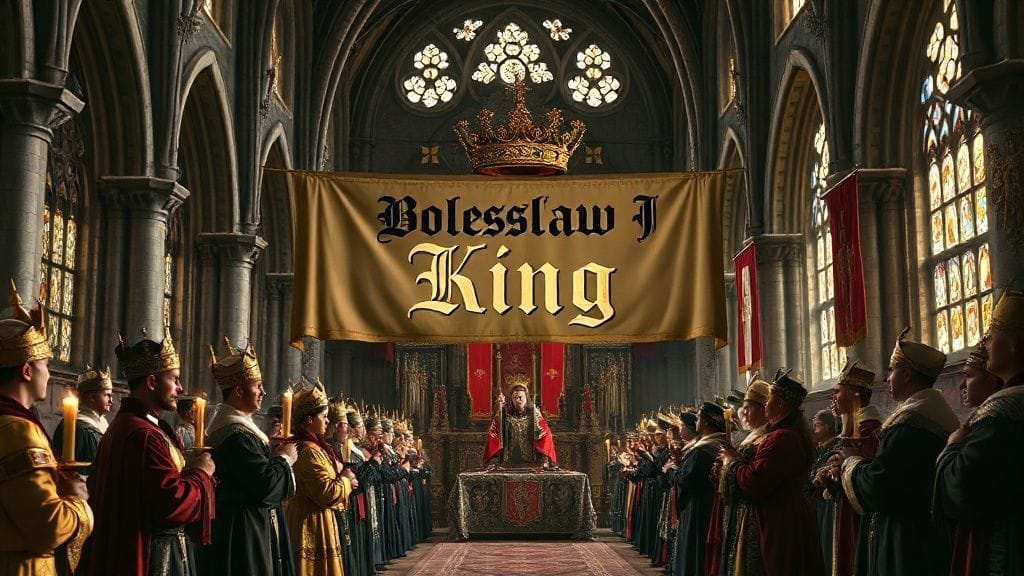
On a bright day in May, the assembled crowd witnessed Bolesław placed under the rich folds of liturgical vestments by Archbishop Radim Gaudentius, the first Polish archbishop. The crown—a shimmering circle of gold and precious stones—was set upon his head with the words that echoed through time: “God, Your Majesty, the crown belongs to you!”
The spectacle was deliberate. It fused the divine right to rule with national pride; Bolesław was no longer merely a duke, but a king—equal in dignity and authority to his European contemporaries. The ceremony blended pagan tradition and Christian liturgy, reflecting Poland’s delicate synthesis of its past and present.
Bolesław’s Crown: More Than a Regal Insignia
The crown did not simply adorn a head—it embodied sovereignty, legitimacy, and ambition. In the hierarchical politics of medieval Europe, the possession of a royal crown was a statement of autonomy from the Holy Roman Emperor’s suzerainty.
Bolesław’s crown was thus both a tangible asset and a potent symbol, a claim stamped in gold challenging the norms of regional power and reshaping the political map of Central Europe.
Reactions in Europe: Allies, Rivals, and the Balance of Power
News of Bolesław’s coronation rippled across courts from Aachen to Constantinople. Some rulers viewed it as a threat, others as an opportunity. The Holy Roman Emperor, already balancing warring noble factions and asserting authority over German duchies, reluctantly acknowledged the new king but was wary of Poland’s growing confidence.
In the east, Kievan Rus’ observed the coronation with suspicion, for Bolesław’s expansionist policies encroached on their borders. Yet, the Byzantines, intrigued by this Western Christian realm on the fringes, saw potential allies against both German and Slavic rivals.
The Immediately Following Days: Bolesław’s Rule as King
The days and months following the coronation were a period of celebration but also intense governance for Bolesław. He sought to consolidate his newly minted kingdom through legal reforms, strengthened military presence, and renewed ecclesiastical appointments.
However, time was not on his side. Bolesław’s death only months later tested the resilience of the nascent Polish kingdom and posed the question of whether the crown was merely his personal triumph or a lasting institutional reality.
Political and Ecclesiastical Ramifications of the Coronation
The coronation enhanced the stature of the Polish church, elevating the archbishopric of Gniezno and affirming the alliance between crown and cross. The ecclesiastical hierarchy became a partner in governance, guiding spiritual life and legitimizing monarchical authority.
Politically, Bolesław’s elevation triggered new territorial ambitions but also new rivalries. The independence implied by kingship forced Poland onto a collision course with imperial ambitions and regional powers, shaping centuries of conflict and alliance.
Poland’s Territorial Ambitions Post-Coronation
Bolesław’s reign had extended Poland’s borders through military campaigns against neighboring tribes and states. Now officially a kingdom, these ambitions took on new legitimacy.
The claim to lands in Pomerania, Silesia, and Lusatia, as well as contested areas near Kievan Rus’, became a central feature of Polish politics, embroiling the realm in almost perpetual conflict and diplomacy.
Bolesław’s Death and the Fragility of the New Kingdom
The new king’s death in June 1025, just weeks after his coronation, cast a long shadow. The sudden loss of the creator-king presented a challenge: could Poland maintain its royal status without Bolesław’s force of will?
His son, Mieszko II, inherited a kingdom alive with potential but vulnerable. The ensuing decades would see Polish rulers both inspired and burdened by the legacy of the first crowned monarch.
Long-Term Impact: The Foundation of the Polish Monarchy
Bolesław’s coronation laid the indispensable foundation for the Kingdom of Poland, establishing the precedent of monarchy as the form of governance and sovereignty.
His reign influenced not only political institutions but also cultural identity, serving as a touchstone for Polish unity through centuries of partition, foreign domination, and revival.
Contemporary Chronicles and the Memory of the Coronation
Chroniclers such as Gallus Anonymus immortalized Bolesław in glowing accounts, blending fact and legend to craft the image of a wise, just, and valiant king.
These narratives, though shaped by the agendas of their time, contributed to Poland’s collective memory and national mythology.
Myths, Legends, and the Making of a National Hero
Stories of Bolesław’s bravery, including his exploits in battles and governance, became integral to Polish folklore and identity.
The coronation itself was imbued with symbolic meanings in later centuries, epitomizing not just monarchy but the spirit of Polish independence and resilience.
Poland and Europe in the Shadow of Bolesław’s Ascension
Bolesław I’s coronation signaled a new player in the European chessboard, a testament to the shifting currents of power and faith.
His legacy influenced not only Polish history but also the broader development of medieval Central Europe, as kingdoms rose and fell, boundaries moved, and alliances shifted.
The Coronation’s Cultural and Religious Significance
The event cemented the fusion of pagan heritage and Christian doctrine, marking Poland’s official place within the Latin Christendom.
Religious practices, art, and architecture blossomed following 1025, nurturing a vibrant cultural renaissance that defined Poland’s medieval identity.
Revisiting 1025 Today: Historical Debates and Interpretations
Modern historians continue to debate the precise nature and implications of Bolesław’s coronation, questioning the extent of its immediate political autonomy and the pope’s involvement.
Yet, no consensus denies its symbolic power as the birth of the Polish kingdom and a milestone in European medieval history.
Conclusion
The coronation of Bolesław I in Gniezno was far more than a ceremonial crowning—it was the declaration of Poland’s arrival on the European stage as a sovereign, Christian kingdom. Its echoes resound across the centuries, informing the narrative of Polish identity, sovereignty, and resilience. Bolesław’s story is one of ambition, faith, and the forging of a nation under the fierce light of history’s spotlight. In celebrating his coronation, we bear witness not only to a king’s pinnacle but to the birth of a dream—a kingdom carved from uncertainty and hardship, destined to endure.
FAQs
Q1: Why was Bolesław I crowned king and not simply a duke?
A1: The crowning as king elevated Poland’s status from a duchy under the Holy Roman Empire’s shadow to a sovereign kingdom. It affirmed both internal authority and international legitimacy, crucial for Bolesław’s ambitions.
Q2: What role did Christianity play in Bolesław’s coronation?
A2: Christianity was central; the coronation was a religious rite conferring divine legitimacy. It symbolized Poland’s integration into the Christian world and the alliance between monarchy and church.
Q3: How did neighboring powers react to the coronation?
A3: Reactions ranged from acceptance and cautious diplomacy to apprehension, especially by the Holy Roman Empire and Kievan Rus’, who saw Poland’s rise as a strategic challenge.
Q4: Did Bolesław I’s coronation lead to immediate changes in Poland’s governance?
A4: While the coronation was symbolically momentous, actual governance reforms were gradual. New alliances, ecclesiastical empowerment, and military consolidation followed but required time.
Q5: How reliable are the chronicles describing the coronation?
A5: Chronicles like those of Gallus Anonymus mixed fact with legend, reflecting medieval historiography’s style. They provide invaluable insight but must be analyzed critically.
Q6: What was the long-term significance of Gniezno as the coronation site?
A6: Gniezno symbolized the spiritual and political heart of Poland, anchoring the monarchy’s legitimacy. It remained a focal point of Polish identity for centuries.
Q7: How did Bolesław’s coronation influence later Polish kings?
A7: It set precedent and provided a royal model, inspiring future rulers to assert sovereignty, expand territories, and strengthen the crown-church alliance.
Q8: Is Bolesław I remembered as a national hero today?
A8: Absolutely. He is celebrated as a founding figure of the Polish state, his coronation a milestone in the nation’s history and cultural consciousness.

