Table of Contents
- The Dawn of October 14, 1066: A Nation on the Edge
- England Poised for Change: The Death of Edward the Confessor
- Rival Kings and Monarchs: Harold Godwinson, William, and Harald Hardrada
- The Stakes in the British Isles: A Crown Divided
- The Gathering Storm: Preparations for War
- The Norman Armada: Crossing the English Channel
- Harold’s Forced March: From Stamford Bridge to Hastings
- Battle Lines Drawn: The Landscape of Conflict
- A Clash of Titans: The Battle Unfolds
- Shields and Arrows: Norman Tactics vs. Anglo-Saxon Defenses
- The Turning Point: The Death of Harold Godwinson
- Aftermath of Victory: The Norman Ascendancy
- The Fall of Anglo-Saxon England and its Cultural Transformation
- The Creation of the Feudal System: William’s Rule and Legacy
- The Bayeux Tapestry: A Story Woven in Cloth
- The Lasting Echo: How Hastings Shaped England and Europe
- The Myth and Memory of Hastings in British Identity
- Archaeological Discoveries: Unearthing the Battlefield
- The Battle’s Role in Medieval Warfare Evolution
- Conclusion: From Blood to Crown — The Defining Moment of 1066
- FAQs: Understanding the Battle of Hastings
- External Resources
- Internal Link: History Sphere
The Dawn of October 14, 1066: A Nation on the Edge
The early morning mist clung thick over the rolling hills near Hastings, England. The air was heavy with tension, the calm before a storm that would ripple through history. The year was 1066, a turning point as palpable as it was inevitable. Thousands of warriors from Normandy and England stared across the battlefield, gripping weapons that would carve a new destiny for the British Isles. The sun rose over a land about to be transformed forever, where the roar of battle shatterings would drown centuries of tradition in mere hours. This was the Battle of Hastings — more than a fight for a crown, it was a collision of cultures, dreams, and ambitions.
England Poised for Change: The Death of Edward the Confessor
In January 1066, Edward the Confessor — the childless king of England — died, leaving a kingdom without a clear heir. His reign, marked by a near-sacred image and a delicate balance of power, came to an abrupt and unsettling end. England, until then a relatively stable realm, was thrown into uncertainty. The question “Who would wear the crown?” sparked alliances, betrayals, and a future shaped by blood and steel.
Edward’s ties to Normandy, from where William, Duke of Normandy, claimed the English throne, intensified the stakes. The king’s death left not only a political vacuum but also unleashed tensions rivalling the best epics that medieval Europe could offer.
Rival Kings and Monarchs: Harold Godwinson, William, and Harald Hardrada
Here lies the heart of the struggle — three men claimed the right to rule England.
Harold Godwinson, the powerful Earl of Wessex and England’s leading noble, was swift to seize the throne. Crowned king on the very day of Edward’s death, Harold’s claim was backed domestically, but contested abroad.
William, Duke of Normandy, insisted that Edward had promised him the crown years earlier, a pledge supported by alleged oaths Harold himself had sworn during a visit to Normandy. This broken word would seal the fate of empires.
Meanwhile, Harald Hardrada, King of Norway, stepped into the contest, announcing his own claim grounded in Scandinavian precedent and family ties to previous English kings.
These three men were not just contenders but embodiments of clashing worlds: English tradition, Norman innovation, and Viking legacy, all converging on one battlefield.
The Stakes in the British Isles: A Crown Divided
England, though singular on the map, was a realm fracturing beneath the weight of competing loyalties. The death of a monarch was no simple matter; it was a catalyst for civil war, invasion, and cultural transformation.
Anglo-Saxon England held deep attachments to local customs and warrior codes, while Norman society brought feudal structure and continental ambitions. The crown was more than a symbol — it was the keystone to the future of England’s law, language, and identity.
The battle that awaited Hastings was, in truth, a battle for the soul of England, a crucible where history melted and was recast anew.
The Gathering Storm: Preparations for War
In Normandy, Duke William marshaled his forces with strategic rigor, gathering knights from across France. His army was not just soldiers but a well-oiled war machine mixing cavalry, archers, and foot soldiers orchestrated to execute medieval warfare at its zenith.
Across the English Channel, Harold Godwinson faced his own challenges—as much political as military. He had to rally his earls and fyrd (militia), raise armies quickly, and prepare against an inevitable invasion. But fate had one last cruel twist: before meeting William, Harold first had to repel an invasion from the north.
The Norman Armada: Crossing the English Channel
William’s fleet assembled off the coast of Normandy, a spectacle of medieval maritime prowess, dozens, perhaps hundreds of ships sailing together toward England. The Channel’s temperamental weather delayed the crossing, adding dread and urgency to an already high-stakes gamble.
When the fleet landed near Pevensey Bay, it was with careful planning, securing supply lines and fortifications before marching inland. William was not merely invading; he was laying siege to a kingdom unprepared for this new order.
Harold’s Forced March: From Stamford Bridge to Hastings
Before facing the Normans, Harold confronted Harald Hardrada and his Norwegian forces at Stamford Bridge in northern England—a brutal and exhausting battle that ended with the death of Hardrada and a decisive English victory on September 25, 1066.
But victory came with a price. Harold, forced to march his weary troops nearly 200 miles south through hostile terrain within weeks, had little time to rest, regroup, or repair the ranks. The Anglo-Saxon army that faced William was remarkable for its resilience but undeniably drained.
Battle Lines Drawn: The Landscape of Conflict
The chosen battlefield, a gentle slope near Hastings, was marked by forests and open fields — terrain both armies sought to exploit.
Harold’s forces took position atop Senlac Hill, a strategic vantage point anchoring a shield wall defensive line, famous in later descriptions for its nearly impenetrable disposition. Behind them lay the road to London and possible retreat, but the command was clear: hold the line or lose everything.
William arrayed his army below, forming divisions of archers, infantry, and cavalry, ready to break the Anglo-Saxon shield wall with coordinated strikes.
A Clash of Titans: The Battle Unfolds
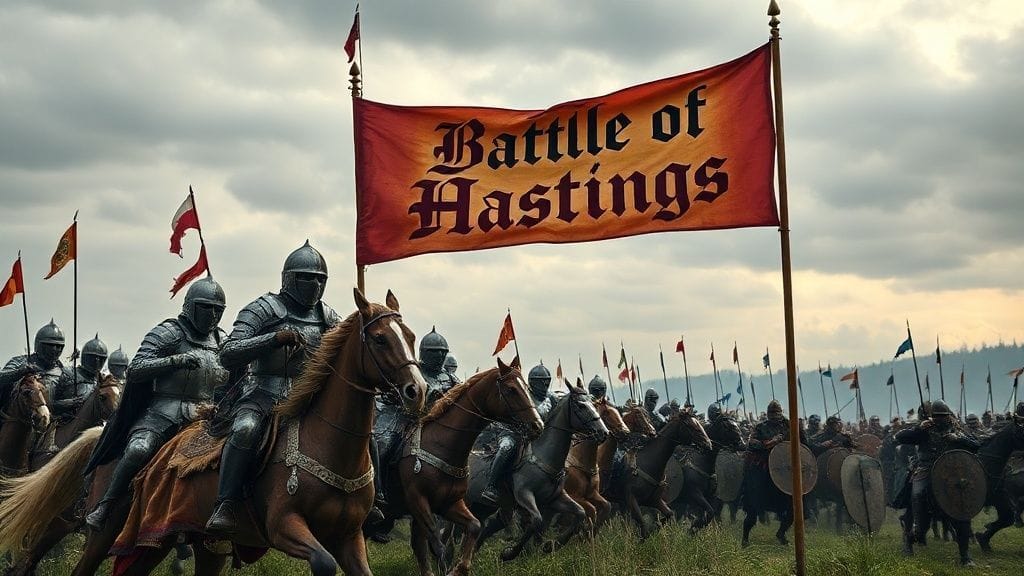
The battle began as the morning mist cleared, with Norman archers volleying their deadly arrows onto the English shield wall. The wall held firm, absorbing wave after wave of attacks.
Norman cavalry attempted charges, breaking and retreating, feigning flight to draw out the English warriors from their stronghold. The shield wall, a symbol of Anglo-Saxon discipline, began to crack, soldiers chasing the fleeing Normans into traps, thinning their own line.
The battle raged for hours—hours that would define the fate of two nations.
Shields and Arrows: Norman Tactics vs. Anglo-Saxon Defenses
The Normans' combined arms tactics—mixing archers, infantry, and cavalry—demonstrated their military sophistication compared to the more static Anglo-Saxon force, mostly infantry bound by the shield wall tradition.
William’s ability to adapt, orchestrate retreats, and renew attacks marked a turning point in medieval military history.
For Harold, it was a desperate struggle to maintain discipline, repair breaks, and hold the line as exhaustion set in. His forces, fighting for their very existence, showed incredible heroism but faced the increasing tide of Norman pressure.
The Turning Point: The Death of Harold Godwinson
A moment etched into English memory was the sudden fall of King Harold Godwinson. Though the exact details remain a matter of historical debate, the famed image of an arrow lodged in his eye, as immortalized by the Bayeux Tapestry, symbolizes the catastrophic collapse of Anglo-Saxon resistance.
Without their king, the English line faltered. Norman knights pressed the advantage, routing the opposition and securing a brutal, decisive victory as dusk cloaked the battlefield in shadow.
The death of Harold was more than a loss of a leader—it was the shattering of a nation's last hope for survival.
Aftermath of Victory: The Norman Ascendancy
William emerged from the Battle of Hastings not just as a conqueror, but as a ruler with a new vision for England. He was crowned king on Christmas Day, 1066, marking the dawn of Norman rule.
The conquest was not a mere change of power but the beginning of a sweeping transformation—norms, laws, languages, and lands were reshaped. William distributed estates to his Norman allies, building castles to consolidate control, and imposing a new feudal order upon a conquered people.
The Fall of Anglo-Saxon England and its Cultural Transformation
With the Norman conquest, centuries of Anglo-Saxon rule came to an end, along with their language, aristocracy, and traditions.
English would continue, but Norman French became the tongue of the ruling class. The merging of cultures forged the foundations of modern English identity but at the cost of centuries-old ways.
The conquest created upheavals for peasants and nobles, the church, and the state alike—altering the social fabric of England indelibly.
The Creation of the Feudal System: William’s Rule and Legacy
William introduced the feudal system to England with unprecedented thoroughness. Every noble was a tenant-in-chief under the king, owing military service in return for land.
This restructuring centralized power, reinforced loyalty through land grants, and changed rural England forever. Castles like the Tower of London became symbols of Norman authority.
William’s legacy was complex—brutal yet effective, melding the medieval continental system to England’s unique history.
The Bayeux Tapestry: A Story Woven in Cloth
The Bayeux Tapestry remains one of the most vivid records of the conquest, a 230-foot-long embroidery depicting the events leading up to and during the battle.
It offers not just a visual narrative but insight into contemporary perceptions—heroes, villains, and divine will all embroidered in thread.
This artifact is not merely decoration but a potent political statement that shaped Norman triumph memory.
The Lasting Echo: How Hastings Shaped England and Europe
The Norman victory at Hastings altered the course of English history—and Europe’s.
It linked England more closely with continental politics, initiated reforms in governance and law, and helped launch England onto the stage as a central medieval kingdom with far-reaching influence.
Hastings is remembered as a seismic moment—where worlds collided, producing a new identity forged from conquest and adaptation.
The Myth and Memory of Hastings in British Identity
Over centuries, tales of Hastings have grown into legend, symbolizing resistance, loss, and eventual unity.
Harold’s bravery, William’s determination, and the battle’s dramatic twists fuel British historical imagination, inspiring literature, drama, and national reflection.
Hastings is not just history—it is a foundational myth capturing the enduring struggle for power and identity.
Archaeological Discoveries: Unearthing the Battlefield
Modern archaeology has intensified interest in the battlefield site, revealing layers of weapons, mass graves, and artifacts that breathe life into ancient chronicles.
Recent digs confirm the scale of the battle and the ferocity of combat, offering tangible connections to a day long past but never forgotten.
This ongoing research deepens our understanding of how the battle unfolded beyond chronicles and tapestries.
The Battle’s Role in Medieval Warfare Evolution
Hastings stands as a landmark in the evolution of medieval warfare—a transition from traditional Anglo-Saxon infantry dominance to combined arms involving cavalry and archers.
Its lessons influenced countless battles thereafter and showcased the importance of strategy, flexibility, and leadership in medieval armies.
It marked the beginning of a new military paradigm dominating Europe for centuries.
Conclusion: From Blood to Crown — The Defining Moment of 1066
The Battle of Hastings was not simply a clash of armies—it was a battlefield where fate was forged, and history rewritten. More than 30 centuries after the fall of Troy or the rise of Rome, this October day would resonate eternally because it altered the identity of a nation.
In the mud and blood of Senlac Hill, cultures collided and merged; a people who favored shields were transformed by the horse and sword of the Normans. It marked the end of one era and the birth of another—violent, uncertain, yet brilliantly transformative.
The echo of that battle remains imprinted in the soul of England, a powerful reminder that history’s turning points seldom arrive softly, but through struggle, loss, and sometimes, unconquerable will.
FAQs: Understanding the Battle of Hastings
Q1: Why was the Battle of Hastings fought?
The battle arose because of competing claims to the English throne after the death of Edward the Confessor, primarily between Harold Godwinson, William of Normandy, and Harald Hardrada of Norway. Ultimately, Norman ambition and Harold’s contested kingship led to war.
Q2: How did the Battle of Hastings change England?
It led to the Norman conquest of England, bringing feudalism, changing the aristocracy, language, administrative systems, and linking England more closely with continental Europe.
Q3: Who was Harold Godwinson?
Harold was the Earl of Wessex and the last Anglo-Saxon king of England. He was crowned quickly after Edward’s death but died in battle at Hastings, ending Anglo-Saxon rule.
Q4: What was William the Conqueror’s strategy at Hastings?
William used a mix of archers, infantry, and cavalry, utilizing feigned retreats to break the Anglo-Saxon shield wall and exploit weaknesses.
Q5: Why is the Bayeux Tapestry important?
It visually narrates the events leading to and during the battle, providing a rare contemporary artistic account that shaped how history remembers the conquest.
Q6: How reliable are the historical sources about Hastings?
Sources like the Bayeux Tapestry, chronicles by Norman and English writers, and archaeological evidence provide a broad but sometimes conflicting picture, leaving some details debated.
Q7: Did the battle immediately secure Norman control?
While decisive, Norman control took time to consolidate. William spent years quelling rebellions and building fortifications to enforce his rule.
Q8: How is the battle remembered today?
It remains a defining moment in English history, commemorated in literature, media, and archaeological interest, symbolizing conquest and identity.

