Table of Contents
- A Winter of Fire and Fury: The Harrying of the North Begins
- England on the Edge: The Aftermath of the Norman Conquest
- The Northern Resistance: Rebels, Outlaws, and Loyalists
- William the Conqueror’s Dilemma: Securing a Fractious Kingdom
- Setting the Stage: The Strategic Importance of Yorkshire and Northern England
- The Spark Ignites: The 1069 Uprising and the Arrival of the Danes
- William’s Response: Scorched Earth and Ruthless Repression
- The Campaign of Destruction: Villages Burned and Fields Laid Waste
- Starvation, Exile, and Death: The Human Toll of the Harrying
- Chroniclers’ Voices: Contemporary Accounts of Horror and Punishment
- Beyond the Battle: The Impact on Northern Society and Economy
- The Domesday Aftermath: How the Harrying Reshaped Land Ownership
- The Psychological Warfare: Fear as a Tool of Norman Rule
- Resistance Rendered Futile: The Quiet Submission of the North
- Legacy of the Harrying: A Dark Chapter in England’s Medieval History
- Historical Debate: Was the Harrying Necessary or Barbaric?
- The Harrying in Culture: Mythmaking and Memory Through the Ages
- The Long Shadow: How 1069–1070 Influenced English National Identity
- Lessons and Parallels: Scorched Earth and Power Across Time
- Conclusion: Rebuilding from Ashes, Forging a New England
- FAQs: Understanding the Harrying of the North
- External Resources
- Internal Link: Visit History Sphere
A Winter of Fire and Fury: The Harrying of the North Begins
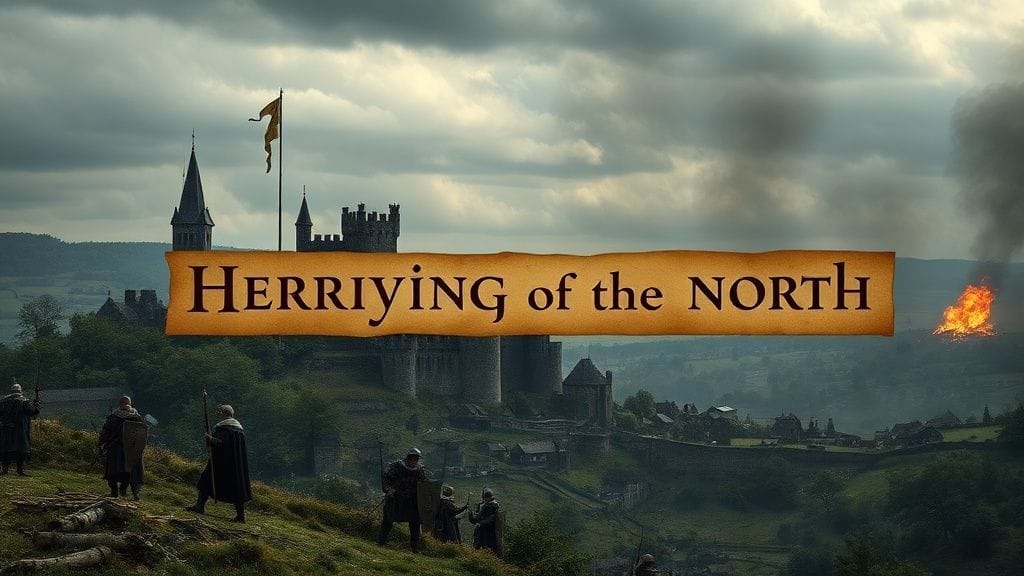
In the dead of winter, the chill biting harshly through ragged cloak and bone, the land of Yorkshire burned like a hellscape. Flames licked at wooden hovels, smoke spiraled into a frozen sky, and the cries of the starving mingled with the crackle of destruction. This was no ordinary warfare; it was a ruthless campaign—a scorched-earth purge that would haunt England for generations.
This was the Harrying of the North, a brutal military operation undertaken by William the Conqueror in 1069 and 1070 to crush the rebellious spirit of northern England. It was a devastating response to defiance—a fiery reckoning that left entire regions desolate and thousands of lives extinguished. For those who lived through those frozen months, hope was a distant ember beneath the ash.
Yet, to understand the full force and significance of the Harrying, one must journey back to the turbulent times following the Norman Conquest, to grasp why the North refused to bow quietly and why William chose a path of fire and famine over diplomacy.
England on the Edge: The Aftermath of the Norman Conquest
The year 1066 had shaken England to its core. When William, Duke of Normandy, defeated King Harold Godwinson on the bloody fields of Hastings, a new era dawned—one characterized by conquest, upheaval, and contested sovereignty. But victory on the battlefield was only the first step; the real challenge lay in transforming a conquered kingdom into a stable realm under Norman rule.
While the South of England was quickly brought under William’s control through castles and loyal Norman nobles, the North remained a tempest waiting to break. For centuries, the area had been a land of Anglo-Saxon and Danish heritage, fiercely independent and proud. The Normans, foreign lords with unfamiliar customs, language, and governance, were perceived not just as conquerors but invaders.
This tension simmered beneath the surface, exacerbated by William’s redistribution of lands to Norman barons and the imposition of new taxes. Peace was fragile; rebellion was inevitable.
The Northern Resistance: Rebels, Outlaws, and Loyalists
By 1069, resistances had coalesced into a formidable threat. The Northern earls, led by figures such as Edwin, Earl of Mercia, and Morcar, Earl of Northumbria, harbored deep resentment. They represented the old Anglo-Saxon aristocracy, dispossessed and desperate.
Moreover, the arrival of Danish fleets, sent to aid the revolts, signaled an international dimension to this resistance. The Danes had their own history with England—the Viking legacy—and took any opportunity to challenge Norman power.
Villagers, monks, and nobles alike found themselves caught in the rising tide of revolt. Raiders, bandits, and rebel lords formed alliances born of convenience and common hatred for Norman overlords.
William the Conqueror’s Dilemma: Securing a Fractious Kingdom
William’s position was precarious. His victory was far from secure unless he could suppress Northern unrest decisively. Diplomacy had failed; half-hearted attempts to placate local lords were rebuffed, and smaller revolts kept flaring across the region.
The North was not just rebellious; it was strategically vital. Control over this stretch of England meant securing trade routes, preventing invasions from Scotland or Scandinavia, and preserving the authority of the Crown.
For William, a man forged in the crucible of conquest, the solution was stark: total subjugation. The North’s defiance would be crushed, its spirit broken through a methodical campaign of destruction that would “pacify” the region once and for all.
Setting the Stage: The Strategic Importance of Yorkshire and Northern England
Yorkshire, the heart of the North, was more than just a province; it was symbolic of English independence and cultural identity. From its ancient Roman walls to sprawling productive farmlands, it held economic and military significance unmatched in the North.
Securing Yorkshire equated to commanding the North, but it also meant confronting a population bitter, embittered, and increasingly desperate. This region was a thorn in William’s side—nest where rebellions were hatched, where Norman castles were attacked, and where the English crown’s writ was openly defied.
The Spark Ignites: The 1069 Uprising and the Arrival of the Danes
The rebellion of 1069 was a tinderbox moment that exploded when Danish forces arrived on the Humber’s coast, lending support and legitimacy to local insurgents. Far from mere opportunists, the Danes shared a stake in England’s destiny and its resources.
Together, rebel English and Danish warriors ravaged Norman holdings, destroyed castles, and forced William’s garrisons to retreat. York, the jewel of the North, fell not once but twice—each time a stark humiliation for William.
News from the South grew grim: rebellious uprisings spread like wildfire, threatening to unravel the fragile Norman hold on their newly won kingdom.
William’s Response: Scorched Earth and Ruthless Repression
Traditionally a cautious and calculated leader, William this time embraced an extreme, brutal approach. Instead of merely chasing rebels or punishing leaders, he sought to erase the very foundation of rebellion: the people and their livelihoods.
The decision was grim and deliberate—to destroy crops, burn houses, kill livestock, and starve out the population. Warriors and peasants alike faced siege, starvation, or death.
The infamous campaign wasn’t just about defeating armies; it was psychological warfare designed to create a chilling deterrent, a warning that rebellion would be met with annihilation.
The Campaign of Destruction: Villages Burned and Fields Laid Waste
Historical records, though sparse, describe a winter campaign of unprecedented violence. Villages from York stretching north to Durham were systematically razed. In the south of Yorkshire, entire areas were turned into wastelands.
Fields became barren, with land stripped bare down to the earth. Food supplies were seized or destroyed. Livestock herds were slaughtered to prevent sustenance for the insurgents. Survivors fled or faced starvation.
One chronicler lamented, “From York to Durham, nothing lived, not even the soil.” The landscape itself became a casualty.
Starvation, Exile, and Death: The Human Toll of the Harrying
The impact on the civilian population was catastrophic. Estimates vary, but tens of thousands are believed to have perished during the winter of 1069–1070—not solely through warfare, but from starvation and exposure.
Chroniclers recount harrowing tales of desperation: children abandoned, elderly left to die, entire families reduced to begging or fleeing into the wilderness.
This was not collateral damage but an intended result—a grim calculus that deemed the cost of rebellion higher than the price of mass suffering.
Chroniclers’ Voices: Contemporary Accounts of Horror and Punishment
The weight of history presses down through the voices of those who wrote close to the events. One such voice is that of Orderic Vitalis, a Norman chronicler who conveyed a chilling mix of horror and justification:
“Forest and plain, city and village, all fell under the sword and fire… so cruel a devastation that for many long years after the land could not recover.”
Meanwhile, English sources, scarred by defeat, remembered the Harrying as an incomprehensible nightmare, a rupture in the social fabric of the North.
Beyond the Battle: The Impact on Northern Society and Economy
Beyond the immediate death toll, the Harrying entrenched economic stagnation and social upheaval. Entire communities vanished; fields remained fallow; the tenant-peasant system lay in ruins.
The demographic blow slowed agricultural recovery for decades. Feudal order adjusted as Norman magnates replaced the old English aristocracy, reshaping the social hierarchy.
Northern England’s economy, once a vibrant patchwork of farming, trade, and artisanal crafts, languished under a pall of fear and deprivation.
The Domesday Aftermath: How the Harrying Reshaped Land Ownership
The 1086 Domesday Book offers a window into the aftermath. Northern lands that once belonged to Anglo-Saxon lords were now recorded under Norman dominion. Many estates were described as “waste” or “deserted,” reflecting ongoing ruin.
Norman barons took advantage of the devastation to seize control of land and resources, cementing their power and embedding the conqueror’s influence.
The Harrying, in this sense, was both a military and structural transformation—clearing the old way to build anew, violently and irrevocably.
The Psychological Warfare: Fear as a Tool of Norman Rule
The lasting legacy of the Harrying wasn’t just physical ruin but psychological dominion. William created a message that echoed: resistance meant ruin.
This terror helped to pacify a rebellious region that might have otherwise proved impossible to govern. The North learned that rebellion had a price unbearable to pay.
Yet, this strategy sowed deep resentment—an undercurrent of hostility that would surface centuries later in culture and folklore.
Resistance Rendered Futile: The Quiet Submission of the North
After the winter of 1069–1070, organized northern rebellion faded. The power of earls like Edwin and Morcar was broken, and surviving elites either fled, submitted, or were dispossessed.
William’s castles secured the region physically; the famine and terror ensured psychological submission.
The Harrying was a dark but effective instrument to impose Norman authority, forcing the North into a reluctant, grinding peace.
Legacy of the Harrying: A Dark Chapter in England’s Medieval History
Historians have long debated the Harrying’s place in narrative: a necessary evil or outright atrocity? It stands as one of the earliest examples of deliberate scorched earth policy in British history.
For centuries, it left scars in local memory—songs, legends, and oral histories recalling a winter of suffering unparalleled.
The Harrying also set a precedent for the ruthless consolidation of power in medieval Europe, reminding rulers of the grim possibilities when defiance crosses the line.
Historical Debate: Was the Harrying Necessary or Barbaric?
Scholars wrestle with William’s choices. Was such wholesale destruction justified in light of the persistent insurrections? Or was it an act of barbaric vengeance?
Some argue it was a military necessity to prevent further rebellions and secure peace; others see it as a punitive excess that traded human lives for political gain.
This debate illuminates broader questions about the costs of conquest and governance in violent times.
The Harrying in Culture: Mythmaking and Memory Through the Ages
Over the centuries, the Harrying of the North became more than history—it grew into myth. Northern England told stories of lost villages, haunted ruins, and ancestral suffering.
Poetry and chronicles painted the Harrying as a nightmarish epoch, a foundational trauma for regional identity.
Even today, its memory colors Yorkshire’s cultural landscape, a somber reflection on conquest and loss.
The Long Shadow: How 1069–1070 Influenced English National Identity
The Harrying played a subtle yet undeniable role in shaping English national consciousness. It highlighted regional divisions, underscored the brutality of Norman rule, and eventually contributed to a shared narrative of survival and resilience.
This dark chapter reminds modern historians and citizens alike of the cost borne in making England what it became—a tapestry woven from conquest, resistance, and reconciliation.
Lessons and Parallels: Scorched Earth and Power Across Time
The Harrying of the North stands as an early example of scorched earth warfare—where destruction extends beyond armies into the fabric of society.
Its echoes resound in conflicts across history, from the Thirty Years’ War to modern scorched earth tactics. It teaches about power’s reach and the ethical dilemmas faced by rulers using terror as a tool.
Conclusion: Rebuilding from Ashes, Forging a New England
The winter of fire was a crucible. From the ashes of the Harrying, England’s North eventually rose, scarred but transformed.
William’s reign moved forward with a firmer grip; Norman England took shape in stone castles, new laws, and blended cultures.
But the memory of winter’s devastation lingered—a timeless warning of the price of resistance and the ruthlessness of conquest.
FAQs
1. Why did William the Conqueror order the Harrying of the North?
William aimed to crush a persistent rebellion in northern England, especially after allied Danish forces supported the uprising. The brutal campaign sought to prevent future insurrections by destroying resources and instilling fear.
2. How long did the Harrying of the North last?
The campaign primarily took place during the winter of 1069 to 1070, though its effects lasted for years as the region struggled to recover.
3. What was the human impact of the Harrying?
Thousands of people—peasants, nobility, clergy—perished from violence, starvation, and exposure. Many villages were destroyed, leading to widespread famine.
4. How did the Harrying affect land ownership in the North?
Much of the Anglo-Saxon land was confiscated and redistributed to Norman nobles. The Domesday Book records many northern estates as "waste" following the devastation.
5. Was the Harrying considered justifiable at the time?
Contemporary Norman chroniclers often framed it as a harsh but necessary act of governance, while English accounts viewed it as an atrocity.
6. How did the Harrying shape English history?
It marked the brutal consolidation of Norman power and influenced medieval military strategy, governance, and cultural memory in England.
7. Is the Harrying remembered in Yorkshire’s culture today?
Yes. The event is part of local folklore, literature, and identity, often symbolizing resilience amid suffering.
8. What lessons does the Harrying offer to modern readers?
It highlights the devastating human cost of conquest and raises enduring ethical questions about power, rebellion, and punishment.

