Table of Contents
- The Dawn of a New Era: Constantinople in Turmoil, 1081
- The Komnenos Family: Shadows and Ambitions
- The Byzantine Empire on the Brink: Political Fragmentation and External Threats
- The Seljuk Threat at the Gates
- The Young Emperor’s Rise: Alexios I Komnenos Steps Forward
- The Fall of Nikephoros III Botaneiates: A Crown for the Taking
- Constantine’s Capital in Crisis: Factions and Betrayals
- The Coronation Ceremony: Symbolism and Significance
- Alexios’s First Decrees: Restoring Order Amidst Chaos
- Military Reforms and Strategic Alliances
- The Battle Against the Normans: Defending the Empire’s Western Frontier
- The Arrival of the Crusaders: An Unexpected Opportunity and Threat
- Alexios’s Diplomacy: Between East and West
- Religious Challenges and the Patriarchate’s Role
- The Legacy of Alexios I: Foundations for the Komnenian Restoration
- Memory and Myth: How History Remembers the New Emperor
- Conclusion: The Beginning of Byzantine Revival
- FAQs: Understanding Alexios I's Ascendancy and Impact
- External Resource: Wikipedia on Alexios I Komnenos
- Internal Link: Visit History Sphere → https://historysphere.com/
1. The Dawn of a New Era: Constantinople in Turmoil, 1081
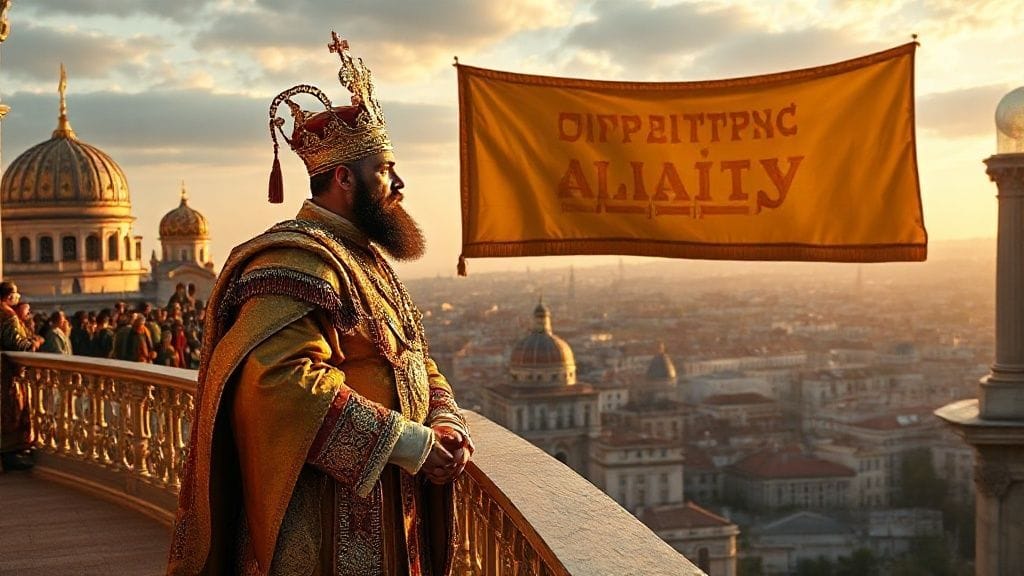
It was a cold winter’s day in April, but the chill in the air of Constantinople was not merely from the season—it was the icy breath of uncertainty that gripped the city. Citizens whispered anxiously in the crowded marketplaces of the impending change, rumors of rebellion and war swirling through the air like the winds along the Bosporus Strait. The great capital of the Byzantine Empire, once a beacon of culture, military might, and dynastic continuity, stood at a precipice. The time for the old order to yield was upon them. And into this maelstrom stepped Alexios I Komnenos, a figure both enigmatic and commanding, whose rise would alter the trajectory of the empire for decades to come.
2. The Komnenos Family: Shadows and Ambitions
Although the Komnenos lineage was not originally imperial in stature, their noble blood and long service in the military aristocracy had positioned them as influential players in Byzantine politics. Known for their provincial roots in Paphlagonia and notable martial prowess, the Komnenoi carried the weight of ambitions heavier than their birthright might have suggested. Alexios, the youngest of his siblings, was far from the obvious candidate for an imperial crown. Yet destiny moves in unpredictable ways. His upbringing, marked by early military distinction and a keen mind for governance, foreshadowed the seismic shift he would soon lead.
3. The Byzantine Empire on the Brink: Political Fragmentation and External Threats
By 1081, the Byzantine Empire was no stranger to crisis. After the death of Emperor Romanos IV Diogenes at the disastrous Battle of Manzikert in 1071 against the Seljuk Turks, the imperial fabric had begun to fray at its edges. The empire was besieged by internal dissension, rampant aristocratic revolts, and external enemies emboldened by Byzantine weakness. The throne was a revolving door, with ambitious generals and nobles fighting for supremacy, leaving Constantinople unstable. The empire’s resources, exhausted by constant warfare and political strife, could barely sustain the sprawling territories that stretched from the Adriatic to the Euphrates.
4. The Seljuk Threat at the Gates
Among the many dangers facing Byzantium, none was more ominous than the Seljuk Turks advancing from the east. Their victory at Manzikert had shattered the eastern frontier, opening Asia Minor to invasion and settlement. By 1081, large swaths of this vital region were lost, populations displaced, and Byzantine control reduced to a precarious foothold. The Seljuks were no mere raiders; they were consolidating power into a coherent state that challenged Byzantium’s eastern claims and threatened to rewrite the map of Anatolia. For Constantinople, the loss of this breadbasket was a blow not merely territorial but existential.
5. The Young Emperor’s Rise: Alexios I Komnenos Steps Forward
Into this fragile state of affairs strode Alexios I. Initially serving as a general and governor of strategic provinces, his reputation as a capable and pragmatic leader grew steadily. But it was during the political upheavals of early 1081 that Alexios made his boldest move. Disillusioned with the reigning Emperor Nikephoros III Botaneiates, whose rule was marred by corruption and ineffectiveness, Alexios leveraged alliances, military support, and popular sentiment to press his claim. Marching toward Constantinople with loyal troops, he became the unlikely spearhead of a hoped-for revival.
6. The Fall of Nikephoros III Botaneiates: A Crown for the Taking
The twilight of Nikephoros III’s reign was marked by indecision and widespread unrest. His power base had eroded, and the military elite's confidence in him had waned. When Alexios entered Constantinople, the city was divided between supporters and detractors, yet the momentum favored the Komnenos claim. Nikephoros abdicated without bloodshed, a rare event in the violent Byzantine court politics, and Alexios was declared emperor. This peaceful transfer was not only a testament to Alexios’s political acumen but also spoke volumes about the desperate desire among Byzantines for stability.
7. Constantine’s Capital in Crisis: Factions and Betrayals
However, the road ahead was far from smooth. Constantinople was a city of factions, where intrigue and betrayal thrived in shadowy corners. Noble families jockeyed for influence, while the bureaucracy was rife with corruption. Foreign powers meddled openly and covertly, exploiting Byzantine weakness. Alexios had to navigate a treacherous political landscape, balancing the interests of military commanders, court officials, and the Church. Winning the loyalty of these groups required not only strategic intelligence but charm and relentless energy. The empire's survival hinged on his deft handling of these internal fractures.
8. The Coronation Ceremony: Symbolism and Significance
On April 4, 1081, Alexios I Komnenos was crowned in the majestic Hagia Sophia, the spiritual heart of Byzantium. The ceremony was imbued with profound symbolism — the handing down of imperial insignia, the reading of ancient oaths, the blessing by the Patriarch. It was not merely a ritual but a collective act of reconciliation and hope. The emperor was the living nexus between the divine and the temporal, protector of Orthodoxy and defender of the Roman legacy. To the assembled dignitaries and the populace peering through the stained glass and gilded columns, Alexios embodied the promise of rebirth amidst decay.
9. Alexios’s First Decrees: Restoring Order Amidst Chaos
In the weeks following his accession, Alexios put forth bold measures that signaled a new direction. He sought to stabilize the economy battered by years of war and mismanagement. Currency reform, restoration of tax collection systems, and crackdowns on corrupt officials were set in motion. Military restructuring was prioritized, with efforts to revive the fading thematic armies — the provincial troops integral to Byzantine defense. The emperor’s vision was clear: to rebuild the foundation before reclaiming lost ground. Yet, each decision was fraught with risk, as vested interests fought tooth and nail to preserve their privileges.
10. Military Reforms and Strategic Alliances
Aware that Byzantium’s survival depended on military strength and diplomacy, Alexios turned his attention to reforming the army. He reinforced frontier defenses, recruited mercenaries including Normans and Varangians, and emphasized the revival of the ‘tagmata’ — professional regiments loyal directly to the emperor. Diplomatically, he reached out to neighboring powers and emerging Western forces for alliances, understanding both the threats and opportunities they presented. In this, he was a pioneer—straddling East and West, tradition and innovation, to forge a new era of Byzantine resilience.
11. The Battle Against the Normans: Defending the Empire’s Western Frontier
One of Alexios’s first major tests came swiftly when the formidable Norman forces under Robert Guiscard invaded Byzantine territories in the Balkans and southern Italy. The Normans were ruthless and battle-hardened, carving out a powerful kingdom in southern Italy. The clash was not merely military but ideological, pitting Frankish Catholic zeal against Orthodox Byzantine tradition. Alexios’s leadership during this conflict, marked by tactical ingenuity and hardened resolve, prevented a devastating collapse. Although the struggle was protracted, it laid bare the emperor’s capacity to wage war on multiple fronts.
12. The Arrival of the Crusaders: An Unexpected Opportunity and Threat
Amidst the chaos, another development would change the course of Byzantium and Christendom forever—the arrival of the First Crusade. By the late 1090s, bands of Western knights journeyed ostensibly to reclaim Jerusalem but also wielded ambitions that could disrupt Byzantine sovereignty. Alexios saw the Crusaders both as potential allies against Muslim adversaries and as unpredictable elements whose loyalty was uncertain. His diplomatic nobility sought to steer the Crusades into a cooperative campaign, but tensions simmered beneath the surface. This encounter would reshape alliances, borders, and faith for the centuries to come.
13. Alexios’s Diplomacy: Between East and West
Navigating the delicate balance between the Latin West and the Islamic East, Alexios demonstrated a diplomatic finesse that was as important as his military prowess. He cultivated ties with Venice and other maritime republics, granting trade privileges in exchange for naval support. Seeking alliances with the Seljuks at times, he played rival factions against each other to buy time and recover lost territory. His reign exemplified the Byzantine art of diplomacy—layered with intrigue, subtlety, and a long-term vision. The emperor was less a conqueror than a statesman, striving to weave a fragile peace amidst clashing empires.
14. Religious Challenges and the Patriarchate’s Role
The Church in Byzantium was more than a spiritual institution; it was a pillar of imperial legitimacy. Alexios skillfully engaged with the Patriarchate of Constantinople to shore up support and unify the people under a common religious identity. Yet, tensions with Rome intensified during his reign, foreshadowing the Great Schism that would harden Christian divides. Religious dissent within the empire, such as the challenges posed by heretical sects or the influence of Eastern monasticism, also demanded the emperor’s attention. Balancing these religious complexities was key to maintaining the moral authority that underpinned his rule.
15. The Legacy of Alexios I: Foundations for the Komnenian Restoration
By the time of his death in 1118, Alexios I Komnenos had transformed the Byzantine Empire from a near-collapse into a revitalized polity ready to reclaim regional influence. His reign birthed what historians call the Komnenian restoration—a period of recovery marked by administrative reform, military revitalization, and cultural flourishing. The dynasty he founded would preside over decades of relative stability and territorial reconquest. More than a warrior or politician, Alexios was a symbol of resilience and adaptability, qualities that ensured Byzantine survival in a turbulent Middle Age.
16. Memory and Myth: How History Remembers the New Emperor
The chronicles of Anna Komnene, the emperor’s daughter, immortalized Alexios I with a mixture of admiration and filial devotion. She portrayed him as a pious, courageous, and wise ruler—the ideal Byzantine monarch. Later historians echoed this narrative, although modern scholarship has added nuance, acknowledging his flaws and the daunting challenges he faced. Popular memory—through folklore, art, and literature—has enshrined Alexios not just as a man, but as the embodiment of Constantinople’s indomitable spirit at a crossroads of history.
Conclusion
The ascent of Alexios I Komnenos to the throne in 1081 was more than a change of emperor—it was the flicker of a flame rekindling in the twilight of an empire. His story is one of courage amid chaos, the struggle for order in a world fractured by war and betrayal. Through shrewd diplomacy, military skill, and unwavering determination, Alexios forged a path that would steer Byzantium away from ruin and back into relevance. His legacy endures not only in the annals of history but in the idea that even in the darkest hours, leadership grounded in vision and courage can alter the tides of destiny.
FAQs
Q1: What were the main causes behind Alexios I’s rise to power?
A1: The Byzantine Empire’s political instability, military defeats such as Manzikert, and dissatisfaction with Emperor Nikephoros III's ineffective rule created an environment ripe for change. Alexios capitalized on his military reputation and alliances to claim the throne.
Q2: How did the Seljuk Turks influence the situation in Byzantium?
A2: The Seljuk victory at Manzikert weakened Byzantine control over Asia Minor, threatening the empire’s eastern defenses and economy. Their ongoing incursions made restoring military strength a priority for Alexios.
Q3: What role did the Komnenos family background play in Alexios’s claim?
A3: Though not an imperial dynasty originally, the Komnenoi's noble status and military prominence allowed Alexios to build a strong power base, leveraging provincial loyalty and army support to assert his legitimacy.
Q4: How did Alexios manage relations with the Crusaders?
A4: Alexios viewed the Crusaders as both opportunity and threat, attempting diplomatic alliances to utilize their forces against Muslim foes while striving to maintain Byzantine sovereignty over contested territories.
Q5: What were some key reforms Alexios implemented early in his reign?
A5: Economic stabilization, military reform including the revival of professional troops, and administrative reorganization were critical. He also tackled corruption and realigned aristocratic factions to support his rule.
Q6: How did religious factors shape Alexios’s reign?
A6: Collaboration with the Patriarchate reinforced his legitimacy; however, tensions with the Catholic West and internal religious challenges required careful navigation to uphold imperial unity.
Q7: What is the Komnenian restoration and why is it significant?
A7: The Komnenian restoration refers to the period of Byzantine revival initiated by Alexios I and continued by his successors, marked by political stability, military recovery, and cultural renaissance after decades of decline.
Q8: How is Alexios I remembered historically and culturally?
A8: Celebrated by contemporaries like his daughter Anna Komnene, Alexios is viewed as a shrewd and resilient leader who salvaged an empire on the brink, becoming a symbol of Byzantine endurance and strategic brilliance.

