Table of Contents
- The Siege Ends: Dawn Over the Levant
- From Jerusalem’s Triumph to the March South
- The Stakes of Ascalon: Gateway to the Crusader Kingdom
- The Forces at Play: Crusaders and Fatimid Defenders
- The Landscape of Conflict: Deserts, Fortresses, and the Coastal Line
- Preparing for Battle: Strategy and Tension on August 12, 1099
- Clash at the Gates: The Day Unfolds in Chaos and Courage
- The Fall of Ascalon: Walls Breached and Flags Raised
- The Price of Victory: Casualties, Destruction, and Human Suffering
- Ascalon’s Aftermath: Consolidating the Crusader States
- Political Reverberations: Fatimid Egypt and the Crusader Threat
- Economic Shifts: Control of Trade and Coastal Access
- The Symbolism of Ascalon: Faith, Power and Legitimacy
- Heroism and Martyrdom: Tales from the Battlefield
- Long-Term Legacy: Ascalon’s Place in the Crusades
- Memory and Historical Narrative: The Battle Through the Ages
- Conclusion: The End of a Beginning in the Holy Land
- Frequently Asked Questions
- External Resource
- Internal Link
The Siege Ends: Dawn Over the Levant
The morning sun broke over a landscape once tumultuous and uncertain, casting long shadows on the battered walls of Ascalon. The air was thick with exhaustion and anticipation as tired Crusaders prepared for what would be the decisive confrontation after the euphoria of Jerusalem’s capture just weeks before. The city of Ascalon, a formidable Fatimid stronghold perched on the southern edge of the Levantine coast, stood as the final bastion between the Crusaders and their control of the Holy Land. On August 12, 1099, the clash that would cement the nascent Crusader states unfolded with a ferocity and gravity that echoed far beyond its battlegrounds.
The Battle of Ascalon is often overshadowed by the fall of Jerusalem; yet, it was this brutal confrontation that secured the Crusaders’ foothold in the Levant. Against a backdrop of religious zeal, political ambition, and military ingenuity, this battle illustrated the complexity of crusading warfare beyond mere conquest—it was about survival, legitimacy, and the forging of a new order.
From Jerusalem’s Triumph to the March South
In July 1099, after a grueling siege, Crusader forces had seized Jerusalem—a moment charged with spiritual and historical significance. Yet, victory brought with it peril. Jerusalem, surrounded by hostile territories and vulnerable to counterattacks, could not be secured without control over its approaches. Ascalon, approximately 40 kilometers to the south, was the greatest obstacle to lasting stability.
The Crusaders were acutely aware that the Fatimid Caliphate, recently victorious at the Siege of Ramla, would not grant this gateway willingly. For the Crusaders, Ascalon was more than a military target—it was the key to legitimacy, an entry point for reinforcements and supplies from Europe, and a buffer against Muslim armies eager to reclaim the city they regarded as theirs by right and religion.
The Stakes of Ascalon: Gateway to the Crusader Kingdom
Few understood the strategic importance of Ascalon as profoundly as the assembled leaders of the First Crusade. Godfrey of Bouillon, Raymond IV of Toulouse, and Robert II of Flanders, among others, realized that control of Ascalon would define the survival of the Kingdom of Jerusalem.
The city’s fortifications were legendary, with thick walls reinforced by towers and a harbor facilitating supplies from Egypt. Its capture would disrupt Fatimid control and deny them a naval and logistical base threatening the recently conquered Christian capital. Moreover, it was a psychological victory: subduing Ascalon would serve as a message to Muslim powers that the Crusaders were not willing to be mere passers-by but invaders with intent to hold.
The Forces at Play: Crusaders and Fatimid Defenders
On the Crusader side, the battle was fought by a coalition of warrior knights, foot soldiers, and pilgrims hardened by months of brutal campaigning. New alliances and the shared goal forged a fragile unity among noble contingents otherwise often divided.
The Fatimid defenders were a mix of professional soldiers, local levies, and Berber auxiliaries, fiercely loyal and battle-savvy. They were under the command of Amir Sharaf al-Ma’ali, a commander who understood the importance of defending Ascalon not simply for territory but as a last bastion for the Fatimid presence in the Levant.
Both sides were nourished by religious conviction as much as by political necessity. To the Crusaders, the battle was a sacred struggle to secure a Christian foothold; for the Fatimids, defending Ascalon meant protecting Islamic lands from foreign invaders.
The Landscape of Conflict: Deserts, Fortresses, and the Coastal Line
Ascalon’s coastal position on the Mediterranean was crucial. The terrain surrounding the city was a blend of arid plains and rocky outcrops, a landscape that both advantaged defenders and challenged besiegers.
The city’s fortifications, built over centuries, featured massive stone walls and towers that had withstood previous sieges. The proximity of the sea allowed Fatimid forces to receive reinforcements by ship, a lifeline the Crusaders sought to sever.
The Crusader encampments stretched southwards from Jerusalem, their lines extended and vulnerable. NGOs among the armies often suffered from supply shortages and fatigue after the long march through hostile lands. These environmental factors infused every decision, from timing the battle to choosing points of assault.
Preparing for Battle: Strategy and Tension on August 12, 1099
As the day of battle dawned, silent prayers mingled with military preparations. The Crusader leadership debated the best approach to breaching Ascalon’s walls. A direct assault risked catastrophic losses, while a prolonged siege could sap their already strained resources.
Reconnaissance revealed weaknesses in the eastern walls; yet, the defenders were alert and ready. The battlefield was charged with tension: men who had just triumphed over Jerusalem now faced an enemy desperate and determined to strike back.
The mood was grim but resolute; after all, failure meant the loss of everything. Leaders encouraged their men, invoking divine favor and the promise of eternal reward for those who fought bravely.
Clash at the Gates: The Day Unfolds in Chaos and Courage
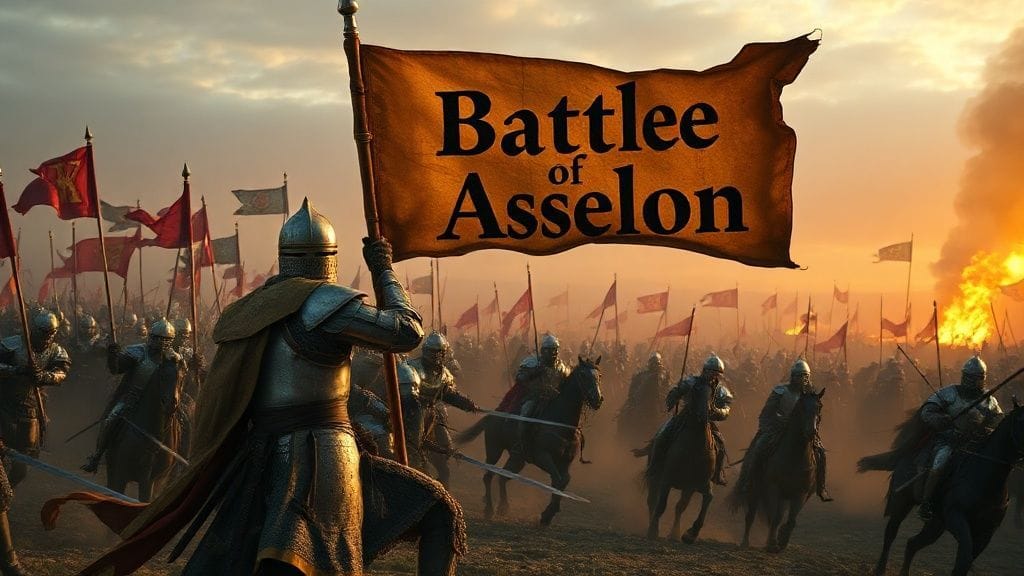
When the attack commenced, the clash was swift and brutal. Catapults roared, arrows darkened the sky, and the battle cries of knights echoed against the ancient stones. The defenders fought valiantly, repelling initial assaults with fierce determination.
But the Crusaders’ relentless pressure, disciplined formations, and sheer numbers began to wear down the Fatimid forces. Knights led daring charges to break gates and scale walls, while foot soldiers engaged in desperate close quarters combat.
Amidst the carnage, stories of extraordinary courage emerged—like that of Tancred of Hauteville, whose charge inspired troops to press forward despite overwhelming odds. Yet tragedy was omnipresent; bodies littered the fields and the cries of wounded men underscored the immense human cost.
The Fall of Ascalon: Walls Breached and Flags Raised
By late afternoon, the city’s defenses crumbled. A breach was forced, and the Crusaders poured inside. The defenders made a final, desperate stand but were overwhelmed.
The sight of the Christian banners unfurling over Ascalon’s walls was a moment of utter jubilation for the Crusaders—a tangible proof that their vision of a Latin kingdom in the Holy Land might endure. Yet the victory was bittersweet: much of the city lay in ruins, and many of its inhabitants were displaced or slain in the aftermath.
The Price of Victory: Casualties, Destruction, and Human Suffering
Victories on the medieval battlefield were often pyrrhic, and Ascalon was no exception. Estimates suggest that several thousand died or were captured, including combatants and civilians.
The city suffered extensive damage from siege engines and street fighting. Accounts from chroniclers like Raymond of Aguilers paint a picture not only of heroic deeds but also of horror: desperate families trapped, marketplaces turned battlegrounds, and sacred spaces desecrated.
Both armies bore scars—physical and psychological—that would influence their future campaigns and diplomacy.
Ascalon’s Aftermath: Consolidating the Crusader States
With Ascalon under Christian control, the Crusader kingdom consolidated its southern border and opened channels for further settlement and reinforcement. The city served as a critical port connecting Europe and the Levant, facilitating trade and military logistics.
Crusader leaders established garrisons and sought to fortify new frontiers while managing relations with local populations, including Muslim and Christian communities with complex loyalties.
Ascalon became a symbol of hope but also a constant reminder of the fragile nature of conquest in this volatile region.
Political Reverberations: Fatimid Egypt and the Crusader Threat
The fall of Ascalon alarmed the Fatimid Caliphate in Cairo. It highlighted their waning influence in the Levant and exposed their southern flank to further Crusader incursion.
Fatimid rulers scrambled to reorganize defenses and formed uneasy alliances in an attempt to check Crusader advances. The battle set off decades of shifting alliances and intermittent warfare that shaped the political map of the eastern Mediterranean.
It also deepened religious animosities, entrenching divisions that would fuel subsequent crusades and campaigns.
Economic Shifts: Control of Trade and Coastal Access
Control of Ascalon meant more than military dominance—it carried profound economic implications. The port was a hub for commodities flowing between Egypt, the Levant, and Europe, including spices, textiles, and precious metals.
By seizing Ascalon, the Crusaders gained a coastal artery essential for maintaining supply lines, collecting tribute, and projecting power.
Trade routes began adjusting, and the Crusader states cautiously sought to integrate these networks into their emerging economic framework—balancing exploitation with diplomacy toward surrounding Muslim polities.
The Symbolism of Ascalon: Faith, Power and Legitimacy
For medieval Christians, the Battle of Ascalon represented not only strategic mastery but divine sanction. Chroniclers framed the victory as a sign of God’s favor, a confirmation that the Crusade was a holy mission destined to reclaim the sacred lands.
Conversely, in the Muslim world, Ascalon became a symbol of loss, martyrdom, and the urgent need for jihad against invaders.
This binary symbolism infused future narratives, shaping how both sides remembered and mythologized the event—ensuring it would endure in collective memory well beyond the battlefield.
Heroism and Martyrdom: Tales from the Battlefield
Among the ruins of Ascalon, countless stories of valor and sacrifice emerged. Knights like Tancred and veterans of Jerusalem’s siege were said to have performed deeds that would echo in epic poems and chronicles.
At the same time, defenders were revered by Muslim chroniclers for their courage against overwhelming odds. The battle thus produced a mosaic of human emotions—hope, despair, honor, and loss—that humanized an event often reduced to mere dates and outcomes.
Long-Term Legacy: Ascalon’s Place in the Crusades
Though overshadowed in popular memory by Jerusalem’s fall, Ascalon played a pivotal role in defining the survival and expansion of the Crusader states. It marked the boundary between ephemeral conquest and enduring settlement.
The city remained a contested prize throughout subsequent decades, witnessing cycles of war, diplomacy, and cultural exchange.
Its legacy is a testament to the complexity of medieval warfare where religious fervor, political ambition, and human resilience intersected on a cosmopolitan frontier.
Memory and Historical Narrative: The Battle Through the Ages
Historical narratives of the Battle of Ascalon differ widely—Western sources emphasized divine vindication and knightly valor, while Muslim accounts stressed resistance and tragedy.
In modern scholarship, the battle is revisited with a nuanced lens, focusing on the socio-political dynamics and lived experiences of all involved.
Public memory, literature, and even archaeological findings continue to shape how Ascalon is remembered, revealing history not as static but as a living dialogue between past and present.
Conclusion: The End of a Beginning in the Holy Land
The Battle of Ascalon did more than close a chapter on the First Crusade; it opened the doorway to a new era of cross-cultural confrontation, alliance, and conflict. It underscored the tenuousness of conquest and the complex human costs beneath grand historical narratives.
By securing Ascalon, the Crusaders transitioned from ephemeral victors to rulers with a fragile but real foothold—setting the stage for centuries of interaction between East and West.
It remains a vivid reminder of how history is shaped not only by battles but also by the courage, fear, and hope of those who lived them.
FAQs
Q1: Why was the Battle of Ascalon crucial after the capture of Jerusalem?
A1: The battle secured the southern approaches to Jerusalem, preventing immediate Fatimid counterattacks and ensuring the safety and consolidation of the newly formed Crusader Kingdom of Jerusalem.
Q2: Who were the main commanders involved in the Battle of Ascalon?
A2: Crusader leaders included Godfrey of Bouillon, Raymond IV of Toulouse, and Tancred of Hauteville. The Fatimid defense was led by Amir Sharaf al-Ma’ali.
Q3: What strategies defined the Crusader assault on Ascalon?
A3: The Crusaders combined siege warfare with direct assaults focusing on perceived weak points in the city’s defenses, leveraging their heavy cavalry and disciplined infantry for close combat.
Q4: How did the battle affect Fatimid control in the Levant?
A4: The loss of Ascalon dealt a significant blow to Fatimid influence, diminishing their strategic foothold in the Levant and prompting military and political recalibrations.
Q5: What were the economic consequences of controlling Ascalon?
A5: Controlling Ascalon granted the Crusaders a vital port for trade between Egypt, the Levant, and Europe, crucial for maintaining supply lines and boosting the economies of the Crusader states.
Q6: How is the Battle of Ascalon remembered differently in Western and Muslim histories?
A6: Western accounts often emphasize divine favor and knightly heroism, whereas Muslim narratives focus on resistance, loss, and the call for jihad, highlighting contrasting cultural perspectives.
Q7: Did the victory at Ascalon guarantee long-term Crusader dominance in the region?
A7: Not entirely; while it significantly strengthened the Crusaders, the region remained contested, with ongoing conflicts and shifting alliances challenging Crusader rule.
Q8: Are there any surviving artifacts or ruins from the Battle of Ascalon today?
A8: Archaeological excavations near the site of Ashkelon (modern Israel) have uncovered fortifications and artifacts related to the battle, contributing valuable insights into the medieval conflict.

