Table of Contents
- The Twilight of Fragmentation: Georgia Before the Bagrationi Ascendancy
- Dawn of a New Dynasty: The Rise of the Bagrationi Kings
- Kutaisi and Tbilisi: Twin Hearts of a Kingdom in Flux
- The Relentless Consolidation: Political Maneuvers and Military Campaigns
- David IV “the Builder”: Visionary Architect of a United Georgia
- Allies and Adversaries: Regional Powers and Intrigues
- Religious Unity as a Political Tool: The Role of the Georgian Orthodox Church
- Socioeconomic Foundations: Agriculture, Trade, and Urban Renewal
- The Siege of Tbilisi: Turning Points and Tactical Genius
- From City-State to Kingdom: Administrative Reforms and Legal Codification
- Nobles and Commoners: Social Dynamics Under the Bagrationis
- Cultural Renaissance: Literature, Architecture, and Identity
- The Crusading Context: Georgia’s Position in the Wider Medieval World
- The Aftermath: Stability, Expansion, and the Georgian Golden Age
- Memory and Myth: How the Bagrationi Kings Shaped Georgian National Consciousness
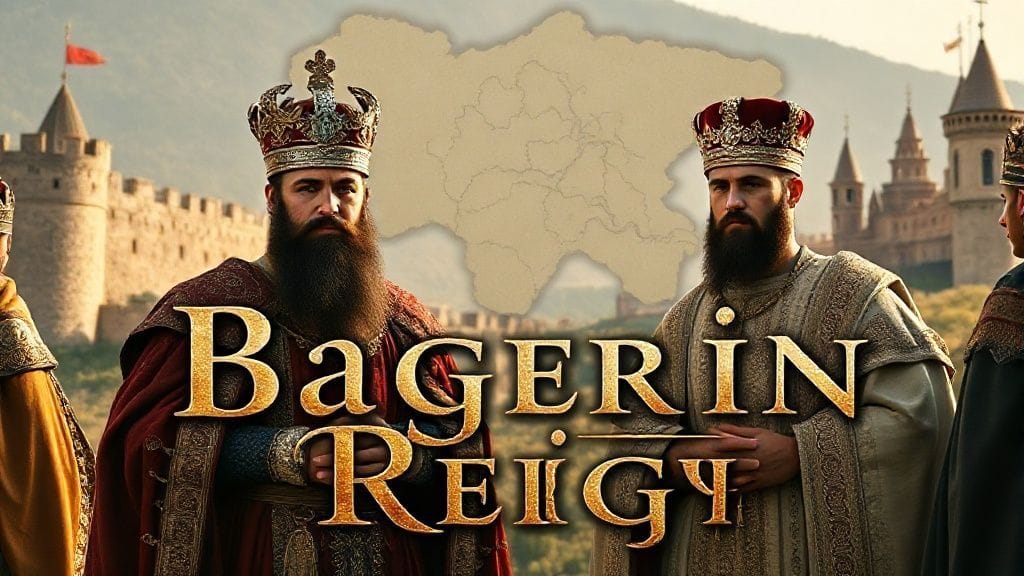
Nestled between the rugged Caucasus Mountains and the sprawling plains of the South Caucasus, the lands of Georgia in the late 11th century were a mosaic of competing principalities, fragile alliances, and shadowed intrigues. Imagine a realm battered by rival warlords and external threats, its soul yearning for unity and strength. This was the stage upon which the Bagrationi dynasty, emerging from its ancestral strongholds, set about transforming a fractured land into a powerful kingdom. The years between 1089 and the 1090s held the promise of a rebirth, where ambition met vision, and bloodied battles paved the way for a renaissance.
As dawn crept over the twin cities of Kutaisi and Tbilisi, it illuminated a Georgia on the cusp of monumental change. The Bagrationi kings—descendants of ancient royal lines and champions of Georgian identity—undertook an extraordinary mission: to consolidate the realm, to bind its people under one crown, and to restore not only borders but pride to their homeland. Their story is one of audacity and resilience, a story that reverberates through the annals of time and remains alive in Georgian hearts today.
The Twilight of Fragmentation: Georgia Before the Bagrationi Ascendancy
To understand the magnitude of the Bagrationi consolidation, one must first peer into the twilight of pre-unification Georgia. By the late 11th century, the once-unified kingdom had succumbed to fragmentation. The dissolution that followed the weakening of the Bagratid monarchs had resulted in three major political centers—namely, Tao-Klarjeti, Kartli, and Kakheti-Hereti—each ruled by autonomous princes and nobles wielding varying degrees of power.
Kutaisi, a historic city in western Georgia, served as the capital of the Kingdom of Imereti, while the eastern city of Tbilisi, with its centuries-old cosmopolitan heritage, stood as a prize coveted by many. But internal divisions and continuous feudal struggles made governance tenuous, leaving the land vulnerable to external pressures—especially from the Seljuk Turks who were expanding their influence throughout the Caucasus.
A patchwork of factions vied for authority. The political landscape was, in many respects, a chessboard where alliances shifted with the seasons. Georgian princes contended not only amongst themselves but also with expanding Islamic emirates. For the Georgian people, daily life was fraught with uncertainty and fear—fears of invasion, deprivation, and loss of cultural identity.
But amidst the crumbling old order, a new hope arose from the shadows of noble lineage: the Bagrationi dynasty.
Dawn of a New Dynasty: The Rise of the Bagrationi Kings
The Bagrationi family had roots reaching deep into Georgian tradition, their name steeped in legend and royal bloodlines that claimed descent from biblical King David. By the late 11th century, this dynasty sought to reclaim the mantle of leadership, not just as figureheads but as true unifiers and restorers of Georgian sovereignty.
King George II of Georgia, ascending the throne in 1072, initially struggled to impose his authority over fractious nobles and external enemies. His reign revealed the limitations of fragmented power—especially under the mushrooming threat posed by the Seljuk Empire. Yet it was his son, David IV, known fondly today as “the Builder” (Davit Aghmashenebeli), who would spearhead the monumental effort to consolidate the realm.
The baton passed from George II to David IV in 1089 marked a decisive shift. It was no longer acceptable merely to survive political chaos; Georgia would aim to thrive, to reclaim lost territories, and to unite disparate peoples under a cohesive Georgian kingdom. David IV’s rise to power symbolized this renewed vision.
Kutaisi and Tbilisi: Twin Hearts of a Kingdom in Flux
Kutaisi and Tbilisi were more than mere cities; they were symbols of Georgia’s historical divide and cultural wealth. Each bore scars and treasures from centuries of conflict and coexistence.
Kutaisi, in Imereti, had been a royal seat since antiquity—a city of tradition, steeped in Christian history and Georgian courtly culture. Tbilisi, for its part, was a vibrant mercantile hub. Controlled intermittently by Muslim emirs and Georgian princes, its cosmopolitan atmosphere was a stark contrast to the more homogeneous western provinces.
Securing these centers demanded military acuity and diplomatic deftness. The challenge was to woo nobles, establish administrative oversight, and curtail the influence of foreign powers, all while nurturing the fragile promise of unity.
The Bagrationi kings understood from the outset that controlling both cities was crucial—not only for territorial integrity but for forging a national identity that syncretized the diverse cultures and histories of the Georgian peoples.
The Relentless Consolidation: Political Maneuvers and Military Campaigns
Consolidation was not a given; it was violently contested with blood and grit. David IV recognized that political acuity would be as vital as military prowess. His strategy combined diplomatic alliances with a formidable military campaign to subdue rebellious nobles and fend off external enemies.
One remarkable facet of this era was David’s reform of the feudal army. Turning away from reliance on scattered noble levies, he established a standing royal army, integrating various social groups, including the “Monaspa” – a royal guard of trusted warriors attracted from diverse backgrounds. This standing force provided a disciplined, dependable military backbone to assert royal authority.
Campaigns to wrest control of key fortresses and towns were decisive. Tbilisi—then under Muslim emir control—represented the final, most coveted prize. Its capture would symbolize the full reunification of Georgian lands.
Amid these conflicts, David repeatedly demonstrated a capacity to inspire loyalty among his subjects. His promises of justice, religious patronage, and infrastructure improvements created a sense of shared destiny, binding disparate groups to the crown.
David IV “the Builder”: Visionary Architect of a United Georgia
David IV’s epithet, “the Builder,” is richly deserved—not only for his architectural and cultural patronage but for his visionary state-building.
Born in 1073, David was resolute from the start. Historians praise his administrative reforms, including the codification of laws, establishment of centralized institutions, and efforts to curb the power of recalcitrant nobles. He reformed the tax system to ensure fairer revenues while encouraging economic development.
More than a mere monarch, David saw himself as a guardian of the Georgian Orthodox Church and national culture. His patronage of monasteries, scriptoria, and churches enlivened a period of literary and artistic flourishing.
Faith and kingdom-building intertwined tightly in his vision—he recognized that only spiritual unity could mirror and strengthen political unity.
Allies and Adversaries: Regional Powers and Intrigues
Georgia was never isolated. Its fate was intertwined with that of its neighbors—Byzantine Empire, Seljuks, Armenians, and the rising Crusader states in the west.
David’s diplomacy skillfully balanced these relationships. He cultivated alliances with lesser Armenian principalities and negotiated with Byzantium, sometimes as a vassal, other times as an equal power. Against the Seljuks, his military successes stemmed not only from arms but also from exploiting fractures within that great empire.
The arrival of the First Crusade in the 1090s added new complexity. While the Georgian kings were not directly involved in crusading efforts, the shifting dynamics of Christian-Muslim power reshaped trade routes and military postures in the region, sometimes to Georgia’s advantage.
Behind closed doors, complex intrigues played out. Powerful nobles within Georgia, reluctant to lose autonomy, as well as ambitious neighboring rulers, tested David’s patience and resolve at every turn.
Religious Unity as a Political Tool: The Role of the Georgian Orthodox Church
The Georgian Orthodox Church played a central political and cultural role in the consolidation process. The Church was not merely an institution of faith, but a pillar of national identity and cohesion.
David IV understood this deeply. He supported the autocephalous status of the Georgian Church, strengthening the Catholicos (the head of the Church) as a national figure. Monasteries became centers of learning and political influence.
The Church’s endorsement sanctified David’s kingship, framing his campaigns as holy struggles for the protection and revival of Christianity against Islamic encroachment. This divine justification helped unite the populace behind the crown.
Georgian liturgy, language, and sacred art experienced a renaissance, intertwined with the narrative of a re-emerging Georgia destined to reclaim its rightful stature.
Socioeconomic Foundations: Agriculture, Trade, and Urban Renewal
Political consolidation required solid socioeconomic foundations. David IV embarked on policies to revitalize agriculture, foster trade, and rehabilitate urban centers.
Reforms encouraged the clearance of new arable lands, irrigation projects, and resettling depopulated regions. Trade links were reestablished, benefitting from Georgia’s strategic position along key silk and spice routes connecting East and West.
Kutaisi and Tbilisi underwent urban renewal. Markets flourished anew and artisans found patronage. This economic revival laid the groundwork for sustaining a unified realm far beyond mere military conquest.
Yet these policies also transformed social structures—craftsmen, merchants, and peasants gained renewed importance, subtly shifting the balance of medieval Georgian society.
The Siege of Tbilisi: Turning Points and Tactical Genius
The capture of Tbilisi in 1122, although slightly beyond the 1090s scope, was foreshadowed by earlier military campaigns in David IV’s reign and symbolized the culmination of decades of consolidation efforts initiated in the 1089–1090s.
While many battles and sieges characterized the Bagrationi effort, Tbilisi’s eventual fall was the zenith of David’s military and political strategy. The siege involved prolonged tactics, exploitation of internal discontent within the city, and alliances with key Armenian and Muslim factions opposing the local emir’s rule.
This victory returned the ancient city to Georgian Christian rule for the first time in centuries and served as a powerful emblem of national revival.
From City-State to Kingdom: Administrative Reforms and Legal Codification
David IV’s reign saw a leap from fragile feudal alliances to a more centralized, structured kingdom. This transformation came with comprehensive administrative reforms.
He established new provincial administrations headed by loyal royal governors, diminishing the autonomy of local noble clans. Legal codes were compiled and standardized, promoting justice and curbing corruption.
These measures unified the realm not only militarily but institutionally, laying foundations for a durable state apparatus. They also enhanced royal prestige, fostering a direct relationship between monarch and subjects.
In this new political order, loyalty was exchanged for protection, justice, and prosperity—a social contract crucial for medieval statehood.
Nobles and Commoners: Social Dynamics Under the Bagrationis
Consolidation altered traditional relationships within Georgian society. The nobility, once fractured and often at loggerheads, was gradually brought under royal oversight.
Some noble houses resisted fiercely, resulting in rebellions that David quashed with both force and negotiation. Others were incorporated skillfully through marriage ties and appointments to the royal court.
For commoners—the peasants, artisans, and merchants—life was complex. While military campaigns caused hardship, reforms often improved legal protections and economic opportunities. The growing towns offered avenues for advancement previously unavailable.
This reshaping of social dynamics underscores the real human cost and benefit of state-building—beyond grand narratives of kings and battles.
Cultural Renaissance: Literature, Architecture, and Identity
The late 11th century marked the dawn of a cultural renaissance intertwined with Georgia’s political resurgence. The Bagrationi monarchs were themselves patrons of arts and letters.
Literature blossomed, with religious texts, chronicles, and poetry commemorating the kingdom’s divine mission and heroic deeds. Architectural projects—the rebuilding of cathedrals, fortresses, and monasteries—transformed cities into enduring monuments of Georgian identity.
The fusion of Byzantine influences with native Georgian traditions created a unique cultural synthesis, fostering pride and unity beyond mere survival.
David IV’s era thus stands as a defining chapter, when culture traveled hand in hand with conquest.
The Crusading Context: Georgia’s Position in the Wider Medieval World
While Georgia’s consolidation might appear as a parochial affair, it unfolded amid seismic shifts in the broader medieval world.
The First Crusade (1096–1099) altered power balances in the Near East. Although Georgia did not participate militarily, the crusading movement’s ramifications were felt in trade, diplomacy, and military alliances.
The kingdom’s Christian identity aligned Georgia more closely with Western Christendom and Byzantium, providing a counterbalance to Muslim powers in the region.
This broader global context emphasizes Georgia’s role as a crucial crossroads of civilizations—a buffer, a bridge, and a beacon for medieval Christendom.
The Aftermath: Stability, Expansion, and the Georgian Golden Age
By the early 12th century, the fruits of Bagrationi consolidation became unmistakable. The restored kingdom expanded its borders, embraced internal stability, and debuted on the international stage as an emerging regional power.
David IV’s reign ushered in the renowned Georgian Golden Age—a period marked by territorial expansion, flourishing culture, and diplomatic influence.
His successors built upon this foundation, confirming the long-term impact of the transformative work begun in the 1089–1090s.
Yet the path had been hard—built on courage, vision, and the stubborn perseverance of a people determined to reclaim their destiny.
Memory and Myth: How the Bagrationi Kings Shaped Georgian National Consciousness
Stories from this era live on in Georgian folklore, songs, and historiography. David IV and his predecessors are exalted as national heroes, guardians of faith, and unifiers of people.
Their legacy transcends mere political achievement; it embodies the Georgian spirit of resilience, unity, and identity.
The Bagrationi kings’ consolidation efforts provided not just a kingdom but a cultural and spiritual framework that Georgian consciousness has revered for centuries—a testament to how history shapes, inspires, and endures.
Conclusion
The unification of Georgia under the Bagrationi kings during the years 1089–1090s was much more than a series of military conquests or political stratagems; it was a profound rebirth of a nation fractured but unyielding. Against a backdrop of external threats, internal divisions, and shifting regional powers, the Bagrationi dynasty—embodied by the towering figure of David IV “the Builder”—forged a new kingdom knit together by faith, law, and culture.
Their story is one of vision and determination, showing how leadership can harness the power of identity, faith, and the will of a people to transform a fractured realm into a flourishing state. The legacy of these kings is etched not only in stone and sword but in the hearts and stories of generations, reminding us that nationhood is a living, breathing narrative—ever shaped by those who dare to unify and rebuild.
Today, the Georgian spirit that rose in those critical decades continues to inspire resilience and pride, a beacon reflecting a timeless ideal: that unity, built on heritage and hope, can transcend even the most turbulent of eras.
FAQs
Q1: What were the primary causes of Georgia’s fragmentation before the Bagrationi consolidation?
A: After the decline of earlier Bagratid monarchs, Georgia splintered into several principalities due to weak centralized authority, feudal rivalries, and pressure from invading powers like the Seljuks. This fragmentation destabilized the realm and necessitated a strong, unifying leadership.
Q2: How did David IV “the Builder” contribute to the unification of Georgia?
A: David IV initiated military reforms, established a standing army, executed a series of campaigns to subdue rival nobles and foreign forces, reformed administration, supported the Georgian Orthodox Church, and codified laws—efforts that collectively forged a united kingdom.
Q3: Why were Kutaisi and Tbilisi so crucial to the Bagrationi consolidation?
A: Kutaisi was a historic royal city and cultural center, representing western Georgia, while Tbilisi was a strategic, cosmopolitan city crucial for controlling eastern territories and trade routes. Securing both was key to political and symbolic unification.
Q4: What role did religion play in the Bagrationi efforts to consolidate power?
A: The Georgian Orthodox Church provided spiritual legitimacy and cultural cohesion. The kings leveraged religious unity to foster national identity and justify their rule as defenders of Christianity against Muslim neighbors.
Q5: How did Georgia’s position relate to wider medieval geopolitical events like the Crusades?
A: Georgia was a Christian kingdom on the frontier of Islamic territories and was indirectly affected by the Crusades through shifting alliances, trade, and military pressures. The crusading context reinforced Georgia’s role as a Christian bulwark in the Caucasus.
Q6: What were the social impacts of the Bagrationi consolidation on Georgian society?
A: The consolidation altered feudal dynamics, diminished noble autonomy, and improved conditions for commoners through legal reforms and economic revival. It created a more structured, centralized society.
Q7: How is the Bagrationi consolidation remembered in Georgian culture today?
A: It is celebrated as a foundational period of national revival and unity, with David IV and his predecessors revered as symbols of Georgian resilience, faith, and sovereignty, inspiring ongoing pride and historical consciousness.

