Table of Contents
- A Dawn Like No Other: The Calm Before the Storm at Stamford Bridge
- The Year of Chaos: England in 1066
- The Norwegian King Harald Hardrada: The Viking’s Last Quest
- The English Throne in Peril: Harold Godwinson’s Heavy Burden
- The Norwegian Invasion: A Bold Strike for Power
- The March to York: Speed and Surprise on the English Campaign
- The Clash at Stamford Bridge: Meeting of Armies and Fates
- The Battle Unfolds: Tactics, Tenacity, and Turning Points
- The Death of Harald Hardrada: The End of the Viking Age?
- The Aftermath: England Weary and Vulnerable
- Harold Godwinson’s Moment of Triumph and Exhaustion
- The Impact on the Subsequent Norman Conquest
- Recollections and Chronicles: How Medieval Chroniclers Saw Stamford Bridge
- The Legendary Valor and the Human Cost of the Battle
- Stamford Bridge’s Place in National Memory and Myth
- Archaeological Discoveries and Modern Interpretations
- The Battle’s Influence Beyond England: Scandinavia and Europe
- Never Just a Skirmish: Stamford Bridge’s Broader Historical Meaning
- Legacy of 1066: The Year That Changed England Forever
- Reflections on Power, War, and Fate in Medieval England
A Dawn Like No Other: The Calm Before the Storm at Stamford Bridge
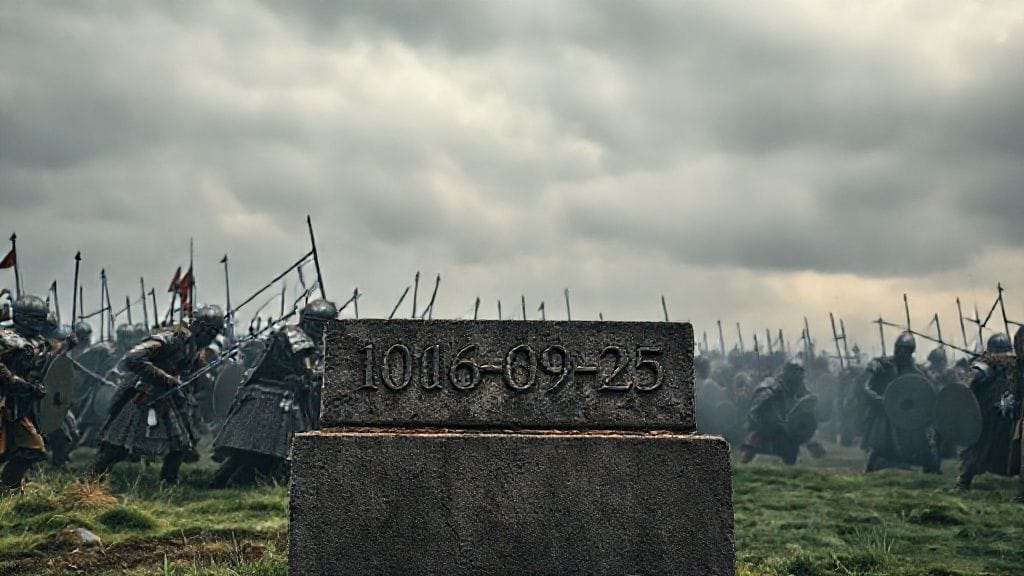
It was the 25th of September, 1066, a morning bathed in an eerie tranquility that belied the violence soon to erupt. Gentle mists hung low over the rivers near York, England, while the early autumn sun filtered weakly through the haze. Farmers tended to their fields, children played in nearby villages — yet far from these quiet routines, two massive armies prepared for a confrontation that would echo through history.
Imagine the tension, the anticipation, the solemn dread permeating the air. The rustle of armor, the clash of steel in practice, the distant roar of shouting commanders — all signs pointing to a brutal collision. The Battle of Stamford Bridge had arrived, a moment when dynasties would be tested and empires trembled. Here, in this seemingly serene northern English landscape, the fate of kingdoms and the course of history would pivot on a bloody, fierce contest of strength and will.
The Year of Chaos: England in 1066
To understand Stamford Bridge is to immerse oneself in the turmoil engulfing England in 1066, a year unlike any other in medieval history. The death of Edward the Confessor in January unleashed a seismic power struggle, with no clear heir to the throne. England, fractured and weighed down by conflicting loyalties, became a powder keg.
Against this backdrop, three contenders emerged: Harold Godwinson, Earl of Wessex; William, Duke of Normandy; and Harald Hardrada, King of Norway. Each claimed divine and legal rights to the English crown, each marshalled armies for invasion, and each prepared for war. The island nation—often isolated but never untouched by the tides of continental ambition—was bracing for a storm.
But the English defied the norm of slow medieval mobilization. Harold Godwinson swiftly assembled his forces, a testament to his political acumen and military resolve. His rapid response was soon to be tested by a foe from the north, forging the stage for what would become one of the most remarkable moments of medieval warfare.
The Norwegian King Harald Hardrada: The Viking’s Last Quest
Harald Sigurdsson, known to history as Hardrada — "hard ruler" — was one of the last great Viking warriors, a king whose name still sends a shiver of awe through the annals of Norse legend. His life was one of relentless ambition, battle-hardened charisma, and fierce loyalty to tradition. Returning to Norway after years in exile and mercenary service, he ascended the throne in 1046 and sought to restore the Viking glory days.
By 1066, Hardrada saw England as the rightful prize, a realm whose throne he sought to claim alongside or in place of Harold Godwinson. His claim, rooted in agreements made by previous kings and ages-old dynastic ties, was buttressed by the precision of the ancient Norse blade and the valor of the sea-faring warrior.
Hardrada’s invasion was not merely an act of conquest; it was an assertion of a Viking legacy on the brink of extinction, a desperate last hurrah before the age of castles and knighthood fully eclipsed Norse dominance in the British Isles.
The English Throne in Peril: Harold Godwinson’s Heavy Burden
Harold Godwinson was a man burdened by expectations as heavy as his royal mantle. As Earl of Wessex, he had long been the most powerful noble in England, a wartime leader beloved by his people, yet his claim to the throne was constantly challenged. His coronation, mere days after Edward the Confessor’s death, was contested and fraught with danger from all sides.
The prospect of defending England on two fronts was a nightmare. Invaders threatened from both the north and the south. And Harold had little time to regroup after years of political strife, familial squabbles, and internal dissent. He proved resilient, though, mobilizing English forces with urgency and determination.
His leadership was critical in the months preceding Stamford Bridge, gathering levies and preparing fatigued men to face one of the most experienced warrior kings of the age. Yet the strain showed, and the costs of war were yet to reveal themselves.
The Norwegian Invasion: A Bold Strike for Power
In late September 1066, King Harald Hardrada sailed from Norway with an army estimated at 10,000 men, staffed by fierce Vikings and allied troops, setting his sights on York— the strategic jewel in northern England and a symbol of centuries of contested rule.
Arriving with intelligence about English defences and local unrest, Hardrada’s forces landed near the mouth of the Humber River and swiftly took York by surprise. His initial invasion was brilliantly executed, catching English garrisons off guard and asserting dominance before the full English army could respond.
York’s capture was a significant victory but also endangered Hardrada by putting him deep in hostile territory, far from Norwegian reinforcements. Among the spoils of York were enormous amounts of treasure, but holding the city required defeating Harold Godwinson’s counterattack. What followed was a race against time and stamina, setting the table for one of England’s most legendary battles.
The March to York: Speed and Surprise on the English Campaign
Harold Godwinson’s response to the Norwegian invasion was nothing short of astounding. Learning of the Viking landing, he gathered his forces, leaving the south vulnerable, and moved at a forced march of nearly 185 miles in just four days—a logistics feat virtually unheard of in medieval warfare.
This forced march brought Harold and his army northward with surprising speed and determination, catching the Vikings largely unprepared. The exhaustion of the English troops did not deter their intensity when they reached York’s surroundings.
Harold's strategy hinged on the element of surprise and unyielding attack, which would disrupt Hardrada’s foothold and possibly end the invasion swiftly. This march was both a physical testament to medieval endurance and a psychological blow to the Vikings, who believed themselves firmly in control.
The Clash at Stamford Bridge: Meeting of Armies and Fates
On the morning of September 25th, the two armies finally confronted each other at Stamford Bridge, near the River Derwent. The English and the Norwegians, each battle-hardened but with markedly different tactics, faced off on a landscape that would witness the convergence of old Viking ferocity with the evolving knightly warfare of England.
The initial skirmishes were brutal. Vikings were famed for their ferocity and shield wall tactics, while the English army relied on archers and infantry formations designed to pierce and break enemy lines. The weather, the terrain, and the sheer willpower of men equally desperate for victory set the stage for a battle that stretched beyond typical medieval confrontations, resonating with mythic overtones.
The Battle Unfolds: Tactics, Tenacity, and Turning Points
The battle lasted for hours, a brutal ordeal with both sides incurring heavy casualties. The Viking forces, caught by surprise and dispersed in a partial state of readiness—some waiting in York, some at the bridge—had to quickly rally to defend their positions.
Stories tell of a lone Viking left to guard the narrow Stamford Bridge, wielding his axe with incredible endurance against wave after wave of English attacks until his death. This small but symbolic stand speaks volumes of the desperate courage displayed on the battlefield.
English forces slowly overwhelmed the Vikings, breaking their shield wall and exploiting weaknesses in their formations. The weather held — clear and crisp — favoring longbow volleys and swift infantry charges. Amidst the chaos, sharp disputes emerged as commanders directed their troops with grim determination.
The Death of Harald Hardrada: The End of the Viking Age?
King Harald Hardrada’s death during the battle marked a monumental turning point. Struck down amidst the carnage, he became a symbol of the last stand of the Viking era in Britain. His death ended Norway’s ambitions on English soil and dramatically shifted the balance of power in northern Europe.
Hardrada’s fall was more than a personal loss; it was a death knell for Norse Viking incursions that had once terrorized these shores. Soon after, the Viking way of war and politics would give way to feudal armies and Norman dominance, forever changing the cultural landscape.
The Aftermath: England Weary and Vulnerable
Although Harold Godwinson emerged victorious, this triumph came at an immense cost. His army was exhausted and depleted after the forced march and bloody battle, leaving England vulnerable to other threats—most notably to William of Normandy, lurking in the south.
This exhaustion proved fateful: just weeks later, Harold would face William at the Battle of Hastings, where the English king’s forces were decisively defeated, changing the course of English history forever.
Stamford Bridge was both a victory and a pyrrhic one, an achievement shadowed by the monumental challenge awaiting England’s defenders.
Harold Godwinson’s Moment of Triumph and Exhaustion
Despite the glory, records describe Harold as a man forever marked by the tremendous effort he exerted. Chroniclers noted his army’s heroism but also the fatigue that seeped deep into English morale.
Harold's leadership was beyond question, but history might judge his timing and strategy with a harsher eye. Could he have divided his forces differently or anticipated the southern Norman threat more effectively? These questions linger, evoking the human side of history’s relentless march.
The Impact on the Subsequent Norman Conquest
Stamford Bridge’s effect on the Norman Conquest cannot be overstated. The battle forced Harold to fight two brutal engagements separated by mere weeks: first against Harald Hardrada, then Norman William.
The English army’s weakened state after Stamford Bridge contributed directly to their defeat at Hastings. William’s victory ultimately reshaped England’s social, political, linguistic, and cultural fabric — introducing feudalism, Norman law, and setting the stage for the English monarchy as we know it.
Without Stamford Bridge, 1066 may have unfolded quite differently.
Recollections and Chronicles: How Medieval Chroniclers Saw Stamford Bridge
Medieval chroniclers such as the Anglo-Saxon Chronicle and Norse sagas provide invaluable windows into the battle’s perception. For the English, it was a heroic defense of the homeland; for the Norwegians, a tragic but noble defeat.
These texts, filled with dramatic imagery and valorous epitaphs, help humanize the warriors behind the shields and create a narrative tapestry blending history and legend.
The Legendary Valor and the Human Cost of the Battle
More than 9,000 men are believed to have died, including countless warriors whose names were lost to time. The horrific violence of the battle—axes clashing, arrows ripping through the sky, men falling beneath heavy swords—exacted a severe toll.
Yet stories of individual bravery and sacrifice endure, reminding us that history is more than dates and outcomes—it is about human lives, dreams, and the harsh realities of power struggles.
Stamford Bridge’s Place in National Memory and Myth
In England and Scandinavia alike, Stamford Bridge holds a mythic place. It symbolizes the end of one era and the uncertain dawning of another.
Monuments and commemorations continue to mark the site, and its story is taught as a pivotal chapter in medieval history. It is simultaneously a tale of glory, loss, and the complex interplay of destiny and choice.
Archaeological Discoveries and Modern Interpretations
Excavations near Stamford Bridge reveal traces of the battle’s violence—weapon fragments, bones, and artifacts that help historians reconstruct the events.
Modern scholarship nuances past narratives, analyzing logistics, battlefield strategies, and the socio-political stakes in ever more precise detail.
The Battle’s Influence Beyond England: Scandinavia and Europe
Hardrada’s defeat resonated through Scandinavia, signaling a shift in Viking ambitions and Norwegian policy. Europe watched as England’s fate hung in the balance, foreshadowing larger shifts in medieval power structures.
Stamford Bridge was not merely an isolated conflict; it was a turning point with ripples extending well beyond its immediate geography.
Never Just a Skirmish: Stamford Bridge’s Broader Historical Meaning
More than a battle, Stamford Bridge represents the twilight of the Viking Age, the resilience of Anglo-Saxon England, and the brutal realities of medieval kingship.
It challenges us to understand history as fluid, contested, and profoundly human — shaped by decisions, chance, valor, and the shadows of war.
Legacy of 1066: The Year That Changed England Forever
1066 stands as the most fateful year in English medieval history. With Stamford Bridge and Hastings, it encapsulates the dramatic fall of the old order and birth of new political realities.
The echoes of 1066 reverberate in literature, politics, and identity to this day.
Reflections on Power, War, and Fate in Medieval England
Stamford Bridge offers us lessons on leadership under pressure, the cruel math of war, and the complexity of fate. It is a somber reminder that history’s grand moments unfold through acts of courage and failure alike — a mirror to the enduring human experience.
Conclusion
The Battle of Stamford Bridge was more than a fierce military engagement; it was a pivotal crossroads where the winds of change swept through England and Scandinavia alike. On that bright September day in 1066, amid the clashing swords and battle cries, old Viking legacies died, and a beleaguered England momentarily breathed relief.
Yet this victory was fragile. Harold Godwinson’s triumph, immense in its immediate moment, became the prelude to his ultimate downfall. The exhaustion and losses sustained near York created a vulnerability that altered the course of English history forever.
Stamford Bridge is not only a tale of strategy and bloodshed; it is a testament to the limits of human endurance and the relentless march of history — where kings fall, empires shift, and the past is always both a shadow and a guide for the future.
FAQs
Q1: Why did Harald Hardrada decide to invade England in 1066?
A1: Harald Hardrada claimed the English throne based on an agreement with a previous English king and his belief in his dynastic right. Seeing opportunity amid England’s succession crisis, he launched an invasion to press his claim and revive Viking power in Britain.
Q2: What was the strategic importance of York in the invasion?
A2: York was a vital political and logistical center in northern England, historically linked to Viking rule. Controlling York meant holding a strong defensive position and a base from which to expand control southward.
Q3: How did Harold Godwinson manage to confront the Vikings so quickly?
A3: Harold organized a forced march of nearly 185 miles in just four days—remarkably swift for the era—allowing his army to surprise and confront the Norwegian forces before they fully prepared defenses.
Q4: What role did the Battle of Stamford Bridge play in the Norman Conquest?
A4: The battle severely weakened and exhausted Harold’s forces, leaving England exposed to a new invasion from William of Normandy, who defeated Harold at Hastings less than a month later.
Q5: How is the Battle of Stamford Bridge remembered in historical and popular culture?
A5: It is commemorated as the end of the Viking Age in England, celebrated for heroic fighting, and remembered in chronicles, literature, and modern historical studies as a turning point in medieval history.
Q6: What archaeological evidence supports the narrative of the battle?
A6: Finds include weapon fragments, human remains, and artifacts unearthed near Stamford Bridge, which help verify the battle’s location and provide insight into the scale and violence of the conflict.
Q7: Did the Battle of Stamford Bridge mark the end of Viking influence in the British Isles?
A7: While the battle signaled the decline of Viking military campaigns in England, Norse cultural and political influences persisted in parts of the British Isles for decades afterward.
Q8: Who were the key leaders involved in the battle?
A8: The principal figures were Harold Godwinson, the English king defending his crown, and Harald Hardrada, the Norwegian invader. Tostig Godwinson, Harold’s brother, also fought alongside Hardrada.

