Table of Contents
- The Dawn of a Tumultuous Era: Normandy and England on the Brink
- Bloodlines and Betrayals: The Roots of Rivalry
- Henry I and Robert Curthose: Brothers Divided
- The Precipice of War: Political Maneuvers and Broken Alliances
- September 28, 1106: The Day Tinchebray Changed History
- The Gathering Storm: Armies Assemble in the Norman Hills
- Clash of Titans: The Battle Unfolds on the Fields of Tinchebray
- The Turning Point: Military Tactics and Heroic Exploits
- The Defeat of Robert Curthose: Captivity and Consequences
- Aftermath on the Battlefield: Bloodshed and Silent Fields
- Unification of Normandy and England: The Dawn of a New Rule
- Political Reverberations Through Europe: Allies and Enemies Realigned
- The Fate of Robert Curthose: A Prisoner’s Long Shadow
- Foundations for a Stronger England: Henry I’s Consolidation of Power
- Cultural and Social Impacts in Normandy and England
- Legacy Through the Ages: How Tinchebray Shaped Anglo-Norman Relations
- Revisiting Tinchebray: Memory, Myth, and Historical Debate
- Conclusion
- FAQs
- External Resource
- Internal Link
In the unfolding tapestry of medieval Europe, certain days blaze brighter than others—moments where the fate of kingdoms hinge on the clash of swords, the courage of men, and the ambitions of rulers. One such day was September 28, 1106. On the battlefield of Tinchebray, nestled among the rolling hills of Normandy, a decisive fight would redefine the destiny of two great realms: England and Normandy.
The air was heavy with anticipation, a thick fog mixing with the distant clang of armor and the nervous murmurs of thousands of soldiers though the sun pierced through, promising clarity and resolution. For years, the brothers Henry and Robert Curthose, scions of the formidable House of Normandy, had been locked in a rivalry that threatened to sunder what once seemed unbreakable—the unity of England and Normandy under a single crown.
But this was more than a mere quarrel between siblings; it was a conflict posed by dynastic ambition, feudal pride, and the enduring question of who had the right to wield power in a fractured but still formidable realm. As the armies arrayed themselves on that September morning, the stakes could not have been higher, for the outcome would shape the political landscape of Western Europe for generations.
The Dawn of a Tumultuous Era: Normandy and England on the Brink
To understand the monumental significance of the Battle of Tinchebray, one must first step back into a world still reeling from the Norman Conquest of 1066. William the Conqueror’s victory at Hastings had marked the beginning of a new age—Norman lords sweeping across England, a melding of French and Anglo-Saxon cultures, and the establishment of a cross-Channel empire that few had hoped would endure.
Yet, by the early 12th century, this nascent empire was anything but stable. The conquests had created powerful, yet rival, noble families with shifting loyalties. Above all, the ducal crown of Normandy and the English throne had come into dispute within the same family—an uneasy coexistence that masked the fractures beneath.
William’s death in 1087 split his realms between his sons: Robert Curthose inherited the duchy of Normandy, while William Rufus took the English throne. Upon William Rufus’s sudden death in 1100, Henry—another brother—seized England, setting the stage for a fractious contest with Robert for supremacy over the Anglo-Norman world.
Bloodlines and Betrayals: The Roots of Rivalry
At the heart of the conflict lay a family tumultuous as any Shakespearean tragedy. Robert Curthose was the elder but considered reckless, prone to indulgence and perceived weakness. Henry, by contrast, was pragmatic, shrewd, and relentlessly ambitious—qualities that endeared him to the English barons weary of instability.
Their father William had forged a formidable legacy but left a divided inheritance that neither son fully controlled. Robert’s rule in Normandy was troubled by rebellions and financial difficulties, while Henry’s claim to England was challenged by his brothers’ lingering ambitions and the loyalty of nobles torn between two lords.
As Robert returned from participating in the First Crusade, he found his duchy vulnerable; Henry, meanwhile, had solidified his hold on England through deft political moves—securing the treasury, winning local support, and even marrying Matilda of Scotland to strengthen his legitimacy.
The stage was thus set for an inevitable confrontation to determine who would wield the sword over both England and Normandy.
Henry I and Robert Curthose: Brothers Divided
Henry, often called “Beauclerc” for his scholarly interests, was no ordinary king. His reign would be characterized by administrative reforms, legal codifications, and unyielding efforts to consolidate his domains. Yet, his personal relationship with Robert was fraught with tension—a blend of familial affection, distrust, and stark rivalry.
Robert, whose nickname “Curthose” referred to his short stature, was a soldier and crusader but lacked the political acumen that Henry possessed. His struggles to pay off debts accrued on his crusade and to govern the unruly Norman barons painted a portrait of a duke losing his grip.
Despite efforts at mediation, diplomacy failed to bridge the gulf. Henry’s invasion of Normandy in 1105 was the opening gambit in a campaign to bring the duchy under his control. The decisive battle the following year would determine if the Norman-English empire could indeed be reunited under a single lord.
The Precipice of War: Political Maneuvers and Broken Alliances
The months before Tinchebray saw a flurry of alliances and betrayals. Robert sought support from neighboring powers, including King Louis VI of France, hoping to outflank Henry’s ambitions. Meanwhile, Henry rallied his forces, marshaling not only English knights but Norman loyalists disillusioned with Robert’s rule.
The political chessboard was volatile: many nobles hedged their bets, unsure which brother’s eventual victory would best secure their lands and titles. The church, too, played a subtle role—poised between supporting order and profiting from instability.
When Henry crossed into Normandy in 1106, it was not merely a military incursion but a declaration of intent—to claim the entire Anglo-Norman inheritance and eliminate a rival who still threatened his rule.
September 28, 1106: The Day Tinchebray Changed History
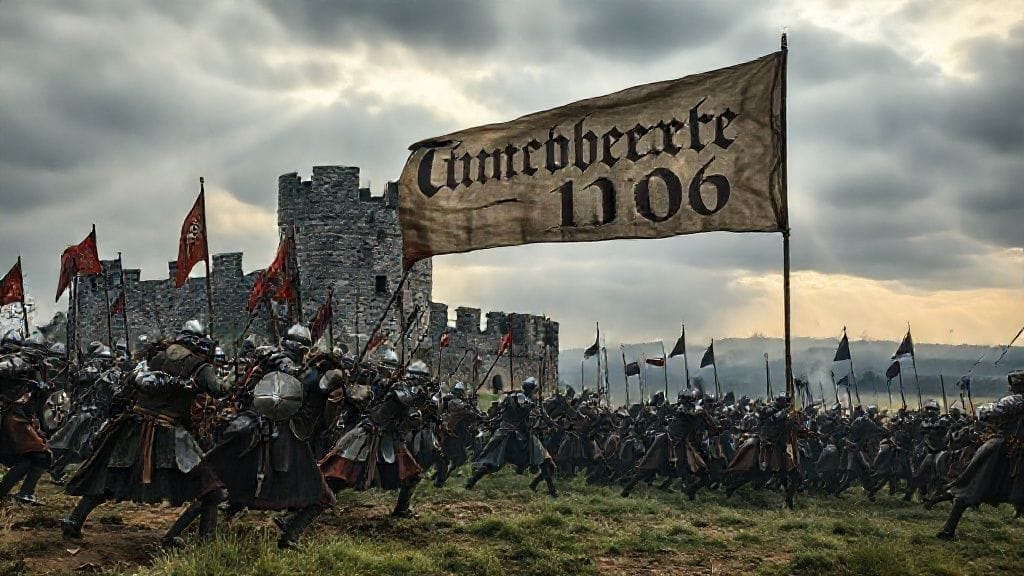
The dawn of September 28 rose over mist-covered fields near the small village of Tinchebray. Henry’s forces, seasoned and disciplined, awaited the arrival of Robert’s army—a motley assembly of knights, levies, and barons still loyal to the duke.
The terrain was a rolling mixture of farmland and woodland, offering tactical opportunities and risks. Both sides understood what was at stake: a defeat meant loss of duchy, crown, and freedom; victory meant becoming undisputed ruler of a vast, intertwined realm.
In the first light, the clatter of mounted knights and the thrust of spears echoed, signaling the beginning of what would become a defining moment in medieval history.
The Gathering Storm: Armies Assemble in the Norman Hills
Henry’s army was an impressive force, bolstered not only by English knights but by Norman lords discontented with Robert’s leadership. His logistical preparation, including supply lines and command structure, reflected a king intent on a swift and decisive battle.
Robert, though perhaps less well-prepared, relied on the loyalty of his retainers and the defensive advantage of familiar terrain. His troops understood that they fought to preserve the independence of the duchy, a cause that weighed heavily on their hearts.
The swelling tension as formations clashed was palpable, the battle cries rising above the clangor of weapons. Each man knew that this fight transcended mere martial glory—it was a battle for identity and destiny.
Clash of Titans: The Battle Unfolds on the Fields of Tinchebray
The armies met with thunderous impact. Shields cracked, horses reared, and the dust rose thick like a pall over the land. Henry’s forces, disciplined and well-organized, pushed relentlessly against Robert’s defenses.
Despite the duke’s attempts to rally his men and hold strategic positions, Henry’s cavalry charged with unstoppable momentum. Chroniclers noted the king’s presence at the front, inspiring his troops with resolute courage.
As the day wore on, the Norman forces began to falter. Key nobles were captured or slain, and the coherence of Robert’s army broke under pressure.
The Turning Point: Military Tactics and Heroic Exploits
What tipped the scales decisively in Henry’s favor was a combination of tactical acumen and sheer determination. He employed feigned retreats to draw enemy knights into traps and coordinated archers to weaken the Norman frontline.
One dramatic episode recounts a stalwart knight who rallied a beleaguered contingent, buying critical time for Henry’s reserves to flank the enemy. Tales of individual heroism mingled with the grand strategy, weaving a narrative both human and epic.
In the end, Robert Curthose was overwhelmed and captured, his banner lowered in defeat. The battle was over, but the consequences had only just begun.
The Defeat of Robert Curthose: Captivity and Consequences
Robert’s capture was not merely a military setback but a political catastrophe. Imprisoned in England for over two decades, he became a pawn in Henry’s quest for undisputed rule.
The duke’s wife and family were left in a precarious position; his loss shattered the hopes of many Norman barons who had supported him. Henry’s triumph thus marked the end of one era and the beginning of another.
The defeat rippled through the aristocracy—loyalties recalibrated, alliances shifted, and the old divisions began to heal under a single banner.
Aftermath on the Battlefield: Bloodshed and Silent Fields
The aftermath was grim—fields littered with fallen knights, horses, and the remnants of shattered hopes. Yet, amidst the carnage, a new order emerged.
Beggars, peasants, and chroniclers alike witnessed what some called divine judgment, others a brutal necessity. The blood spilled at Tinchebray paved the way for political unity, but at a profound human cost.
For those left to tend the wounded and bury the dead, the battle was a somber reminder of the price of power.
Unification of Normandy and England: The Dawn of a New Rule
Henry’s victory solidified his claim over both England and Normandy—territories that had been separated for nearly two decades. For the first time since William the Conqueror, the Anglo-Norman empire was whole again.
This unification was not simply a matter of land but of governance. Henry moved swiftly to integrate administrative systems, enforce law and order, and quell discontent. Normandy’s rebellious spirit was subdued, replaced by royal authority.
The crown’s coffers swelled, its armies strengthened, and its influence extended across the Channel, setting the stage for a more centralized and potent monarchy.
Political Reverberations Through Europe: Allies and Enemies Realigned
The impact of Tinchebray extended beyond England and Normandy. French kings observed the shift warily, knowing that Henry’s enhanced power challenged their ambitions.
Allies of Robert, including segments of the French nobility, faced diminished influence. Papal authorities viewed the stabilization as conducive to peace but remained cautious.
The victory altered diplomatic relations—Henry positioned himself as a peerless ruler in Western Europe, shaping alliances that would last through turbulent decades.
The Fate of Robert Curthose: A Prisoner’s Long Shadow
Though imprisoned, Robert’s story did not end at Tinchebray. His captivity reflected the political calculus of Henry, who preferred to hold his brother alive as leverage rather than risk martyrdom through execution.
For twenty-eight years, Robert lived a shadowed existence in England, his hopes dimming as his liberty was lost. He became a symbol—both of resistance to central authority and of the limits of medieval fraternal bonds.
His death in 1134 closed a chapter but left behind questions of legitimacy and succession that haunted the English crown.
Foundations for a Stronger England: Henry I’s Consolidation of Power
Freed from rival claims, Henry focused on strengthening his realm. He issued the Charter of Liberties, an early forerunner to the Magna Carta, signaling his intent to govern with justice.
Reforms in taxation, law, and military organization extended his control. Henry’s reign thus laid the groundwork for the English monarchy’s evolution from feudal patchwork to a more centralized state.
The unification realized at Tinchebray was both a political triumph and a catalyst for modernization.
Cultural and Social Impacts in Normandy and England
The battle stirred not only armies but cultures. It reinforced Norman identity within England, weaving stronger ties between the Channel Islands, Normandy, and English society.
Feudal relationships were recalibrated, castles fortified, and new noble appointments made to secure loyalty. The cross-Channel aristocracy became more coherent, fostering cultural exchanges that would endure for centuries.
The common people, meanwhile, experienced the cost of war but also the promise of relative peace and stability.
Legacy Through the Ages: How Tinchebray Shaped Anglo-Norman Relations
Historians have long debated Tinchebray's lasting significance. Some see it as the event that salvaged the Anglo-Norman empire, others as a moment of missed opportunities and fraternal tragedy.
Yet, few contest that without Tinchebray, the shape of England—and indeed Europe—would have been markedly different. The battle's legacy resonates in the evolution of medieval kingship and in the enduring ties between England and Normandy.
Revisiting Tinchebray: Memory, Myth, and Historical Debate
Over the centuries, Tinchebray has inspired chronicles, poems, and scholarly inquiry. Medieval writers often framed it as a clash ordained by God, a test of rightful kingship.
Modern historians investigate the socio-political dynamics beneath the surface, exploring the battle’s human dimension as well as its military details.
Public memory occasionally revives the battle as a symbol of brotherhood torn by ambition, reminding us that history is never only about winners and losers, but about the complex stories of those who lived it.
Conclusion
The Battle of Tinchebray stands as a vivid testament to the power struggles that shaped medieval Europe. More than a mere skirmish, it was a turning point—a crucible where family, ambition, courage, and fate intertwined to reshape the destiny of England and Normandy. It reminds us that history is a human story, fraught with hope, tragedy, and the ceaseless pursuit of power and peace.
Henry I’s victory ushered in an era of relative stability and centralized authority, though not without cost. Robert Curthose’s defeat and imprisonment symbolize the fragility of kinship when set against the relentless demands of kingship. Tinchebray is thus more than a battlefield; it is a mirror reflecting the timeless tensions of leadership and legacy.
FAQs
Q1: Why was the Battle of Tinchebray so significant?
Because it unified England and Normandy under Henry I, ending decades of rivalry and establishing a precedent for centralized rule that shaped medieval governance.
Q2: Who were the key figures involved?
Henry I, King of England, and his elder brother Robert Curthose, Duke of Normandy, whose contest defined the battle.
Q3: How did the battle impact the political landscape of Europe?
It strengthened Henry’s position vis-à-vis France, realigned noble allegiances, and influenced the balance of power in Western Europe.
Q4: What were Henry I’s main achievements after the battle?
He consolidated control, reformed law and administration, issued the Charter of Liberties, and laid groundwork for stronger monarchy.
Q5: What happened to Robert Curthose after his defeat?
He was imprisoned in England for nearly three decades until his death in 1134, effectively removing him from political power.
Q6: How is the Battle of Tinchebray remembered today?
As a symbol of medieval power struggles, dynastic conflict, and a pivotal moment that forged Anglo-Norman unity.
Q7: How did the battle affect common people at the time?
Though exact details are scarce, it likely caused hardship through warfare and instability but eventually contributed to a period of relative peace.
Q8: Are there any monuments or memorials related to the battle?
The exact site remains largely rural and unmarked, but historians and local communities preserve its memory through historical records and local narratives.

