Table of Contents
- The Twilight Before the Fall: Edessa on the Brink
- A Jewel of the Crusader States: The County of Edessa
- The Strategic Heart of Mesopotamia: Geography and Significance
- The Rise of Zengi: A New Threat Emerges
- Edessa in 1144: A City Divided and Vulnerable
- The Siege Begins: December 1144, Shadows Over Edessa
- The Fall of the Citadel: The Collapse of Defense and Hope
- The Flight and the Captivity: The Fate of Edessa’s Inhabitants
- News Spreads Like Wildfire: The Shockwaves Through the Latin East
- Rallying Calls and Missed Opportunities: Responses from Crusader States
- King Baldwin III and the Failed Rescue Expedition
- The Lost Opportunity: Why No Levies Came
- Zengi’s Triumph and Its Symbolic Weight
- The Fall’s Aftermath: Political Tremors in the Crusader Levant
- The Birth of Nur ad-Din: Zengi’s Heir and Continuation of the Jihad
- The Fall of Edessa and Pope Eugene III’s Call for the Second Crusade
- The Second Crusade: Ill-Fated Western Response
- The Cultural Impact: End of an Era for the Frankish East
- Edessa’s Legacy in Medieval Memory and Historiography
- Modern Perspectives on the Fall: Lessons in Diplomacy and Defense
- Conclusion: The Moment that Shook Christendom’s Frontier
- FAQs: The Fall of Edessa Explored
- External Resource: Further Reading
- Internal Link: More on History Sphere
The Twilight Before the Fall: Edessa on the Brink
The cold winds of late December in 1144 swept mercilessly over the ancient city of Edessa, stirring dust into the narrow streets and carrying with them the murmurs of a looming catastrophe. Inside the high stone walls, the tension was palpable. Walls once thought impregnable now whispered tales of cracks and despair. The inhabitants—knights, nobles, merchants, and peasants—felt the weight of anticipation, bracing themselves against an enemy who had already surrounded their fate.
It was not just a military conquest that awaited Edessa; it was the fall of the first Crusader state, the fragile jewel of the Latin East, the first domino to topple in a series of events that would reverberate throughout Christendom. The city’s fate had been sealed long before the siege began, by years of neglect, division, and the rise of a formidable adversary. On the cold morning of December 24th, 1144, Edessa fell—and with it, the hopes of many.
A Jewel of the Crusader States: The County of Edessa
Founded in the aftermath of the First Crusade, Edessa was more than merely a fortress or a city. Established in 1098 by Baldwin of Boulogne, who would later become King Baldwin I of Jerusalem, the County of Edessa was the earliest and most vulnerable of the Latin Crusader states. Unlike the coastal strongholds of Jerusalem, Antioch, or Tripoli, Edessa was an inland bastion perched precariously in the borderlands of Mesopotamia, surrounded by hostile powers and fractious alliances.
Known for its diverse population—Armenians, Syriacs, Franks, and Muslims lived within its walls—the county was a cultural crossroads and a strategic buffer. Its rulers leased ambitions not just at survival, but at forging lasting dominion in an unforgiving land. Yet, this dream was always under threat: Edessa’s borders shrank and expanded with the tides of war, alliances shifted, and its loyalty was often questioned.
The Strategic Heart of Mesopotamia: Geography and Significance
Edessa was much more than a mere political entity; it was the gateway to the fertile lands of Mesopotamia, a jewel in the contested frontier stretching between the Byzantine remnants and the rising Muslim powers. Situated in the hills north of the upper Euphrates River, its position allowed it control over crucial river crossings and trade routes linking the East and West.
Holding Edessa meant defense against the powerful Muslim emirates of Mosul and Aleppo, and dominance over the lands leading deeper into Syria and the Jazira. The city was surrounded by a rugged landscape of hills and castles, but this geography brought as many challenges as advantages. Supply lines were fragile, and the county’s relatively shallow manpower pool made its defense a constant concern.
The Rise of Zengi: A New Threat Emerges
In the years leading up to 1144, the figure of Imad ad-Din Zengi loomed larger with each passing day. Appointed governor of Mosul and Aleppo, Zengi combined vision with ruthlessness, determination with genuine political and military skill. He held a unifying ambition: to rally the Muslim principalities under a single banner to reverse the Crusaders’ gains.
Unlike his predecessors marked by internal Muslim discord and division, Zengi dreamed of “jihad,” holy war against the Latin invaders. His rise meant not only military pressure but an ideological resurgence that threatened to engulf the fragile Christian domains established a generation earlier. The County of Edessa, isolated and weak, became his first target.
Edessa in 1144: A City Divided and Vulnerable
In the winter of 1144, Edessa was not just a fortress under threat but a city fragmented by political and social fissures. The ruling Count Joscelin II struggled with dwindling resources and unreliable allies. His grasp on the nobility was tenuous; many local Armenian leaders eyed their own interests warily. Rumors swirled that Joscelin had sent troops on risky campaigns elsewhere, weakening the city’s immediate defences.
At the same time, calls for aid from Edessa to other Crusader states were met with thinly veiled reluctance. The Latin East was suffering from internal rivalries, lack of coordination, and overextended military commitments. Some saw Edessa as a lost cause, others as a strategic liability. These fractures proved fatal.
The Siege Begins: December 1144, Shadows Over Edessa
When Zengi’s forces encircled Edessa in mid-December of 1144, the city’s fate was sealed by the swiftness and intensity of the siege. Tales from chroniclers such as William of Tyre describe a relentless assault on the city walls, engineering efforts to breach defenses, and psychological warfare to cut morale.
Despite the defenders’ fierce resistance, shortages of food and weapons, coupled with the exhaustion of its defenders, eroded the city’s capacity to hold. Winter, usually an ally to besieged cities by freezing attackers’ campaigns, instead boded ill. The city’s allies failed to arrive, and internal divisions sapped the defenders’ will.
The Fall of the Citadel: The Collapse of Defense and Hope
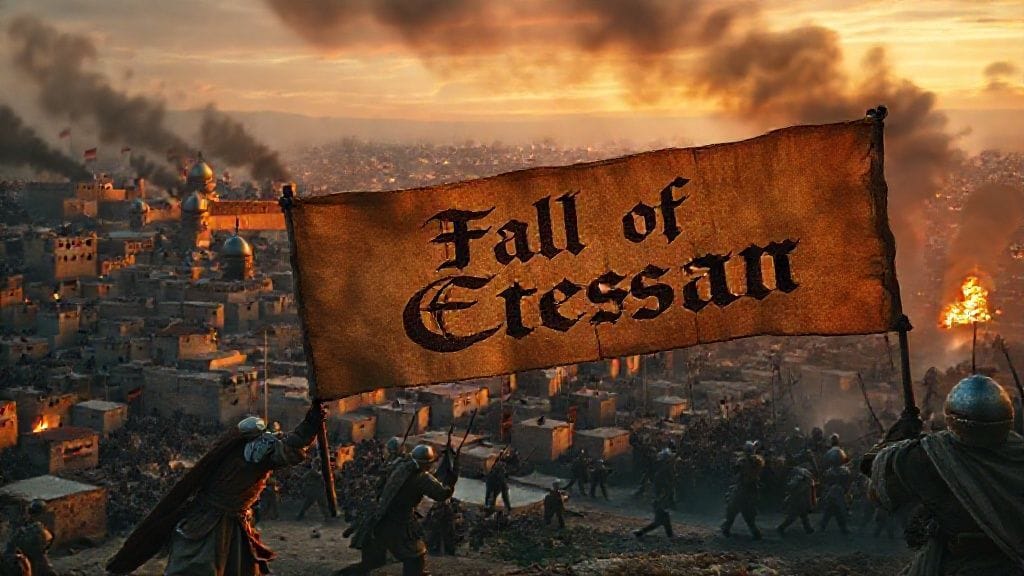
On December 24th, 1144—Christmas Eve—a decisive breach was achieved. Zengi’s forces stormed the city, overwhelming the exhausted garrison. Few precise details survive, but chroniclers agree on the speed and violence of the fall.
The citadel’s gates were thrown open; defences collapsed in disarray. The once proud fortress crumbled in less than a week of siege. Joscelin II fled, abandoning his holdings and the people he was meant to protect. Many inhabitants were killed, others captured or sold into slavery. The Christian population was decimated or scattered.
The Flight and the Captivity: The Fate of Edessa’s Inhabitants
One of the most tragic aspects of the fall was the suffering inflicted upon Edessa’s civilian population. Chroniclers from both Muslim and Christian sides speak of massacres, looting, and forced conversions.
Yet, some noble families managed flight routes through caves and hidden paths along the Euphrates, seeking refuge in more stable Crusader states. Others were enslaved, their fates intertwined with Zengi’s promise to humiliate Latin powers. The event haunted the survivors, imprinting itself as a dark scar in the collective memory.
News Spreads Like Wildfire: The Shockwaves Through the Latin East
The news of Edessa’s fall shattered the fragile optimism that had lingered among the Crusader states. It arrived with the unexpected speed of a storm, carried by fleeing refugees, dispatch riders, and fleeing soldiers.
Jerusalem, Antioch, Tripoli, and the Outremer towns felt the tremors instantly. Councils convened hastily, kings scrambled to comprehend the loss, and the pressure to respond mounted. Many perceived the fall not just as a military disaster but as divine punishment, a reckoning of faith and strategy.
Rallying Calls and Missed Opportunities: Responses from Crusader States
Yet, righteous anger often turned to indecision. King Baldwin III of Jerusalem summoned troops, calling for a relief expedition, but internal disputes and logistical challenges hampered any real effort.
The city’s geographic remoteness, coupled with political rivalries particularly between the Latin states and Armenian lords, prevented unified action. Some lords debated over prioritizing their own territories. The moment to reclaim Edessa passed all too quickly, and with it a chance to restore the frontier’s stability.
King Baldwin III and the Failed Rescue Expedition
Baldwin III’s march northwards in early 1145 symbolized a last-ditch effort. However, despite initial advances, the relief army lacked necessary strength, siege equipment, and crucial local support.
Zengi, now firmly entrenched, had consolidated defenses around Edessa’s environs. A protracted siege or open battle would have drained both parties. Baldwin’s forces finally retreated, unable to restore what was lost—a bitter blow to Latin morale.
The Lost Opportunity: Why No Levies Came
Historians have long puzzled over why no substantial relief arrived sooner or with adequate force. The answer lies in the complex politics of the Levant, fragmentation among Crusader leaders, and competing priorities.
Jerusalem was under pressure from Muslim raids; Antioch was wary of Baldwin’s ambitions; the count of Tripoli had limited military capacity. Moreover, the western European states had yet to mobilize a second crusade, and messages took precious time crossing the Mediterranean.
Zengi’s Triumph and Its Symbolic Weight
For Zengi, the fall of Edessa was not merely a tactical victory. It was a powerful propaganda tool legitimizing his leadership and ideological crusade — or counter-crusade — to unite Muslims under jihad.
His title “Atabeg” gained gravitas, and his prestige soared throughout Syria and Iraq. The event marked a turning tide in the crusading narrative: the invaders on the offensive were beginning to feel the sting of reversal.
The Fall’s Aftermath: Political Tremors in the Crusader Levant
The immediate aftermath witnessed a collapse in Crusader confidence and a dangerous weakening of the Latin presence in the northern Levant. The loss destabilized trade routes and alliances with local Armenian and Muslim principals.
Internal discussions on defense strategies and alliances intensified, but fractures deepened. The fall became a catalyst for changing power dynamics, with Muslim forces increasingly emboldened.
The Birth of Nur ad-Din: Zengi’s Heir and Continuation of the Jihad
Following Zengi’s assassination in 1146, his son Nur ad-Din took up the cause. More eloquent and devout, Nur ad-Din enhanced the jihadist movement started by his father.
Under his reign, Muslim unity strengthened, fortresses were reclaimed, and the momentum decisively shifted against the Crusaders. The capture of Edessa was the opening salvo in a campaign that would culminate in the loss of Jerusalem itself decades later.
The Fall of Edessa and Pope Eugene III’s Call for the Second Crusade
The dramatic shock of Edessa’s capture resonated deeply in Europe. Pope Eugene III issued the papal bull Quantum praedecessores in 1145, calling for the Second Crusade—the first crusade to be preached by a pope.
Stirred by the loss, knights, nobles, and kings took up the cross once more. Yet, despite grand hopes, the crusade would fail to reclaim Edessa or halt the rise of Muslim dominion, highlighting the gulf between intentions and realities.
The Second Crusade: Ill-Fated Western Response
Led by Louis VII of France and Conrad III of Germany, the Second Crusade was launched with enthusiasm but ended in defeat. The crusaders failed in their march through Anatolia and, crucially, did not manage to retake Edessa.
The campaign’s hardships exposed cultural misunderstandings, supply issues, and political rivalries. The failure echoed the earlier divisions that allowed Edessa’s fall and solidified Muslim control in the region.
The Cultural Impact: End of an Era for the Frankish East
Edessa’s fall marked an epoch-defining moment—the beginning of the gradual contraction of Crusader territories and the end of the first wave of conquest in the East.
In Europe and the Levant, poets, chroniclers, and theologians reflected on the loss as divine judgment and a call to greater piety and unity. The city’s multicultural legacy faded, but its memory endured in art and literature, symbolizing both valour and tragedy.
Edessa’s Legacy in Medieval Memory and Historiography
For centuries, Edessa stood in the medieval Christian imagination as a symbol of lost hope and valiant struggle. Chroniclers like William of Tyre and later historians dissected the event, seeking lessons and reasons.
In Muslim historiography, the siege and conquest were celebrated as milestones of the jihad. The event invites reflection on the interplay of military strategy, faith, and politics in medieval warfare.
Modern Perspectives on the Fall: Lessons in Diplomacy and Defense
Today's historians view the fall of Edessa through complex lenses—acknowledging the intricate local alliances, logistic constraints, and broader geopolitical shifts.
Modern scholarship highlights the fragile nature of frontier states, the risks of internal disunity, and the significance of charismatic leadership—whether Zengi’s or Joscelin’s—in determining outcomes.
Conclusion: The Moment that Shook Christendom’s Frontier
The fall of Edessa on that cold winter night in December 1144 was far more than a military setback. It was a profound rupture that exposed the vulnerabilities of the Crusader states and heralded a new phase in the crusading enterprise. The shockwaves sent ripples from the banks of the Euphrates to the halls of European monarchs and popes.
Edessa’s fall was the beginning of a reckoning with lost ambitions, fragmented alliances, and the unyielding tides of history. It reminds us of the precariousness of empire on foreign soil and the enduring human stories amid the clash of civilizations.
FAQs: The Fall of Edessa Explored
Q1: Why was Edessa so vulnerable compared to other Crusader states?
A: Positioned far inland and surrounded by hostile powers, Edessa lacked strong reinforcements and was politically fragmented. Its ruler Joscelin II had limited resources and allies, making the county susceptible to sieges like Zengi’s.
Q2: Who was Zengi and what role did he play in the fall?
A: Imad ad-Din Zengi was the atabeg (governor) of Mosul and Aleppo. He unified Muslim forces to launch a jihad against the Crusaders, capturing Edessa in 1144 through a well-executed siege.
Q3: How did the fall of Edessa affect the wider Crusader states?
A: It caused political and military destabilization, undermined morale, and exposed the divisions among Latin rulers, ultimately prompting calls for the ill-fated Second Crusade.
Q4: What was King Baldwin III's response to Edessa’s fall?
A: Baldwin III launched a relief expedition but lacked sufficient forces and local support, resulting in failure to retake Edessa.
Q5: How did Christianity in Europe react to this event?
A: The fall was perceived as a grave loss and divine admonition, prompting Pope Eugene III to call the Second Crusade—the first crusade formally preached by a pope.
Q6: What legacy did the fall of Edessa leave in history?
A: Edessa symbolized the fragile nature of the Crusader states and was a catalyst for Muslim reconquests, shaping the trajectory of the Crusades and medieval Christian-Muslim relations.
Q7: Was the fall of Edessa a turning point in the Crusades?
A: Absolutely; it marked the beginning of a gradual Muslim resurgence and the decline of Crusader territorial control in the Levant.
Q8: How do modern historians interpret the fall?
A: Scholars consider it a complex event shaped by local politics, leadership challenges, and wider geopolitical forces, offering lessons on the challenges of maintaining frontier states.
External Resource: Further Reading
For an in-depth exploration, see the Wikipedia article:

