Table of Contents
- A Fateful Summer: The Aftermath of Hattin
- The Gathering Storm in Christendom
- Vézelay, 1189: The Rallying of a Kingdom
- The Call of the Cross: From Defeat to Defiance
- Key Players on a Stage Set for War
- The Siege of Jerusalem: A City in Peril
- King Richard the Lionheart: The Embodiment of Crusading Zeal
- Philip II of France: Rivalry and Resolve
- Frederick Barbarossa: The Emperor Whose Heart Was Lost in the East
- The Naval and Land Campaigns: A Dual Front
- The Siege of Acre: Blood and Diplomacy Intertwined
- Muslim Leadership: Saladin’s Response to the Crusade
- Political Intrigue and Alliances in the Levant
- The Crusaders’ March: Perils Beyond the Battlefield
- The Battle for the Holy City: Strategy, Sacrifice, and Stalemate
- The Treaty of Jaffa: A Bitter Compromise
- The Legacy of the Third Crusade: Myths and Memories
- The Impact on Europe: Politics, Piety, and Prestige
- The Muslim World: Resistance and Resilience
- Cultural Exchanges Born of Conflict
- The Crusading Ideal Revisited
- Conclusion: The Third Crusade’s Enduring Echo
On a scorching summer day in July 1187, the fields around Tiberias in the Kingdom of Jerusalem bore witness to something both bleak and illustrious. The Christian forces of the Levant, led by King Guy of Lusignan, were shattered by the armies of Saladin at the Battle of Hattin, a defeat so devastating that it reverberated through the halls of power in Europe and the hearts of countless believers. This was not simply a loss of soldiers or lands; it was the shattering of a dream, the collapse of a cherished order established nearly a century earlier. Bloodied, demoralized, but not extinguished, Christendom’s rallying cry echoed from the cathedrals of Vézelay to the courts of kings: the Third Crusade was proclaimed.
A Fateful Summer: The Aftermath of Hattin
The dust of battle had barely settled when the extent of the disaster became apparent. Saladin’s forces captured King Guy, seized the True Cross that had been carried since the First Crusade, and soon Jerusalem itself, a jewel of Christian devotion, fell under Muslim control for the first time in nearly a century. No event in the near past had so sundered the fragile peace of the Holy Land. This was a devastating blow not just militarily but spiritually, striking at the very heart of Christendom’s crusading raison d’être. The news traveled swiftly, carried by messengers and pilgrims fleeing the collapse. Europe was shaken.
The Kingdom of Jerusalem, once a bulwark against Muslim powers and a beacon of Latin Christendom, was crippled. Its cities and castles fell systematically to Saladin’s troops. This sense of loss was visceral, raw; churches emptied as congregants grappled with a profound crisis of faith. But if despair was palpable, it sparked a fire beneath a continent hungry for salvation, redemption, and glory. It was in Vézelay, a small town in Burgundy, that this monumental turning point would crystallize into resolve.
The Gathering Storm in Christendom
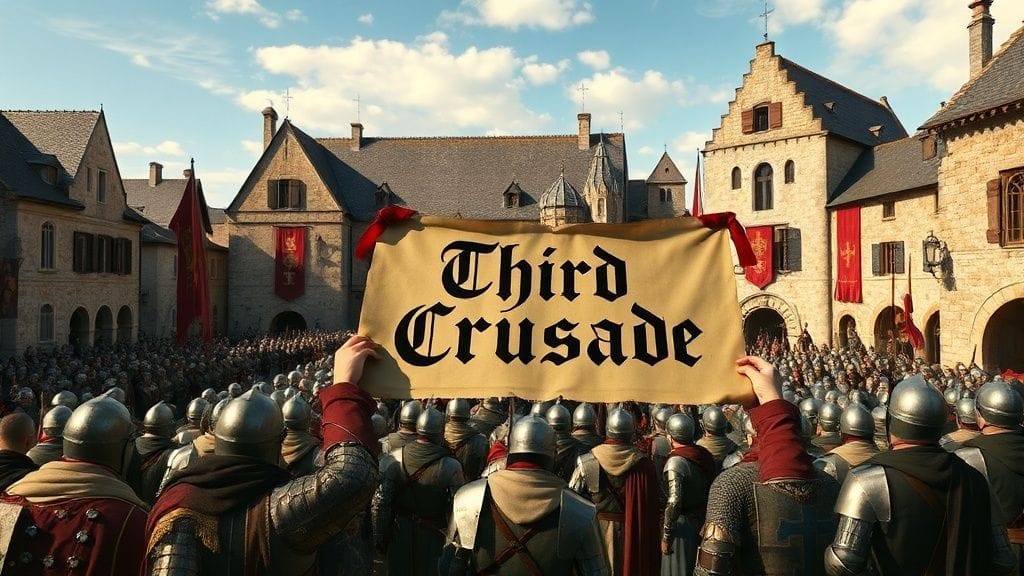
At Vézelay in March 1189, an assembly unlike any other convened under the gaze of the aged and revered Archbishop of Bordeaux, Henri de Sully, and supported by the papacy. Pilgrims, nobles, clergy, and common folk filled the city with an atmosphere charged with fervor. Amongst them was King Philip II of France, freshly crowned and eager to assert his prowess. His presence symbolized the importance of this call.
The air was thick with sermons and prayers, chants mixing with urgent speeches that stirred the crowd to action. The proclamation of the Third Crusade was not simply a response to military defeat; it was portrayed as a sacred duty to reclaim the holy city, restore Christendom’s honor, and protect pilgrims from further harm. Pope Gregory VIII’s bull ‘Audita Tremendi’ had already reached the ears of many, declaring the holy war against Saladin’s forces and promising plenary indulgences—a spiritual reward beyond earthly measures.
Vézelay, 1189: The Rallying of a Kingdom
The assembly at Vézelay was theatrical and meticulously orchestrated. King Philip II, sword drawn and face resolute, publicly took the cross—a symbolic act that ignited enthusiasm among the nobility and commoners alike. A sea of white crosses, pinned to cloaks and banners, soon became the visual hallmark of this crusading wave.
Local lords pledged their fealty and manpower while peasants offered what they could—a mixture of hope and desperation echoed in their voices. The fervor was contagious. Even troubadours and chroniclers immortalized the day, weaving songs and stories of righteous vengeance and divine justice. It was a moment where politics met piety, where personal ambition aligned with collective faith.
The Call of the Cross: From Defeat to Defiance
But this crusade was as much a political maneuver as a spiritual quest. The fractured nature of European politics—potent rivalries, territorial ambitions, and dynastic disputes—underlay the noble dedication. Philip’s declaration was as much about consolidating power domestically and across France’s domains as it was about the Holy Land.
Still, the Third Crusade was bigger than any individual kingdom. England, too, embraced the call, as its charismatic ruler, Richard the Lionheart, answered with vigor. The stage was set for a conflict that transcended borders—a pan-Christian endeavor whose outcome would mold the medieval world.
Key Players on a Stage Set for War
Three figures emerged as the titans of the Third Crusade. Richard I of England, fierce and cunning, epitomized the romantic ideal of the crusader king; Philip II of France, strategic and ambitious, sought to reclaim France's influence; and Frederick I Barbarossa, the aging yet formidable Holy Roman Emperor, whose military reputation preceded him and whose commitment added gravitas.
Their complex interactions—friendship and rivalry, alliance and suspicion—would shape the conduct and fate of the campaign. Richard’s temperament, fiery and uncompromising, collided with Philip’s more diplomatic approach, while Frederick’s tragic death during the march east threw the crusader forces into disarray.
The Siege of Jerusalem: A City in Peril
Jerusalem remained the ultimate prize, its capture a point of both spiritual longing and political necessity. Saladin’s control over the city, following its entry after Hattin, was not merely military; it was a symbol, a narrative cable in the fabric of Islamic resurgence. For the Christians, it was the cross on the hill, a sacred citadel lost but not forgotten.
The Third Crusade’s objective was clear: to wrest Jerusalem back from Muslim hands. Yet the complex realities on the ground—fortifications, supply lines, local alliances—made the venture arduous. The crusaders focused first on regaining strategic cities like Acre, a brutal prelude to the battle for Jerusalem itself.
King Richard the Lionheart: The Embodiment of Crusading Zeal
Richard’s arrival to the Holy Land in 1191 electrified the crusading cause. Known for his martial prowess and commanding presence, he swiftly moved to assert his authority, garnering loyalty among fractious barons and mounting military campaigns that showcased his tactical genius.
Yet Richard was never just a warrior; his charisma and leadership made him a legend in his own time. Tales of his exploits—both victorious and near-fatal—fueled the popular imagination in Europe and the Levant alike. His capture of Acre and engagement in key battles further solidified his reputation as the quintessential crusading knight.
Philip II of France: Rivalry and Resolve
Philip’s role was more ambivalent. Though he championed the crusade at its inception, political pressures and health problems drove him back to France before the campaign’s conclusion. His departure fueled tension with Richard, poisoning relationships and altering the momentum of the crusade.
Nonetheless, his initial push had been essential in mobilizing resources and setting the stage. His desire to reclaim France’s stature paralleled the crusading zeal, intertwining personal ambition and religious purpose.
Frederick Barbarossa: The Emperor Whose Heart Was Lost in the East
The death of Frederick Barbarossa in 1190, after drowning crossing a river in Anatolia, was a turning point. His demise not only deprived the crusaders of a seasoned general but also fractured the German contingent, many of whom returned home.
Frederick’s legacy was double-edged; he symbolized the might and reach of the Holy Roman Empire, but his early death underscored the mortality and unpredictability of medieval warfare. His passing threw a pall over an already daunting campaign.
The Naval and Land Campaigns: A Dual Front
The Third Crusade was remarkable for its coordination of naval and terrestrial operations. Control of coastal cities meant supply routes and communication with Europe could be maintained. The confrontations at sea, including naval engagements near Acre, reflected the emergent importance of maritime power in crusading warfare.
On land, harsh terrain, logistical challenges, and disease took their toll. The crusaders had to navigate not only hostile armies but also a punishing environment, testing their resilience and resolve.
The Siege of Acre: Blood and Diplomacy Intertwined
The prolonged siege of Acre (1189–1191) was among the bloodiest and most pivotal episodes of the crusade. Despite immense losses on both sides—estimated at tens of thousands—the city’s fall swung the strategic advantage towards the crusaders.
Yet victory at Acre was undercut by complicated diplomacy and internecine conflicts between Christian factions. Negotiations, betrayals, and intrigue played out alongside battlefield heroics, illustrating the murky intersection of faith and realpolitik.
Muslim Leadership: Saladin’s Response to the Crusade
Saladin, the Sultan of Egypt and Syria, emerged as a masterful leader and symbol of Muslim unity and resistance. His response to the crusaders combined military skill, diplomatic savvy, and religious authority.
Far from being a mere adversary, Saladin inspired respect even among his enemies. His chivalry and magnanimity, famously shown in his treatment of prisoners and conduct towards captured lands, shaped the narrative of the crusade on both sides.
Political Intrigue and Alliances in the Levant
The Levant was a tapestry of competing ethnicities, religions, and political interests. The crusaders had to negotiate alliances with certain Muslim factions opposed to Saladin, as well as Armenian and other local powers, complicating the notion of a simple “holy war.”
These shifting alliances underscore the complex human and political dimensions that framed the military campaigns, reminding us crusading history was never solely about religious ideology.
The Crusaders’ March: Perils Beyond the Battlefield
Disease, starvation, and the harsh climate took as heavy a toll as the sword. Long marches through arid plains and rugged mountains pushed crusading armies to their limits. The loss of men exceeded many battlefield casualties, and morale waxed and waned with small victories and major defeats.
The human cost, often neglected amid grand narratives of kings and battles, reveals the immense hardships endured by thousands who joined the crusade, driven by faith and hope.
The Battle for the Holy City: Strategy, Sacrifice, and Stalemate
Ultimately, the Third Crusade failed to recapture Jerusalem itself. Despite victories at Acre and on the battlefield, Richard and his forces could not break Saladin’s hold on the city.
Their final confrontations culminated in strategic stalemates, with both sides exhausted and wary of further massive bloodshed. The complexity of siege warfare, armored knights’ limitations, and the difficulties of maintaining supply lines converged to halt the crusader advance.
The Treaty of Jaffa: A Bitter Compromise
In 1192, the Treaty of Jaffa formalized a precarious peace. It allowed Christian pilgrims access to Jerusalem while leaving the city under Muslim control. This compromise was bitterly received by many, yet it preserved a fragile coexistence and opened avenues for future diplomacy.
Richard’s decision to negotiate rather than press for a potentially ruinous assault reflected the pragmatic limits of crusading idealism, a sobering moment in the saga.
The Legacy of the Third Crusade: Myths and Memories
The Third Crusade became an enduring legend of chivalry, heroism, and religious fervor. Richard the Lionheart emerged as a mythic figure; Saladin as a noble and respected adversary. Their clash became the stuff of epic poetry, romantic tales, and historical debates.
But beneath the myth lies a story of lost opportunities, political maneuvering, and human suffering—a complex saga that challenges simplistic triumphalist versions of history.
The Impact on Europe: Politics, Piety, and Prestige
Back in Europe, the crusade’s mobilization altered political dynamics. Kings leveraged crusading credentials to assert authority; the church reinforced its spiritual and temporal influence. The campaign influenced art, literature, and fundraising practices.
The costs were immense, and the crusade’s mixed results provoked reflection on the efficacy of such distant and costly ventures, setting the stage for future conflicts and religious movements.
The Muslim World: Resistance and Resilience
Saladin’s victory rejuvenated Islamic confidence and political cohesion across the Near East. His leadership became a rallying symbol against Western incursions.
The crusade’s failure to permanently dislodge Saladin preserved a period of relative Muslim stability in the region, influencing subsequent centuries of Levantine history and shaping Muslim-Christian relations.
Cultural Exchanges Born of Conflict
Despite the violence, crusading contact facilitated cultural and intellectual exchanges. Ideas, technologies, and goods traveled between East and West, subtly influencing medieval societies.
The crusades, including the Third, acted as conduits for the transmission of knowledge—medical, scientific, and architectural—that would eventually energize Renaissance Europe.
The Crusading Ideal Revisited
The Third Crusade forced a reassessment of crusading ideals. The dissonance between spiritual aspirations and harsh political realities revealed the contradictions of holy war.
Future crusades would learn from these lessons, but the fundamental tension between faith and power, idealism and pragmatism, endured.
Conclusion
The proclamation of the Third Crusade at Vézelay in 1189, following the catastrophic defeat at Hattin, marked a watershed in medieval history. It was a moment where despair was transformed into determination, where faith inspired action amid uncertainty. The crusade that followed was a tempest of kings and warriors, sieges and battles, spiritual longing and worldly ambition.
Though Jerusalem itself remained beyond their grasp, the Third Crusade resonated across the centuries as a narrative of conflict and coexistence, heroism and tragedy. It encapsulates the human capacity for courage and cruelty, hope and frustration, unity and division. More than a mere military campaign, it was a crucible of culture, diplomacy, and belief—a story as rich and complex as the lands it sought to conquer.
We remember these moments not merely for their grandeur but because they illuminate who we are, how we face crisis, and how the past shapes the present. The Third Crusade’s echoes remind us that history is never static; it pulses with the lives of those who dared to dream and fought to make those dreams reality.
FAQs
Q1: What caused the proclamation of the Third Crusade in 1189?
The immediate cause was the catastrophic defeat of Christian forces by Saladin at the Battle of Hattin in 1187 and the subsequent fall of Jerusalem. The loss galvanized Europe to organize a major military expedition to reclaim the Holy Land.
Q2: Who were the main leaders of the Third Crusade?
The crusade was led primarily by three monarchs: Richard I of England (Richard the Lionheart), Philip II of France, and Frederick I Barbarossa, Holy Roman Emperor.
Q3: Why was Jerusalem so important to both sides?
Jerusalem held profound religious significance for Christians, Muslims, and Jews. For Christians, it was the site of Christ’s passion; for Muslims, the Al-Aqsa Mosque and Dome of the Rock reside there, making it Islam’s third holiest city.
Q4: What was the outcome of the Third Crusade?
While the crusaders reclaimed key coastal cities like Acre, they failed to retake Jerusalem. The campaign ended with the Treaty of Jaffa, which allowed Christian pilgrims limited access to Jerusalem under Muslim control.
Q5: How did the Third Crusade affect relations between European kings?
Tensions and rivalries, especially between Richard and Philip, complicated cooperation. Philip’s early return to France weakened the crusader alliance, and Richard’s capture on his return affected English politics.
Q6: What was Saladin’s role during the Third Crusade?
Saladin led the defense of Muslim territories and upheld his reputation for chivalry. His leadership was decisive in holding Jerusalem and negotiating the eventual truce with the crusaders.
Q7: Did the Third Crusade have lasting cultural impacts?
Yes, it sparked cross-cultural exchanges and contributed to the transmission of knowledge, technologies, and ideas between Europe and the Muslim world, influencing the later course of European development.
Q8: How is the Third Crusade remembered today?
It survives in history as both a tale of heroic medieval warfare and a complex episode marked by political intrigue, religious fervor, and enduring questions about crusading motivations and consequences.

