Table of Contents
- The Burning Sun Over Cyprus: May 1191
- The Third Crusade’s Forgotten Chapter
- Richard the Lionheart: A King Burdened by Destiny
- Isaac Komnenos: The Defiant Emperor of Cyprus
- A Kingdom on the Brink: Cyprus Before the Siege
- From Sail to Shore: The Crusaders’ Arrival
- The Shifting Sands of Alliance and Betrayal
- The Siege of Limassol: Clashing Titans
- The Turning Tide: Unfolding of a Brief but Fierce Conquest
- Diplomacy or Domination? Richard’s Strategy Unveiled
- The Aftermath of Capture: Cyprus Under New Rule
- The Human Cost: Lives Torn Between Crusade and Conquest
- Cyprus at the Crossroads of East and West
- The Political Chessboard: Repercussions Across the Mediterranean
- Cyprus’s Role in the Third Crusade’s Grand Narrative
- The Birth of a Crusader Kingdom on Cyprus
- How Richard’s Occupation Shaped Medieval Geopolitics
- Remembering the Conflict: Myths and Chronicles
- The Legacy of Isaac Komnenos: Defiance and Decline
- The Lionheart’s Odyssey: Beyond Cyprus
- Conclusion: A King, An Island, and the Shaping of a Crusade
- FAQs: Unraveling the Mysteries of 1191 Cyprus
- External Resource
- Internal Link
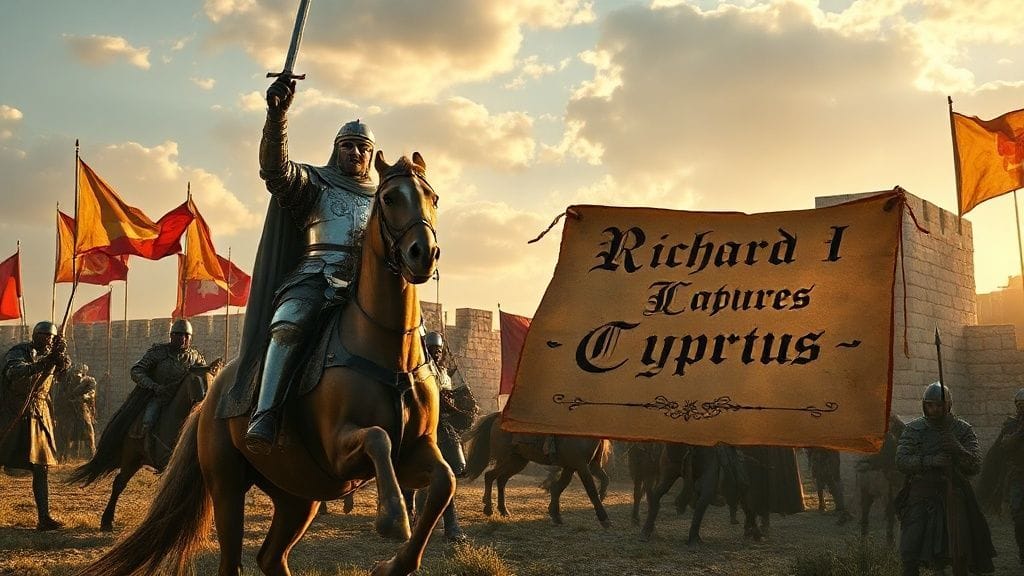
In the blistering heat of May 1191, the Mediterranean sun beat down mercilessly on the fortress city of Limassol in Cyprus, casting long shadows on the stone walls that had withstood centuries of storms and conquest. Yet, on this day, history was about to pivot dramatically. The roar of war cries echoed through the narrow streets, mingling with the clashing of swords and the thunder of siege engines. King Richard I of England, known to many as the Lionheart, stood poised to wrest one of the Eastern Mediterranean’s most coveted jewels from the grasp of a lover of power—Isaac Komnenos, the self-declared emperor whose ambition had ignited a spark that would reverberate far beyond the island itself.
This was no mere footnote in the grand saga of the Third Crusade. The capture of Cyprus in 1191 was a fulcrum upon which the fate of the Crusaders, the balance of power in the Mediterranean, and the destiny of an entire region tilted. But to understand the magnitude of this event, one must journey back in time—to the undercurrents of tension, ambition, and desperation that birthed the conflict. Cyprus, a land steeped in myth and empire, stood as a silent witness to shifts in loyalty, hearts torn between East and West, and the clash of titans whose visions for conquest could neither be reconciled nor contained.
Richard’s arrival on the island was no accident; it was a calculated move born of necessity, revenge, and strategic foresight. Isaac Komnenos, whose lineage traced back to the Byzantine imperial family, ruled Cyprus as a tyrant and opportunist, refusing to yield to the demands of the Crusader forces and disrupting their vital supply lines. The stage was set for a confrontation where swords and diplomacy would wrest control of this island kingdom—an oasis of wealth, strategic value, and intrigue.
As the siege unfolded, the air thickened with tension, the clash of cultures deepened, and the shadow of the Crusade stretched over the azure waters of the Mediterranean. It was a brief episode measured by days but weighted with consequences that echoed through centuries, shaping not only the island’s fate but also the course of the Crusader states and their tenuous hold on the Holy Land.
But this was only the beginning…
The Third Crusade’s Forgotten Chapter
When most recount the Third Crusade, their minds drift to the sweeping battles between Richard the Lionheart and Saladin, the Christian king’s legendary exploits at Arsuf and Jaffa, and the fragile treaties that followed. Yet, the capture of Cyprus is often overshadowed, relegated to a tactical necessity rather than the dramatic and transformative epoch it truly was.
Cyprus, nestled at the crossroads of empires—Roman, Byzantine, Frankish, and Arab—had always been a prized possession. But by 1191, its political landscape had fractured, with Isaac Komnenos seizing power, defying both Byzantine claims and the Crusader interests. Richard’s campaign on the island would thus represent not only a military venture but a profound realignment of Mediterranean power.
The Third Crusade itself was a response to the shocking loss of Jerusalem in 1187 to Saladin’s forces—an event that sent shockwaves through Christendom. King Richard, alongside other European monarchs, answered the call, embarking on a brutal, arduous journey to reclaim the Holy Land. Cyprus fell not by mere happenstance on this road but emerged as a critical strategic waypoint.
Richard the Lionheart: A King Burdened by Destiny
Few kings of his era cut so imposing a figure as Richard I of England. Born in 1157, his nickname "Lionheart" was whispered in both admiration and dread. A warrior by nature, a commander by necessity, Richard’s life was an unrelenting series of battles—personal, political, and territorial.
Yet beneath the armor and the legend lay a man driven by a complex web of duty, ambition, and the burdens of kingship. His detainment on Cyprus was as much a test of his resolve as a prelude to greater military endeavors. When Richard landed on the island, his fleet had recently suffered shipwrecks and attacks, including a notorious incident where his fleet was damaged by a storm and plundered by pirates under Isaac Komnenos’s tacit approval.
It was an affront Richard could not ignore.
Isaac Komnenos: The Defiant Emperor of Cyprus
While Richard was a lion preparing to roar, Isaac Komnenos was a man cloaked in Byzantine imperial dreams. A descendant of the Komnenos dynasty that once ruled a vast swath of the Byzantine Empire, Isaac was no ordinary ruler. By toppling the island’s existing rulers and declaring himself emperor of Cyprus, he positioned himself as a formidable, if isolated, power in the struggle for regional supremacy.
His rule, however, was marred by cruelty, betrayal, and autocracy. Contemporary chronicles paint him as a tyrant who mistreated both locals and newcomers alike. His refusal to cooperate with the Crusaders, and worse, his seizure of Crusader ships and supplies, transformed him from a regional oddity to an outright enemy of the Christian coalition.
A Kingdom on the Brink: Cyprus Before the Siege
Cyprus in the late 12th century was more than a geographical stepping stone—it was a vibrant, diverse land rich with culture, commerce, and history. Once a jewel of the Byzantine Empire, its strategic ports and fertile soils made it a melting pot of Greek, Armenian, Frankish, and Arab influences.
The island’s turbulent politics, however, left it vulnerable. Its rulers struggled to maintain order amidst factional rivalries and external pressures. Isaac Komnenos’s rise was as much a symptom as a cause of this instability, setting a stage ripe for conquest.
From Sail to Shore: The Crusaders’ Arrival
By early May 1191, Richard and his assembled forces reached Cypriot shores, weary but determined. The fleet, battered by storms and piracy, sought refuge and reassurance of support. Instead, they faced hostility and betrayal—a stark welcome that quickly turned violent.
Richard’s forces disembarked with the sound of anticipation and the steel resolve of soldiers used to combat. What followed were days of rapid, relentless movement—battles in the streets, sieges on fortified castles, and diplomatic brinkmanship that left no room for complacency.
The Shifting Sands of Alliance and Betrayal
The complex web of alliances on Cyprus was woven with treachery and opportunism. Several local noble families and merchants found themselves torn between loyalty to Isaac, collaboration with Crusaders, or trying to carve their own path amid chaos.
Richard’s campaign would exploit these fractures. Some Cypriots welcomed the Crusaders as liberators from the oppressive grip of Isaac; others bristled at yet another foreign power’s imprint on their land.
The Siege of Limassol: Clashing Titans
Limassol—the jewel of southern Cyprus—became the crucible of this confrontation. Its walls, strong and ancient, transformed into a battlefield echoing with the diversity of medieval warfare: catapults hurled burning projectiles, archers loosed volleys of arrows, and desperate men swung swords in narrow alleyways.
Isaac Komnenos made a last stand in the city, rallying defenders with fierce determination. Yet the superior numbers, discipline, and war machinery of Richard’s army gradually turned the tide. The siege was brief but brutal, characteristic of the era’s unforgiving nature.
The Turning Tide: Unfolding of a Brief but Fierce Conquest
Within weeks, Richard had subdued key strongholds across Cyprus. The fall of Limassol was a symbolic moment—the fortress that once seemed impenetrable now lay at the conqueror’s feet.
Richard’s swift and decisive actions surprised many contemporaries. The ease with which he transformed an island ruled by a fractious emperor into a well-organized Crusader base was a testament to his strategic acumen and ruthless efficiency.
Diplomacy or Domination? Richard’s Strategy Unveiled
Was Richard I’s capture of Cyprus purely a military conquest, or a calculated diplomatic masterstroke? Scholars have debated for centuries whether the annexation was driven by short-term military necessity or a long-term vision of expanding Crusader power.
What is clear is that Richard swiftly moved to consolidate control—intercepting Isaac Komnenos, who was captured and taken prisoner, and integrating the island into the network of Crusader territories that would dominate the Eastern Mediterranean for decades.
The Aftermath of Capture: Cyprus Under New Rule
Following the conquest, Cyprus was more than a trophy—it became a vital port and base of operations for Crusader campaigns. Richard auctioned the island to the Knights Templar, who found governing the fractious region challenging, leading eventually to its sale to Guy de Lusignan, former King of Jerusalem.
This transition laid the foundations for the Lusignan dynasty, which would rule Cyprus for nearly three centuries—a lasting Crusader legacy that shaped the island’s identity and interactions between East and West.
The Human Cost: Lives Torn Between Crusade and Conquest
While armies and kings fought over Cyprus, the island’s inhabitants bore the weight of war. Civilians faced sieges, plundering, and the disruption of daily life. Ancient cities, hubs of trade and culture, suffered damage. Families were displaced or caught between conflicting loyalties.
These human stories, often overshadowed by the exploits of kings, reveal the complexity and tragedy of crusading warfare, where ideals met harsh realities.
Cyprus at the Crossroads of East and West
The capture of Cyprus reaffirmed the island’s role as a fulcrum of Mediterranean politics—a meeting point of Christendom and Islam, of Byzantine heritage and Frankish conquest. Its position allowed Crusaders to stage operations with greater ease but also exposed it to continuing conflict and cultural flux.
Cyprus embodied the tensions and possibilities of a medieval world in transition.
The Political Chessboard: Repercussions Across the Mediterranean
Richard’s seizure of Cyprus did not go unnoticed. Powers ranging from the Byzantine Empire to Saladin’s sultanate adjusted their strategies in response. The island became a lynchpin in the logistical and political framework of the Crusades.
The event also influenced maritime trade routes and the ambitions of emerging states, weaving Cyprus into a complex diplomatic tapestry.
Cyprus’s Role in the Third Crusade’s Grand Narrative
Though often overlooked, Cyprus was essential to the Third Crusade's ultimate military and diplomatic outcomes. Without a reliable base so near the Levantine coast, Richard’s campaign might have faltered or failed entirely.
Cyprus stood as a beacon and battlefield by which the fate of Jerusalem and Crusader hopes turned.
The Birth of a Crusader Kingdom on Cyprus
Richard’s conquest marked the beginning of a new chapter for Cyprus as a Crusader stronghold. The Lusignan dynasty established feudal institutions, castles, and a unique cultural milieu blending Western and Eastern elements.
This kingdom would become a symbol of the complexities and contradictions of Crusader endeavors—both a bastion of Christian power and a crossroads of cultural fusion.
How Richard’s Occupation Shaped Medieval Geopolitics
Strategically and symbolically, Richard’s Cyprus campaign shifted power balances. Control of the island gave Crusaders naval supremacy in the eastern Mediterranean and complicated Byzantine and Muslim dominance.
It underscored the enduring importance of island strongholds in medieval warfare and diplomacy.
Remembering the Conflict: Myths and Chronicles
The conquest of Cyprus inspired chroniclers and legends. Stories of Richard’s valor, Isaac’s defiance, and the dramatic siege of Limassol passed into medieval lore, shaping narratives and identities.
Yet the reality often stood at odds with myth: harsh measures, betrayals, and the relentless grind of war marked this episode as much as heroism and chivalry.
The Legacy of Isaac Komnenos: Defiance and Decline
Isaac Komnenos’s downfall was emblematic of defiance unmet by accommodation. His legacy remains complex—some saw him as a usurper and tyrant, others as a symbol of resistance against the overwhelming tide of Crusader expansion.
His fate, a prisoner following the siege, mirrored the island’s transformation from Byzantine autonomy to Crusader dominion.
The Lionheart’s Odyssey: Beyond Cyprus
Richard’s capture of Cyprus was a pivotal moment in his journey. It provided a critical springboard for his campaigns in the Holy Land, but also foreshadowed the perils and setbacks that awaited him, including his eventual captivity on his way home.
Cyprus was a chapter in the lionheart’s larger saga—a testament to his military genius and the tumultuous fate of a crusading king.
Conclusion
The capture of Cyprus in May 1191 was more than a strategic seizure; it was a poignant chapter of ambition, resilience, and transformation. Richard the Lionheart’s conquest echoed far beyond the stone walls of Limassol, rewriting the island’s destiny and reshaping the geopolitical contours of the medieval Mediterranean.
It was a moment where the hopes and horrors of crusading met: the clash of emperors and kings, the suffering of people caught in the crossfire, and the inexorable march of history toward new orders. Cyprus changed hands not just through force, but through the interplay of culture, power, and survival.
In understanding this episode, we grasp not only a striking military feat but a window into an age defined by faith, warfare, and human complexity. The island endured, as did its stories—as vibrant and enduring as the sun that once shone down on the battlefield of Limassol.
FAQs
1. Why did Richard I decide to capture Cyprus during the Third Crusade?
Richard’s fleet faced shipwrecks and piracy near Cyprus; Isaac Komnenos had seized Crusader ships and supplies, threatening their campaign’s viability. Capturing Cyprus ensured a safe base and supply point near the Holy Land.
2. Who was Isaac Komnenos, and why was he significant?
Isaac Komnenos was a Byzantine noble who declared himself emperor of Cyprus. His autocratic rule and hostility to Crusaders disrupted their logistics, making him a key obstacle to Richard’s campaign.
3. How long did the siege of Limassol last?
The siege and battles around Limassol were brief but intense, unfolding over several weeks in May 1191, culminating in the city’s fall to Richard’s forces.
4. What happened to Cyprus after Richard captured it?
Richard initially sold Cyprus to the Knights Templar. After difficulties in governance, it was sold to Guy de Lusignan, establishing a Crusader kingdom that lasted until the late 15th century.
5. What was the impact of Cyprus’s capture on the Third Crusade?
Cyprus became a critical logistical and military base, helping Richard sustain his campaigns in the Holy Land and maintain supply lines.
6. Did Isaac Komnenos ever regain Cyprus?
No, Isaac remained a prisoner after his capture and never reclaimed Cyprus, which remained under Crusader control for centuries.
7. How did the local Cypriot population react to the Crusader conquest?
Reactions were mixed: some welcomed the end of Isaac’s harsh rule; others resisted foreign domination, leading to complex social and political dynamics.
8. How is the capture of Cyprus remembered today?
It is recognized as a pivotal yet often overlooked event in Crusader history, highlighting the interplay of Mediterranean power, culture, and conflict during the High Middle Ages.

