Table of Contents
- The Fourth Crusade: An Ambitious Dream Set Aflame
- The Crusading Spirit in the Early 13th Century
- Europe on the Brink: Political Turmoil and Economic Ambitions
- Pope Innocent III’s Vision: A Holy War to Reclaim Jerusalem
- The Gathering Storm: Recruitment, Financing, and the Venetians’ Role
- Venice and the Price of Passage: A Problem of Unpaid Debt
- Zara: A Coastal City at the Crossroads of Faith and Politics
- The Decision to Attack Zara: Necessity, Ambition, or Betrayal?
- The Siege of Zara: Struggle, Suffering, and the Clash of Loyalties
- Reactions at Home and Abroad: Excommunication and Controversy
- The Diverted Crusade: How the Dream of Jerusalem Was Lost
- The Aftermath in Dalmatia: Political Realignments and Venetian Dominance
- The Impact on the Crusading Movement: Shattered Ideals and Waning Enthusiasm
- Moral and Religious Repercussions: Voices of Protest and Reconciliation
- The Fourth Crusade’s Legacy in Balkan and European History
- Revisiting Zara Today: Memory, Identity, and Historical Debate
- Conclusion: Lessons from a Crusade Gone Awry
- FAQs: Understanding the Twilight of the Fourth Crusade
- External Resource
- Internal Link
The Fourth Crusade: An Ambitious Dream Set Aflame
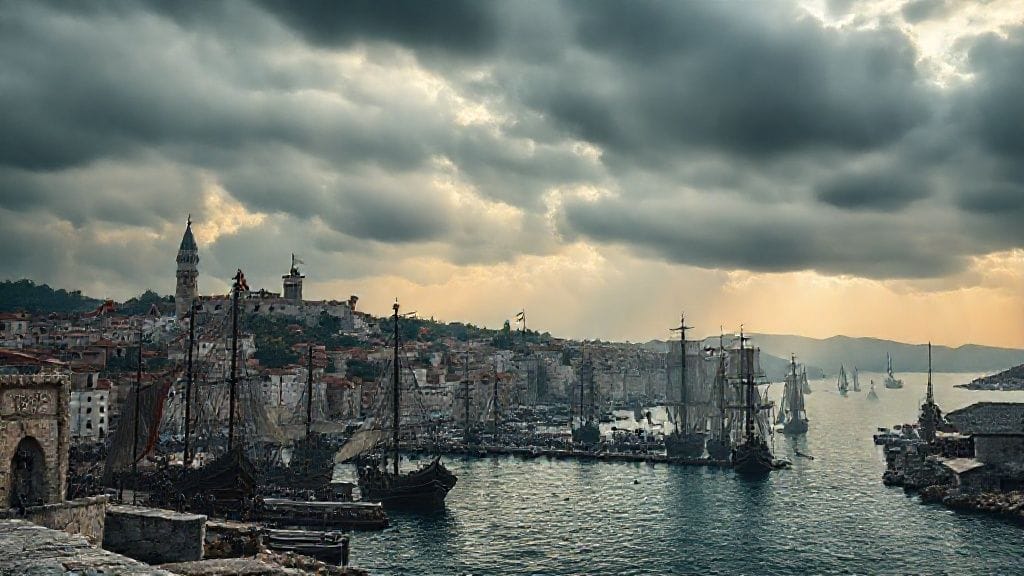
The dawn air hung heavy with the salt of the sea and the clangor of preparations echoing from the Venetian docks. It was the year 1202, and the Fourth Crusade was set to embark—not yet upon the sun-baked sands of the Holy Land but from the bustling maritime republic of Venice. Warriors and knights outfitted with chainmail clattered on wooden decks, their faces a mixture of steely resolve and anxious hope. Above them, the banners of Christendom fluttered, poised for a campaign to reclaim Jerusalem from the grip of Muslim rulers, a cause deemed sacred by the Papacy and the European nobility.
Yet, this crusade—called by Pope Innocent III himself—would soon derail into a complex web of politics, commerce, and betrayal. Instead of charging toward the Holy City, the knights found their swords raised against a Christian city on the Dalmatian coast: Zara (modern-day Zadar), a Venetian rival and a tragic prelude to an even darker chapter in the Crusade’s history. How did a holy expedition become a bleak saga of diversion, siege, and internecine conflict? This is the untold story of the Fourth Crusade diverted to Zara.
The Crusading Spirit in the Early 13th Century
At the turn of the 13th century, the ideal of crusading was not merely a call to arms; it was a powerful spiritual and social impetus that shaped Western Europe. The earlier crusades had left a legacy of valor and devastation alike, carving out Christian enclaves in the Levant and even reshaping European politics in subtle ways. Yet by 1200, the dream of reclaiming Jerusalem was galvanized by a booming religious zeal and a growing network of nobles, knights, and warriors who saw fighting in the Crusades as a path to salvation and glory.
Pope Innocent III, one of the most powerful pontiffs of the medieval era, seized on this moment to rally Christendom with remarkable zeal. His proclamation of the Fourth Crusade in 1198 was infused with spiritual fervor and a clear political agenda: to unite Christendom under the banner of faith and reclaim the Holy Land, ensuring that the sacred Christian sites would not remain under Muslim control. The call resounded across France, Germany, Italy, and beyond, attracting fervent nobles like Boniface of Montferrat and the youthful Baldwin of Flanders.
Europe on the Brink: Political Turmoil and Economic Ambitions
Yet, the ideological purity of the crusading call was soon tangled with the complex realities of Europe's political and economic landscape. Europe was no idyllic tableau of collective Christian unity; it was a patchwork of competing cities, mercantile republics, and aristocratic houses, each vying for influence and wealth.
Venice, the maritime powerhouse on the Adriatic, was a fulcrum of commercial might vested in controlling trade routes between East and West. The city's doge and leading merchant families eyed the Crusade as an opportunity not only for pious glorification but also for economic expansion. The alliance between crusaders and Venice was both pragmatic and fraught. Venice promised ships and transport in exchange for a hefty fee, but political currents would soon submerge the crusaders into Venice’s ambitious designs beyond the Holy Land.
Pope Innocent III's Vision: A Holy War to Reclaim Jerusalem
To comprehend the tragedy of the Fourth Crusade, one must appreciate Pope Innocent III’s sweeping vision. He wielded unprecedented authority to call the Western Christian noble class to arms, articulating the campaign as a spiritual imperative that trumped all earthly concerns. Innocent envisioned not just a military expedition but a restoration of Christian orthodoxy and political stability in the East.
Behind these lofty aims, however, lurked a fragile network of alliances, debts, and logistics. Crusaders were expected to provide their own equipment and financing, which placed many under financial strain. Innocent urged generosity but faced the reality that the nobility’s resources were limited, and enthusiasm alone could not sustain such a costly enterprise. Thus, when the crusaders made their pact with Venice, it was a marriage of convenience borne out of necessity.
The Gathering Storm: Recruitment, Financing, and the Venetians’ Role
As recruitment gathered pace throughout 1201 and 1202, the enthusiasm of knights and nobles clashed starkly with the practicalities of war. The Venetians promised a fleet of 90 ships, capable of carrying some 33,500 men at a price of 85,000 silver marks. These terms were daunting but initially accepted in good faith.
However, when the crusaders arrived in Venice in late 1202, fewer than half the promised force had mustered. Worse yet, they lacked funds to pay Venice’s impressive bill. Doge Enrico Dandolo, an astute and ruthless leader despite his blindness and advanced age, recognized an opportunity. Venice held the powerful leverage: no payment, no ships. The crusade risked fading into an expensive failure on the Venetian docks.
Venice and the Price of Passage: A Problem of Unpaid Debt
The crisis of unpaid debt forced the crusaders into an impossible bind. Knowing the prestige and piety resting on the mission, Venice proposed a compromise: the crusaders could settle part of their debt by aiding Venice in an assault on Zara, a rebellious former Venetian possession that had defected to the Kingdom of Hungary.
Zara was a Christian city, and its siege posed a moral and theological conundrum. Many crusaders were deeply troubled, yet pragmatism won out. The city's capture meant a tangible payoff that would secure passage for the crusaders to the East. The decision to attack fellow Christians was controversial, but the financial desperation and Venetian political machinations held sway.
Zara: A Coastal City at the Crossroads of Faith and Politics
Zara was no ordinary target. Situated on the Dalmatian coast of the Adriatic, this city had long been a contested jewel coveted by Venice, Hungary, and local powers. Its fortified walls and strategic harbors embodied centuries of regional tension.
For Zara’s inhabitants, the arrival of a crusading armada—expected as liberators of the Holy Land—soon turned into a nightmare. The city prepared for siege, its citizens and defenders filled with uncertainty, realizing that the threatening ships were Christian, not Muslim foes. This irony—fellow Christians besieging a Christian city under a banner of piety—would stain the crusade’s historical legacy irrevocably.
The Decision to Attack Zara: Necessity, Ambition, or Betrayal?
The choice to besiege Zara was fueled by a toxic mix of Venetian ambition and crusader desperation. Doge Dandolo was no mere merchant; he was a shrewd strategist who viewed the opportunity to reassert Venetian control over Dalmatian ports as a crucial investment. The crusaders, caught between debt and duty, reluctantly agreed, blurring the lines between holy war and political conquest.
To many participants, particularly those with rigid spiritual convictions, Zara was a moment of profound crisis. The challenge of justifying the assault in the face of canon law led to internal soul-searching and dissent. Pope Innocent III initially condemned the attack, excommunicating the entire crusading army—a rare and dramatic move, underscoring the gravity of this deviation.
The Siege of Zara: Struggle, Suffering, and the Clash of Loyalties
From November to December 1202, the siege of Zara unfolded with grim intensity. Venetian ships bombarded the city, while crusader knights pressed against its walls. The defenders, including townsfolk and local militias, resisted fiercely, knowing that surrender meant subjugation and loss of autonomy.
Contemporary chroniclers recount scenes of desperation—the deafening roars of catapults, the cries of the wounded, and the bitter winters endured by assailants and defenders alike. The ideological bitterness of the siege—the fact that Christian soldiers lashed out against Christian citizens—cast a pall over the feat.
As Zara fell, the incident sent shockwaves through Europe, shaking faith in the crusade’s purity. Innocent III’s excommunication loomed, sowing dissent and regret.
Reactions at Home and Abroad: Excommunication and Controversy
The Pope’s harsh response to the siege of Zara was swift. Innocent III excommunicated the crusading forces, underscoring the spiritual peril of attacking a Christian city. This rare condemnation split the crusaders—some struggled with guilt and public reproach, others were defiant or pragmatic.
The Kingdom of Hungary, protector of Zara, decried the assault, demanding restitution that was never fulfilled. Across Europe, rumors and debates about the crusade’s moral failure spread. The sense of an expedition veering from divine mission toward Venetian opportunism deepened.
Yet, paradoxically, Innocent III later lifted the excommunication for all but the Venetians, desperate to maintain momentum for the crusade’s ultimate goal—the Holy Land. This pragmatic volte-face revealed the tensions between idealism and realpolitik.
The Diverted Crusade: How the Dream of Jerusalem Was Lost
The siege of Zara was a turning point—the moment the crusade drifted irrevocably from its spiritual course. The knights, now indebted and tainted by Christian bloodshed, found themselves enmeshed in further Venetian schemes.
Soon, their ambitions turned eastward—not toward the sands of Palestine but toward the Byzantine Empire, culminating in the fateful siege of Constantinople in 1204. This diversion into Christian-on-Christian warfare, a shocking betrayal of crusading ideals, began with Zara’s fall and foreshadowed catastrophic consequences.
The dream of reclaiming Jerusalem would be indefinitely postponed, buried beneath the rubble of political machinations and fractured Christendom.
The Aftermath in Dalmatia: Political Realignments and Venetian Dominance
Zara’s capture solidified Venetian dominance over the Dalmatian coast, transforming the city into a strategic outpost in the Adriatic and a jewel of Venice’s expanding maritime empire. The local population endured years of Venetian control, marked by cultural shifts, new trade patterns, and military garrisons.
For Venice, Zara was both a trophy and a warning of the power of commerce and war combined. This episode forged the blueprint for Venice’s later mercantile and naval enterprises, projecting power across the Mediterranean.
The Impact on the Crusading Movement: Shattered Ideals and Waning Enthusiasm
The Fourth Crusade’s diversion, beginning with Zara, marked a blow to the crusading ideal itself. The image of knights pillaging fellow Christians eroded the moral foundation of crusading ideology.
Recruitment in later campaigns faltered, and skepticism toward papal calls to war increased. The very concept of crusade as a holy mission was questioned, foreshadowing a slow decline in enthusiasm for large-scale expeditions to the East.
Moreover, the schisms opened by the Crusade—between Western Latin and Eastern Orthodox Christians—reshaped geopolitics with reverberations lasting centuries.
Moral and Religious Repercussions: Voices of Protest and Reconciliation
The Zara episode was a source of spiritual anguish and debate. Chroniclers like Geoffrey of Villehardouin expressed conflicted admiration for the knights’ valor yet lamented the moral cost. The Pope’s excommunication and subsequent partial revocation underscored the tension between divine law and human failings.
Religious leaders struggled to reconcile the need for the crusade with the apparent sins committed in its name. This discourse influenced church policy on warfare and laid foundations for future questions about just war theology.
The Fourth Crusade’s Legacy in Balkan and European History
Zara’s siege was a microcosm of the broader forces reshaping Europe and the Near East. The entangled interests of commerce, politics, and faith revealed the fragility of medieval Christendom’s unity.
The Fourth Crusade’s legacy—beginning with Zara and culminating in Constantinople’s fall—would influence Balkan identities, Venetian imperial ambitions, and the Orthodox-Western Christian divide for centuries. It remains a defining moment where religious idealism clashed brutally with geopolitical ambition.
Revisiting Zara Today: Memory, Identity, and Historical Debate
Modern historians and inhabitants of Zadar trace their city’s complex history with a mixture of pride, regret, and reflection. The siege is commemorated not only as a tragic episode but as part of the city’s resilience.
Scholars continue to debate the motivations behind the attack, the extent of Venetian manipulation, and the moral responsibilities of the crusaders. Contemporary discourses often emphasize the human cost and the tragedy of a crusade lost to greed and power struggles.
Conclusion: Lessons from a Crusade Gone Awry
The Fourth Crusade’s diversion to Zara shines as a poignant example of how noble ideals can be compromised by politics, debt, and ambition. It teaches us about the dangers of conflating religious zeal with mercantile interests, and the consequences of actions driven more by pragmatism than principle.
This episode invites timeless reflection on the price of expedience, the fragility of unity in times of strife, and the human toll hidden beneath grand historical narratives. As we look back at Zara, we see a mirror for our own struggles between faith, power, and morality.
FAQs
Q1: Why was the Fourth Crusade diverted to Zara instead of heading directly to the Holy Land?
A1: The diversion was primarily due to financial difficulties. The crusaders could not pay Venice for transport, so Venice insisted they help capture Zara, a rebellious city, to settle part of the debt.
Q2: Who were the main political players behind the decision to attack Zara?
A2: The Venetian Doge Enrico Dandolo masterminded this strategy, leveraging Venice’s naval power and the crusaders’ desperation to reassert Venetian control over the Dalmatian coast.
Q3: How did Pope Innocent III react to the siege of Zara?
A3: The Pope initially condemned the attack and excommunicated the entire crusading army, as Zara was a Christian city, making the siege a grave moral offense at the time.
Q4: What were the consequences of the siege for the city of Zara?
A4: Zara fell under Venetian control, suffering military occupation and political absorption into Venice’s maritime empire, profoundly shaping its subsequent history.
Q5: How did this event affect the overall crusading movement?
A5: The attack on a Christian city disillusioned many and tainted the crusading ideal, contributing to declining enthusiasm and increasing criticism of crusades.
Q6: Did the rest of the Fourth Crusade proceed after Zara?
A6: Yes, but it further deviated from its original goal, most notably culminating in the sack of Constantinople in 1204.
Q7: How do historians interpret the diversion to Zara today?
A7: Modern historians see it as a complex mix of economic necessity, political ambition, and betrayal of religious ideals, illustrating the flawed nature of the crusade.
Q8: Is Zara (Zadar) commemorated or remembered differently due to this event?
A8: Yes, it remains a significant historical moment in Zadar’s identity, evoked more with reflection on resilience and loss than simple triumph or defeat.
External Resource
For more in-depth information, please consult the Wikipedia page:
Fourth Crusade – Siege of Zara
Internal Link
🏠 Visit History Sphere → https://historysphere.com/

