Table of Contents
- The Dawn of April 12, 1204: An Eternal City on the Brink
- A City of Glory and Vulnerability: Constantinople Before the Fall
- The Fourth Crusade: From Holy Quest to Tragic Diversion
- The Tangled Politics of Christendom and Byzantium
- The Crusader Fleet Arrives: Tensions on the Golden Horn
- Clashing Ambitions: Crusaders versus Byzantines
- The Breach: Chaos Unleashed at the Walls
- The Rampage Begins: Pillage and Destruction in the Heart of Byzantium
- Witnesses of Horror: Chroniclers and the Human Cost
- The Looting of the Hagia Sophia and Other Sacred Sites
- Art, Relics, and Wealth: The Spiritual and Material Losses
- The Role of Venetian Interests and the Quest for Treasure
- The Establishment of the Latin Empire: New Masters of Constantinople
- Byzantine Resistance and the Empire in Exile
- The Long Shadow: How the Sack Reshaped East and West
- The Cultural Devastation and the Dispersal of Byzantine Heritage
- The Aftermath: Political Repercussions Across Europe and the Near East
- Memory and Myth: The Sack of Constantinople in Historical Narratives
- Lessons from Catastrophe: Reflections on Faith, Power, and Greed
- The Rediscovery and Preservation of Byzantine Legacy in Modern Times
The Dawn of April 12, 1204: An Eternal City on the Brink
In the pale light of an early April morning, the ancient walls of Constantinople stood stoic against a rising sun that would bear witness to tragedy. The city, once hailed as the jewel of the Eastern Roman Empire, was alive with a tension that pulsed through every stone, every alley, every whispered prayer. Sailors, knights, and merchants crowded the harbors and markets, while the distinct strains of Orthodox chant mingled with the clangor of armor being readied. But beneath this vibrant surface lurked an imminent storm—an invasion that would irreparably scar the soul of Byzantium.
On April 12, 1204, the legendary city—founded by Constantine the Great and crowned as the “New Rome”—was breached, not by a pagan horde or a distant barbarian army, but by Christian Crusaders. Those sent ostensibly on a mission of faith and salvation had instead transformed into agents of ruin, turning European idealism into a bloodied reality. By nightfall, Constantinople had surrendered to chaos: its treasures plundered, churches defiled, and its proud population plunged into despair.
Yet, the sack of Constantinople was not a mere military conquest. It was a complex story of political intrigue, betrayal, religious schism, and uncontrollable greed—a turning point that resounded far beyond the city’s mighty walls, shaking the medieval world and echoing across centuries.
A City of Glory and Vulnerability: Constantinople Before the Fall
To understand the catastrophe of 1204, one must first drink in the magnificence of Constantinople in its twilight years. More than a city, it was an empire condensed—a bustling metropolis where East met West, where sacred and secular powers intertwined. Its strategic location on the Bosporus Strait made it a coveted prize, a gateway between continents and faiths.
Home to breathtaking architecture, mosaics that shimmered like captured sunlight, and institutions that preserved classical knowledge, Constantinople was also a city marked by internal frailty. Decaying infrastructure, political factionalism, and the lingering wounds of earlier Crusades and civil wars complicated its defense. Despite boasting one of the most formidable fortification systems in the medieval world, cracks had begun to appear—not just in stone, but within its ruling elite.
Emperor Alexios IV Angelos, seeking to restore his family’s throne and protect his empire, found himself entangled in desperate alliances, dreaming of aid from the very knights of the West. The city’s Orthodox traditions set it apart from the Latin world, and that religious divide sowed distrust and enmity that would later serve as tinder for the conflagration to come.
The Fourth Crusade: From Holy Quest to Tragic Diversion
The Fourth Crusade was conceived with a clear spiritual and military goal: to reclaim Jerusalem from Muslim rule, following months of papal appeals and fevered religious enthusiasm sweeping across Western Europe. Armies of knights, nobles, and pilgrims gathered, ready to embark on a sacred mission. Yet, the campaign quickly veered from its path, enveloped in financial troubles and power struggles that would darken its course.
Venice, the maritime republic, emerged as an indispensable but calculating player. Offering ships and supplies, the Venetians demanded exorbitant payments the Crusaders struggled to meet. The plot thickened when these Western warriors were persuaded—or coerced—into diverting towards Constantinople, initially to reinstate Emperor Alexios IV, who had promised rewards and military support.
What began as a contest for faith soon transmuted into a quagmire of political manipulation. The Crusade had morphed into a pawn in a Byzantine dynastic drama, with the original spiritual mission eclipsed by the intertwined greed and ambition of Latin princes and Venetian doges.
The Tangled Politics of Christendom and Byzantium
The relationship between the Byzantine Empire and the Latin West had long been fraught with tension and misunderstanding. The Great Schism of 1054 had irreversibly fractured Christian unity, branding the Eastern Orthodox Church and the Roman Catholic Church as doctrinal adversaries. Suspicion thickened in the decades that followed, colored by competing territorial ambitions and cultural prejudices.
By 1204, Byzantium was a shadow of its former self, with empires pressing on its borders and civil turmoil weakening imperial authority. Alexios IV Angelos, desperate to reclaim his father's throne, struck a fateful deal with the Crusaders, pledging vast wealth and military aid—a promise ultimately impossible to fulfill.
At the same time, Venetian commercial interests aligned uneasily with the Crusaders' military objectives. Venice’s desire to dominate trade routes and control access to the Black Sea turned the Crusade’s decision to besiege Constantinople into an economic gambit cloaked in religious rhetoric.
The clash of these intertwined motives—faith, power, money—set the stage for an inevitable catastrophe.
The Crusader Fleet Arrives: Tensions on the Golden Horn
In early April 1204, the Crusader fleet appeared on the horizon of the Golden Horn, the famed inlet guarding the city’s northern approach. The sight of thousands of warships and soldiers summoned unease and hope in equal measure within Constantinople’s walls.
Negotiations faltered amid mutual suspicion. The defending Byzantines hesitated to open gates to foreign warriors, while the Crusaders, growing impatient and hungry for riches, pressed for immediate access. Skirmishes broke out sporadically, and repeated demands were met with mistrustful Byzantine refusals.
The streets buzzed with rumors, families strengthened doorways, and prayers intensified in the city’s countless churches. The eternal city was poised on a knife’s edge.
Clashing Ambitions: Crusaders versus Byzantines
Encounters soon spilled into violence as both sides maneuvered for advantage. The Crusaders, fueled by frustration and the promise of plunder, staged assaults on the city walls, while the Byzantines, seasoned defenders familiar with siege warfare, mounted steadfast resistance.
Yet, beneath the surface of military tactics lay a far more poisonous enemy: betrayal. Political factions within Constantinople itself grappled with opportunities, some eager to collaborate with the invaders to regain lost influence. These fissures proved fatal.
When a breach finally opened near the Gate of St. Romanus, it was less a triumphant conquest and more a frantic surge of disorganized chaos as the Crusaders poured into the city, encouraged by factions that had once harbored parallel ambitions.
The Breach: Chaos Unleashed at the Walls
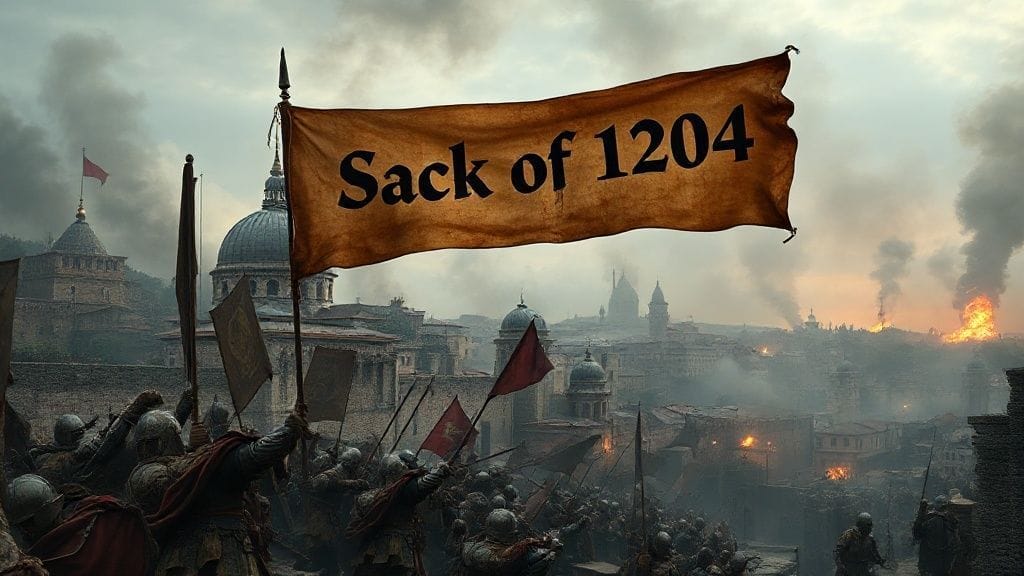
April 12 marked the moment the city’s defenses succumbed. The massive walls, tested by centuries of invasions, saw their first major collapse to a Christian force. Once inside, the Crusaders found themselves immersed in a bewildering labyrinth of palaces, churches, and narrow streets.
What followed was less battlefield conquest than the raw frenzy of looting and destruction. Houses were set ablaze, priceless artifacts ripped from their sanctuaries, and the cries of civilians echoed against ancient stone. The heroic discipline of the knights dissolved into frenzied bands determined to harvest the city’s legendary wealth.
This breach unleashed a torrent of suffering and devastation that was as much psychological as it was physical.
The Rampage Begins: Pillage and Destruction in the Heart of Byzantium
The initial hours of occupation saw indiscriminate carnage. Crusaders entered homes, churches, and markets alike, seizing gold, jewels, holy relics, and manuscripts. The imperial palace was ransacked, and its treasures transported to Venice and Western Europe as spoils of war.
The common populace bore the brunt of the violence. Accounts tell of mass killings, rapes, and enslavement, often justified in twisted rhetoric about punishing a heretical city. Women and children were not spared, and the city's artistic masterpieces—some created during the height of Byzantine civilization—were systematically destroyed or carted away.
As if in a macabre spectacle, churches like the Hagia Sophia were violated, their sacred spaces turned into stables or warehouses, their mosaics vandalized. Faith itself seemed to shatter amidst the roaring fires and looting.
Witnesses of Horror: Chroniclers and the Human Cost
The sack of 1204 was recorded by both Latin and Byzantine chroniclers, leaving a trove of vivid, often heartbreaking testimonies. Venetian Marino Sanudo described the horrors as “a terrible and unheard-of devastation.” Byzantine historian Niketas Choniates lamented the “tearing apart of the city’s very soul.”
These voices reveal a spectrum of human emotions: fear, rage, despair, and disbelief. Families were torn apart, clergy murdered or displaced, and an entire urban population traumatized. Contemporary accounts speak not just of lost property, but of a stolen identity—an empire’s heart ripped from its chest.
Importantly, these chronicles also underscore the deep divisions that allowed such a catastrophe: religious hatred, cultural misunderstandings, and political rivalries magnified in violence.
The Looting of the Hagia Sophia and Other Sacred Sites
Among the city’s many horrors, the desecration of the Hagia Sophia stands out as a symbol of the sack’s sacrilege. This basilica, consecrated a century earlier as the world’s grandest Christian edifice, was ransacked by Crusader knights. Precious icons and relics vanished, mosaic images defaced, and sacred altars destroyed.
The fury extended to other religious sites, including the Monastery of the Pantocrator and the Church of the Holy Apostles. For many Byzantines, these acts were not only sacrilegious—they were a profound betrayal of Christian fraternity.
The profound spiritual loss, combined with physical destruction, illuminated the extent to which the Crusaders had shattered the bonds of faith and trust.
Art, Relics, and Wealth: The Spiritual and Material Losses
Constantinople’s treasures were unmatched in medieval Christendom. Enormous quantities of gold, silver, jewels, and priceless artworks—including illuminated manuscripts and icons—were seized.
Venetian merchants and soldiers took much of this loot back to the West, sparking cultural waves by dispersing Byzantine art across Europe. However, this dispersal was also a cultural wound: a dispersal of knowledge, artistry, and religious tradition that fractured Byzantine identity.
The loss of relics and sacred artifacts, many believed to contain miraculous powers, deepened the spiritual crisis. Byzantium’s role as the custodian of Orthodox Christianity was gravely undermined.
The Role of Venetian Interests and the Quest for Treasure
Among the Crusaders, Venice played a dual role as both enabler and beneficiary. Doge Enrico Dandolo, himself blind and aged, orchestrated much of the campaign's diversion toward Constantinople, motivated as much by geopolitical calculation as by religious conviction.
Venice coveted the wealth of Byzantium as payment for its naval support in the Crusade and sought to cement its dominance over Eastern Mediterranean trade routes. Venetian merchants quickly claimed key quarters of the city after its fall, turning Constantinople into an entrepôt for Western goods and influence.
This fusion of sacred mission with mercantile ambition exemplifies how the Fourth Crusade deviated irrevocably from its initial spiritual path.
The Establishment of the Latin Empire: New Masters of Constantinople
Following the sack, Crusader leaders proclaimed Baldwin of Flanders as emperor, establishing the Latin Empire (1204–1261). This new regime sought to replace Byzantine governance structures with Western feudal models—a project fraught with resistance.
The Latin Empire struggled from the outset, lacking legitimacy among Greek Orthodox subjects and facing continuous attacks from Byzantine successor states such as the Empire of Nicaea and the Despotate of Epirus.
This political fragmentation evident after 1204 signaled the effective end of Byzantine preeminence and the beginning of a fractured, weakened East Christian polity.
Byzantine Resistance and the Empire in Exile
Despite the fall of Constantinople, Byzantine resistance endured. Several successor states declared themselves true heirs of the empire, notably the Empire of Nicaea, which became a refuge for exiled Byzantine nobility and clergy.
For nearly six decades, these entities worked to reclaim the capital and restore the Byzantine state. This period was marked by complex diplomacy, warfare, and cultural survival.
It was not until 1261 that Michael VIII Palaiologos retook Constantinople, reinstating the Byzantine Empire—though one forever altered by its 1204 humiliation.
The Long Shadow: How the Sack Reshaped East and West
The sack of Constantinople sent shockwaves far beyond its city walls. For the East, it marked a major rupture—pushing Byzantium into decades of decline and vulnerability, hastening its eventual fall to the Ottomans in 1453.
For the West, it opened trade routes and enriched Italian maritime republics, but also sowed deep mistrust between Orthodox and Catholic Christians, poisoning ecumenical hopes. The rift hardened, fueling centuries of religious rivalry.
Politically, the event highlighted the dangers of fragmented Christendom and foreshadowed the complex conflicts between burgeoning European powers and the Byzantine world.
The Cultural Devastation and the Dispersal of Byzantine Heritage
The dispersal of Byzantine treasures enriched Western Europe, influencing Renaissance art and scholarship, but also implied a cultural pillage that the Eastern Orthodox world mourned for generations.
Countless manuscripts and icons vanished or were destroyed, and the aesthetic and theological legacy of Byzantium fragmented. This loss delayed intellectual and artistic developments in the region and served as a cultural trauma whose echoes persisted in Eastern Europe and Russia.
The Aftermath: Political Repercussions Across Europe and the Near East
Politically, the establishment of the Latin Empire altered the power balance. Neighboring states jostled for influence amid the Byzantine collapse. The Seljuk Turks, Bulgarians, and emerging Serbian powers recalibrated their strategies in response.
The fractured Christian world allowed Muslim states to consolidate. The hoped-for recovery of Jerusalem became ever more remote.
Meanwhile, Western European monarchies grew more detached from Eastern Christendom, deepening misunderstandings that influenced continental diplomacy and warfare.
Memory and Myth: The Sack of Constantinople in Historical Narratives
Over centuries, the sack entered collective memory cloaked in myth and moral reckoning. In Byzantine sources, it was a catastrophic betrayal by misguided—or even heretical—brothers in Christ. Western narratives varied between justification and silence.
This event later became a symbol of Christian disunity and served as a cautionary tale in literature and religious discourse. It remained embedded in Orthodox identity as a historical pain, symbolic of Western imperialism and religious arrogance.
Lessons from Catastrophe: Reflections on Faith, Power, and Greed
Looking back, the sack reveals how idealism can be subverted by earthly motives. The Fourth Crusade’s descent into violence underscores the fragility of religious unity when confronted with political ambition and economic greed.
It invites reflection on the dangers of cultural arrogance and the devastating consequences when diplomacy fails. The human toll, remembered through chronicles and archaeological remains, continues to resonate as a somber warning.
The Rediscovery and Preservation of Byzantine Legacy in Modern Times
Today, the art and architecture of Byzantine Constantinople are celebrated globally, inspiring fascination and scholarly inquiry. Restoration efforts, archaeological discoveries, and cultural dialogues aim to reclaim the legacy marred by 1204’s destruction.
Institutions in Turkey, Greece, and beyond work to preserve what remains of this extraordinary civilization. The city itself, now Istanbul, embodies a fusion of histories—a testament to endurance amid transformations.
The sack, while a dark chapter, also stimulates conversations about reconciliation, heritage, and the shared history of civilizations.
Conclusion
The sack of Constantinople in April 1204 was more than a military conquest; it was a turning point that reshaped medieval history in profound and lasting ways. It revealed the precariousness of faith-based alliances, the destructive potential of political and economic ambitions entangled with religion, and the tragic cost borne by innocent lives caught in the waves of history.
But amid the ruins and sorrow, Constantinople’s story continues to inspire. The city’s beauty, resilience, and cultural achievements remind us that human creativity and spirit can survive even the most harrowing catastrophes.
As we remember the sack, we are called to reflect on the lessons of unity and humility, recognizing that history’s darkest moments are often also its most urgent teachers.
FAQs
Q1: What sparked the diversion of the Fourth Crusade toward Constantinople instead of Jerusalem?
A1: The diversion was primarily caused by financial difficulties faced by the Crusaders in paying Venice for naval support, combined with political intrigue involving Byzantine exiled princes seeking Western help to reclaim the throne, ultimately shifting the Crusade’s focus from the Holy Land to Constantinople.
Q2: Why was Constantinople so heavily targeted by the Crusaders despite being Christian?
A2: Religious schism between Eastern Orthodox and Roman Catholic Churches created mistrust, but deeper motives included Venetian commercial interests, the promise of immense wealth, and fractured Byzantine politics, which painted the city as both a prize and a rival.
Q3: What was the immediate impact of the sack on the Byzantine Empire?
A3: The empire was fractured, its capital occupied by Latin Crusaders who established the Latin Empire. Byzantine rulers fled and established successor states in exile, and Byzantium’s political and military power diminished sharply.
Q4: How did the sack affect Christian relations between East and West?
A4: It deepened the Great Schism, fostering lasting resentment and hostility between Orthodox and Catholic Christians, harming efforts at reconciliation and fueling religious division for centuries.
Q5: What cultural treasures were lost or stolen during the sack?
A5: Priceless artworks, relics, manuscripts, and architectural marvels were looted or destroyed, including treasures from the Hagia Sophia. Many were transported to Western Europe, dispersing Byzantine cultural heritage.
Q6: Who was Doge Enrico Dandolo and what role did he play?
A6: The blind Venetian Doge was a central architect behind the Crusade’s diversion to Constantinople, motivated by Venice’s strategic and economic interests, and his leadership profoundly influenced the campaign’s tragic outcomes.
Q7: When did the Byzantines manage to recapture Constantinople?
A7: In 1261, under Emperor Michael VIII Palaiologos, Byzantine forces retook Constantinople, ending the Latin Empire, but the city and empire never fully regained their former glory.
Q8: How is the sack of Constantinople remembered today?
A8: It is commemorated as a tragic betrayal within Eastern Orthodox memory and studied as a pivotal event illustrating the complexities of medieval Christendom, religious conflict, and cultural interaction.

