Table of Contents
- The Fall of Constantinople to the Crusaders: Dawn of a New Empire
- Prelude to Conquest: The Fourth Crusade’s Divergence
- Venice’s Ambition and the Fragile Alliances Forge
- Constantinople Before the Siege: A City of Glory and Vulnerability
- The Siege of April 1204: Brutality and Betrayal Unleashed
- The Sack of Constantinople: A Cataclysm of Culture and Civilization
- Baldwin of Flanders Crowned Emperor: The Latin Empire’s Birth
- The Complex Politics Behind the Latin Empire’s Formation
- The Role of Venice: Mastermind and Beneficiary
- Resistance and Fragmentation: Byzantine Successor States Emerge
- Latin Empire’s Governance: Challenges of Legitimacy and Control
- The Empire’s Economy: Trade, Tribute, and Venetian Dominance
- The Social and Religious Impacts: Orthodox Church Under Siege
- Military Struggles and Border Conflicts: A Fragile Dominion
- The Decline of the Latin Empire: Internal Strife and External Pressures
- The Recapture of Constantinople in 1261: Byzantine Revival
- Legacy of the Latin Empire: Cultural Loss and Political Aftermath
- Memory and Myth: How History Remembers 1204
- Lessons from the Latin Empire’s Rise and Fall
- Conclusion: Echoes of a Lost Empire in Modern History
- FAQs: Understanding the Latin Empire’s Place in History
- External Resource
- Internal Link
The Fall of Constantinople to the Crusaders: Dawn of a New Empire
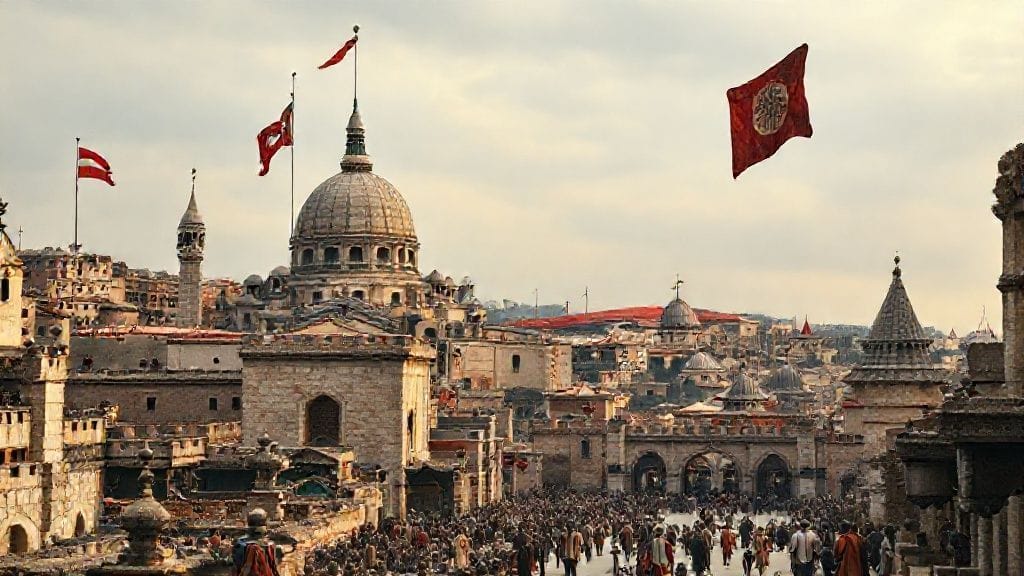
April 1204 was a month etched in fire and blood, where the skyline of Constantinople—once gleaming with golden domes and ancient fortifications—was torn asunder by the swords, flames, and greed of Western crusaders. The air hung thick with the smoke of burning libraries, churches, and homes, while the cries of those caught in the maelstrom echoed through narrow Byzantine streets. The Latin Empire had been born, not from a noble quest for holy land, but from a violent betrayal of Christian kin; its first emperor crowned amid ruins and sorrow, Baldwin of Flanders swept into an uneasy throne as a kingdom carved from conquest and calamity.
Yet, to understand this seismic upheaval, one must travel back into the tangled web of medieval politics, religion, and ambition that led the Crusaders far from their intended path. The Fourth Crusade was supposed to reclaim Jerusalem — and yet ended with one of the most controversial moments in Christian history: the sacking of Constantinople.
Prelude to Conquest: The Fourth Crusade’s Divergence
Conceived originally as a holy expedition, the Fourth Crusade was launched in 1202 with fervent hopes to retake Jerusalem from Muslim forces. However, the crusaders’ intentions were soon hijacked by a complex set of economic pressures and political manipulations. The Venetians, led by their shrewd leader Doge Enrico Dandolo, saw an opportunity to leverage the crusade to serve their own commercial ambitions against Byzantine economic hegemony.
Financially crippled and heavily indebted to Venice for transport, the crusaders found themselves entangled in Venetian schemes that diverted their forces first to Zara (a Christian city they captured and sacked) and then to Constantinople itself. This detour was grounded in Byzantine dynastic squabbles—most notably the exile of Alexios IV Angelos, son of the deposed emperor Isaac II, who promised substantial rewards in return for aid reclaiming the throne.
Venice’s Ambition and the Fragile Alliances Forge
Venice was no innocent bystander. Its naval power was unmatched in the Mediterranean, and they viewed the Byzantine Empire as both a competitor and an obstacle threatening their mercantile dominance. The city was the gateway between East and West, controlling critical trade routes. Venice’s doge, despite his advanced age and blindness, engineered the crusade’s course with ruthless precision.
This alliance of convenience was volatile. The crusaders’ original religious zeal collided with Venetian pragmatism, breeding tensions and fueling mistrust. The Byzantine princes’ promises were Leveraged to manipulate the crusaders, who were in desperate need of funds and supplies. This uneasy partnership would prove a fatal miscalculation.
Constantinople Before the Siege: A City of Glory and Vulnerability
Before the storm descended, Constantinople was the jewel of Christendom. Its massive walls, constructed by Emperor Theodosius II in the 5th century, were thought impregnable. The city was an amalgamation of grand imperial palaces, bustling markets, majestic churches—most famously Hagia Sophia—and a melting pot of cultures, arts, and scholarship.
However, despite its grandeur, the empire beneath was troubled. Politically fragmented and militarily overstretched, Byzantine rulers struggled to defend distant borders and maintain internal stability. The imperial court was rife with intrigue, and recent civil wars had weakened Constantinople’s ability to resist external threats.
The Siege of April 1204: Brutality and Betrayal Unleashed
When the crusaders finally turned their weapons on Constantinople in April 1204, they did so with calculated ruthlessness. Despite professing a shared Christian faith, the attackers showed little mercy. After breaching the walls following intense combat, sailors, knights, and mercenaries poured into the city.
The violent sack lasted for days. Palaces were looted, priceless works of art were destroyed or stolen, and churches desecrated. Many civilians were massacred or enslaved. Historian Geoffrey de Villehardouin, himself a crusader chronicler, described the chaos with chilling detachment, recounting the “shameful plunder” and widespread devastation.
The Sack of Constantinople: A Cataclysm of Culture and Civilization
The sack of 1204 represented more than just a military defeat; it was a catastrophic blow to Byzantine culture. Priceless manuscripts, relics, and icons were lost or scattered across Western Europe, many never to return. Hagia Sophia was turned into a Latin cathedral, sparking religious outrage.
This event fractured the Orthodox world, fanning centuries of mistrust between Eastern and Western Christendom. The loss of the city was a massacre of legacy, an irreparable rupture of what had been the anchor of Byzantine identity and religious life.
Baldwin of Flanders Crowned Emperor: The Latin Empire’s Birth
Amid the ruins, Baldwin of Flanders was proclaimed emperor on May 16, 1204. His coronation in the Hagia Sophia — degraded though it was — symbolized the Latin Empire’s establishment. Baldwin represented the Western feudal order, foreign to Byzantine traditions, and his reign epitomized the cultural and political dislocation wrought by conquest.
The new empire was a patchwork of Latin holdings on Byzantine lands, a fragile construct dependent on both military resistance and Venetian naval supremacy. Baldwin’s rule was marked almost immediately by conflict—both with Byzantine successor states vying for control, and with internal unrest among the diverse subjects he ruled.
The Complex Politics Behind the Latin Empire’s Formation
The creation of the Latin Empire wasn’t simply a byproduct of war; it was a carefully negotiated political arrangement, rife with competing interests. Venetian leaders secured key positions and territories—most notably the vital port of Galata and portions of the city itself.
Meanwhile, Western knights and nobles sought out fiefdoms and titles in the conquered lands. Many Byzantines viewed the Latin rulers as illegitimate usurpers, which fueled persistent resistance.
The empire depended on the fragile coalition of disparate Western powers lacking common ground beyond their military victory. This tenuous political balance would soon be tested.
The Role of Venice: Mastermind and Beneficiary
Venice’s influence in the Latin Empire was decisive. In exchange for providing the naval and logistical support critical to the conquest, Venice was granted extensive commercial privileges in Constantinople and the surrounding territories.
Venetian merchants dominated trade, shaping the city’s economy to favor their interests at the expense of indigenous Byzantine merchants. Their naval fleet secured control of crucial sea lanes, making Venice the Atlantic pivot for Eastern trade for decades.
Yet Venice’s dominance came at a cost: growing corruption, resentment, and the marginalization of native populations within the empire.
Resistance and Fragmentation: Byzantine Successor States Emerge
The fall of Constantinople sent ripples across the Byzantine world. Though the city was lost, loyalists regrouped in exile. Three principal successor states arose: the Empire of Nicaea, the Despotate of Epirus, and the Empire of Trebizond.
Among these, the Empire of Nicaea under Theodore I Lascaris emerged as the legitimate Byzantine heir, determined to reclaim lost lands. These states preserved Byzantine traditions, Orthodox faith, and imperial hopes, becoming centers of resistance to Latin rule.
Their existence complicated the Latin Empire’s authority, turning it from conqueror into a beleaguered regime under siege.
Latin Empire’s Governance: Challenges of Legitimacy and Control
The Latin rulers faced immense obstacles governing a city and empire that resented their presence. Linguistic, cultural, and religious divides separated them from the largely Greek population.
Administrative structures were often awkward hybrids of Western feudalism imposed onto Byzantine systems. Many Latin lords struggled to assert effective control over the countryside, which was rife with banditry and rebellion.
Lack of local support hampered taxation and military recruitment, undermining the empire’s sustainability.
The Empire’s Economy: Trade, Tribute, and Venetian Dominance
Economically, the Latin Empire relied heavily on Venetian trade networks. The new rulers attempted to extract tribute from Byzantine lands, but this was hampered by ongoing conflicts and loss of territory.
Venetian colonists established a mercantile oligarchy controlling the city’s key economic arteries. Their ships sailed gleaming trade routes, exporting grain, silk, and spices.
This economic shift enriched Venice enormously but created economic disparity and mounting resentment among locals.
The Social and Religious Impacts: Orthodox Church Under Siege
One of the most profound consequences of the Latin occupation was the assault on the Orthodox Church. Latin clergy replaced Greek bishops, igniting fierce religious conflicts.
The Orthodox clergy and laity saw the Latin presence as a sacrilege and an affront to their identity. Churches were plundered or converted for Catholic use, fueling deep fissures in East-West Christian relations that persist to this day.
This religious conquest deepened the cultural wounds inflicted by the sack.
Military Struggles and Border Conflicts: A Fragile Dominion
The Latin Empire never enjoyed peace. Surrounded by hostile states—Greek successor empires, Bulgarians, and Seljuk Turks—its borders were constantly contested.
The empire’s military was stretched thin, reliance on mercenary forces costly and often unreliable. Baldwin himself was captured and died in battle against the Bulgarians in 1205, highlighting the vulnerability of the new regime.
These ceaseless conflicts eroded the empire’s stability and territorial control.
The Decline of the Latin Empire: Internal Strife and External Pressures
Over the ensuing decades, the Latin Empire’s fortunes waned. Internal disputes over succession and governance fractured leadership, while its external enemies grew stronger.
Venice, while still a dominating force, shifted priorities elsewhere, leaving the empire isolated. Byzantine Greeks consolidated power, retaking lands steadily. By mid-century, the Latin dominion was little more than a shadow of its former ambitions.
This decline set the stage for Byzantine resurgence.
The Recapture of Constantinople in 1261: Byzantine Revival
In 1261, the Empire of Nicaea accomplished the improbable: the reconquest of Constantinople. General Alexios Strategopoulos seized the lightly defended city, restoring Byzantine rule under Michael VIII Palaiologos.
This return was a moment of triumph but came with scars. The city and empire were devastated, weakened economically and militarily. The revival was more restoration of lost heritage than renewal of imperial glory.
The Latin Empire was consigned to the annals of history, a cautionary tale of conquest and hubris.
Legacy of the Latin Empire: Cultural Loss and Political Aftermath
The Latin Empire’s legacy is a complex mosaic of cultural dislocation, political fragmentation, and long-lasting East-West Christian divisions. The sack of 1204 shattered centuries of Byzantine cultural continuity.
Western Europe gained precious relics and manuscripts but also deepened its mistrust of the Orthodox East. Byzantine political power fragmented, never fully regaining its former strength.
The Latin Empire’s brief existence reshaped Mediterranean geopolitics and the medieval world order.
Memory and Myth: How History Remembers 1204
The events of 1204 have taken on mythic proportions. In Orthodox memory, the sack is a symbol of betrayal and loss—termed “the deepest wound” in the Byzantine soul. Western narratives have often downplayed or justified the crusade’s detour.
Modern historians wrestle with divergent legacies: a crusade gone awry, Venetian ambition run amok, or tragic chapter in Christian disunity. The Latin Empire remains a stark lesson in the dangers of political greed and cultural arrogance.
Lessons from the Latin Empire’s Rise and Fall
The Latin Empire’s brief but tumultuous life reveals timeless dynamics—how ambition, religious zeal, and economic interests intersect in unpredictable, often violent ways.
It exposes the fragile nature of empires built on conquest without legitimacy and the costs of internal division during external threats. It reminds us that cultural heritage is vulnerable, and that history’s pendulum often swings swiftly between creation and destruction.
Conclusion: Echoes of a Lost Empire in Modern History
The Latin Empire of Constantinople stands as a stark monument to the crossroads of medieval Christendom, where faith clashed with power and civilization trembled. Its creation and destruction mirrored the fragility of alliances and the enduring scars wrought by war.
Though its life was brief, the reverberations of the Latin occupation echoed for centuries, shaping relations between East and West, altering the course of Byzantine and Mediterranean history. Beyond politics and battle, it is a story of human aspiration and tragic loss—reminding us of the fragility of cultural splendor amid the unforgiving march of ambition and conflict.
FAQs
Q1: What caused the Fourth Crusade to divert and ultimately attack Constantinople?
A1: Economic debts to Venice, political manipulation, and Byzantine dynastic disputes led the crusaders away from their original goal to Constantinople, where shifting alliances and Venetian ambition redirected the crusade’s course.
Q2: Who was Baldwin of Flanders and what role did he play in the Latin Empire?
A2: Baldwin of Flanders was a leading crusader noble who was crowned the first Latin Emperor of Constantinople in 1204. His reign was marked by military challenges and attempts to assert control over the fragmented Byzantine territories.
Q3: How did the Latin Empire impact Byzantine Orthodox Christianity?
A3: The Latin Empire suppressed the Orthodox Church, replacing Greek bishops with Latin clergy, looting churches, and deepening the religious rift between Eastern Orthodoxy and Western Catholicism.
Q4: What were the main successor states following Constantinople’s fall?
A4: The main Byzantine successor states were the Empire of Nicaea, the Despotate of Epirus, and the Empire of Trebizond, each vying to reclaim Byzantine heritage and resist Latin domination.
Q5: How long did the Latin Empire last, and what ended it?
A5: The Latin Empire lasted approximately 57 years, from 1204 until 1261, when Byzantine forces under Michael VIII Palaiologos recaptured Constantinople, restoring Byzantine rule.
Q6: What role did Venice play in the Latin Empire’s establishment and economy?
A6: Venice orchestrated much of the Fourth Crusade’s route, gained significant territories and commercial privileges, and dominated the empire’s economy, using it to cement their maritime and economic power in the region.
Q7: Why is the sack of 1204 considered a major turning point in Christian history?
A7: Because it represented a brutal rupture between Eastern Orthodox and Western Catholic Christians, devastating Byzantine culture, and deepening religious and cultural divides that would have profound historical consequences.
Q8: How is the Latin Empire remembered in modern scholarship and popular memory?
A8: It is viewed as a tragic era of betrayal and fragmentation—both a cautionary tale of overreach and a historical event that shaped medieval geopolitics, often evoked in discussions on East-West relations.

