Table of Contents
- The Dawn of Destiny: Muret on the Eve of Battle
- The Troubled South: Political and Religious Turmoil in Early 13th Century Languedoc
- Simon de Montfort: The Crusader Count and His Vision
- The Albigensian Crusade: Background to the Bloodshed
- The Rival Forces Gather: Counts, Kings, and the Lords of Occitanie
- The Day of Reckoning: September 12, 1213, Muret’s Battlefield Comes Alive
- Tactical Genius and Brutal Resolve: The Course of the Battle
- The Death of Peter II of Aragon: A King Falls
- The Aftermath: Shockwaves Through Languedoc and Beyond
- The Siege of Toulouse: Consequences of Montfort’s Victory
- The Shift of Power: The Albigensian Crusade Intensifies
- Faith, Politics, and Identity: The Cultural Impact of the Battle of Muret
- Memory and Myth: How Muret Entered History and Legend
- Modern Reflections: Muret’s Legacy in the French and Occitan Collective Imaginations
- Revisiting the Battlefield: Archaeology and Historical Debate Today
- Conclusion: From Muret to Memory — The Enduring Echo of a Crusading Victory
- FAQs: Understanding the Battle of Muret
- External Resource
- Internal Link
1. The Dawn of Destiny: Muret on the Eve of Battle
September 12, 1213, began with a strange calm over the small town of Muret, nestled in the rolling hills of Languedoc, southern France. Mist hung low over vineyards and olive groves, cloaking the landscape in a fragile veil that seemed to mute the anxious whispers of the townsfolk. Yet beneath this tranquil dawn, fate was brewing a violent storm set to redraw the map of medieval Europe. The sun would rise not just on a routine day but on a clash of knights, kings, and convictions—a collision destined to shape the region’s religious and political future for centuries. This was no ordinary battle; this was the Battle of Muret, where Simon de Montfort, the indomitable leader of the Albigensian Crusade, sought to cement his power amid a fracturing society.
2. The Troubled South: Political and Religious Turmoil in Early 13th Century Languedoc
Long before the clash beneath Muret’s walls, Languedoc was a land of contradictions: wealth and piety, culture and heresy, loyalty and rebellion. The region was a mosaic of independent counties and lordships, united only by their shared Occitan tongue and its flourishing culture of troubadours and nobles. Nonetheless, beneath the surface thrived a religious tension that would explode violently in the early 13th century. The Cathars, deemed heretics by the Catholic Church for their dualistic theology rejecting the material world as evil, had gained substantial influence among the local populations.
By 1208, Pope Innocent III declared the Albigensian Crusade to eradicate Catharism, a holy war unlike any other—a campaign authorized against fellow Christians. The political dynamics only complicated matters: powerful families such as the Counts of Toulouse, under Raymond VI, were suspected of tolerating or even sheltering Cathar heretics. Meanwhile, the northern French nobility, eager to expand southward, saw the Crusade as an opportunity for conquest and authority.
3. Simon de Montfort: The Crusader Count and His Vision
At the heart of this maelstrom stood Simon de Montfort, a man of formidable resolve and iron conviction. A French nobleman born around 1165, Simon had risen to prominence not through traditional inheritance alone but through a burning dedication to the papal cause. Entrusted with the crusading mission, Montfort was more than a military commander; he was the embodiment of the Church’s resolve to reshape Occitania culturally and politically.
His vision was uncompromising: an Occitania purged of heresy, integrated firmly into the Kingdom of France’s orbit, and controlled by loyal lords who would enforce orthodox Catholic rule. The campaign was brutal, marked by sieges, massacres, and relentless warfare, but it was also a campaign of transformation for the region’s political order. Simon’s personal charisma and tactical brilliance made him a formidable opponent and a symbol of the northern crusading forces.
4. The Albigensian Crusade: Background to the Bloodshed
The Albigensian Crusade was not a typical crusade to the Holy Land; it unfolded on French soil, across disputed noble territories. It began in earnest in 1209, after the assassination of Pierre de Castelnau, papal legate and fervent opponent of the Cathars—an event that crystallized the Church’s wrath.
This conflict escalated tensions between northern French crusaders led by Montfort and southern Occitan nobility allied with the Cathars or sympathetic to their cause. By 1213, after a series of sieges and skirmishes, the crusade had become a gruelling war for dominance. The stage was set for a decisive confrontation near Muret—a small town that had become a strategic flashpoint between the Count of Toulouse and the crusader movement.
5. The Rival Forces Gather: Counts, Kings, and the Lords of Occitanie
On one side stood Simon de Montfort, his troops hardened by years of crusading zeal and accustomed to brutal siege warfare; on the other, a coalition of southern nobles determined to repel this northern incursion. The south had powerful allies, perhaps none more significant than Peter II of Aragon, a neighboring king with vested interests in protecting Occitania’s autonomy and his family’s connections.
Peter led a sizeable force of knights and infantry, joined by the Count of Toulouse, Raymond VI, and other lords rallying to defend their lands and way of life. This battle was more than a military confrontation; it was a defense of identity, religion, and sovereignty against an aggressive external force. The lines drawn at Muret could seal the fate of an entire culture—and a king.
6. The Day of Reckoning: September 12, 1213, Muret’s Battlefield Comes Alive
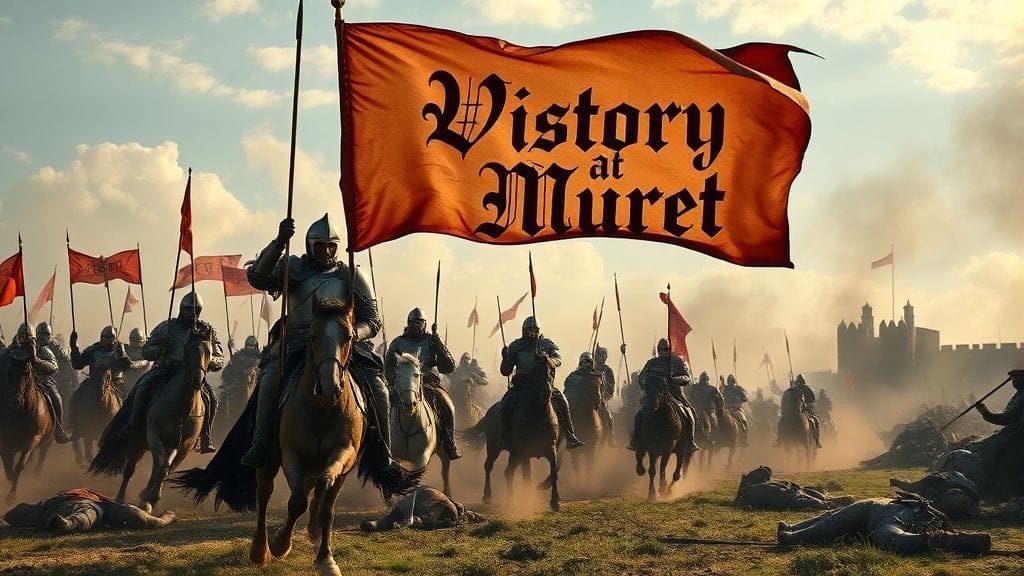
As the morning mist lifted, the knights arrayed themselves on the dry plains outside Muret. Simon de Montfort’s forces, though outnumbered, stood ready. Contemporary chroniclers emphasize the discipline and strategic acumen of Montfort’s men, contrasting starkly with the occasionally disorganized southern coalition.
The clash began with a series of charges, lances shattering, steeds screaming, and swords flashing in the bright September sun. Simon, wielding both leadership and inspiration, directed his men with focused intensity. His troops drove forward in tight formations designed to break the enemy’s ranks effectively.
Despite facing overwhelming numbers, Montfort’s forces exploited momentary gaps and confusion among the southern troops. The decisive moment came when Peter II of Aragon was struck down—cut down in the melee, a blow that devastated the morale and structure of the southern alliance.
7. Tactical Genius and Brutal Resolve: The Course of the Battle
Simon de Montfort’s success at Muret was not merely a product of valor but of calculated tactics. His choice of battlefield, the employment of cavalry charges at critical moments, and his ability to maintain discipline amidst chaos turned the tide. The enemy, meanwhile, was hampered by divergent objectives and less cohesive command.
Montfort’s forces dismounted key units to hold the line, used light cavalry to harass and encircle, and adapted swiftly to shifting lines of battle. The death of Peter II and the loss of command led many southern knights to retreat or scatter. The battle ended in a decisive crusader victory, with heavy casualties on the southern side and numerous prisoners taken.
8. The Death of Peter II of Aragon: A King Falls
The killing of Peter II during the heat of battle was not just a military loss but a symbolic catastrophe for the Occitan cause. Peter was a respected warrior-king, key to southern resistance against northern domination. His presence on the battlefield embodied the alliance between Occitania and Aragon.
Chroniclers describe the king fighting gallantly before being overwhelmed. His death plunged Aragon into mourning and weakened that kingdom’s influence over the region. It also shattered the unity of Occitan nobility, accelerating the decline of their resistance. Montfort’s triumph was inextricably linked to the fall of this charismatic monarch.
9. The Aftermath: Shockwaves Through Languedoc and Beyond
The news of Montfort’s victory spread quickly through France and the broader European world. The immediate aftermath saw the consolidation of crusader power in Languedoc, with many local lords swearing fealty to Montfort. The crusaders imposed stricter orthodoxy and governance, ushering in a new era.
However, the region was far from pacified. Guerrilla resistance, sieges, and political intrigue would continue to mark the following years. The battle, while decisive, was one step in an ongoing, painful process of cultural subjugation and transformation. The seeds of resentment and identity crisis took root alongside the triumph.
10. The Siege of Toulouse: Consequences of Montfort’s Victory
The victory at Muret cleared the way for the siege of Toulouse, the heart of the Count’s power and a Cathar stronghold. Montfort pressed his advantage, determined to crush the remaining resistance once and for all.
The siege itself became emblematic of the cruel and exhaustive nature of the crusade. Toulouse endured hardship, famine, and devastation as Montfort’s forces encircled it. The battle’s ripple effects transformed the political map, undermining the independence of southern lords and increasing northern French influence.
11. The Shift of Power: The Albigensian Crusade Intensifies
Muret marked a pivotal point in the crusade’s momentum. After this victory, Simon de Montfort was acknowledged by the Church as the new Count of Toulouse, a title heavily contested and symbolic of northern ascendancy. His rule over parts of Languedoc, however, remained precarious, constantly challenged by local resistance and political discontent.
The crusade continued through the years, marked by fluctuating fortunes but relentless northern determination to extinguish Catharism and assert royal authority. Muret was the fulcrum of this transformation—a painful pivot towards centralized French control.
12. Faith, Politics, and Identity: The Cultural Impact of the Battle of Muret
Beyond its military significance, the Battle of Muret was a crucible for the cultural identity of Languedoc. The region’s distinctive culture, language, and religious particularities faced systematic suppression after the crusade’s advances.
The conflict blurred lines between ecclesiastical aims and political ambition, leaving a legacy of bitterness and marginalization among the Occitan people. This struggle for identity and survival found echoes in literature, oral tradition, and later Occitan revivalist movements. The memory of Muret became a symbol of loss and resilience for generations.
13. Memory and Myth: How Muret Entered History and Legend
In the centuries following the battle, Muret occupied a complicated space in history and popular memory. Medieval chroniclers celebrated Montfort as a hero of orthodoxy and the church, while local Occitan narratives mourned the catastrophe and martyrdom of their king and culture.
The battle inspired countless poems, songs, and stories that kept the memory alive, sometimes romanticizing the fierce defense of liberty, sometimes vilifying the crusader conquerors. This mythologizing shaped regional identity and historical scholarship alike.
14. Modern Reflections: Muret’s Legacy in the French and Occitan Collective Imaginations
Today, the Battle of Muret resonates in the collective consciousness of both France and the Occitan territories. Historians debate Montfort’s role—hero or villain—while locals commemorate the battle as a defining moment of cultural challenge.
In Occitan poetry and festivals, the echoes of the battle remind descendants of a lost independence and distinct language under threat. For France, it remains a symbol of medieval state-building and the complex intertwining of religion and power. Muret encapsulates the eternal tension between unity and diversity in European history.
15. Revisiting the Battlefield: Archaeology and Historical Debate Today
Recent archaeological efforts around Muret have aimed to clarify the battlefield’s precise layout and the scale of the combatants. Artefacts such as arrowheads, horse fittings, and weapon fragments provide tangible links to that fateful day.
Historians continue to analyze chroniclers’ accounts and reappraise Montfort’s tactics and impact, balancing between propaganda and reality. This ongoing scholarship deepens our understanding of not just the battle but the complex era it symbolized.
Conclusion: From Muret to Memory — The Enduring Echo of a Crusading Victory
The Battle of Muret was more than a military engagement; it was a turning point that altered the course of southern France’s history forever. Simon de Montfort’s victory reshaped the political, religious, and cultural landscape of Languedoc, marking the beginning of the end for Occitan autonomy and Catharism’s presence. Yet, beneath the black and white of victory and defeat lies a tapestry of human stories—of valor, conviction, loss, and transformation.
This battle reminds us that history is lived and remembered not only through grand strategies and titles but in the hearts of those who endure its consequences. The plains of Muret still whisper echoes of swords and prayers, a reminder of the complexity and tragedy of crusading zeal intersecting with a region’s soul.
FAQs
Q1: What triggered the Battle of Muret in 1213?
A1: The battle arose from the escalating conflict of the Albigensian Crusade, sparked by the Church’s campaign against Cathar heresy and the political struggle between northern French crusaders led by Simon de Montfort and southern Occitan lords allied with Peter II of Aragon.
Q2: Who was Simon de Montfort, and why was he important?
A2: Simon de Montfort was a French nobleman and the leader of the Albigensian Crusade. His victory at Muret cemented his power in Languedoc and greatly advanced the crusader and papal cause to suppress Catharism and extend northern French influence.
Q3: Why was the death of Peter II of Aragon significant?
A3: King Peter II was a key ally of the southern Occitan nobility. His death at Muret not only decapitated the southern resistance’s leadership but also symbolized the collapse of Aragon’s influence and the defeat of the regional alliance defending Occitan autonomy.
Q4: What were the broader consequences of the Battle of Muret?
A4: The battle paved the way for northern French dominance in southern France, weakened Cathar power, intensified the Albigensian Crusade, and led to cultural and political suppression of Occitania’s unique identity.
Q5: How is the Battle of Muret remembered today?
A5: Muret holds a dual legacy as both a symbol of crusader triumph and Occitan cultural tragedy. It features prominently in regional memory, historical debate, and cultural expressions underscoring identity and loss.
Q6: Did the battle end the Albigensian Crusade?
A6: No, while Muret was decisive, the crusade continued for many years after, marked by further sieges and conflicts before the Cathar heresy was finally extinguished.
Q7: What role did religion play in the battle?
A7: Religion was central—the conflict was framed as a crusade against heresy, legitimizing northern aggression and motivating both military and political efforts in a volatile mix of faith and power.

