Table of Contents
- A Clash of Worlds on the Steppe: The Stage Is Set
- The Mongol Tide: Origins of an Empire on the Move
- Rus’ Land on the Brink: Political Fragmentation and Threats
- The Road to the Kalka River: A Fateful Encounter
- May 31, 1223: Dawn of Battle at the Kalka
- Strategies and Commanders: The Generals on Both Sides
- The Battle Unfolds: From Skirmishes to a Crushing Blow
- Tales of Valor and Desperation: Warriors Caught in the Storm
- Mongol Tactics: Psychological Warfare and Mobility
- The Rus’ Defeat: Aftermath on the Battlefield
- The Siege of Souls: Prisoners and Displays of Power
- Shifting Sands: How the Battle Foreshadowed Mongol Conquests
- Political Reverberations: Fragmentation and Fear Among Rus’ Princes
- Legacy of the Defeat: Memory in Chronicles and Folklore
- Lessons from the Kalka: The Mongols’ Military Genius and Rus’ Unpreparedness
- The Battle’s Place in the Grand Sweep of Eurasian History
- Conclusion: A River’s Blood and the Dawn of Mongol Dominance
- FAQs: Unpacking the Battle of the Kalka River
- External Resource
- Internal Link
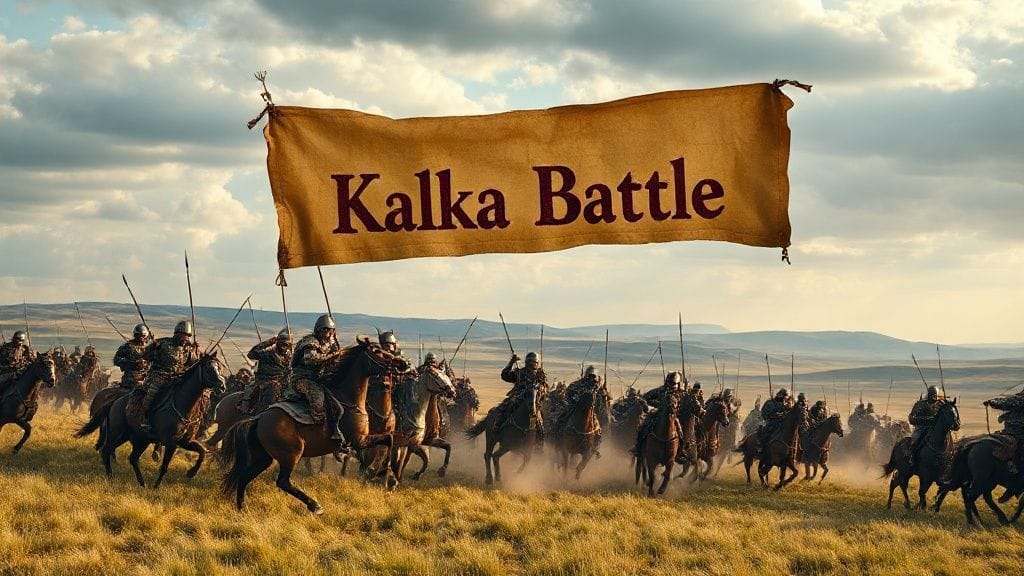
The vast expanse of the Eurasian steppe, under the golden blaze of a May sun, was about to become a theater of one of the most decisive and harrowing clashes of the early 13th century. On May 31, 1223, the armies of the Mongol Empire—fierce, disciplined, and adaptive—would face an unsteady coalition of Rus’ princes along the banks of the Kalka River, a tributary of the Sea of Azov. This was not merely a battle over land or plunder; it was a collision between two worlds: the fluid, horsemanship-based nomadic culture of the Mongols, and the fractured, feudal principalities of Rus’ struggling to maintain their sovereignty.
A Clash of Worlds on the Steppe: The Stage Is Set
The steppe landscape—a seemingly endless panorama sweeping westward—had long been the highway for nomads, merchants, and conquerors. By the early 13th century, the steppes had become the launching pad of an unprecedented wave of conquests led by a young ruler named Genghis Khan and his formidable successors. The Mongol Empire, forged in the crucible of hardship and relentless warfare, was expanding rapidly from Mongolia to the fringes of Eastern Europe.
To the west lay the clusters of Rus' principalities—Kyiv, Galicia-Volhynia, Vladimir-Suzdal among others—divided by rivalries and dynastic squabbles. Their knights and armies bore the scars of constant battles against each other, Cumans to the south, and various other hordes. Steppe diplomacy was a delicate dance, and for the Rus’ princes, the threat posed by the Mongols was both mysterious and terrifying.
The Mongol Tide: Origins of an Empire on the Move
The Mongols were not just conquerors wielding brute force; they were unparalleled strategists and masters of mounted warfare. Their rise began modestly under the leadership of Temujin, later crowned Genghis Khan in 1206. Through unification and ruthless efficiency, the Mongols had forged an empire where skill, loyalty, and mobility were king.
By 1223, their western vanguard was probing into Eastern Europe to assess the strength of neighboring powers and to expand the empire’s influence. The initial encounters with the Rus’ were not just military actions, but combinations of reconnaissance, plunder, and psychological testing. The Mongol cavalry—fast, disciplined, and with composite bows that rained arrows from a distance—would soon introduce the Rus’ to a style of warfare they had never faced.
Rus’ Land on the Brink: Political Fragmentation and Threats
The political map of the Rus’ principalities was a mosaic of competing interests. Princes guarded their domains jealously, often at odds with each other. This disunity was one of the critical vulnerabilities in facing an organized and unified external threat. Compounding this was the uneasy relationship with the Cumans, the nomadic Turkic tribes who roamed the steppe south of the Rus’. At times allies, at times enemies, the Cumans had themselves clashed with the Mongols, and their shifting alliances set the stage for the battle to come.
The Rus’ armies were composed mostly of heavy cavalry, infantry levies, and militia, lacking the mobility and coordination that the Mongols possessed. This was a crucial disadvantage that would soon become brutally apparent at the Kalka River.
The Road to the Kalka River: A Fateful Encounter
The Mongols’ western expedition was led by generals Subutai and Jebe, two of Genghis Khan’s most trusted commanders. They had pursued the defeated Cumans into Rus’ territory, seeking to decisively dismantle the steppe opposition to Mongol expansion. The Rus’ princes, alerted to the danger, assembled a coalition force, pooling resources and men.
Yet, suspicion and lack of unified command plagued their assembly. Among them were Mstislav the Daring of Galicia, Mstislav II of Kiev, and other princes whose armies converged near the Kalka River. What followed would test alliances and bravery in desperate fashion.
May 31, 1223: Dawn of Battle at the Kalka
The morning of May 31 dawned thick with tension. Scouts reported the Mongol forces advancing like a wave over the plains. The Rus’ commanders met hurriedly on the riverbanks, attempting to coordinate a strategy that could absorb and repel the swift, relentless Mongol assaults.
The air was heavy with both hope and dread—hope that unity might save them, dread of the unknown tactics of their adversaries. The sharp neighs of horses and the clinking of armor soon gave way to the thunder of hooves and the cries of men as the battle erupted in full fury.
Strategies and Commanders: The Generals on Both Sides
On the Mongol side, Subutai and Jebe employed a combination of feigned retreats, swift encirclements, and relentless pressure. Their forces were small but supremely flexible, with light cavalry units capable of harassing the enemy and drawing them into traps.
Leading the Rus’ forces were seasoned princes but with conflicting aims. Mstislav the Daring, noted for his courage and aggressive stance, sought to engage decisively; others favoured caution or were less coordinated. The mosaic of tactics reflected the fragmented political reality of the Rus’.
The Battle Unfolds: From Skirmishes to a Crushing Blow
Initially, both sides tested each other with skirmishes along the riverbanks. However, the Mongols’ classic stratagem of a feigned retreat soon baited the Rus’ forces into chasing, disrupting their formations and making them vulnerable to Mongol cavalry circling around for devastating flanking attacks.
The Rus’ army—for all its bravery—was unable to regroup effectively once drawn into the steppe’s vast openness. Step by step, the Mongol forces encircled and massacred their opponents, turning what had been a promising coalition into a route.
Tales of Valor and Desperation: Warriors Caught in the Storm
Among the stories that emerged from Kalka were accounts of startling courage—as noble Rus’ knights fought to the last, covering their prince's retreat, or the desperation of civilians caught in the widening chaos. Chroniclers, both Rus’ and Mongol, would recount moments of heroism, betrayal, and tragedy.
Mstislav the Daring, known for defiance, met a grim fate, and nearly all leaders perished or were captured, their executions serving as brutal warnings of Mongol resolve.
Mongol Tactics: Psychological Warfare and Mobility
The Mongols excelled not only at physical combat but in psychological manipulation. Reports mention their use of exaggerated numbers, lightning strikes, and displays of ruthlessness designed to terrify and demoralize foes. Their ability to coordinate across vast distances and adapt to terrain showcased an advanced military culture rarely matched in the region.
The Rus’ Defeat: Aftermath on the Battlefield
By nightfall, the Rus’ army lay shattered. The Kalka River ran red, a symbol both of defeat and of the sweeping change that would come over Eastern Europe. The Mongol victory was total; those captured were subjected to brutal punishment, and survivors fled in disarray.
The Siege of Souls: Prisoners and Displays of Power
In the days following, captured Rus’ princes and warriors were executed in a manner intended to leave no doubts about Mongol supremacy. They fashioned mock thrones from the skulls of enemies and sent terrifying messages back to Eastern Europe, heralding a new era dominated by the Mongol yoke.
Shifting Sands: How the Battle Foreshadowed Mongol Conquests
Though the Mongols did not immediately occupy Rus’ after Kalka, this battle marked the beginning of a more extensive campaign that would culminate in the devastating invasions of the late 1230s and beyond. The battlefield exposed the weaknesses of the Rus’ and served as a dire lesson in the importance of unity and adaptation.
Political Reverberations: Fragmentation and Fear Among Rus’ Princes
The shockwaves of the defeat deepened divisions within Rus’. Princes blamed one another for the failure, trust eroded further, and while some sought alliances or tribute arrangements, others prepared for a new and more relentless enemy. The Mongol shadow loomed large, changing the political calculus for decades.
Legacy of the Defeat: Memory in Chronicles and Folklore
The Battle of Kalka entered Rus’ collective memory as a symbol of both tragedy and warning. Chronicles lamented the heroism and the folly leading to defeat, while folklore embellished tales of the fierce and cunning Mongol warrior and the doomed Rus’ knights. The event echoed through generations, influencing perceptions of invaders, resilience, and identity.
Lessons from the Kalka: The Mongols’ Military Genius and Rus’ Unpreparedness
Historians often point to Kalka as a stark testament to the Mongols' superior military organization and adaptability. The Rus’ failure to coordinate, underuse of intelligence, and underestimation of the enemy culminated in disaster. For the medieval world, it was a devastating wake-up call about the shifting balance of power.
The Battle’s Place in the Grand Sweep of Eurasian History
In the broader panorama of history, the Battle of the Kalka River was one thread in the vast tapestry of Mongol expansion that reshaped trade, culture, and politics across Eurasia. It symbolized the collision of settled and nomadic societies, the transformation of warfare, and the onset of a new geopolitical order.
Conclusion: A River’s Blood and the Dawn of Mongol Dominance
The Kalka River flows quietly still, but beneath its serene surface lies the memory of a day when the fate of nations hung in the balance. The Mongol victory in 1223 was a brutal prelude to a sweeping transformation of Eastern Europe and beyond—where empires would rise and fall, alliances would be remade, and the very shape of history would change. This battle, often overshadowed by later Mongol conquests, speaks vividly of courage, miscalculation, and the relentless march of an empire destined to connect, conquer, and transform the medieval world.
Conclusion
The Mongol defeat of the Rus’ at the Kalka River was more than a battlefield victory; it was an event that crystallized the vulnerabilities of fragmented medieval societies against a rising, unified force of steppe warriors. It demanded a reckoning with new military realities and triggered profound political and cultural shifts that echoed for centuries.
The courage of the Rus’ princes and their armies, though ultimately overwhelmed, is a testament to a world on the brink of irrevocable change. The Mongols’ blend of strategic genius, adaptability, and psychological warfare rewrote the rules of engagement on the vast Eurasian steppes.
In history’s grand theater, the Kalka stands as a somber reminder of the tides of power that shape human destiny—how a river’s blood can signify both an ending and a beginning.
FAQs
Q1: Why did the Mongols attack the Rus’ principalities in 1223?
The Mongols were expanding their empire westward and sought to eliminate potential threats like the Cumans, who had alliances with some Rus’ principalities. The attack was a reconnaissance-in-force aiming to weaken steppe opposition and test Rus’ military strength.
Q2: Who were the main commanders on both sides at the Battle of Kalka?
The Mongol forces were led by generals Subutai and Jebe, two of Genghis Khan’s top strategists. The Rus’ coalition included several princes, such as Mstislav the Daring of Galicia and Mstislav II of Kiev.
Q3: What made the Mongol forces so effective against the Rus’?
Their exceptional mobility, disciplined light cavalry, use of psychological warfare, feigned retreats, and superior coordination enabled them to outmaneuver the heavier and less unified Rus’ armies.
Q4: What were the immediate consequences of the battle for the Rus’ principalities?
The defeat weakened the Rus’ politically and militarily, deepened internal divisions, and paved the way for future Mongol invasions that would dominate the region for decades.
Q5: Did the Mongols conquer Rus’ immediately after the battle?
No, the Mongols retreated after the battle but returned in force during the 1230s, initiating a full-scale invasion that resulted in the subjugation of the Rus’ lands.
Q6: How is the Battle of Kalka remembered in Russian and Ukrainian history?
It is remembered as a tragic defeat but also a narrative of resistance and valor. It features in chronicles and folklore as a significant early encounter with the Mongol Empire.
Q7: What lessons did the Rus’ and other European powers learn from this battle?
The importance of unity, intelligence gathering, adaptation to new military tactics, and respect for the Mongols as a formidable power became clear after this devastating encounter.
Q8: How did this battle influence the Mongol strategy going forward?
It reinforced Mongol confidence in rapid, decisive strikes and demonstrated the effectiveness of combining cavalry mobility with psychological tactics, shaping their subsequent campaigns across Eurasia.

