Table of Contents
- Introduction
- A Daughter, Not a Heir
- Early Childhood and Political Peril
- The Tower Years and Survival
- Ascension to the Throne
- The Elizabethan Religious Settlement
- Image of a Monarch: The Virgin Queen
- Patron of the Arts and Renaissance
- Foreign Policy and the Spanish Armada
- Personal Life and Marriage
- Rivalry with Mary, Queen of Scots
- Challenges at Home and Abroad
- Legacy of a Queen
- Final Years and Death
- External Resource
- Internal Link
1. Introduction
On September 7, 1533, Elizabeth Tudor was born at Greenwich Palace, the second daughter of King Henry VIII and his second wife, Anne Boleyn. Her arrival was greeted with disappointment, as England awaited a male heir. Few could have predicted that this infant girl would one day become one of the most powerful and iconic monarchs in British history.
2. A Daughter, Not a Heir
Henry VIII had broken with the Roman Catholic Church in part to marry Anne Boleyn and produce a male heir. When Elizabeth was born a girl, this disrupted his plans and strained their marriage. Anne’s failure to produce a son led to her arrest and execution in 1536, when Elizabeth was just two years old.
This tragic event stripped Elizabeth of her status as a legitimate heir, reducing her to Lady Elizabeth and casting her into the complex web of Tudor succession.
3. Early Childhood and Political Peril
Elizabeth’s youth was marked by uncertainty and danger. She witnessed the rise and fall of stepmothers, and the volatile religious changes of her father’s reign. Educated by some of the finest tutors, including Roger Ascham, Elizabeth became fluent in Latin, Greek, French, and Italian, and was a keen scholar.
Her education played a vital role in forming her political acumen, enabling her to navigate the treacherous court politics that defined the Tudor court.
4. The Tower Years and Survival
Under the reign of her half-sister, Mary I, a devout Catholic, Elizabeth was suspected of involvement in Protestant plots, especially the Wyatt Rebellion in 1554. She was imprisoned in the Tower of London, uncertain whether she would live or die. This time in the Tower deeply affected Elizabeth but also hardened her resolve.
Eventually released, she lived under house arrest at Hatfield House until Mary’s death.
5. Ascension to the Throne
In 1558, following Mary I’s death, Elizabeth ascended the throne at age 25, greeted by a country weary of religious persecution and political instability. Her coronation marked the beginning of the Elizabethan era, a period of relative peace, flourishing culture, and strengthened national identity.
6. The Elizabethan Religious Settlement
One of Elizabeth’s first and most defining acts was the Elizabethan Religious Settlement, which sought a middle ground between Catholicism and Protestantism. The Act of Supremacy (1559) re-established the monarch as the head of the Church of England, while the Act of Uniformity standardized worship practices.
This compromise brought relative religious peace after decades of turmoil and persecution.
7. Image of a Monarch: The Virgin Queen
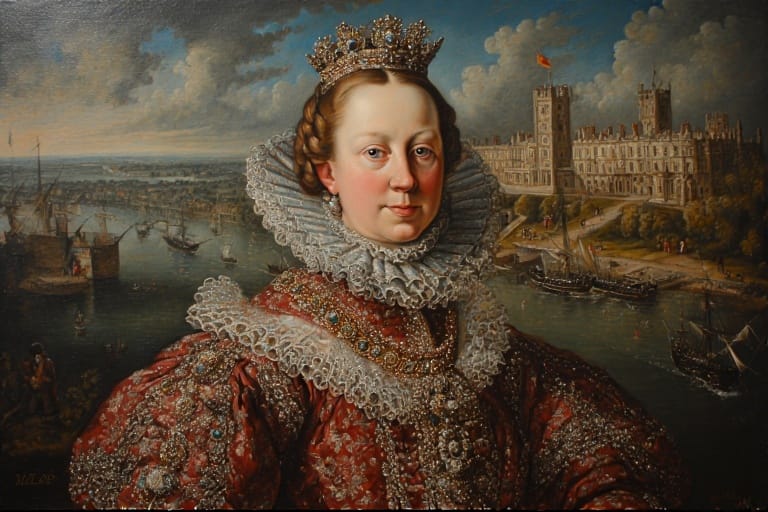
Elizabeth carefully crafted her public image, portraying herself as married to her people rather than a husband. Her decision to remain unmarried earned her the moniker “The Virgin Queen”, a symbol of purity, strength, and devotion to England.
She used portraits, speeches, and festivals to solidify her status as a unifying figure, and her charisma helped her maintain authority over a court and country dominated by men.
8. Patron of the Arts and Renaissance
The Elizabethan era is renowned for its cultural achievements, much of which was encouraged by the Queen herself. She was a patron of William Shakespeare, Christopher Marlowe, and Edmund Spenser. Theatres flourished, and the English language evolved dramatically.
Music, poetry, exploration, and science were also championed, and her court became a center of innovation and expression.
9. Foreign Policy and the Spanish Armada
Elizabeth’s foreign policy was largely defensive, yet pragmatic. She engaged in complex diplomacy, avoided overcommitment, and skillfully navigated threats. Her greatest foreign policy triumph came in 1588, when the Spanish Armada, sent by Philip II of Spain, attempted to invade England.
Against the odds, the English navy, aided by bad weather and strategic brilliance, defeated the Armada, securing Elizabeth’s reputation as a defender of Protestant England.
10. Personal Life and Marriage
Elizabeth’s refusal to marry was both personal and political. Though she entertained suitors—including Robert Dudley, King Philip II, and the Duke of Anjou—she remained unwed. This preserved her political independence and avoided the instability that a foreign prince or domestic faction might introduce.
Her court was alive with speculation, intrigue, and gossip, but Elizabeth maintained strict control over her image and court dynamics.
11. Rivalry with Mary, Queen of Scots
Elizabeth’s cousin and rival, Mary Stuart, posed a continuous threat to her reign. A devout Catholic with a claim to the English throne, Mary was eventually imprisoned for nearly two decades in England.
After uncovering the Babington Plot, in which Mary was implicated in a plan to assassinate Elizabeth, the Queen reluctantly signed her execution order in 1587. Mary’s death eliminated a key threat but also created diplomatic tensions, especially with Catholic powers like Spain.
12. Challenges at Home and Abroad
Despite her successes, Elizabeth’s reign was not without hardship. She faced economic strain, harvest failures, and domestic unrest in her later years. The war with Spain continued intermittently, and the Irish rebellions, especially the Nine Years’ War, drained resources.
She also struggled with the aging of her court and the loss of loyal advisors like William Cecil and Robert Dudley.
13. Legacy of a Queen
Elizabeth I reigned for 44 years, an extraordinary length in a turbulent period. She stabilized England, strengthened the monarchy, and helped forge a sense of national identity. Her reign laid the foundations for the British Empire, which would expand dramatically in the following centuries.
She remains a symbol of resilience, intellect, and statecraft, often invoked in times of national uncertainty.
14. Final Years and Death
Elizabeth’s final years were marked by melancholy and physical decline. After the deaths of close friends and advisors, she became increasingly reclusive. She died on March 24, 1603, at Richmond Palace, aged 69. With no direct heirs, the Tudor dynasty ended, and the Stuart dynasty began with James VI of Scotland.