Table of Contents
- The Dawn of a Grand Crusade: Europe on the Brink
- Louis IX’s Vision: Piety and Power Intertwined
- Preparing the Fleet: Aigues-Mortes, the Birthplace of the Expedition
- Crossing the Mediterranean: Perils and Hope at Sea
- Arrival at Damietta: First Steps on Egyptian Soil
- Damietta’s Siege: Walls, Waterways, and Warfare
- The Role of the Knights Templar and Hospitallers: Faith and Fury
- French-Arab Diplomacy: Allies, Enemies, and Unlikely Encounters
- The Nile’s Deadly Embrace: Disease and Despair Among the Crusaders
- Strategic Ambitions Versus Harsh Realities
- The Sultan’s Counterattack: From Defensive to Offensive
- Louis IX’s Capture: A Monarch’s Fall and Its Ripple Effects
- Negotiations and Ransom: The Political Chessboard
- The Crusaders’ Retreat: Lessons in Humility and Failure
- Aftermath in Christendom: The Impact on European Psyche
- Egypt’s Resilience: A Testament to Ayyubid Strategy
- Chronicles and Legends: How the Seventh Crusade Was Remembered
- The Seventh Crusade’s Place in the Age of Crusading Wars
- Long-term Consequences for the Mediterranean World
- Reflections on Religious Zeal, War, and Human Cost
- Conclusion: Between Faith and Folly – The Legacy of the Seventh Crusade
- FAQs: Understanding the Seventh Crusade
- External Resource
- Internal Link
The Dawn of a Grand Crusade: Europe on the Brink
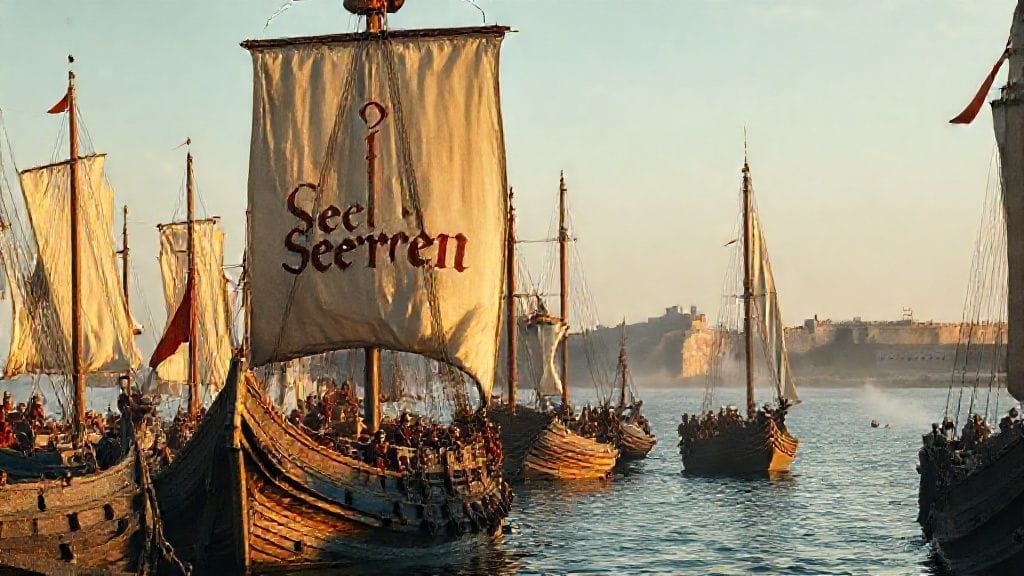
In the chill dawn of August 1248, the ancient port of Aigues-Mortes buzzed with a restless energy that pulsed through every weathered stone and bustling dock. Amidst banners flapping in a rising mistral wind, lanterns flickered in the cool haze, illuminating the faces of knights, sailors, nobles, and pilgrims alike. Their breaths, visible in the crisp early morning, hung suspended above the quays, trembling with hope, fear, and resolve. This was not merely a fleet preparing for a journey; it was a symbol of Christendom’s enduring obsession — the reconquest of Jerusalem and the defense of the Holy Land.
Louis IX, the devout King of France, stood on the deck of his flagship, his gaze fixed on the horizon where the azure waters of the Mediterranean met the sky. His heart flamed with a sacred mission, one that would soon embroil thousands in a grand military adventure — the Seventh Crusade, a campaign set to sail directly to the heart of Muslim power: Egypt. But beneath the resolve, tension stirred. The flickers of doubt that no man voiced aloud whispered of the immense challenges ahead.
This was 1248, a time when the medieval world wrestled with faith, politics, and the ever-shifting tides of power. The Seventh Crusade would become a saga of bravery, tragedy, and unforeseen consequences — a chapter in history where piety collided with geopolitics on a stage as vast as the Mediterranean itself. The story begins here.
Louis IX’s Vision: Piety and Power Intertwined
Louis IX, later canonized as Saint Louis, was no ordinary monarch. To understand the Seventh Crusade, one must appreciate the man who conceived it. King of France since 1226, Louis exemplified the ideal of the “Christian king” — pious, just, yet utterly dedicated to the expansion and spiritual purification of Christendom. His reign blended administrative genius with a deep personal spirituality, shaped by the Church’s influence and his own rigid moral code.
The call for the crusade was born from a complex tapestry of loss and aspiration. The Crusader states in the Levant had suffered setbacks, with Jerusalem lost to Saladin’s forces decades prior and renewed pressure threatening remaining Latin holdings. Louis envisioned a strike at Egypt, the Ayyubid Sultanate’s center, believing that control over the Nile Delta would provide leverage to reclaim the Holy Land.
Yet Louis’s crusading zeal was more than geopolitics; it was a pilgrimage writ large, a divine mission intertwined with kingship. He framed the crusade as a penitential journey, a chance for redemption not only for the sins of Christendom but for his own soul. The Seventh Crusade would become a mirror reflecting both the aspirations and agonies of medieval Europe.
Preparing the Fleet: Aigues-Mortes, the Birthplace of the Expedition
Aigues-Mortes was a modest fortress town nestled in the marshy coastline of southern France, but that summer it transformed into a throbbing nexus of activity. The port was chosen strategically for its proximity to the heart of France and access to the Mediterranean routes essential for the voyage ahead. For weeks, shipbuilders labored to ready vessels, while merchants and officials coordinated supplies — from food and arms to luxury goods and religious relics.
The gathering was immense: knights in shining armor, clad in crosses of red and white; infantry armed with spears and bows; clerics who offered prayers and blessings; and the common folk whose roles were less glorious but no less vital. Horses, camels, and packs of provisions swarmed the docks in a chaotic ballet of preparation.
Behind the scenes, negotiations and fears brewed. The Papacy weighed in with solemn encouragement, yet whispers of political intrigue and rival interests simmered beneath the surface. Money was tight, the risk enormous, but the collective hope was boundless. These ships would carry the future — fragile, uncertain, yet determined — across the waters towards destiny.
Crossing the Mediterranean: Perils and Hope at Sea
When the fleet finally slipped its moorings, a collective breath was held throughout Christendom. The sea voyage was a test in itself — medieval ships braved unpredictable storms, treacherous currents, and the ever-looming threat of pirates. Days blended into weeks, with sailors battling not only waves but homesickness, scurvy, and the simmering anxiety of what awaited them.
Yet each night, the stars above seemed to guide their passage. Pilgrims knelt in prayer, knights sharpened their swords, and the air was thick with chants and the scent of salt and woodsmoke. The Mediterranean, once a Roman highway of empire and commerce, now bore the hopes of a crusading force hungry for glory and salvation.
The crossing was also a moment of cultural dissonance. Sailors and soldiers from diverse regions gathered, speaking different tongues yet united by a common purpose. The fragile camaraderie forged on deck was a prelude to the complex alliances and rivalries that would shape the campaign in Egypt.
Arrival at Damietta: First Steps on Egyptian Soil
After a grueling sea passage, the silhouette of Damietta’s fortified walls finally appeared on the horizon — a jewel nestled at the mouth of the Nile, the gateway to Egypt. For centuries, this city had guarded the fertile delta and stood as a formidable bulwark of the Ayyubid Sultanate.
The arrival was both exhilarating and daunting. The crusaders disembarked onto foreign sands, facing a scorching sun and the hum of an alien world. Horses’ hooves raised dust clouds, the scent of spices rode the breeze, and the chatter in unfamiliar tongues filled the air.
Damietta was no mere target; it was a strategic prize whose capture promised to open pathways deeper into Egypt and towards Jerusalem. Yet its inhabitants were resolute and prepared. The siege that followed would test every ounce of the crusaders’ strength and resolve.
Damietta’s Siege: Walls, Waterways, and Warfare
The siege of Damietta was a labor of endurance and innovation. Medieval warfare was not merely about brute force; it was a complex contest of engineering, patience, and psychological warfare. The crusaders employed trebuchets, siege towers, and trenches, while attempting to control the surrounding marshland and waterways critical to city supply lines.
Defenders exploited the Nile’s shifting channels and seasonal floods to frustrate the attackers. Floodwaters undermined siege works, while disease and hunger seeped into the crusaders’ ranks like a silent enemy. The city’s high walls and determined garrison made every yard of advancement costly.
What emerged was a brutal stalemate, flickering moments of hope punctuated by despair. The siege became a crucible, revealing not only the limits of medieval martial technology but the resilience of human will on both sides.
The Role of the Knights Templar and Hospitallers: Faith and Fury
Integral to the crusading effort were the military orders: the Knights Templar and the Hospitallers. These warrior-monks blended religious devotion with martial discipline, sworn to protect Christian pilgrims and fight Islam’s advance. Their presence lent both prestige and military prowess to the campaign.
The Templars, known for their distinctive white mantles adorned with red crosses, led charges and manned critical defensive positions. The Hospitallers, equally fierce, tended to the wounded even as they wielded weapons on the battlefield. Their leadership often drew grudging respect from foes.
Yet tensions sometimes flared among different crusader factions — rivalries born of varied national origins and divergent agendas threatened cohesion at crucial moments. The Knights’ legendary valor was tempered by human flaws, reminding us that history is rarely a tale of pure heroes and villains.
French-Arab Diplomacy: Allies, Enemies, and Unlikely Encounters
Amid the clashing steel and cascading arrows, diplomacy wove a subtle, complex thread through the crusade’s fabric. Some Muslim factions, fractured by rivalries within the Ayyubid dynasty, viewed the crusader invasion as an opportunity or a threat in differing measure.
Louis IX sought negotiations and alliances at various points, hoping to exploit divisions or broker truces. Interactions with local Coptic Christians and Arab leaders revealed unexpected nuances. Not all Muslims were united under a single banner, and not all Christians in the region aligned with the French crown.
These encounters underscored the intricate cultural and religious tapestry of the medieval Eastern Mediterranean — a landscape shaped by centuries of coexistence, conflict, and accommodation.
The Nile’s Deadly Embrace: Disease and Despair Among the Crusaders
As days bled into weeks, the Nile asserted its dominance over man’s ambitions. The swampy environs of Damietta became a breeding ground not just for mosquitoes but for far deadlier diseases. Dysentery, malaria, and scurvy swept through the crusading camp with devastating effect.
The health crisis decimated ranks, eroded morale, and complicated logistics. The cries of the sick mingled with the clangor of battle, while clergy hastened to administer last rites and comfort the dying. Louis IX himself fell seriously ill, his suffering becoming a haunting symbol of the expedition’s toll.
This invisible enemy wielded a destructive power far surpassing that of enemy swords, reminding all that nature could be the cruellest adversary.
Strategic Ambitions Versus Harsh Realities
Despite initial optimism and careful planning, the crusade confronted a brutal truth: conquering Egypt was no simple matter. The scale of the terrain, unfamiliar climate, entrenched fortifications, and the determination of defenders rendered the French campaign a grueling ordeal.
Louis’s strategy, focused on taking Damietta as a foothold, relied heavily on rapid advances that never materialized. Supply lines stretched perilously, and the hoped-for local uprisings did not occur. Allies were fewer, enemies more numerous, and the crusading forces found themselves bogged down in protracted warfare.
The gulf between idealistic ambition and on-the-ground reality grew daily wider, heralding the eventual unraveling of the expedition.
The Sultan’s Counterattack: From Defensive to Offensive
The Ayyubid Sultan, turbanned and steely-eyed, watched the unfolding crisis with grim patience. As the siege dragged on, his forces regrouped, reinforced by seasoned commanders well-versed in Nile warfare.
Gradually, the momentum shifted. The crusaders, weakened by attrition and sickness, found themselves vulnerable to unexpected sallies and strategic maneuvers. The Muslims capitalized on their intimate knowledge of the terrain, cutting supply routes and isolating French detachments.
The once-hopeful invaders saw their lines pressed, their camps encircled, and their confidence shaken. The counterattack was ruthless and decisive, exposing critical flaws in the crusaders’ plans and challenging the myth of their invincibility.
Louis IX’s Capture: A Monarch’s Fall and Its Ripple Effects
In a dramatic and crushing blow, Louis IX was taken prisoner during the disastrous Battle of Fariskur in April 1250. The humiliation of a king in chains sent shockwaves through Europe, casting doubt on the crusading ideal and shaking monarchies’ claims to divine favor.
Yet Louis’s captivity also revealed his personal courage and dignity. Chroniclers noted his calm acceptance, his reflection on suffering, and his unyielding faith. Negotiations for his ransom involved delicate diplomacy, blending political leverage with religious symbolism.
The king’s capture became both a personal tragedy and a turning point, precipitating the crusaders’ hasty withdrawal and altering the course of Mediterranean politics.
Negotiations and Ransom: The Political Chessboard
The negotiations for Louis’s release were a protracted affair, involving not only lavish sums of gold but strategic concessions. The crusaders agreed to relinquish Damietta, a costly but necessary price to regain their sovereign.
Behind the scenes, envoys shuffled between courts and camps, balances of power shifted, and the fragile peace was negotiated with an awareness of the broader implications. Louis’s ransom underscored the tangible cost of holy war — financial, human, and political.
This episode also highlighted the pragmatism underlying even the most ideologically driven conflicts. It was a reminder that faith and diplomacy often danced a delicate waltz on the battlefield’s edge.
The Crusaders’ Retreat: Lessons in Humility and Failure
By late 1250, the surviving crusaders retreated from Egypt, their ships laden with the wounded, the weary, and the bitter lessons of an ordeal that had tested the limits of endurance. What had begun as a grand crusade now ended in bitter defeat.
The retreat was marked not only by strategic withdrawal but by reflection on the flaws in command, logistics, and the very concept of crusading itself. The French crown faced criticism but also sympathetic understanding, as chroniclers sought reasons in divine will and human frailty.
Louis IX returned to France with a vision still intact but tempered by hard-earned humility. The Seventh Crusade stood as a mirror to the limits of medieval power and the perils of zealotry.
Aftermath in Christendom: The Impact on European Psyche
Back in Europe, news of the disaster trickled slowly, but when it arrived, it stirred consternation and soul-searching. The ideal of crusading had always been fraught with contradictions, splitting opinions between fervent supporters and cynical realists.
For the Church, the failure was a spiritual trial; sermons urged repentance and resilience. Among nobles and commonfolk, the crusade became a cautionary tale tinged with romance and tragedy. Louis’s piety kept hope alive, inspiring future expeditions but also highlighting the necessity of better preparation.
The Seventh Crusade left a scar on the European psyche — a moment when faith was both sword and shield, but not always a guarantee of victory.
Egypt’s Resilience: A Testament to Ayyubid Strategy
For Egypt, the campaign reaffirmed the resilience of the Ayyubid Sultanate and the strategic importance of the Nile delta. The ability to mobilize defenses, leverage geography, and exploit internal divisions among the crusaders showcased sophisticated governance and military acumen.
The victory also enhanced the prestige of the sultan and reinforced the Islamic world’s confidence in repelling Western incursions. Egypt remained a pivot of power, culture, and diplomacy for decades to come, its legacy intertwined with the ebb and flow of crusading ambition.
The Seventh Crusade was a cautionary tale for future invaders — a reminder that Egypt was no mere battleground but a kingdom of its own making.
Chronicles and Legends: How the Seventh Crusade Was Remembered
The Seventh Crusade was immortalized in chronicles, epic poems, and oral traditions that blended fact and fiction. Chroniclers like Jean de Joinville, who accompanied Louis, painted vivid portraits of the king’s saintliness and the campaign’s epic scale.
Stories of heroism, betrayal, and divine intervention weaved a tapestry rich in symbolism and moral reflection. Legends arose about the king’s suffering and the miraculous survival of crusaders, shaping the medieval imagination and informing later European perspectives on Islam and the East.
These narratives endure as windows into how the medieval world grappled with defeat and sought meaning in the crucible of war.
The Seventh Crusade’s Place in the Age of Crusading Wars
The expedition to Egypt was not an isolated event but part of a larger continuum of crusading zeal that spanned two centuries. It reflected evolving tactics, shifting alliances, and the gradual waning of Christian control in the Levant.
Compared to earlier crusades, the Seventh was marked by greater logistical complexity and the direct involvement of a European monarch leading his forces personally. Its failure signaled the changing dynamics that would eventually render large-scale crusading expeditions increasingly untenable.
Yet the spirit it embodied — a fusion of faith, ambition, and transcontinental conflict — remained a defining feature of medieval geopolitics, echoing in subsequent campaigns and cultural memory.
Long-term Consequences for the Mediterranean World
The ripple effects of the Seventh Crusade extended beyond immediate military outcomes. The taxing conflict influenced trade routes, diplomatic relations, and the balance of power between Christian and Muslim states.
Economically, the crusade strained finances but also opened channels for cultural exchange and commerce. Politically, it reshaped alliances and rivalries, with some Mediterranean powers recalibrating their strategies in light of the crusade’s lessons.
The campaign also left enduring imprints on the collective identities of peoples on both sides, shaping perceptions that would fuel conflicts and coexistence for centuries.
Reflections on Religious Zeal, War, and Human Cost
The Seventh Crusade starkly embodies the paradoxes of holy war. It was driven by sincere religious conviction yet wrought devastation and suffering. It showcased heroic determination but also tragic miscalculations.
The human toll was immense — thousands perished through combat, disease, and deprivation. Families were shattered, kingdoms shaken, and faith tested. Yet amidst this, moments of compassion and courage shone through, revealing the complex humanity that history so often obscures.
This episode invites us to contemplate the costs of war, the power of belief, and the fragile boundary between faith and folly.
Conclusion: Between Faith and Folly – The Legacy of the Seventh Crusade
The Seventh Crusade stands as a timeless testament to the ambitions and limitations of medieval Christendom’s encounter with the Islamic world. Louis IX’s expedition, launched from the small port of Aigues-Mortes to the mighty walls of Damietta, was a saga of profound hope tinged with devastating reality.
It reminds us that history is never a simple tale of triumph or defeat but a tapestry woven from human dreams and frailties. The campaign tested faith, challenged strategies, and reshaped the geopolitical map of the Mediterranean. It left scars but also stories — of sacrifice, valor, and the enduring quest for meaning in an unpredictable world.
More than seven centuries later, the voyage of the Seventh Crusade continues to echo, urging us to remember that the pursuit of ideals must always wrestle with the complexities of human nature and the world’s vast uncertainties.
FAQs: Understanding the Seventh Crusade
Q1: What triggered the launch of the Seventh Crusade?
A1: The loss of crusader territories in the Holy Land and the strategic belief that conquering Egypt would enable the recovery of Jerusalem spurred Louis IX’s decision to launch the Seventh Crusade.
Q2: Why was Aigues-Mortes chosen as the departure port?
A2: Its location on the French Mediterranean coast allowed efficient assembly of troops and ships, making Aigues-Mortes a strategic point for launching naval expeditions to the Eastern Mediterranean.
Q3: How significant was Louis IX’s personal involvement in the crusade?
A3: Louis IX was deeply involved as both spiritual leader and commander, embodying the ideal of the Christian king crusader and personally leading the expedition, which was rare among European monarchs.
Q4: What were the key reasons for the crusade’s failure?
A4: Factors included disease, logistical shortcomings, strong Egyptian defenses, internal divisions among crusaders, and underestimating the sultan’s strategic capabilities.
Q5: How did the capture of Louis IX affect the crusade?
A5: The king’s capture was a severe blow, forcing the crusaders to negotiate a ransom, cede territorial gains like Damietta, and ultimately retreat, marking a decisive end to the campaign.
Q6: What was the impact of the Seventh Crusade on Christian-Muslim relations?
A6: While it deepened hostilities, the crusade also led to complex diplomatic interactions and reflected the intertwined nature of conflict and coexistence in the medieval Mediterranean.
Q7: How is the Seventh Crusade remembered in history and legend?
A7: Chroniclers portrayed it as a noble yet tragic enterprise; King Louis’s sanctity and suffering became central themes, and the crusade’s story blended historical fact with myth.
Q8: Did the Seventh Crusade influence future crusading efforts?
A8: Yes, it shaped subsequent expeditions by highlighting the need for better preparation and more realistic strategies, even as it signaled the waning era of large-scale crusades.

